Best Online Patient Safety and Quality MSN Programs
Compare 6 accredited online Patient Safety & Quality programs, with graduate earnings, cost, debt, and completion data from IPEDS and the U.S. College Scorecard.
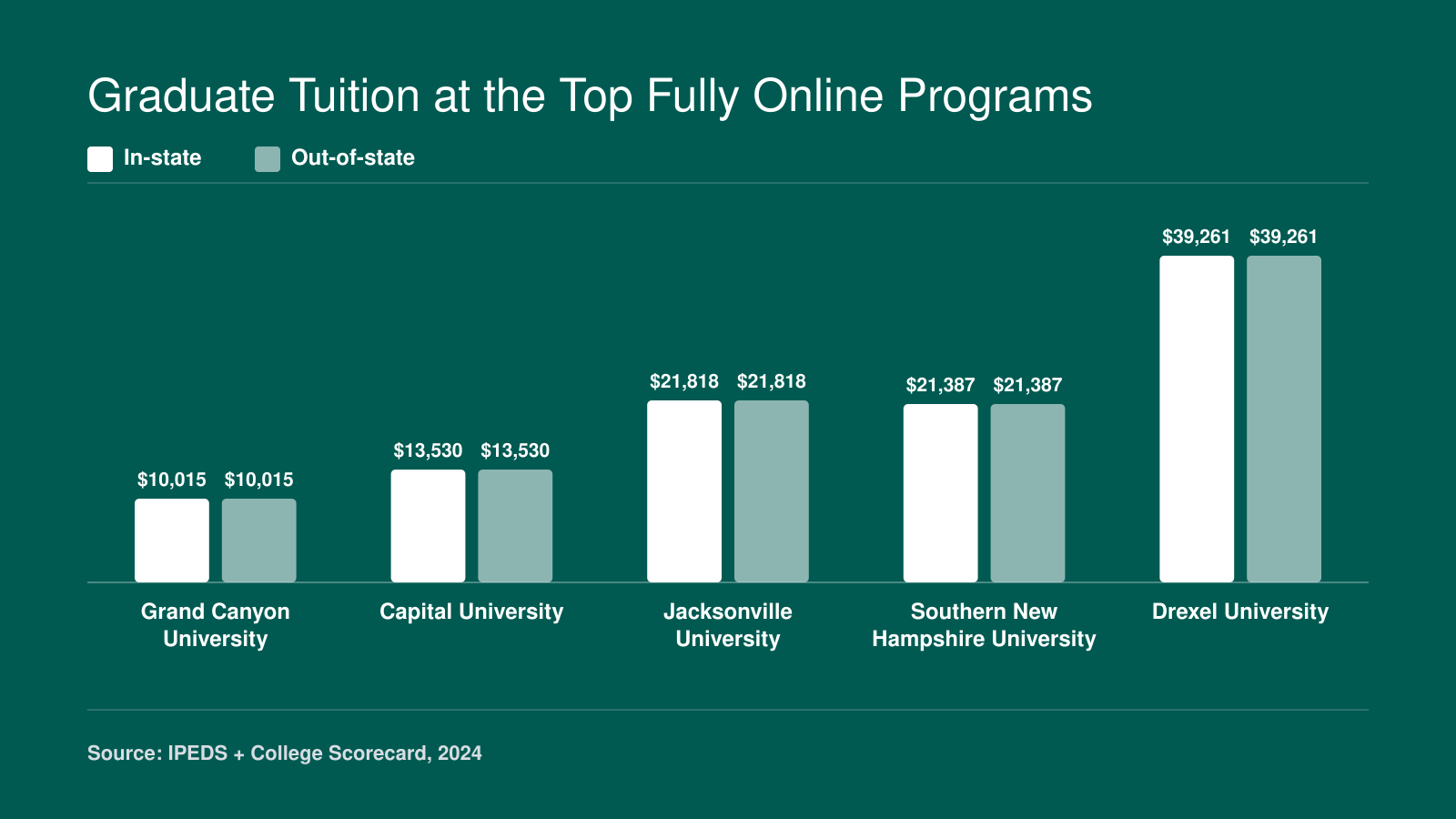
Graduate tuition across the fully online programs ranked here runs from $10,015 to $39,261, nearly a fourfold spread for degrees aimed at the same job.
For a working RN who wants to lead quality improvement, risk reduction, or patient safety work without leaving the bedside schedule, that gap matters. Every program here is 100% online, and hybrid options are excluded.
Practicum hours, live sessions, and state authorization differ by school. CPHQ certification is a separate exam that no degree replaces.
Key Points
- The 2027 ranking weighs cost, graduate outcomes, and completion data.
- Top programs here charge online students the same tuition regardless of residency.
- Drexel University reports the strongest published graduate earnings among ranked schools.
Top Fully Online Patient Safety and Quality MSN Programs for 2027
These are the fully online patient safety and quality MSN programs that made the 2026 list, with hybrid and campus-required options excluded. The ranking weighs a mixed quality composite of cost, graduate outcomes, and completion data, so it does not measure any single metric. The list below lets you compare program strengths, concentrations, and practical details side by side before digging into the full curriculum. Data for this guide comes from federal IPEDS and College Scorecard records, and program-level earnings and debt figures appear only where schools have published them.
Drexel University
#1Philadelphia, PA · ~$39,000/yr (est.)
Best for: Experienced RNs pursuing interdisciplinary quality leadership
Drexel's online MSN in quality, safety, and risk management prepares you to lead improvement in healthcare outcomes through leadership, human factors, systems thinking, and evidence-based practice. The program uses interactive video discussions, virtual simulation, and a mandatory two-day virtual residency, with four 10-week quarters each year. It is CCNE accredited and CAHME certified, and reports a 100% employment rate for graduates.
- CCNE and CAHME accredited
- Mandatory two-day virtual residency
- Four 10-week quarters per year
- Realistic virtual simulation experiences
- Interdisciplinary, competency-based approach
- Faculty are practicing quality, risk, and legal experts
- 100% job placement rate reported
Grand Canyon University
#2Phoenix, AZ · ~$10,000/yr (est.)
Best for: Budget-conscious nurses needing flexible online pacing
Grand Canyon University's online MSN with a Health Care Quality and Patient Safety emphasis prepares working nurses for leadership roles in improving healthcare systems. The 36-credit program covers quality improvement, patient safety, project management, and change management, with 200 practicum hours for hands-on experience. The curriculum emphasizes evidence-based practice, data analysis, and stakeholder engagement to enhance patient outcomes.
- CCNE accredited
- 36 total credits required
- 200 practicum hours included
- 8-week course sessions
- Focus on quality improvement and patient safety
- Project management and change management coursework
- Evidence-based practice and data analysis focus
- HLC accredited institution
Capital University
#3Columbus, OH · ~$14,000/yr (est.)
Best for: Working RNs wanting small cohorts and Magnet placements
Capital University's online Master of Science in Nursing with a Quality and Safety concentration is built for registered nurses who want data-driven improvement and real clinical practice. The asynchronous curriculum integrates applied statistics, healthcare informatics, and advanced nursing science, and students complete more than 360 hours of field practice at leading Magnet hospitals. Small cohorts of 20 or fewer and 8- or 16-week course formats support working professionals.
- CCNE accredited
- 360+ clinical hours at leading Magnet hospitals
- 20 students or fewer per class
- 8- or 16-week course formats
- Asynchronous online classes
- Six-semester program with full-time or part-time options
- Work with interdisciplinary experts on performance improvement projects
- 70+ years of nursing education
Jacksonville University
#4Jacksonville, FL · ~$22,000/yr (est.)
Jacksonville University's online MSN in Healthcare Quality and Safety blends MSN core courses with specialized work in quality culture, health law, improvement science, and human factors. The program offers full-time and part-time tracks, synchronous and asynchronous classes in 7-week formats, and a capstone project. Small class sizes, an assigned academic advisor, and immersive virtual reality simulation support working registered nurses.
Southern New Hampshire University
#5Manchester, NH · ~$21,000/yr (est.)
Southern New Hampshire University's online MSN Healthcare Quality and Safety track prepares RNs to lead quality improvement and patient safety initiatives through courses in healthcare quality, health policy, finance, program design, and safety culture. The 36-credit program uses 10-week terms and includes 135 clinical hours, with no application fee or entrance exam. It is CCNE accredited and reports a 93.4% online student recommendation rate.
- CCNE accredited
- 36 credits and 12 courses
- 135 clinical hours
- 10-week term length
- No application fee or entrance exam
- Rolling admissions
- Full-time and part-time options
- 3.0 GPA minimum
Cost & outcomes by school
Federal data for the highest-earning Patient Safety & Quality programs, independent of the ranking above. Earnings are this field's master's graduates four years after completing, where the Scorecard reports them.
| School | Earnings | Tuition / yr | Debt | Grads/yr | Format |
|---|---|---|---|---|---|
| Northeastern University MA | $81,227 | $26,020 | $41,000 | — | Online |
| Drexel University PA | $76,628 | $39,261 | $61,917 | 79 | Online |
| Southern New Hampshire University NH | $69,637 | $21,387 | $36,900 | 213 | Online |
| Grand Canyon University AZ | $68,242 | $10,015 | $45,080 | 151 | Online |
| Capital University OH | — | $13,530 | — | — | Online |
| Jacksonville University FL | — | $21,818 | — | — | Online |
Sources: U.S. Department of Education. Tuition and graduates: IPEDS. Earnings and debt: College Scorecard, this field's master's graduates; a dash means no figure is reported.
Cost, debt & payoff
Median earnings of this field's master's graduates (4 yrs after completing) vs. their median federal loan debt · U.S. College Scorecard
Across these programs the median graduate earns about $73,133 and finishes with roughly $43,040 in debt — a ratio that clears a common rule of thumb (keep debt below first-year salary). Tuition and debt vary widely school to school, so check the per-school figures in the table above before you shortlist.
Admission Requirements: BSN, RN License, and Experience
- RN licenseA current, unencumbered RN license is typically required; confirm which state your license must be in for practicum or state authorization.
- BSN vs. RN-to-MSNThe standard entry route is a BSN earned through CCNE, ACEN, or CNEA accreditation. ADN or diploma nurses may have bridge options, Arizona State's RN-to-MSN bridge accepts ADN, while Sacred Heart's RN-BSN-MSN accepts ADN or diploma.
- GPAA 3.0 undergraduate GPA is common, though some schools use the last 60 credits or prior coursework and may allow provisional admission below that.
- RN experienceMinimums vary: SNHU and Drexel specify no required years, UTA's Nursing Administration track asks for two years of clinical RN experience, and St. Augustine's RN-entry pathway asks for one full-time year.
- GREMany programs do not require GRE; a few use it only for probationary or conditional admission.
- Application materialsExpect a resume, professional references, and a goal statement or essay, with specifics varying by school.
How 100% Online Really Works: Live Sessions, Campus Visits, and State Authorization
"Online" rarely means entirely on your own schedule. Online patient safety and quality MSN programs still require fixed commitments, and those vary enough to shape your shortlist.
Asynchronous vs. Synchronous
Asynchronous coursework lets you log in and complete work whenever your shift schedule allows. Synchronous requirements mean scheduled live sessions or presentations you must attend in real time. Capital University publishes its online classes as asynchronous. Jacksonville University describes a mix of synchronous and asynchronous options. For Drexel, Grand Canyon, Fayetteville State, and SNHU, the published materials do not clearly specify the balance, so confirm it with each admissions office before enrolling.
Campus Visits and Virtual Residencies
Since hybrid programs are excluded here, the on-site requirements are limited. Drexel lists no on-campus residency but requires a mandatory two-day virtual residency, held online. Fayetteville State asks students on campus one to three times during the final capstone semester, with dates set by instructors. Grand Canyon and SNHU complete practicum hours locally rather than on a home campus.
State Authorization
Online nursing programs must be authorized to enroll students in your state of residence, through NC-SARA participation or individual state approval. SNHU, for example, does not currently accept applicants residing in Washington or U.S. territories. Check each school's state authorization page before you apply, and if you work rotating shifts, confirm the time zone and frequency of any live sessions first.
Graduate Tuition at the Top Fully Online Programs
These are the annual graduate tuition and fees for the top fully online patient safety and quality MSN programs. Every program shown charges the same rate to online students regardless of residency, so no out-of-state premium applies. This differs from the institution-wide net price used in the ranking because it reflects the program's published annual price.
Curriculum and Practicum Hours: What You'll Actually Do
Two online MSN quality-and-safety tracks can look nearly identical on paper, but their practicum structures often diverge sharply: one anchors a 135-hour final quality project at your current workplace, while another asks for 150 supervised field hours behind a prerequisite course.
Core Coursework and Credit Load
Most of these patient safety and quality MSN programs online build on MSN foundations in research, policy, and informatics, then layer on quality improvement methods, patient safety science, risk management, data analytics, and healthcare leadership. Southern New Hampshire University and Grand Canyon University each publish a 36-credit total. SNHU splits that into 21 track credits and 15 core credits; GCU runs 8-week online sessions.
Practicum Hours and Placement
SNHU places its 135 clinical hours in the final course, while GCU requires 150 practicum hours after HQS-630A. In both cases the practicum is usually a quality or safety project at your own facility rather than direct patient care. Neither program page lists formal placement assistance, so assume you will need to identify the preceptor and site yourself and allow several weeks to months for approval, especially if your employer needs a signed affiliation agreement.
Completion Time
SNHU lists an 18-month track; GCU does not publish a fixed time to degree. A 36-credit online MSN track commonly takes about 18 to 24 months part-time; do not assume a one-year finish unless the school states it directly.
Related Articles
Top Program-Level Graduate Earnings
Among the programs here with published graduate earnings, Drexel University reports the strongest outcome.
Patient Safety & Quality programs by state
Frequently Asked Questions About Online Patient Safety and Quality MSN Programs
How long does an online patient safety and quality MSN take?
Which online patient safety and quality MSN programs are CCNE accredited?
Do I need a BSN to enroll in an online patient safety and quality MSN?
Are online patient safety and quality MSN programs fully asynchronous?
Compare Patient Safety & Quality programs on the data that matters
Explore more Nursing specializations or browse every graduate field.
All Nursing programs