Best Online RN to MSN Programs
Compare 150+ accredited online RN to MSN programs, with graduate earnings, cost, debt, and completion data from IPEDS and the U.S. College Scorecard.

An RN to MSN bridge lets a licensed nurse holding an associate degree or a non-nursing bachelor's earn a master's without first finishing a separate BSN. Credit loads vary sharply: Chamberlain's accelerated option runs 45 credits, while Stevenson's RN to MS track totals 120.
Every program ranked here is delivered fully online, with no campus residency built into the coursework, though supervised clinical hours still happen in person near you. The variable that moves cost and timeline most across most affordable rn to msn programs is how much of your existing nursing coursework a school will actually accept.
Key Points
- Every online RN to MSN program requires in-person clinical or practicum hours.
- WGU charges $5,325 per undergraduate term and $5,050 per graduate term.
- California remains the only state outside NC-SARA in 2027.
Top 10 Fully Online RN to MSN Programs for 2027
These are fully online RN to MSN programs, with hybrid formats excluded. The list is ordered by a mixed quality composite rather than any single metric, so a lower position does not mean a weaker program overall.
American Public University System
#1Charles Town, WV · $5,000 – $10,000/yr (est.)
Best for: Military-connected RNs seeking asynchronous online pace
American Public University System's RN to MSN is a fully online, CCNE-accredited program that awards both a BSN and MSN, with concentrations including Community and Public Health Nursing. The 147-credit curriculum uses asynchronous 8- to 16-week courses, requires 160 clinical hours, and accepts up to 90 transfer credits plus 30 credits for an active RN license. Tuition is $8,400 in state or out of state, with an average net price around $9,600. The program is closed to D.C., Washington state, and New York residents.
- CCNE-accredited with three concentration options
- 147 total credit hours, earning both BSN and MSN
- $360 per credit first 120 credits, $470 remaining
- Asynchronous 8- to 16-week courses with rolling starts
- 160 clinical hours across practicum and capstone
- 30 credits for active RN license, up to 90 transfer credits
- 3.0 GPA and unencumbered RN license required
- Median earnings one year after completion: $105,483
The University of Alabama
#2Tuscaloosa, AL · ~$12,000/yr (est.)
Best for: Experienced RNs pursuing nurse educator concentration
The University of Alabama offers an accelerated online RN to BSN/MSN pathway for registered nurses with an associate degree or diploma, leading to a Master of Science in Nursing with a Nurse Educator concentration. Students complete 52-58 credit hours, receive 42 nursing credits at admission, and earn the BSN after the fourth semester. Master's tuition is $480 per credit hour, and the school's average net price is about $22,400. The program is CCNE-accredited and does not require ACT or SAT scores through fall 2026.
- CCNE-accredited RN to BSN/MSN nurse educator pathway
- 52-58 credit hours with 42 nursing credits at admission
- BSN conferred after fourth semester
- $480 per credit plus college fee
- 3.0 GPA and unencumbered RN license required
- ACT/SAT not required through fall 2026
- Median earnings one year after completion: $94,911
University of St Francis
#3Joliet, IL · ~$15,000/yr (est.)
Best for: Practicing RNs choosing between FNP and PMHNP tracks
The University of St. Francis offers an online Master of Science in Nursing through the Leach College of Nursing, with concentrations in Family Nurse Practitioner and Psychiatric-Mental Health Nurse Practitioner. The program runs in eight-week cohorts, starts at five points during the year, and takes 24-36 months. Tuition is $830 per credit, with an average net price around $13,000. Graduates can sit for AANP or ANCC certification exams.
- CCNE-accredited with FNP and PMHNP concentrations
- $830 per credit, complete in 24-36 months
- Five start dates per year, eight-week courses
- Prepares for AANP or ANCC certification exams
- Cohort-based fully online format
- 20% alumni discount on master's programs
- Median earnings one year after completion: $112,521
Chamberlain University-Illinois
#4Addison, IL · ~$15,000/yr (est.)
Chamberlain University-Illinois offers two fully online RN to MSN routes, including an accelerated option that awards the MSN without a BSN in as few as 10 months. The 45-credit program costs $33,750 in total tuition and offers concentrations in Advanced Nursing Leadership and Advanced Nursing Leadership With AI. Admission requires a 3.0 GPA and an active, unrestricted RN license. The master's nursing program is CCNE-accredited.
- CCNE-accredited accelerated RN to MSN option
- $33,750 total tuition, $750 per credit
- Complete in as few as 10 months
- 45 credit hours, no BSN required
- Concentrations: Advanced Nursing Leadership and AI
- 3.0 GPA and active unrestricted RN license
- Asynchronous online coursework with practicum
- Median earnings one year after completion: $104,394
Massachusetts College of Pharmacy and Health Sciences
#5Boston, MA · ~$27,000/yr (est.)
MCPHS University's Family Nurse Practitioner Bridge Program (AD to MSN) is a fully online pathway that starts with a bridge year building baccalaureate competencies. Students complete 750 supervised direct patient care hours and two on-campus residencies before sitting for ANCC certification. Tuition is $40,530 per year, with an average net price around $39,500. The program is CCNE-accredited.
- CCNE-accredited AD to MSN Family Nurse Practitioner bridge
- Bridge year builds baccalaureate-level competencies
- 750 supervised direct patient care hours
- Two on-campus residencies included
- Prepares for ANCC FNP certification
- Median earnings one year after completion: $106,861
- Fully online RN to MSN bridge option
- Part-time enrollment available
- Bridge program designed for ADN nurses
- Ties to New England medical institutions
Bradley University
#6Peoria, IL · ~$20,000/yr (est.)
Bradley University offers a fully online MSN specialization in Nursing and Healthcare Leadership, with a dedicated RN entry track for nurses holding an ADN, diploma, or non-nursing bachelor's degree. RN-entry students complete 49.5 semester hours and 500 leader practicum hours, plus 50 community health practicum hours. Tuition is $42,160 per year, with an average net price around $22,700. The program prepares graduates for ANCC or AONL nurse leader certifications.
- Nursing and Healthcare Leadership concentration
- 49.5 semester hours for RN entry, 40 for BSN entry
- 500 practicum hours plus 50 community health hours for RN entry
- 3.0 GPA and unencumbered nursing license required
- Prepares for ANCC or AONL nurse leader certification
- Scholarly capstone project required
- Median earnings one year after completion: $105,021
Stevenson University
#7Owings Mills, MD · ~$8,000/yr (est.)
Stevenson University's online RN to MS in Nursing lets students earn both a BSN and MSN, with concentrations in Forensic Nursing, Nursing Education, Nursing Leadership/Management, and Population Health Nursing. The 120-credit program costs $505 per credit with no fees and runs in primarily eight-week sessions. The school's average net price is about $26,500. CCNE accredits the program, which requires a current RN license and a 3.0 GPA.
- CCNE-accredited RN to MS with four concentrations
- 120 total credit hours, earns BSN and MSN
- $505 per credit with zero fees
- Six start dates per year, 8-week courses
- 3.0 GPA and current RN license required
- 45 clinical hours in outpatient care
- First graduate course billed at undergrad rate
- Median earnings one year after completion: $103,437
Tennessee Tech
#8Cookeville, TN · $10,000 – $15,000/yr (est.)
Tennessee Tech's Whitson-Hester College of Nursing offers an online RN-to-MSN bridge for registered nurses who already hold a bachelor's degree in another field, allowing them to enter the MSN without a separate BSN. Students choose from five concentrations, including family nurse practitioner, psychiatric/mental health nurse practitioner, and nursing administration. The program is CCNE-accredited and features precepted clinical hours arranged locally. In-state tuition is $11,376, out-of-state $15,576, and the average net price is about $14,200.
- CCNE-accredited RN-to-MSN bridge with five concentrations
- Clinical hours precepted in your local area
- 3.0 GPA and unencumbered RN license required
- Provisional admission possible below 3.0 GPA
- Bridge works with any MSN concentration
- Median earnings one year after completion: $93,349
Herzing University-Kenosha
#9Kenosha, WI · ~$9,000/yr (est.)
Herzing University-Kenosha offers an Accelerated RN to MSN in Nursing Informatics for licensed RNs with an associate degree, with no separate BSN awarded. The 52-credit program takes 20 months full-time, includes 180 clinical practicum hours, and costs $630 per credit. The school's average net price is about $23,000. CCNE accredits the program.
- CCNE-accredited nursing informatics RN to MSN
- $630 per credit, 52 semester credits
- 20 months full-time, five semesters
- 180 clinical practicum hours
- Rolling admissions with multiple start dates
- No separate BSN required
- Dual credit toward DNP available
- Median earnings one year after completion: $103,068
Ball State University
#10Muncie, IN · $10,000 – $15,000/yr (est.)
Ball State University offers a fully online Master of Science in Nursing with nurse educator, nurse administrator, and family nurse practitioner concentrations. The RN to MSN option welcomes licensed RNs with an associate degree or a non-nursing bachelor's, and FNP students complete 690 supervised clinical hours. In-state tuition is $11,082, out-of-state $29,630, and the average net price is about $14,900. CCNE accredits the program.
- CCNE-accredited MSN with three concentrations
- Nurse educator, nurse administrator, and FNP tracks
- Asynchronous online courses, full- or part-time
- 690 supervised clinical hours for FNP students
- FNP track completes in six or eight semesters
- Dual master's degree with MBA available
- Median earnings one year after completion: $103,103
Cost & outcomes by school
Federal data for the highest-earning RN to MSN programs, independent of the ranking above. Earnings are this field's master's graduates four years after completing, where the Scorecard reports them.
| School | Earnings | Tuition / yr | Debt | Grads/yr | Format |
|---|---|---|---|---|---|
| William Paterson University of New Jersey NJ | $137,010 | $16,963 | — | 226 | Online |
| West Coast University-Anaheim-Orange County CA | $136,520 | $16,178 | $35,570 | 591 | Hybrid |
| California Baptist University CA | $134,166 | $15,562 | $93,083 | 31 | Hybrid |
| Gonzaga University WA | $133,955 | $21,987 | $54,023 | 164 | Hybrid |
| Massachusetts College of Pharmacy and Health Sciences MA | $132,366 | $27,210 | $41,000 | 82 | Online |
| Point Loma Nazarene University CA | $130,691 | $11,880 | $50,562 | 19 | Hybrid |
| University of Michigan-Flint MI | $129,633 | $14,473 | $45,578 | 95 | Online |
| Wilkes University PA | $127,350 | $26,088 | $41,390 | 356 | Hybrid |
| Colorado State University Pueblo CO | $126,927 | $10,064 | $41,000 | 21 | Hybrid |
| Florida International University FL | $125,543 | $11,334 | $42,812 | 94 | Hybrid |
| Grand Canyon University AZ | $123,688 | $10,015 | $32,443 | 1,394 | Hybrid |
| University of South Carolina SC | $123,101 | $14,134 | $44,143 | 148 | Hybrid |
Sources: U.S. Department of Education. Tuition and graduates: IPEDS. Earnings and debt: College Scorecard, this field's master's graduates; a dash means no figure is reported.
Cost, debt & payoff
Median earnings of this field's master's graduates (4 yrs after completing) vs. their median federal loan debt · U.S. College Scorecard
Across these programs the median graduate earns about $120,338 and finishes with roughly $41,160 in debt — a ratio that clears a common rule of thumb (keep debt below first-year salary). Tuition and debt vary widely school to school, so check the per-school figures in the table above before you shortlist.
Eligibility for RNs With an ADN or a Non-Nursing Bachelor's
Your admission path depends on your first nursing credential, your RN license, and any bridge or prerequisite coursework.
- Active RN licenseChamberlain requires a current, unrestricted RN license valid for your practicum state; WGU requires an active, unencumbered RN license.
- Degree pathway and bridge coursesADN or nursing diploma holders can enter RN-to-MSN tracks at Chamberlain and WGU, and Chamberlain may admit before BSN completion. Non-nursing bachelor's holders generally need BSN-equivalency coursework in community health, nursing research, and leadership before the MSN core.
- Minimum GPAChamberlain lists a 3.0 prior nursing GPA, with provisional admission from 2.5–2.99 on its accelerated MSN track. WGU does not state a minimum GPA.
- Prerequisites and work experienceStatistics prerequisites vary by school, so confirm early. WGU does not require RN work experience; Chamberlain's materials emphasize degree, GPA, and license rather than work hours.
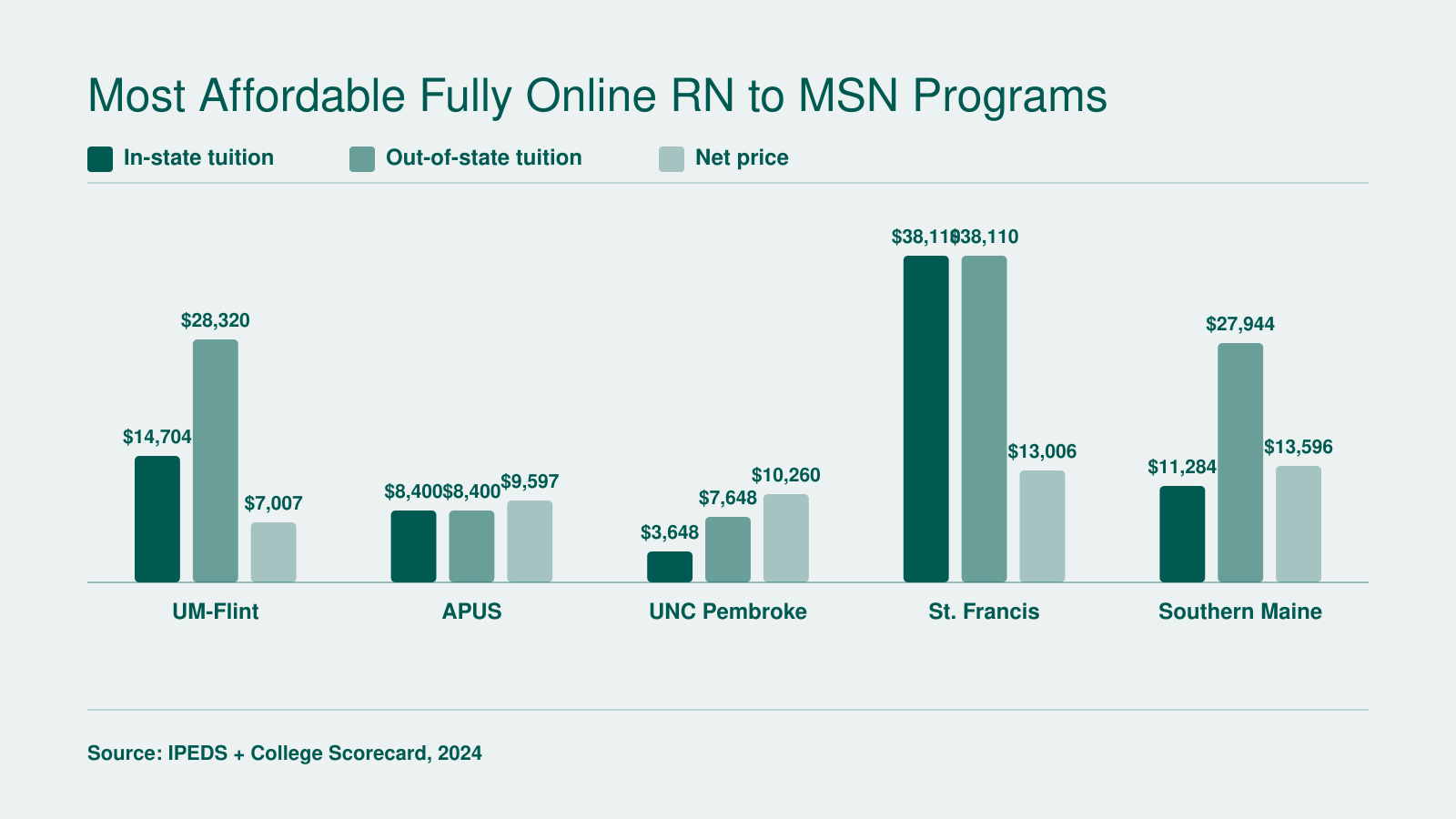
Most Affordable Fully Online RN to MSN Programs
Compare listed graduate tuition with the average net price after aid across several fully online RN to MSN programs. Net price is an institution-wide average, not a program-specific quote. For per-credit planning, WGU charges $5,325 per undergraduate term and $5,050 per graduate term (up to 90 transfer credits), Chamberlain's accelerated RN-to-MSN is $750 per credit for 45 credits, and Herzing's nursing informatics track is $630 per credit for 52 credits.
Related Articles
Choosing an RN to MSN Specialization: NP, Education, or Administration
The nurse practitioner role was ranked the top healthcare job of 2025, and that demand shapes how most RN to MSN students pick a track. Your choice determines the credential you sit for after graduation, so start from the certification, not the course catalog.
Nurse Practitioner
NP tracks (FNP, PMHNP, AGPCNP) prepare you to diagnose, treat, and prescribe. You sit for AANP or ANCC boards, which require an active RN license, graduate coursework in advanced assessment, pharmacology, and pathophysiology, and at least 500 supervised clinical hours.1 NP practice is regulated state by state, so confirm your state board recognizes the program and authorizes your population focus before you enroll. Several programs here offer an FNP path, including MCPHS, Ball State, and Tennessee Tech; Massachusetts College of Pharmacy lists only 22 states where its bridge is available.
Education and Leadership
Nurse executive leadership MSN tracks, such as The University of Alabama's, prepare you for administrative leadership rather than classroom teaching. The NLN Certified Nurse Educator credential requires unencumbered licensure plus two years of employment in a nursing program2, so it rewards time already spent teaching.
Leadership and administration tracks, like Bradley University's and Ball State's, lead to AONL's CENP4 or ANCC's NE-BC. NE-BC calls for a nursing bachelor's or higher, 2,000 hours of leadership experience in the last three years, and 30 hours of management continuing education.3
Accreditation alone doesn't guarantee you can enroll. California is the only state that doesn't participate in NC-SARA, so its residents lose SARA complaint and reciprocity protections in out-of-state online programs. And Arkansas State University's online MSN-FNP, though accredited, admits only residents of Arkansas, Mississippi, Missouri, and Tennessee.
Clinical and Practicum Hours in 100% Online RN to MSN Programs
In a fully online RN to MSN program, your lectures, readings, and exams happen online, but the hands-on hours do not. Every program requires supervised clinical or practicum work you complete in person, usually at a hospital, clinic, or school near your home under a qualified preceptor. The coursework travels with your laptop; the clinical hours do not.
Hours Vary Sharply by Track
Nurse practitioner tracks in online nurse practitioner programs carry the heaviest load. Under the 2022 NTF standards, new NP programs set 750 direct patient care hours as the minimum, and in 2026 most family, psychiatric-mental health, adult-gerontology primary care nurse practitioner, pediatric, and women's health tracks fall in the 500 to 750 range depending on specialty and accreditation pathway. Arkansas State's online FNP requires 750; West Coast University's FNP runs 540 with two on-site intensives; Tennessee Tech lists 560 for PMHNP and 650 for WHNP.13
Education and leadership practicums in online MSN programs are lighter and far less standardized, with no national minimum. Arkansas State's nurse administrator track requires 180 hours, Florida State's education practicum 140, and St. Augustine's nurse educator track 290.245
Who Finds Your Preceptor
Placement support differs by school, and this matters more than hour counts. Some programs actively help locate sites and preceptors; others assign a specialist but do not guarantee placement, leaving you to secure your own. Many online programs expect students to identify three to five qualified local preceptors first. Ask exactly how placement works before you enroll.
RN to MSN programs by state
Frequently Asked Questions About Online RN to MSN Programs
These answers cover the questions prospective students ask most often about online RN to MSN programs, including length, accreditation, and pathway differences.
What is the shortest online RN to MSN program?
Are online RN to MSN programs accredited?
What is the difference between RN to MSN and RN to BSN to MSN programs?
Do online RN to MSN programs accept RNs with a non-nursing bachelor's degree?
Compare RN to MSN programs on the data that matters
Explore more Nursing specializations or browse every graduate field.
All Nursing programs