Best Online Master's in Reading and Literacy Programs
Compare 320+ accredited online Reading & Literacy programs, with graduate earnings, cost, debt, and completion data from IPEDS and the U.S. College Scorecard.

Reading specialist and literacy coach roles rarely require pausing a teaching job. A fully online reading and literacy master's lets licensed teachers complete clinical fieldwork in their own schools while continuing full-time work. The programs ranked here are 100% online, with hybrid options excluded.
Net price runs from $6,541 at University of Florida to $29,689 at Saint Joseph's University, while early-career median earnings run from $49,916 at Auburn University to $58,486 at SUNY Cortland. Certification remains state-specific, so approval in one state does not transfer automatically, and CAEP status plus practicum hours determine where the degree leads.
Key Points
- Per-credit prices range from about $350 to $1,100 before fees.
- University of Wisconsin-Whitewater reports the highest published earnings in this comparison.
- Verify your home state's reading specialist pathway before enrolling.
Top 10 Fully Online Master's in Reading and Literacy Programs
The programs below are fully online reading and literacy master's degrees, with no hybrid or on-campus coursework required. Each entry is a focused option for working educators who want to advance as reading specialists, literacy coaches, or interventionists while staying in their current role.
University of Florida
#1Gainesville, FL · ~$13,000/yr (est.)
Best for: Practicing teachers seeking non-thesis flexibility
University of Florida's non-thesis M.Ed. in Reading Education focuses on evidence-based literacy strategies for PreK-12 classrooms. The 36-credit online program covers reading foundations, assessment, diagnosis, ESOL, and educational technology, with full-time and part-time pacing. Florida reports an overall graduation rate of about 91% and one of the lowest net prices in this list.
- 36-credit, non-thesis online program
- Covers foundations, assessment, diagnosis, and ESOL
- Full-time and part-time options
- 3.0 GPA minimum
- No thesis or capstone required
- Includes educational technology focus
- Nationally accredited and highly ranked
Grove City College
#2Grove City, PA · ~$9,000/yr (est.)
Best for: Certified educators targeting Pennsylvania certification
Grove City College's asynchronous M.S. in Education in Reading Specialist is built for certified teachers who want to lead literacy intervention. The 30-credit curriculum emphasizes the science of reading, assessment, and remediation, with rolling enrollment and asynchronous delivery. The school reports an overall graduation rate of about 83%, and graduate tuition is the same for in-state and out-of-state students.
- 30-credit curriculum
- Asynchronous online classes
- Rolling admissions
- Prepares for Pennsylvania Reading Specialist Certification
- Emphasis on science of reading
- Prerequisite: valid teaching certificate
- Literacy coaching and intervention skills
Texas A&M University-College Station
#3College Station, TX · ~$12,000/yr (est.)
Best for: Working educators adding Reading Specialist certification
Texas A&M's online M.Ed. in Curriculum and Instruction with a Reading and Literacy emphasis prepares educators for reading specialist, literacy coach, and curriculum coordinator roles. The 36-credit non-thesis track includes synchronous and asynchronous online coursework, a Reading Specialist Certification option, and an Early Start pathway for undergraduate seniors. The university reports an overall graduation rate of about 84% and an institution-wide average net price of $21,315 after aid.
- 36-credit non-thesis track
- Synchronous and asynchronous online options
- Reading Specialist Certification option
- Early Start program for seniors
- Core curriculum plus literacy specialization
- Graduate advisors available
Virginia Polytechnic Institute and State University
#4Blacksburg, VA · ~$19,000/yr (est.)
Virginia Tech's Reading Specialist Program offers an online M.A.Red. with a Reading Specialist endorsement and a cohort structure. Cohorts are limited to 20 participants and include working professionals, with priority and standard summer application deadlines. Virginia Tech reports an overall graduation rate of about 86%, and many faculty members bring more than 15 years of K-12 experience.
- Fully online option available
- Cohort-based with 20 participants
- Priority deadline May 1
- Standard deadline July 1
- Includes Reading Specialist endorsement
- Faculty average over 15 years with K-12 educators
North Carolina State University at Raleigh
#5Raleigh, NC · $12,000 – $33,000/yr (est.)
NC State's fully online M.Ed. concentration in K-12 Reading is a two-year, cohort-based program for working teachers. Evening online courses cover the science of reading, literacy assessment, and intervention, and completion can lead to K-12 Reading Specialist licensure after passing the Praxis exam. The university reports an overall graduation rate of about 85%.
- Two-year program with 10 courses
- Cohort-based online format
- Prepares for K-12 Reading Specialist licensure
- Science of reading focus
- Evening classes for working professionals
- 3.0 GPA minimum
University of Delaware
#6Newark, DE · $20,000 – $25,000/yr (est.)
University of Delaware's M.Ed. in Literacy is a 30-credit, fully online program with no required campus visits. Seven-week terms and multiple start dates support part-time study, and the curriculum leads toward Reading/Literacy Specialist certification. The university reports an overall graduation rate of about 81%.
- 30-credit, 10-course program
- 7-week terms with four start dates
- Prepares for Reading Specialist certification
- No electives required
- Part-time option for practicing teachers
- Fully online with no campus visits
Auburn University
#7Auburn, AL · $13,000 – $34,000/yr (est.)
Auburn's M.Ed. in Reading Education is grounded in evidence-based instruction, with faculty who helped develop the Alabama Reading Initiative. The online program does not lead to teacher certification, and the university notes it is not currently accepting applications. Auburn reports an overall graduation rate of about 82%.
- Evidence-based reading instruction focus
- Faculty helped create Alabama Reading Initiative
- Does not lead to teacher certification
- CAEP-accredited
- Not currently accepting applications
University of Missouri
#8Columbia, MO · ~$14,000/yr (est.)
The University of Missouri's online MEd in Literacy Education is designed for certified educators and covers the science of reading, multimodal literacy, and culturally responsive teaching. The 30-credit curriculum can be tailored from early childhood through secondary, and a graduate certificate in literacy instruction is also available. Missouri reports an overall graduation rate of about 75%.
- 30-credit curriculum
- Designed for certified practicing educators
- Science of reading and culturally responsive teaching
- Tailored from early childhood through secondary
- Graduate Certificate in Literacy Instruction available
- Entrance exam required: GRE
Saint Joseph's University - Philadelphia
#9Philadelphia, PA · ~$20,000/yr (est.)
Saint Joseph's offers an online MS in Education in Reading Specialist PK-12 for teachers who want to improve school or district literacy outcomes. Graduates pursue reading specialist, literacy coach, and instructional specialist roles in PK-12 settings. The university reports an overall graduation rate of about 79%, and a separate online Reading Specialist Certificate is available for educators with Level 1 certification.
- Fully online option available
- PK-12 focus
- Careers: reading specialist, literacy coach
- Instructional specialist roles in PK-12 reading
- Separate online Reading Specialist Certificate available
State University of New York at Cortland
#10Cortland, NY · $10,000 – $15,000/yr (est.)
SUNY Cortland's online M.S.Ed. in Literacy prepares certified PK-12 educators for New York literacy specialist certification, with virtual field experiences and a summer practicum. Full-time students can finish in about one year, and part-time pacing supports working teachers. The school reports an overall graduation rate of about 68%.
- One-year completion possible
- No GRE or MAT required
- Asynchronous, fully online coursework
- Virtual field experiences with K-12 students
- Graduates sought by New York school districts
- Birth to Grade 6 concentration
- Summer practicum with elementary students
- Virtual hands-on field experience
- Prepares for NYS literacy specialist certification
- Grades 5-12 concentration
- Prerequisite courses required
- Summer virtual literacy tutoring program
- Advisors work with you
Cost & outcomes by school
Federal data for the highest-earning Reading & Literacy programs, independent of the ranking above. Earnings are this field's master's graduates four years after completing, where the Scorecard reports them.
| School | Earnings | Tuition / yr | Debt | Grads/yr | Format |
|---|---|---|---|---|---|
| University of Wisconsin-Whitewater WI | $104,601 | $10,543 | $31,000 | 6 | Online |
| Capella University MN | $94,795 | $15,092 | $24,938 | 7 | Online |
| California State University-Fullerton CA | $91,226 | $8,994 | $27,925 | 43 | Online |
| CUNY Queens College NY | $87,964 | $11,612 | $19,100 | 183 | Hybrid |
| CUNY Lehman College NY | $87,910 | $11,570 | $20,500 | 105 | Hybrid |
| Touro University NY | $86,765 | $14,979 | $20,500 | 32 | Hybrid |
| CUNY Hunter College NY | $79,416 | $11,398 | $24,573 | 172 | Hybrid |
| Grand Canyon University AZ | $63,874 | $10,015 | $21,180 | 1,009 | Online |
| American College of Education IN | — | $6,600 | — | 966 | Online |
| Middle Georgia State University GA | — | $4,534 | — | — | Online |
| Salish Kootenai College MT | — | $5,376 | — | — | Hybrid |
| Wayne State College NE | — | $5,784 | — | — | Online |
Sources: U.S. Department of Education. Tuition and graduates: IPEDS. Earnings and debt: College Scorecard, this field's master's graduates; a dash means no figure is reported.
Cost, debt & payoff
Median earnings of this field's master's graduates (4 yrs after completing) vs. their median federal loan debt · U.S. College Scorecard
Across these programs the median graduate earns about $60,742 and finishes with roughly $24,737 in debt — a ratio that clears a common rule of thumb (keep debt below first-year salary). Tuition and debt vary widely school to school, so check the per-school figures in the table above before you shortlist.
What an Online Reading and Literacy Master's Really Costs
The published per-credit price rarely tells the whole story. Programs list per-credit rates from about $350 to $1,100, and some add technology, distance learning, or services fees on top, such as a $750 services fee at Regent University. Practicing teachers may offset costs through the TEACH Grant, which can provide up to $4,000 per year and $8,000 cumulative, and through district reimbursement or state literacy scholarships, though net price remains an institution-wide average, not a personal quote.
| School | In-State Graduate Tuition | Out-of-State Graduate Tuition | Net Price |
|---|---|---|---|
| University of Florida | $12,737 | $30,130 | $6,541 |
| California State University-Fresno | $8,865 | $18,945 | $7,000 |
| California State University-East Bay | $9,107 | $19,187 | $9,320 |
CAEP Accreditation and Why It Matters for Reading Specialists
Reading specialist credentialing for online master's in reading and literacy has moved toward a three-part test: the provider's CAEP status, the specific program's advanced-level scope, and the home state's approval pathway.
CAEP accredits the educator preparation provider at initial and advanced levels.1 A reading specialist master's program for already-licensed teachers normally counts as advanced, but accreditation belongs to the provider and its approved scope, not automatically to every concentration. Regional accreditation and state program approval remain separate checks.
That distinction matters because many states issue reading specialist endorsements only to graduates of state-approved programs, whether or not the provider also holds CAEP accreditation. Some states accept either pathway, so check your state's rules before applying.
Many programs align their coursework and clinical work with the International Literacy Association Standards for Specialized Literacy Professionals. Alignment is a strong curriculum signal, but it does not replace state approval.
Practical step: before applying, search the CAEP accredited provider database and confirm the specific reading specialist program is within the provider's advanced-level scope. Marketing pages are not enough.
What Reading and Literacy Graduates Earn
University of Wisconsin-Whitewater's online master's in reading instruction and dyslexia intervention reports the highest published program-level earnings figure in this comparison.
Reading Specialist Certification Requirements in Key States
State rules for reading specialist credentials differ more than program names do. Some states issue reading specialist certificates, while others add a literacy endorsement to an existing teaching license. If you are completing an online program from another state, your home state's rules govern your eligibility, not the state where the school is located.
| State | Credential Name | Master's Required | Teaching Experience | Required Exam |
|---|---|---|---|---|
| Texas | Reading Specialist certificate | Yes | 2 years classroom teaching in a public or accredited private school | TExES 151 Reading Specialist EC-12; TExES 251 begins no earlier than 9/1/2027 |
| Florida | Reading Endorsement | No specific master's degree requirement; bachelor's or higher with eligible certification | Not specified | Reading Certification Exam |
| Ohio | K-12 reading endorsement | Recommended for literacy specialist qualification: master's degree with reading and writing concentration | Prior teaching experience recommended; no specific number of years stated | Not specified |
| Virginia | Reading Specialist endorsement, preK-12 | Not specified | Not specified | Praxis Reading Specialist 5302 with passing score 162 |
| Illinois | Reading Specialist endorsement | Yes; master's degree or higher from a regionally accredited institution | 2 years full-time teaching experience | Reading Specialist (221) test |
Related Articles
Practicum Hours: How Fully Online Students Complete Clinical Work
Texas A&M's RDNG 605 asks for 160 practicum hours,1 while Gannon requires 42 clinical hours in GEDU 639,2 and Olivet Nazarene lists four 15-hour clinical experiences plus a seminar practicum of at least 32 school-setting clock hours.3 Hour totals vary widely, so compare them before you apply.
Most fully online programs let you complete the work locally. Arkansas State commonly arranges its two practicums around your teaching schedule, often in your own school or district. Old Dominion's online M.S.Ed. in Reading Education Specialist and Elmira's M.S.Ed. in Literacy (Birth to 12) also permit local completion. Supervision typically combines a site supervisor with recorded video. Texas A&M, for example, requires three 45-minute recorded tutorials (135 minutes) with parent or guardian permission.1
What to verify
- Supervisor credentials: Arkansas State's Ed.S. mentor needs an advanced reading degree, and its M.S.E. asks for reading or language-arts experience.
- Your own classroom: Texas A&M requires an actual school setting and excludes virtual schools, so confirm whether your current placement qualifies.1
- Paperwork and visits: Ask about partnership agreements, signed time logs, and any on-campus requirement.
A literacy master's without licensure may carry a lighter field component than a reading specialist track.
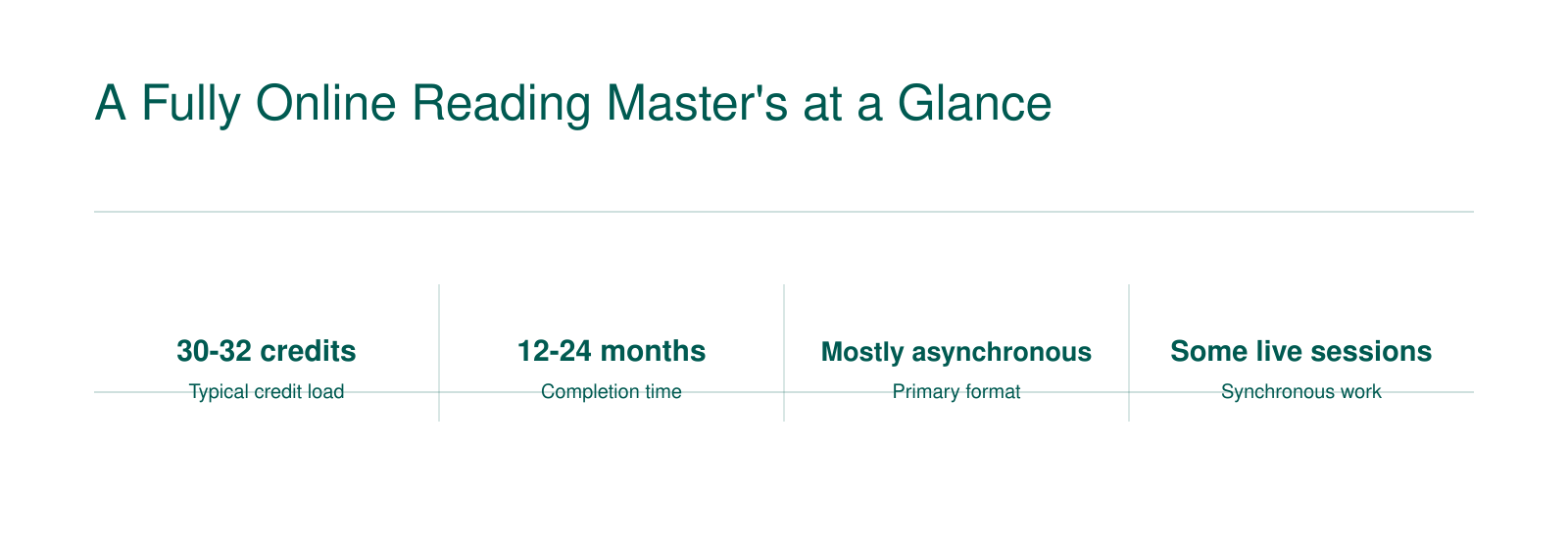
A Fully Online Reading Master's at a Glance
Most fully online reading and literacy master's programs are built for working teachers, with part-time pacing, asynchronous coursework, and a handful of live sessions.
Reading & Literacy programs by state
Frequently Asked Questions About Online Reading and Literacy Master's
Choosing between a reading specialist license and a broader literacy degree shapes your coursework, clinical work, and career options. These answers focus on the distinctions that matter for online students.
What is the difference between a reading master's and a literacy master's?
Can you become a reading specialist with an online master's degree?
Do you need a teaching license to enroll in a reading master's program?
What jobs can you get with a master's in literacy besides reading specialist?
Compare Reading & Literacy programs on the data that matters
Explore more Education & Teaching specializations or browse every graduate field.
All Education & Teaching programs