Best Master's in Health Education Programs in Maryland
Compare 6 accredited Health Education programs in Maryland at 5 schools, with graduate earnings, cost, debt, and completion data from IPEDS and the U.S. College Scorecard.

A master's in health education in Maryland, including accelerated master's in health education programs, is less a generalist degree than a credential play. Community health, hospital, public agency, and nonprofit employers increasingly screen for CHES or MCHES eligibility even though Maryland requires no state license.
The ranked list puts campus and online programs side by side, which makes format and cost the real tradeoff. Federal earnings data for Towson University's Health Science M.S. shows median earnings near $61,000 one year after completion, a benchmark against tuition and debt.
Key Points
- The University of Maryland, Baltimore waived the GRE for Fall 2027 Master of Public Health applicants.
- Towson University's Health Science M.S. has the lowest net price here and federal earnings data.
- Maryland requires no license for community health educators, so the CHES credential is voluntary.
Best Master's in Health Education Schools in Maryland, Ranked
These Maryland programs range from dedicated health education and health promotion degrees to adjacent options in health professions education, exercise science, and nursing. Where we could confirm them, we note start terms and deadlines. Where a school does not publish a current date in what we reviewed, check the program page before you plan around it.
Johns Hopkins University
#1Baltimore, MD · ~$65,000/yr (est.)
Best for: Campus students wanting a long field placement
Johns Hopkins houses its MSPH in Health Education and Health Communication in the Department of Health, Behavior and Society, which centers on health education, behavioral theory, and program planning and evaluation. The university graduates about 94% of its students, and the campus program includes a six-month field placement and eligibility for the CHES exam. Listed graduate tuition is about $64,730 a year with no separate in-state rate, but need-based scholarships can cover up to 50% of first-year tuition and a 75% reduction is available in the second year of the two-year full-time track. No deadline or start term was confirmed in our research, so check the program page.
- STEM-designated, campus-based program
- 1.5 to 2 years, full-time or part-time
- Six-month field placement
- Eligible to sit for the CHES exam
- College-level math required, no standardized test scores
- Scholarships include need-based aid and a second-year tuition reduction
Towson University
#2Towson, MD · ~$13,000/yr (est.)
Best for: Working professionals needing flexible evening classes
Towson University offers a fully online Health Science M.S. with Community Health and Administration concentrations, built for working adults with evening and hybrid course options. The university graduates about 69% of its students. Listed graduate tuition is roughly $9,558 a year in-state and $19,782 out-of-state before fees, which makes it one of the lower-cost routes in the state. No deadline or start term was confirmed, so check the program page.
- 36 credits, online with part-time study
- Focus on health behavior and community programs
- No thesis required
- 36 credits with a thesis or project
- Covers healthcare finance and management
- Builds leadership skills
- No GRE required
- Dual concentration possible
- Health leadership certificate available
- Quantitative analysis and program planning emphasis
University of Maryland, Baltimore
#3Baltimore, MD · ~$18,000/yr (est.)
Best for: Clinicians moving into teaching roles
The University of Maryland, Baltimore offers an online Master of Science in Health Professions Education for clinicians and educators who want to teach while still working. It is a teaching and educational leadership degree rather than a health promotion degree, so it fits those moving into instruction more than community health roles. Tuition is $783 per credit in-state and $997 out-of-state for the 32-credit program, and the GRE is not required.
- Online, 32 credits, about 24 months
- Specializations in educational research and educational leadership
- Focus on curriculum design, assessment, and interprofessional education
- No GRE required
- Bachelor's degree in a health-related field and three recommendation letters
- Up to 6 transfer credits allowed
- Fall start only
Notre Dame of Maryland University
#4Baltimore, MD · ~$13,000/yr (est.)
Notre Dame of Maryland University offers an online Master of Science in Health Promotion with a Community Health Education concentration and a Workplace Wellness option. The program takes an integrative approach, covering mindfulness, holistic nutrition, program evaluation, and needs assessment, and prepares graduates to sit for the CHES exam. The university graduates about 50% of its students. Tuition is about $960 per credit plus a university fee each trimester, with no application fee. Entry is in the fall, and the official page gives only a general trimester deadline, so check it for the exact date.
- 35 credits over six trimesters, online
- 23 core credits and 12 concentration credits
- Fall trimester entry
- Bachelor's degree with a minimum 2.0 GPA, resume, and essay responses
- CHES exam eligibility
- 35 credits, online, fall trimester entry
- Focus on leading wellness initiatives in organizations
- Covers communication strategies and program evaluation
Maryland University of Integrative Health
#5Laurel, MD · ~$18,000/yr (est.)
Maryland University of Integrative Health in Laurel offers an online Master of Science in Health Promotion with a Workplace Wellness concentration, aimed at people who want to lead wellness programs inside organizations. The curriculum blends mindfulness, holistic nutrition, and evidence-based program design, and it includes a capstone project. Tuition runs about $960 to $980 per credit, with no application fee. Entry is fall trimester, and we did not confirm a deadline, so check the program page.
- 35 credits over six trimesters, online
- Fall trimester entry
- Capstone project included
- Mindfulness, holistic nutrition, and needs assessment coursework
- CHES exam eligibility
- Bachelor's degree with a minimum 2.0 GPA required
Salisbury University
#6Salisbury, MD · ~$11,000/yr (est.)
Salisbury University's Master of Science in Health and Human Performance is a campus-based degree centered on exercise physiology, strength and conditioning, and clinical applications. It is adjacent to health education rather than a direct match, so it suits readers aiming at fitness, rehabilitation, or clinical exercise roles. The university graduates about 68% of its students, and graduate tuition is listed at roughly $8,517 a year in-state and $13,504 out-of-state before fees. Application deadlines are typically in the spring for fall enrollment, so confirm the current date on the program page.
- CAAHEP-accredited program
- Campus-based, also offered at The Universities at Shady Grove
- NSCA recognition for graduate studies
- Exercise physiology and strength and conditioning emphasis
- Bachelor's degree and relevant prerequisites required
Stevenson University
#7Owings Mills, MD · ~$8,000/yr (est.)
Stevenson University's online nursing master's programs are for registered nurses, and they sit next to health education rather than within it. The nursing education track trains nurse educators, which overlaps most with health education teaching roles. The university graduates about 69% of its students, and courses run in six 8-week sessions a year. Check the program page for current start terms and deadlines.
- 36 credits, 100% online
- Prepares RNs for academic and clinical educator roles
- Includes a practicum component
- Requires a current RN license and a 3.0 GPA
- 36 credits, 100% online, under two years
- Covers healthcare finance and quality management
- Capstone project included
- 36 credits, 100% online, two years or less
- Focus on population health and vulnerable populations
- Capstone project included
- One recommendation letter required
Cost & outcomes by school
Federal data for the highest-earning Health Education programs, independent of the ranking above. Earnings are this field's master's graduates four years after completing, where the Scorecard reports them.
| School | Earnings | Tuition / yr | Debt | Grads/yr | Format |
|---|---|---|---|---|---|
| Johns Hopkins University MD | $99,605 | $64,730 | $65,952 | 127 | Campus |
| University of Maryland-College Park MD | $96,194 | $18,276 | $41,326 | 118 | Campus |
| Notre Dame of Maryland University MD | — | $12,731 | — | — | Online |
| Towson University MD | — | $12,636 | — | — | Online or campus |
| University of Maryland, Baltimore MD | — | $17,827 | — | 24 | Online |
Sources: U.S. Department of Education. Tuition and graduates: IPEDS. Earnings and debt: College Scorecard, this field's master's graduates; a dash means no figure is reported.
Online and Hybrid Master's in Health Education Options in Maryland
Yes, Master's Programs in Maryland include online options, but the formats differ. In the programs ranked here, Towson University's Health Science M.S. is online with hybrid course options, Notre Dame of Maryland University's MS in Health Promotion is listed as fully online1, Maryland University of Integrative Health's MS in Health Promotion is online, Stevenson University's nursing education master's is 100% online, and University of Maryland, Baltimore's Health Professions Education program is online. Johns Hopkins University's MSPH in Health Education and Health Communication and Salisbury University's Health and Human Performance program are campus based.
Delivery details and in-person expectations
Published pages do not consistently state whether the online health education programs are fully asynchronous or include live sessions. Stevenson notes no campus visits required. Towson includes hybrid course options. Notre Dame and MUIH list online delivery but do not specify physical presence requirements. Students who want an entirely asynchronous experience should confirm live attendance expectations directly.
Practicum and field placements
Online students may still need an in-person practicum. Stevenson's online nursing education track includes a practicum component. For campus programs, Johns Hopkins includes a six-month field placement. If an online program requires field hours, ask whether the school can place you locally or approve a site near you.
State authorization
Program materials do not publish comprehensive state-by-state authorization for out-of-state online students. Working professionals benefit most from the flexibility of online and hybrid formats; career changers may prefer campus programs with built-in field placements.
Which Maryland Master's Programs Waive or Make the GRE Optional?
The University of Maryland, Baltimore's School of Medicine waived the GRE for Fall 2026 applicants to its Master of Public Health. Its admissions page also lists the MCAT, LSAT, PCAT, DAT and VCAT as substitute tests. This waiver is tied to a single application cycle, placing the program among No-GRE master's programs for that term.
- University of Maryland, Baltimore (MPH): GRE waived for Fall 2026. Requires a bachelor's degree or equivalent from an accredited college or university. Recommended coursework includes a science such as biology, a social science such as sociology or anthropology, and at least one quantitative course in math, statistics or research methods.
- Johns Hopkins University, Towson University, Notre Dame of Maryland University, Maryland University of Integrative Health, Salisbury University and Stevenson University: No published policy confirmed. Check each program's current admissions page before you register for a test.
A waiver for one term is not a permanent policy. When you contact admissions, ask whether the waiver will extend to your entry term. Also ask whether a GPA threshold, a prior graduate degree or professional experience in health education can stand in for a score. If your transcript lacks a statistics or math course, taking one before you apply strengthens your file wherever the GRE is no longer part of the review.
CEPH Accreditation and CHES Exam Preparation in Maryland Master's Programs
Employers in public health increasingly treat accreditation as a screening filter, which makes it worth checking before you apply rather than after you graduate. Council on Education for Public Health (CEPH) accreditation signals that a program has been reviewed against national standards, and some government public health roles and competitive fellowships give preference to graduates of accredited schools and programs.
Who holds CEPH accreditation
Among the institutions here, the University of Maryland School of Public Health is CEPH-accredited, with accreditation first granted in June 2001, reaffirmed in 2023, and running through July 1, 2030. The University of Maryland School of Medicine's MPH program, among the MPH programs in Maryland, carries separate CEPH accreditation, also through July 1, 2030. Other Maryland Master's in Health Education Programs are not documented as CEPH-accredited, so confirm status directly with the department if accreditation matters to your career plans.
Qualifying for the CHES exam
CEPH accreditation and CHES eligibility are different things. The National Commission for Health Education Credentialing (NCHEC) requires a bachelor's, master's, or doctoral degree plus either a major explicitly in health education (community, public, or school health education) or at least 25 semester credits addressing the Eight Areas of Responsibility. Within those credits, at least 12 semester hours must be process courses, no more than 9 may be topic-focused, and no more than 6 may fall into the other category.
Ask each program's advisor to map your intended course plan against those categories before you enroll.
Related Articles
What Do Maryland Health Education Master's Graduates Earn?
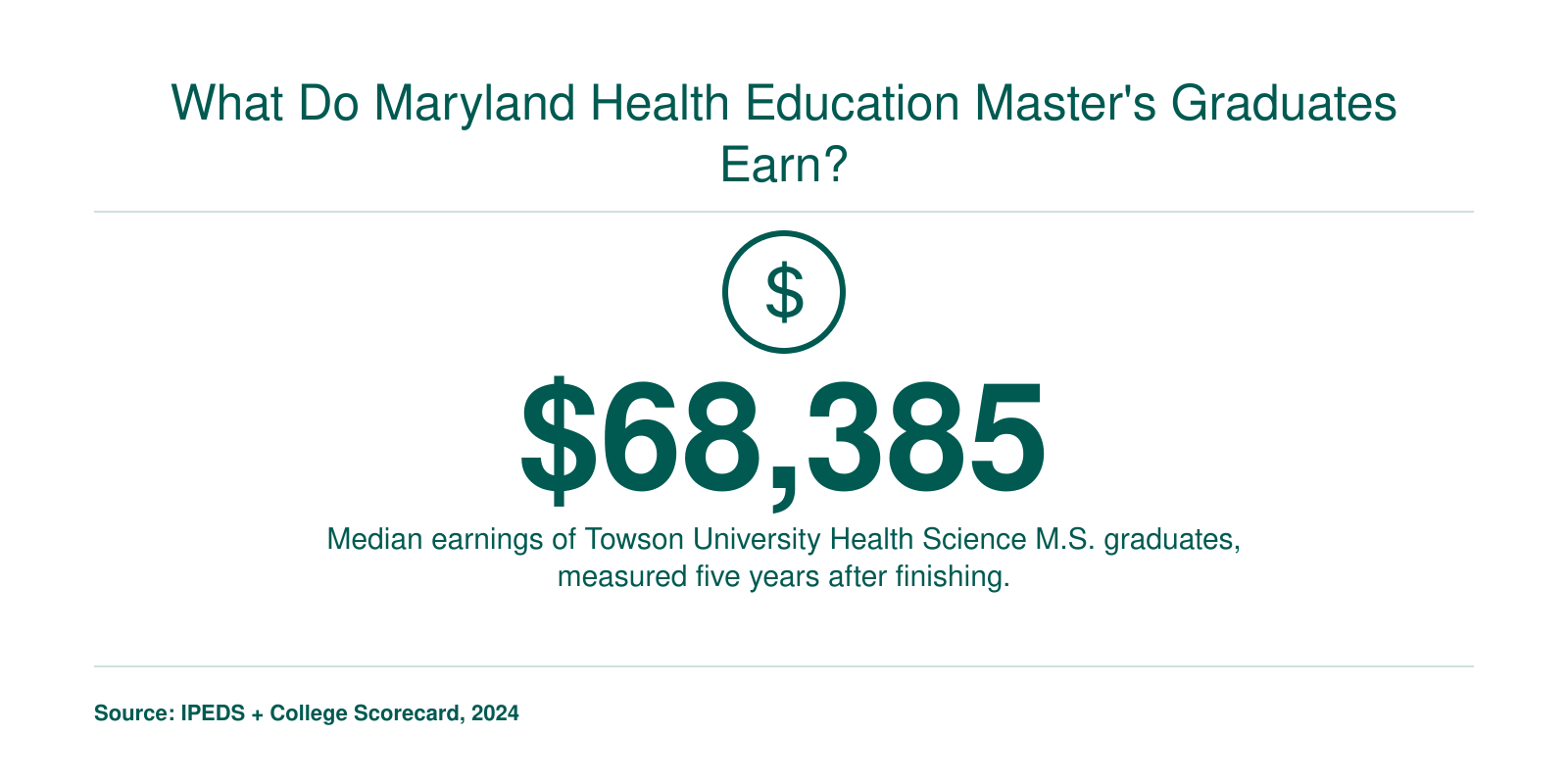
Federal program-level earnings data is available for the Health Science M.S. at Towson University, so the figure below reflects that one program. Graduates of Maryland health education master's programs commonly work as health education specialists, community health program managers, wellness coordinators, health communication specialists, and public health educators in state or county agencies.
Maryland Licensure and Certification for Health Educators
Cost of a Master's in Health Education in Maryland and Ways to Pay Less
The table is sorted lowest net price first, so the cheapest master's in health education program in Maryland by that measure is Towson University's Health Science M.S. Net price is an institution-wide average after aid, not an exact quote for any one student, and sticker tuition can rank differently, so confirm figures on each program's page. For reference, the University of Maryland, Baltimore lists its MPH at $923 per credit in-state, with FY2026 totals of $29,829 in-state and $50,839 out-of-state. To pay less, ask about graduate assistantships and departmental scholarships (Johns Hopkins and Stevenson both mention scholarship options), and check the Janet L. Hoffman Loan Assistance Repayment Program (October 1 deadline), which covers only certain government and nonprofit employees. The Maryland Loan Repayment Program (applications open March 1, close April 15) is aimed at licensed clinicians, so health educators may not qualify.
| School | Program | In-state tuition and fees | Out-of-state tuition and fees | Average net price after aid | Credits and per-credit rate |
|---|---|---|---|---|---|
| Towson University | Health Science M.S. (Community Health) | $12,636 | $22,860 | $17,413 | 36 credits; per-credit rate N/A |
| Salisbury University | Health and Human Performance | $10,785 | $15,772 | $17,743 | N/A |
| Johns Hopkins University | MSPH in Health Education and Health Communication | $64,730 | $64,730 | $18,809 | N/A |
| Notre Dame of Maryland University | M.S. in Health Promotion (Community Health Education) | $12,731 | $12,731 | $19,169 | 35 credits; $960 per credit; $275 university fee per trimester |
| Stevenson University | Master's in Nursing Education | $8,460 | $8,460 | $26,505 | 36 credit hours; per-credit rate N/A |
Compare Health Education programs on the data that matters
Explore more Healthcare specializations or browse every graduate field.
All Healthcare programs