Accelerated Master's in Health Education Programs
Compare 180+ accredited fastest Health Education programs at 150+ schools, with graduate earnings, cost, debt, and completion data from IPEDS and the U.S. College Scorecard.

Can you really earn a health education master's in a year, and does it cost less? Often, yes. Accelerated formats can cut a year or more off the standard two-year timeline, and fewer semesters means fewer tuition bills.
"Accelerated" covers two different models, though. 4+1 pathways let current undergraduates share graduate credits with their bachelor's degree. Compressed one-year formats take outside applicants who already hold a degree. The right model depends on where you are now.
The tradeoff is intensity: a faster pace leaves little room for part-time work, and CHES eligibility still hinges on specific coursework.
Key Points
- Sharing graduate credits toward a bachelor's can cut time to one year.
- Median earnings range $50,879 to $70,674 and Tufts debt is roughly $96,600.
- CHES eligibility requires an accredited degree and qualifying coursework, not work experience.
Best Accelerated Health Education Master's Programs, Ranked
Accelerated master's programs in health education compress a graduate credential into about one year while keeping online, hybrid, and campus options on the table. The schools below stand out for their shorter timelines, focused concentrations, and practical applied experiences. Use the cards to compare delivery format, price after aid, and program fit before deciding where to apply.
Tufts University
#1Medford, MA · ~$51,000/yr (est.)
Best for: Online learners wanting flexible MPH concentrations
Tufts pairs a 42-credit online MPH with concentrations in health promotion, nutrition, policy, epidemiology, biostatistics, and global health. The 12-month accelerated path includes applied practice and integrative learning experiences, and students can pace completion up to five years when needed. Standalone MPH admits may receive an automatic 25 percent tuition scholarship, with additional merit- and need-based aid available. That flexibility makes it a strong fit for working public health professionals who want a well-known research university without relocating.
- 42 credit hours
- Online and on-campus options
- Core courses in epidemiology, biostatistics, and public health action
- Accelerated 12-month path with flexible scheduling
- Applied practice and integrative learning experiences
- Focus on health promotion, nutrition, and policy
- 42 credits required
- Online format with flexible class schedules
- Full-time in four semesters or accelerated 12-month option
- Applied Practice Experience and Integrative Learning Experience capstone
- Electives allow customization
- Focus on health equity and real-world application
- 42-credit program
- Online with live synchronous and self-paced asynchronous learning
- Full-time in four semesters or accelerated 12-month option
- Applied Practice Experience and Integrative Learning Experience
- No on-campus requirement
- Evening online classes available
Saint Francis University
#2Loretto, PA · ~$22,000/yr (est.)
Best for: Working healthcare leaders needing online health education
Saint Francis University's online Master of Health Science offers a health education concentration in 30 credits, with accelerated eight-week courses and fall, spring, and summer start dates. The program is designed for working healthcare professionals, with a 2.75 GPA minimum, statement of purpose, reference letters, and a capstone project. It can be completed in 18 to 24 months while staying fully online.
- 30 credits total
- Online program delivery
- 18 to 24 months completion
- Accelerated eight-week courses
- 2.75 GPA minimum and statement of purpose
- Health education concentration with 21 core credits and 9 concentration credits
- Capstone project required
- Fall, spring, and summer sessions
Simmons University
#3Boston, MA · $25,000 – $30,000/yr (est.)
Best for: Social justice-focused public health students
Simmons University's CEPH-accredited online MPH emphasizes health equity and social justice, with 42 credit hours and a 15-month accelerated option. Live online courses are paired with in-person immersions in Boston and Arizona, so students get community-based experience without leaving their jobs. Holistic admissions consider community experience alongside academic background, and the traditional 24-month track allows employment.
- 42 credit hours required
- 15-month accelerated or 24-month traditional option
- CEPH accredited
- Online with in-person immersion experiences in Boston and Arizona
- Social justice and community partnership focus
- Practicum experience and Health Equity Change Project
- Holistic admissions and live online courses
Arizona State University
#4Scottsdale, AZ · ~$11,000/yr (est.)
Arizona State University Online offers a 30-credit interdisciplinary master's focused on community health and wellbeing, created through two colleges. The online format serves working professionals and students at various life stages, with accelerated options and a culminating applied project. A minimum 3.0 GPA, personal statement, and three recommendation letters are required.
- 30 credit hours
- Online program format
- Minimum 3.0 GPA required
- Focus on community health and interdisciplinary curriculum
- Accelerated options available
- Culminating applied project
- Partnership with two colleges
Oregon State University
#5Corvallis, OR · $15,000 – $20,000/yr (est.)
Oregon State's CEPH-accredited MPH in Public Health Practice blends online and on-campus learning and requires 56 to 64 credits with a 160-hour internship. The program can be completed in as few as 21 months, and a full-time or part-time pace is available with no GRE requirement. Quarter-system scheduling and a dedicated faculty advisor support students through the integrative learning experience.
- 56 to 64 credit hours
- Online and campus options
- No GRE required
- 160-hour internship
- CEPH-accredited program
- Full-time or part-time pace
- 21-month completion possible
- Quarter-system scheduling and faculty advisor
Wayne State University
#6Detroit, MI · ~$18,000/yr (est.)
Wayne State's Master of Science in Health and Physical Education Teaching is built for certified teachers adding a Michigan K-12 endorsement. The 51-credit program uses evening, hybrid, and online courses so educators can stay in the classroom while completing the degree in under two years. No GRE is required, and the minimum undergraduate GPA is 2.75.
- 51 credit hours
- Campus-based program with evening, hybrid, and online courses
- No GRE required
- Minimum GPA 2.75
- Designed for certified teachers adding K-12 endorsement
- Flexible course options and accelerated pathway
- Focus on curriculum development, instructional technology, and assessment
Texas State University
#7San Marcos, TX · ~$9,000/yr (est.)
Texas State's Master of Science in Public Health Education and Promotion is a 30-credit online degree that can be completed in about 14 months through eight-week courses. The curriculum covers program design and evaluation, health behavior theory, and health disparities, and completion meets CHES exam eligibility. With total tuition advertised at $14,970 and no GRE or GMAT required, it is among the most cost-conscious entries on this list.
- 30 credit hours total
- Accelerated online format
- No GRE required
- CHES exam eligible
- Total tuition $14,970, or $499 per credit
- Minimum 2.75 GPA required
- Eight-week course durations
- Focus on program design, evaluation, and health behavior theory
- 30 credit hours
- Online eight-week accelerated format
- Health Equity concentration
- No GRE or GMAT required
- CHES exam eligible after completion
- Thesis and non-thesis options
- 2.75 GPA minimum for admission
Montana State University
#8Bozeman, MT · ~$8,000/yr (est.)
Montana State's Master of Health Science is an on-campus, 30-credit program built for one-year completion and offers tracks in Molecular Medicine, Community Health, and Health and Medicine. It includes a clinical practicum and scholarly project, with prerequisites in biology, chemistry, physics, and statistics. Students looking for a concentrated face-to-face experience in health science may find this a fit.
- 30 credits total
- On-campus program
- Intended one-year completion
- Three track options: Molecular Medicine, Community Health, and Health and Medicine
- In-state tuition $8,480; out-of-state $32,760
- Clinical practicum and scholarly project
- Prerequisites include biology, chemistry, physics, and statistics
- Fall and spring admissions
Millersville University of Pennsylvania
#9Millersville, PA · $12,000 – $17,000/yr (est.)
Millersville's online MSN in Nursing Education prepares working nurses to move into teaching roles through 37 credit hours and seven-week courses. Admission requires a BSN, active RN license, and one year of clinical experience, and the program includes in-person internships along with preparation for NLN certification exams. The total advertised tuition is $23,421.
- 37 credit hours
- Online program format
- Total tuition $23,421
- BSN and active RN license required
- One year of clinical experience
- Seven-week course durations
- In-person internships included
- Prepares for NLN certification exams
Union Adventist University
#10Lincoln, NE · $30,000 – $35,000/yr (est.)
Union Adventist University offers a 42-credit campus-based MPH in Lincoln, Nebraska, with an applied practice experience and accelerated options. The program is designed for students with a healthcare background who want to improve community health through research and policy. Small student-faculty ratios on campus support close faculty interaction.
- 42-credit program
- Campus-based learning in Lincoln, Nebraska
- Applied practice experience
- Bachelor's degree required
- Accelerated options available
- Focus on public health research and policy
- Healthcare background preferred
Cost & outcomes by school
Federal data for the highest-earning Health Education programs, independent of the ranking above. Earnings are this field's master's graduates four years after completing, where the Scorecard reports them.
| School | Earnings | Tuition / yr | Debt | Grads/yr | Format |
|---|---|---|---|---|---|
| Nova Southeastern University FL | $98,338 | $24,830 | $51,097 | 36 | Online |
| Longwood University VA | — | $7,758 | — | — | Online |
| Northwest Missouri State University MO | — | $8,096 | — | — | Online |
| Washburn University KS | — | $10,787 | — | — | Online |
Sources: U.S. Department of Education. Tuition and graduates: IPEDS. Earnings and debt: College Scorecard, this field's master's graduates; a dash means no figure is reported.
Cost, debt & payoff
Median earnings of this field's master's graduates (4 yrs after completing) vs. their median federal loan debt · U.S. College Scorecard
Across these programs the median graduate earns about $81,983 and finishes with roughly $39,823 in debt — a ratio that clears a common rule of thumb (keep debt below first-year salary). Tuition and debt vary widely school to school, so check the per-school figures in the table above before you shortlist.
Cheapest Accelerated Health Education Master's Programs: Sticker Price vs. What You Pay
The most affordable options here compare sticker graduate tuition with the net price students actually pay after aid. Multiplying a published per-credit rate by the required credits gives the clearest total tuition before fees, because program lengths vary and annual tuition alone can hide the full cost. Texas State, for example, lists $502 per credit for a 30-credit program, or $15,060 before fees.
| School | Program | Format | Total credits | In-state graduate tuition | Out-of-state graduate tuition | Net price |
|---|---|---|---|---|---|---|
| Southeastern Oklahoma State University | MS in Community Health | Online | 33 credits | $7,530 | $16,740 | $8,039 |
| Morehead State University | MA in Wellness Promotion | Online | N/A | $10,024 | $14,980 | $9,793 |
| University of Illinois Springfield | Graduate Certificate in Community Health Education | Online or on-campus | 20 credits | $12,252 | $22,017 | $9,833 |
How Long an Accelerated Health Education Master's Takes, and How Classes Are Delivered
Shared credits set the timeline
Most accelerated master's in health education paths save time by letting graduate courses count toward your bachelor's degree. How many credits can be shared varies widely by school:
- American University: Its combined programs share 9 credits of a 30-credit MS.1 The five-year track shortens to four years only for Public Health Scholars on the three-year bachelor's.
- CUNY: The 4+1 allows up to 18 shared credits at undergraduate tuition, but CityTech and Lehman students are capped at 12.2 Each course must satisfy both programs and needs adviser approval.
- Miami University: Up to 9 shared hours, but only if the bachelor's is awarded before the master's is finished.3
- Loyola Chicago: Up to half of graduate hours can double-count, but only at the 400 level or above. Those credits count toward your undergraduate GPA, not your graduate one.4
- Sam Houston State: 12 graduate hours are built into the 120-credit BS, followed by 30 more graduate hours for the MPH.5
What "online" actually means
American University's online MS uses asynchronous 8-week courses, typically one per term across 10 terms, with five terms a year.6 Lehman's online master's in health education and promotion program is fully asynchronous and requires no campus attendance.7 Some schools still ask for a campus visit for a capstone, so confirm visit and practicum rules before you enroll. The Format column in the rankings lets you filter for online or campus programs.
Related Articles
Admission Requirements: Current Undergrads vs. Outside Applicants
Requirements split by applicant type: internal 4+1 students usually have earlier credit checkpoints, while external applicants face stricter transfer limits.
- Current undergraduates (4+1 pathways)Many accelerated 4+1 routes accept only the school's own undergraduates. UMass Amherst considers juniors only, Arizona State expects declared majors with a 3.0 GPA who apply after 75 credits and begin with 90, and North Dakota requires a 3.0 plus B grades in specific public-health prerequisites before degree completion.
- Outside applicantsSouthern Oregon and Vanderbilt accept external bachelor's-holders. A 3.0 minimum GPA is common, and Florida's review uses the upper-division GPA after 60 semester hours. Statement and reference requirements vary by program, so confirm each school's current checklist.
- GRE and transfer creditGRE scores are typically waived, not required by Southern Oregon or Florida and optional at Vanderbilt. External transfer limits are tight: up to 16 quarter credits at Southern Oregon and up to 9 credits at Florida, subject to department review.
CHES Eligibility: Will Your Accelerated Degree Qualify You to Sit for the Exam?
The Certified Health Education Specialist (CHES) credential, issued by the National Commission for Health Education Credentialing (NCHEC), is awarded through an academic pathway, not a work-experience one. You need a bachelor's degree or higher from an accredited institution, plus one of two transcript routes.
Two Routes to Eligibility
- The major route: An explicit degree in health education, such as Community Health Education, Public Health Education, or School Health Education.
- The coursework route: At least 25 semester credits (37 quarter hours), earned with a C or better, covering NCHEC's Eight Areas of Responsibility. NCHEC expects at least 12 semester credits in process courses aligned with those areas, no more than 9 in topic-focused courses, and no more than 6 in other courses with relevant elements.
Why an MPH Title Isn't Enough
A general MPH program, public health degree, or health science degree does not automatically qualify you. NCHEC reviews every applicant individually, and a school code is a reference only, not approval. A dedicated health education or health promotion program maps more cleanly to the Eight Areas than a generalist accelerated MPH track, where speed does not substitute for the required coursework.
CEPH accreditation signals program quality but does not waive the credit requirement on its own. Before you enroll, ask admissions for a course-to-competency mapping against the Eight Areas, and request an NCHEC determination if your case looks borderline.
The National Commission for Health Education Credentialing (NCHEC) reports that more than 15,000 people actively hold the CHES or MCHES credential. Because sitting for the CHES exam depends on your degree and coursework, confirm an accelerated program qualifies you before you enroll.
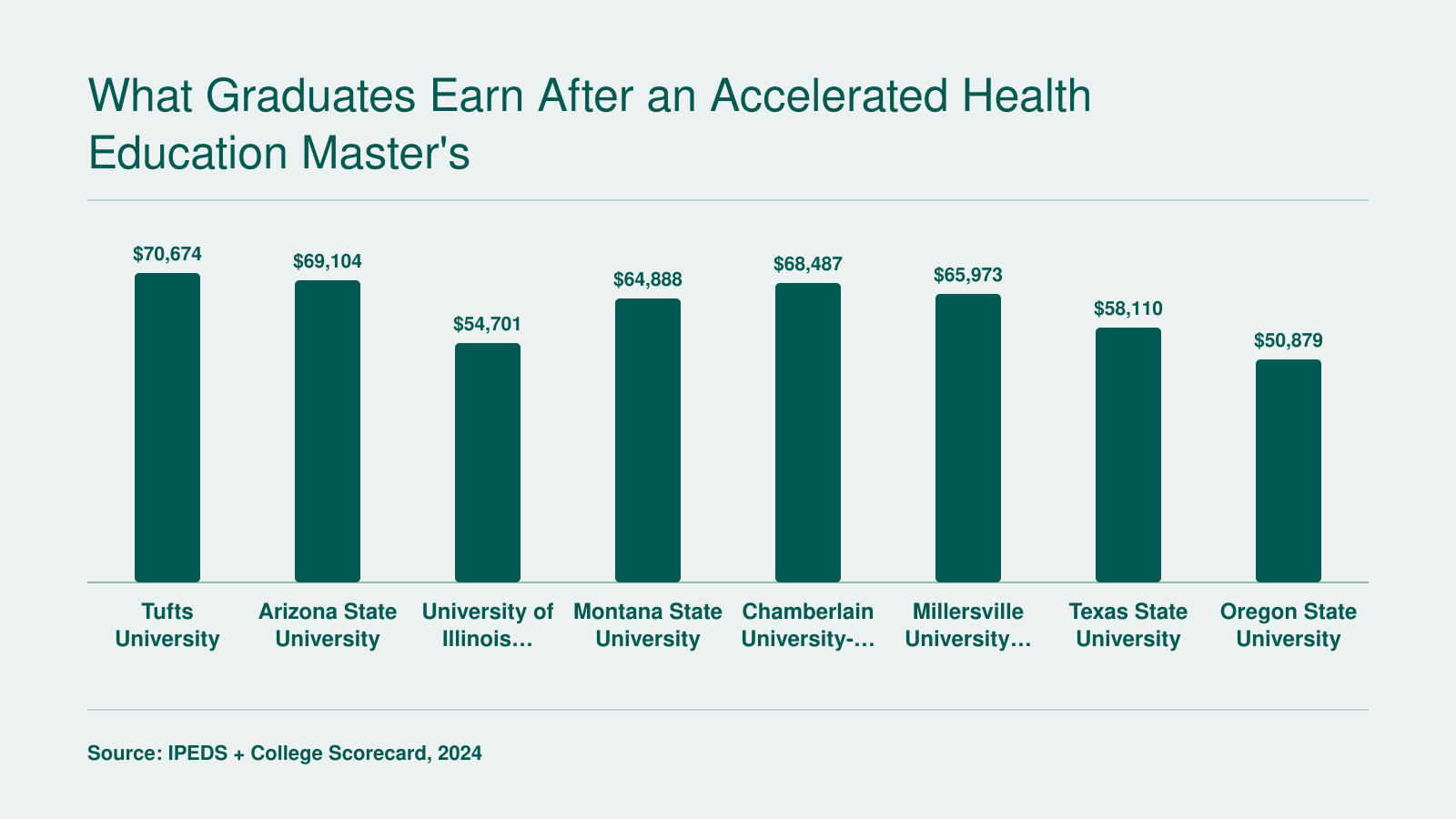
What Graduates Earn After an Accelerated Health Education Master's
One year after finishing, median earnings for program completers range from $50,879 at Oregon State to $70,674 at Tufts. The range is a useful first check, but debt changes the picture: Tufts completers carry roughly $96,600 in median debt (about $1,099 a month on a 10-year plan), while Arizona State completers carry about $33,000 (about $375 a month).
Health Education programs by state
Frequently Asked Questions About Accelerated Health Education Master's Programs
What is the cheapest accelerated health education master's program?
Can I complete an accelerated health education master's online?
Do accelerated health education master's programs accept transfer credits?
What can you do with a master's in health education?
Compare Health Education programs on the data that matters
Explore more Healthcare specializations or browse every graduate field.
All Healthcare programs