Best Master's in Health Education Programs in Connecticut
Compare 1 accredited Health Education programs in Connecticut, with graduate earnings, cost, debt, and completion data from IPEDS and the U.S. College Scorecard.

Connecticut health education master's degrees cluster around two distinct tracks: the Health, PreK-12 teaching endorsement for school settings, and the Certified Health Education Specialist (CHES) path for community and public health roles. The programs here reflect that split, from Southern Connecticut State University's school health M.S. to MPH degrees at Yale, Fairfield, and the University of Saint Joseph, and the University of Connecticut's M.S. in Health Promotion Sciences.
Campus, online, and hybrid formats sit together in this ranking because delivery alone rarely decides the right fit. Tuition swings sharply, with public out-of-state rates roughly doubling resident charges, while private universities hold one flat rate.
For school-health candidates, the endorsement requirements set the terms; for CHES applicants, coursework eligibility does. Choosing well means matching the credential you actually need to the price you can justify.
Key Points
- This ranking prioritizes verifiable graduate earnings, debt, tuition, and net price.
- University of Saint Joseph's M.P.H. is fully online and flexible.
- Connecticut health teachers need PreK-12 endorsement #043; CHES requires 25 credits.
Ranked: Best Master's in Health Education Schools in Connecticut
Connecticut's eligible health education master's universe is small, so this ranked list brings together five schools with relevant MPH, health promotion, and school health degrees. Each entry includes program details and available outcome measures, with a focus on affordability, delivery format, and certification preparation.
Yale University
#1New Haven, CT · ~$50,000/yr (est.)
Best for: Research-oriented public health scholars
Yale's MPH with a health behavior change concentration is a two-year, campus-focused public health degree built around biostatistics, epidemiology, and social justice. Students complete applied practice and a thesis or capstone, and the program's research and policy emphasis can support health education and promotion roles. Available public materials do not state whether the concentration directly satisfies CHES eligibility.
- Two-year program with applied practice experience
- Core curriculum includes biostatistics, epidemiology, and social justice
- Concentration in health behavior change
- Master's thesis or capstone project required
- Bachelor's degree required for admission
- One year after completion, median earnings were $72,627
- Four years after completion, median earnings were $105,402
- Median graduate debt was $62,532
Fairfield University
#2Fairfield, CT · ~$21,000/yr (est.)
Best for: Working professionals needing online MPH
Fairfield's online MPH uses a 42-credit curriculum that includes a 6-credit fieldwork experience and a capstone project. The program emphasizes social justice and health equity, with full-time and part-time options for working professionals. Fairfield's public materials describe the curriculum but do not confirm a stated CHES eligibility path or programmatic accreditation.
- 42-credit curriculum with 6-credit fieldwork
- Fully online format with full-time and part-time options
- Emphasis on social justice and health equity
- Covers epidemiology, biostatistics, and health policy
- Capstone project included
- Bachelor's degree required for admission
University of Connecticut
#3Storrs, CT · ~$23,000/yr (est.)
Best for: Campus-based students wanting assistantships
UConn's Health Promotion Sciences M.S. is an on-campus program known for its research methods core and thesis or project-and-practicum tracks. Students can pursue a PhD pathway or seek graduate assistantships that may offer tuition support and stipends. Available program pages do not state whether completing the degree automatically qualifies graduates for the CHES exam.
- Minimum 30 credits for the M.S.
- Thesis track: 24 advanced credits
- Project-and-practicum track: 26 advanced credits plus project and practicum
- Master's and PhD options available
- Graduate assistantships may provide tuition waivers and stipends
- Minimum 3.0 GPA and personal statement required
- One year after completion, median earnings were $65,049
- Four years after completion, median earnings were $89,596
University of Saint Joseph
#4West Hartford, CT · ~$18,000/yr (est.)
The University of Saint Joseph's 100% online MPH is designed for new graduates and career changers, with a curriculum that is described as CEPH-aligned. Core topics include epidemiology, environmental health, health promotion, and policy analysis, ending in a practicum and capstone or thesis. Available sources do not establish current programmatic accreditation or a stated CHES eligibility pathway.
- 100% online format
- Bachelor's degree and 3.0 GPA required
- CEPH-aligned curriculum
- Practicum and capstone or thesis required
- Focus on community health
- Covers epidemiology, environmental health, health promotion, and policy analysis
Southern Connecticut State University
#5New Haven, CT · ~$15,000/yr (est.)
Southern Connecticut State University's M.S. in School Health Education is a 30-credit program available online, on-ground, or hybrid and is described as Connecticut's only graduate school health education program. It is designed for certified teachers seeking the state's pre-K-12 health education cross-endorsement and covers curriculum development, behavior theory, and policy. SCSU holds NECHE institutional accreditation and advanced-level CAEP accreditation at the university level, but available materials do not confirm that this specific M.S. is CAEP-accredited or a direct CHES pathway.
- 30-credit flexible master's program
- Online, on-ground, and hybrid format options
- Full-time or part-time enrollment
- Meets Connecticut health education cross-endorsement requirements
- Focuses on Pre-K-12 school health leadership
- Includes curriculum development, behavior theory, and policy
- One year after completion, median earnings were $59,256
- Median graduate debt was $20,500
Cost & outcomes by school
Federal data for the highest-earning Health Education programs, independent of the ranking above. Earnings are this field's master's graduates four years after completing, where the Scorecard reports them.
| School | Earnings | Tuition / yr | Debt | Grads/yr | Format |
|---|---|---|---|---|---|
| Southern Connecticut State University CT | $70,335 | $14,930 | — | 30 | Online or campus |
Sources: U.S. Department of Education. Tuition and graduates: IPEDS. Earnings and debt: College Scorecard, this field's master's graduates; a dash means no figure is reported.
How We Rank Connecticut Health Education Master's Programs
This ranking sorts Connecticut master's programs in health education by numbers you can verify, not by name recognition. Where the federal College Scorecard reports program-level earnings and debt for graduates, we use them. We pair those with published graduate tuition, net price, and institution-wide completion rates from federal data.
What the ranking leaves out is deliberate. We do not score faculty prestige or reputation surveys. Those measures mostly track research standing and history, which matter little for a practitioner degree. Health educators work in schools, hospitals, public health agencies, and community organizations, and employers there care whether a graduate is hired, paid fairly, and not buried in loans. Outcomes and cost answer those questions more directly than a school's brand does.
One caution on price. The net price figure is an institution-wide average after grants and scholarships, not an amount built for graduate students in this field. Use it to compare schools, not as a personal quote. Your own cost depends on aid, assistantships, and enrollment status, so confirm with each school's financial aid office.
Online and Hybrid Health Education Master's Options in Connecticut
Fully online versus campus-based delivery is the first filter for anyone weighing the best online master's in health education programs, and the ranked schools split cleanly along that line.
What Each Program Offers
The University of Saint Joseph's M.P.H. is among the MPH programs in Connecticut that run 100% online with flexible asynchronous coursework, which suits students who need to keep working or who live outside West Hartford. The University of Connecticut's M.S. in Health Promotion Sciences is built around on-campus study in Storrs, with a 30-credit curriculum split into a thesis track and a project-and-practicum track.1 Southern Connecticut State University's M.S. in School Health Education publishes online, on-ground, and hybrid options, giving it the widest range of delivery formats among the schools here. Fairfield University delivers its public health master's online.
Watch the In-Person Requirements
Online coursework does not always mean a fully remote degree. Saint Joseph's program ends in a practicum in a nearby setting plus a capstone or thesis, and UConn's project track requires a practicum. If you live out of state, ask whether placements can be arranged locally or must happen in Connecticut.
Program pages lag behind actual delivery changes, so confirm the current format and any site-based requirements with admissions before you apply.
Related Articles
Which Connecticut Master's Programs Make the GRE Optional or Waive It?
Applicants searching for No-GRE master's programs in Connecticut may still have to confirm directly, because the schools here do not all publish a clear answer. Here is what the admissions pages show.
- University of Connecticut: GRE scores are not required for the M.S. in Health Promotion Sciences.1 A 3.0 undergraduate GPA is the minimum requirement.2 You need a health-related bachelor's, a strong science record, and ideally research or volunteer experience.1 December 1 is the preferred deadline.3 Later applications are reviewed on a space-available basis.1
- Southern Connecticut State University: The online M.S. in School Health Education (30 credits) has no published GRE policy that I found. The 3.0 GPA listed applies to graduation, not clearly to admission. Prerequisites and deadlines are not stated, and neither is whether a teaching certificate or education coursework is needed.
- University of Saint Joseph: The graduate application page states no GRE policy for a health education or health promotion master's, no minimum GPA, and no deadline. It asks for transcripts and program prerequisites but does not specify them.
- Yale University and Fairfield University: I found no published GRE, GPA, or deadline information for health education programs, so check each admissions office.
No school here clearly lists a teaching certificate as an admission requirement. Contact SCSU before applying if you plan to pursue school health education.
Connecticut Health Education Teacher Certification
CHES Certification and Career Paths for Connecticut Graduates
The Certified Health Education Specialist (CHES) credential from NCHEC is the standard for community and public health education roles. Eligibility is academic: a bachelor's or higher, plus 25 semester credits (37 quarter hours) of health education coursework with grades of C or better, mapped to NCHEC's Eight Areas of Responsibility. Students without a health education major can use the coursework pathway. NCHEC's online eligibility checker can confirm whether your transcript qualifies.
CHES is not the path to teach in Connecticut public schools. School health educator roles require Connecticut State Department of Education teacher certification, often through one of the Best Master of Arts in Teaching Programs in Connecticut. CHES supports positions such as community health educator, hospital wellness coordinator, and public health program specialist, roles that can also align with a Master's in Healthcare Administration in Connecticut, while school health teacher roles require both the teaching credential and relevant health education preparation.
Where program-level earnings are published in the latest federal outcomes, median pay five years after graduation was about $95,000 for Yale's MPH, $89,600 for UConn's Health Promotion Sciences, and $66,200 for SCSU's Master of Science in School Health Education.
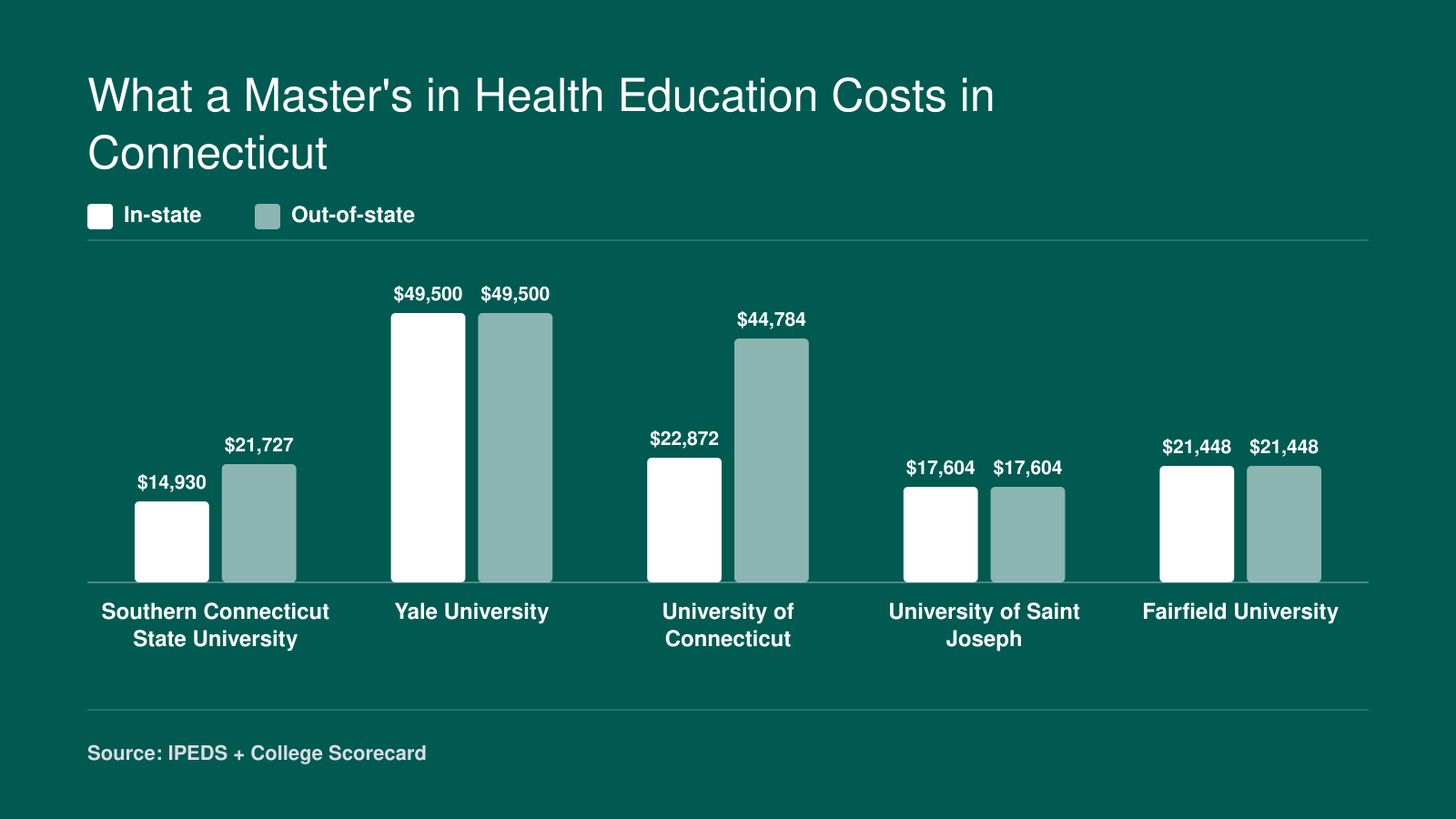
What a Master's in Health Education Costs in Connecticut
Graduate tuition and fees at the schools below vary most by residency. Public programs charge a higher out-of-state rate, while private universities use one rate regardless of state. The sticker price is not the final cost: institution-wide average net price after aid is lower, and aid can reduce the bill further. At USJ, some graduate assistantships may cover up to 15 tuition-free credits per year, a value near $10,000; USJ also lists TEACH Grants up to $4,000 annually for eligible students.
Frequently Asked Questions About Health Education Master's Programs in Connecticut
Is Southern Connecticut State University the only school with a master's in school health education in Connecticut?
What is the difference between a master's in health education and a master's in public health?
Do I need teaching certification to enroll in a school health education master's in Connecticut?
How long does a master's in health education take to complete in Connecticut?
Compare Health Education programs on the data that matters
Explore more Healthcare specializations or browse every graduate field.
All Healthcare programs