Best Master's in Health Education Programs in Arkansas
Compare 4 accredited Health Education programs in Arkansas at 3 schools, with graduate earnings, cost, debt, and completion data from IPEDS and the U.S. College Scorecard.

Is a health education master's in Arkansas the same credential as a public health degree? Not quite. The state's graduate options split between health promotion and health education degrees and MPH programs carrying a rural and community health concentration. Both routes can lead to CHES eligibility, but coursework, fieldwork, and admissions bars differ.
Campus, hybrid, and fully online programs are ranked together here, with attention to format, GRE policy, cost, and certification. Published in-state graduate tuition stays under roughly $8,300 a year at every option, so the deciding factor is usually delivery format and whether a program's curriculum matches the credential you want.
Key Points
- University of Central Arkansas offers a fully online health promotion master's.
- Its graduates earned a median $50,549 four years after finishing.
- CHES eligibility matters more than Arkansas licensure for health educators.
Ranked: Best Master's in Health Education Schools in Arkansas
Arkansas students comparing health education master's options will find three distinct paths here: a fully online health promotion degree, a hybrid health education and promotion master's, and an online public health degree with rural health concentrations. Each school has different strengths in delivery, admissions, and focus, so the right choice often depends on whether you want a dedicated health education credential or a broader public health lens.
University of Central Arkansas
#1Conway, AR · $5,000 – $10,000/yr (est.)
Best for: Working professionals needing online convenience
University of Central Arkansas offers a fully online Master of Science in Health Promotion that does not require campus visits, with 16-week core courses and shorter electives. The program is selective, with a GRE writing score threshold and exceptions for certifications, prior graduate degrees, or a strong undergraduate GPA. This is a dedicated health promotion degree rather than a public health concentration. Accreditation details are not specified in the available profile.
- Fully online program with no campus visits required
- 16-week core courses in fall and spring
- 8-week elective courses and 5-week summer electives
- Selective admission: GRE writing 3.0+ or exceptions
- Exceptions include certifications, prior master's, or 3.25+ GPA
- Dedicated health promotion master's, not a public health concentration
University of Arkansas at Little Rock
#2Little Rock, AR · ~$8,000/yr (est.)
Best for: Health educators seeking hybrid coursework
The University of Arkansas at Little Rock trains health educators through a 36-credit Master of Science in Health Education and Promotion that can be completed online or in person. Admission requires a 2.7 GPA, two reference letters, and a letter of intent, and the program ends with a comprehensive exam and a thesis or project. It is a dedicated health education degree, not a public health concentration. The program holds Arkansas Department of Education accreditation and National Health Education Credentialing certification, and the university is institutionally accredited by the Higher Learning Commission.
- 36 credit hours to complete
- Online or in-person format
- 2.7 GPA and two reference letters required
- 500-word letter of intent required
- Comprehensive exam plus thesis or project
- Dedicated health education degree, not a public health concentration
Arkansas Colleges of Health Education
#3Fort Smith, AR · ~$8,000/yr (est.)
Best for: Rural public health leaders needing pacing options
Arkansas Colleges of Health Education offers a fully online Master of Public Health with concentrations in Rural and Community Health and Nutrition, and the institution also lists an Indigenous Health concentration. Students can choose a full-time 21-month track or a part-time 34-month track, which adds pacing flexibility for working professionals. This is a public health degree with health education relevant concentrations rather than a dedicated health education master's. Accreditation details are not specified in the available profile.
- Rural and Community Health concentration
- Service-learning integrated curriculum
- Community-based research opportunities
- Skills-based practical approach
- 21-month full-time track
- No campus visits required
- Nutrition concentration
- Flexible scheduling options
- Skills-based curriculum
- Community-based research included
- 21-month program length
- Fully online delivery
Cost & outcomes by school
Federal data for the highest-earning Health Education programs, independent of the ranking above. Earnings are this field's master's graduates four years after completing, where the Scorecard reports them.
| School | Earnings | Tuition / yr | Debt | Grads/yr | Format |
|---|---|---|---|---|---|
| University of Central Arkansas AR | — | $7,446 | — | — | Online |
| University of Arkansas at Little Rock AR | — | $7,915 | — | — | Online or campus |
| Arkansas Colleges of Health Education AR | — | $8,240 | — | — | Online |
Sources: U.S. Department of Education. Tuition and graduates: IPEDS. Earnings and debt: College Scorecard, this field's master's graduates; a dash means no figure is reported.
Online and Hybrid Master's in Health Education Programs in Arkansas
Among UCA Graduate programs, the M.S. in Health Promotion runs 100% online, with no campus requirement.1 Arkansas Colleges of Health Education's MPH is also fully online, so UCA is not the only online option.
How the formats sort out
- Fully online: UCA and Arkansas Colleges of Health Education. UCA enrollment runs from part-time to full-time, with Fall and Spring starts and Summer electives.
- In-person and online: UA Little Rock's M.S. in Health Education and Promotion lists both delivery modes. Published details do not make clear whether the whole degree can be finished online, or what its part-time options and start terms are, so confirm with the department.
- Campus-only: None established among the schools here. Arkansas Colleges of Health Education publishes little format detail in the material reviewed, so ask the program directly.
In-person requirements to check
UCA does not require an in-person practicum,1 but its curriculum includes Field Experiences (HLTH 5V65, 3 or 6 credits).2 Ask whether it is mandatory for your track and whether placements must be on site. UA Little Rock's practicum rules are not established, so verify them before applying.
Who each format suits
Working teachers and health department staff will likely prefer UCA's online, part-time structure, an approach shared by many online master's in health education programs. Full-time students who want campus access, and who plan to ask about assistantships, may find UA Little Rock's in-person option the better fit.
Related Articles
Cost of a Master's in Health Education in Arkansas and CHES Certification
Employers in community health increasingly screen for a national credential rather than a state license, which makes exam eligibility, not licensure, the thing to verify before you enroll.
What the degree costs
Published graduate tuition runs lowest at the University of Central Arkansas, at about $7,446 in-state and $12,985 out-of-state, with the University of Arkansas at Little Rock close behind at roughly $7,915 in-state and $15,547 out-of-state. Institution-wide net price, an approximate average across all students rather than a figure for these programs specifically, sits near $16,500 at UCA and $17,200 at UA Little Rock.
Tuition alone understates the bill at affordable health education master's schools. UA Little Rock's degree runs 36 credit hours, so budget for several semesters of mandatory fees (technology, distance-learning, and general service charges) layered on top of the per-credit rate. Ask each graduate office for a current fee schedule before you compare totals, since advertised tuition rarely includes them.
The CHES credential
Arkansas does not license community health educators, so the Certified Health Education Specialist exam from NCHEC is the credential that matters. Both UCA and UA Little Rock describe themselves as health education master's programs with CHES preparation, but NCHEC bases eligibility on your specific academic preparation in health education competencies, not on the degree title, so have your advisor map your transcript against current requirements.
The exam is 165 multiple-choice questions (150 scored, 15 pilot) over three hours, with a discounted fee for students enrolled in at least nine credits.1 Certification lasts five years and requires 75 continuing-education hours plus a $60 annual renewal.1
Teaching health in a K-12 classroom is a separate path: that requires Arkansas teacher licensure, not CHES.
What Health Education Master's Graduates Earn at Arkansas Schools
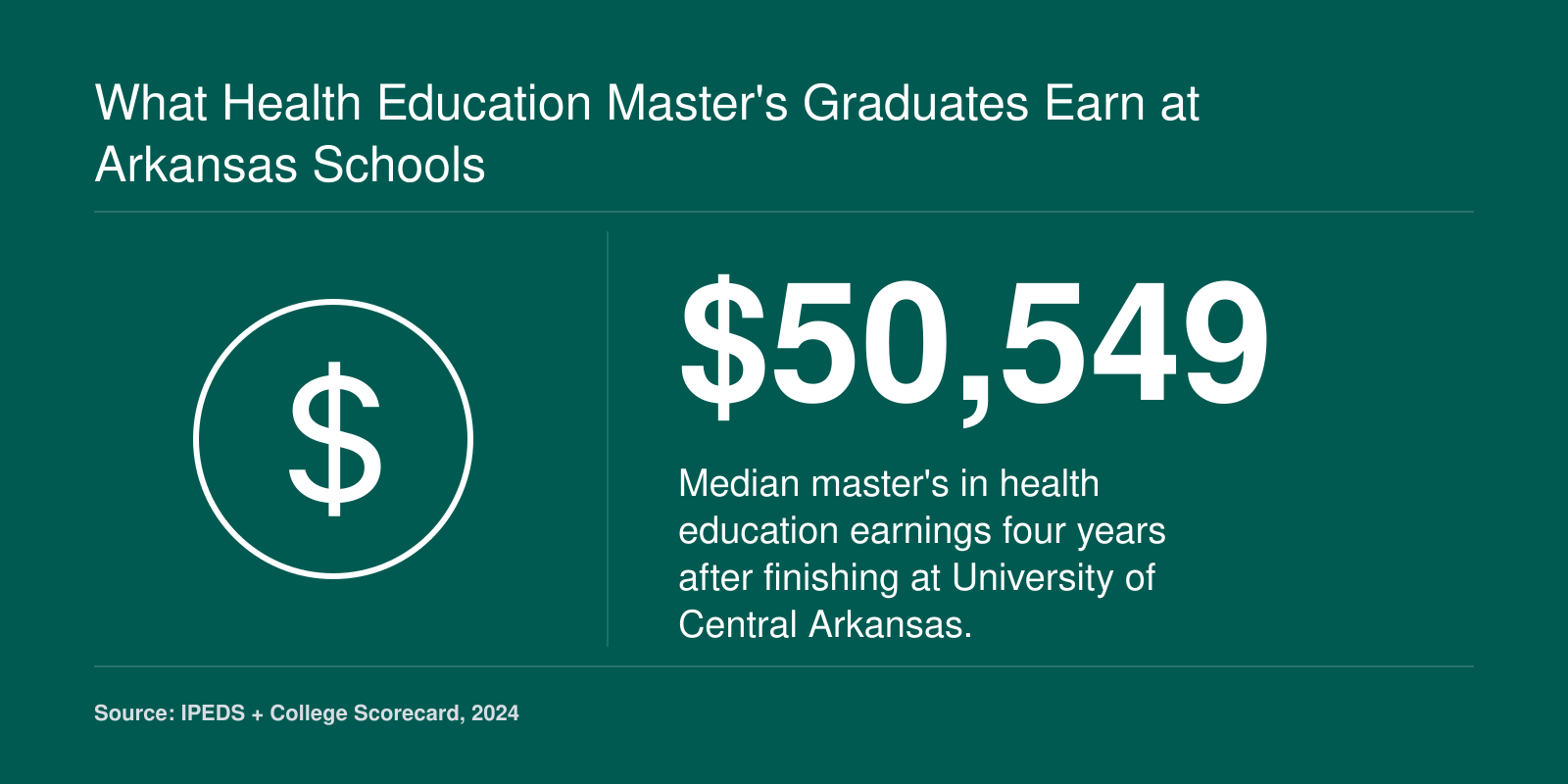
University of Central Arkansas publishes a program-level median earnings figure for its health education master's program in the 2024 College Scorecard data. Its graduates earned a median of $50,549 four years after finishing.
Arkansas Certification Paths for Health Educators
Common Questions About Arkansas Health Education Master's Programs
How does UA Little Rock's M.S. in Health Education and Promotion compare with a broader public health MPH?
Which Arkansas master's program is best specifically for health education rather than general public health?
Do Arkansas health education master's programs offer graduate assistantships or scholarships?
How many graduate credits can transfer into these programs?
Compare Health Education programs on the data that matters
Explore more Healthcare specializations or browse every graduate field.
All Healthcare programs