Most Affordable Master's in Health Education Programs
Compare 180+ accredited most affordable Health Education programs at 150+ schools, with graduate earnings, cost, debt, and completion data from IPEDS and the U.S. College Scorecard.

Net prices at the schools ranked here run from $3,148 at CUNY Lehman College to $10,440 at Cal State Long Beach, a spread of more than $7,000 before program-specific fees. The ranking weights net price and financial aid most heavily, drawing on College Scorecard and federal cost data.
Price is only half the decision. Community health educators typically pursue CHES certification, while K-12 health teaching requires state licensure, and that distinction determines which low-cost program actually fits your career.
Key Points
- CUNY Lehman's online health education master's has the narrowest residency tuition gap.
- A low per-credit rate does not equal a low total bill.
- UC Berkeley reports the highest graduate earnings figure in this comparison.
The 10 Most Affordable Health Education Master's Schools for 2027
These ten schools pair relatively low graduate tuition with public health and health education programs that fit working students. The list spans California, New York, Texas, New Mexico, and Florida, with campus, hybrid, and fully online options.
California State University-Los Angeles
#1Los Angeles, CA · ~$9,000/yr (est.)
Best for: Urban community health students seeking Los Angeles
Cal State LA offers a campus-based Master of Public Health oriented to urban community health in Downtown Los Angeles. The program combines core public health courses, concentrations, and electives, with evening classes and a field experience. It is a strong fit for students who want an affordable public-university route serving diverse populations in the Los Angeles area.
- 42-unit curriculum with core courses, concentrations, and electives
- $525 per unit with a $22,050 total cost
- Campus-based in Downtown Los Angeles
- WSCUC-accredited
- Urban community health focus
- Bachelor's degree and minimum 2.5 GPA required
- Evening class schedule with weekly meetings
- Field experience and culminating project required
California State University-Fullerton
#2Fullerton, CA · $9,000 – $19,000/yr (est.)
Best for: Public health professionals needing campus cohort
Cal State Fullerton provides a campus-based MPH with concentrations in community health promotion, epidemiology, and environmental and occupational health. The 21-month program is CEPH-accredited and emphasizes evidence-based practice, leadership, and policy. It is designed for students from varied backgrounds who want a structured, cohort-style public health degree in Orange County.
- 21-month program length
- CEPH-accredited degree
- Campus-based instruction
- Concentrations in community health promotion, epidemiology, and environmental and occupational health
- Evidence-based curriculum with leadership and policy focus
- Bachelor's degree required
California State University-San Bernardino
#3San Bernardino, CA · ~$10,000/yr (est.)
Best for: Working adults wanting hybrid evening format
Cal State San Bernardino runs a CEPH-accredited hybrid MPH that blends in-person and online instruction. The 42-unit curriculum covers biostatistics, epidemiology, health promotion, and policy, and requires a culminating project or thesis. It suits public health professionals and aspiring agency leaders who need flexible scheduling in the Inland Empire.
- CEPH-accredited hybrid program
- 42 units required
- 3.0 GPA minimum
- Resume, three recommendation letters, and writing sample required
- Core courses in biostatistics, epidemiology, health promotion, and policy
- Field experience and project or thesis culminating experience
CUNY Lehman College
#4Bronx, NY · ~$12,000/yr (est.)
Lehman College offers a fully online Master of Science in Education for health teachers, Pre-K through 12. The program leads to New York State health education certification and can be completed in as little as 18 to 24 months. It is especially useful for teachers certified in another subject or current health educators seeking professional certification.
- Two sequence options: 39 credits or 30 credits
- No GRE required
- $470 per credit
- As little as 18-24 months
- Fully online with synchronous and asynchronous classes
- Fieldwork in your home school
- Leads to NYSED Health Education Certification
- 3.0 GPA and three recommendations required
California State University-Fresno
#5Fresno, CA · ~$9,000/yr (est.)
Fresno State's hybrid MPH with a health promotion concentration prepares students for leadership in health education and behavioral approaches. The 42-unit program includes internships and a thesis or project, with evening and late afternoon classes. It is a practical choice for working professionals in California's Central Valley who need flexible, CEPH-accredited training.
- 42-unit program
- Hybrid online and campus format
- CEPH accreditation
- Focus on health promotion
- Internship and field experience
- Thesis or project options
- Three recommendation letters and statement of intent required
- Evening and late afternoon classes
California State University-Long Beach
#6Long Beach, CA · $9,000 – $19,000/yr (est.)
Cal State Long Beach offers a campus-based MPH with a community health education emphasis. The program focuses on assessing community needs, culturally competent interventions, health equity, and research skills in an urban, multiethnic setting. It is a good fit for students who want hands-on internships and a strong community-health orientation in greater Los Angeles.
- Campus-based program
- CEPH accredited
- Focus on health equity
- Community health emphasis
- Research skills development
- Cultural competence training
- Leadership development included
- Hands-on internship opportunities
The University of Texas at El Paso
#7El Paso, TX · $5,000 – $10,000/yr (est.)
UTEP's campus-based MPH emphasizes Hispanic and border health, with additional concentrations in social and behavioral sciences and health services administration and policy. The 42-credit program is CEPH-accredited and includes a practicum and culminating project or thesis. It is tailored to students interested in public health disparities along the U.S.-Mexico border.
- Hispanic and border health concentration
- 42 credit hours
- Campus-based program
- CEPH-accredited
- Minimum 3.0 GPA and bachelor's degree required
- Three recommendation letters and 500-word essay required
- Practicum and thesis or project option
- Fall admission only; no GRE or MCAT required
- Social and behavioral sciences concentration
- Focus on health disparities
- GRE/MCAT optional
- English proficiency test for non-native speakers
- Core public health courses
- Health services administration and policy concentration
- Teleconference interview required
- Background checks for practicum
- B or higher grade required
- Interdisciplinary curriculum
- Prepares for public and nonprofit sectors
New Mexico State University
#8Las Cruces, NM · $7,000 – $19,000/yr (est.)
New Mexico State University offers a hybrid MPH with health behavior and health promotion, plus a health management, administration, and policy concentration. The program includes online and on-campus options, evening schedules, and field placements, with per-credit tuition. It is designed for working professionals across New Mexico and nearby states who need asynchronous flexibility.
- Health behavior and health promotion concentration
- Hybrid format with online and on-campus options
- Evening class schedules
- Asynchronous online courses
- Per-credit-hour tuition
- CEPH-accredited program
- Field placement included
- Thesis option available
- Health management, administration, and policy concentration
- Online format only
- Designed for working professionals
- No thesis option
- Focus on health equity
- Bachelor's degree required
California State University-Sacramento
#9Sacramento, CA · $10,000 – $20,000/yr (est.)
Sacramento State offers a hybrid MPH in health promotion, policy, and leadership. The 42-unit program uses cohort-based learning and three intensive residencies, with a two-year completion timeline. It is aimed at professionals who want policy analysis, community engagement, and leadership training while continuing to work.
- 42-unit program
- Hybrid format with three intensive residencies
- 2-year completion time
- 3.0 GPA minimum
- Work experience preferred
- Cohort-based learning
- Capstone project and public health practicum
- Community engagement and policy analysis focus
University of Florida
#10Gainesville, FL · ~$13,000/yr (est.)
The University of Florida offers a fully online Master of Science in Health Education and Behavior, with optional concentrations in health communication, health promotion for priority populations, and patient health education. The program prepares students for the CHES exam and can be tailored through electives. It is a competitive option for working professionals nationwide who want UF's public-university resources without relocating.
- Fully online program format
- Prepares for CHES exam
- Customizable electives available
- Focus on health education and behavior
- Health communication concentration
- Flexible scheduling options
- Expert faculty guidance
- No campus visits required
- Diverse student community
- Health promotion for priority populations concentration
- Average admitted GPA 3.44
- Average 5+ years work experience
- Prepares for dietitian exam
- Reported 82.6% CHES pass rate
- Patient health education concentration
- Experiential learning components
- Financial aid options available
- Support for dietitian exam prep
Cost & outcomes by school
Federal data for the highest-earning Health Education programs, independent of the ranking above. Earnings are this field's master's graduates four years after completing, where the Scorecard reports them.
| School | Earnings | Tuition / yr | Debt | Grads/yr | Format |
|---|---|---|---|---|---|
| University of West Florida FL | $111,363 | $9,062 | — | 66 | Online |
| University of California-Los Angeles CA | $110,900 | $14,476 | $52,445 | 198 | Campus |
| Arizona State University AZ | $100,713 | $10,843 | $32,995 | 42 | Online |
| Arizona State University AZ | $100,713 | $13,587 | $32,995 | 1 | Online |
| University of Kentucky KY | $100,253 | $14,644 | $40,014 | 53 | Online |
| Nova Southeastern University FL | $98,338 | $24,830 | $51,097 | 36 | Online |
| University of Maryland-College Park MD | $96,194 | $18,276 | $41,326 | 118 | Campus |
| University of Nevada-Reno NV | $93,116 | $7,032 | $43,452 | 52 | Campus |
| University of Alabama at Birmingham AL | $91,073 | $8,640 | $32,000 | 276 | Online |
| California State University-Long Beach CA | $88,743 | $8,898 | $26,210 | 40 | Campus |
| University of Minnesota-Twin Cities MN | $88,156 | $22,017 | $45,315 | 155 | Online or campus |
| University of New Mexico NM | $87,995 | $9,860 | $32,069 | 37 | Online |
Sources: U.S. Department of Education. Tuition and graduates: IPEDS. Earnings and debt: College Scorecard, this field's master's graduates; a dash means no figure is reported.
Cost, debt & payoff
Median earnings of this field's master's graduates (4 yrs after completing) vs. their median federal loan debt · U.S. College Scorecard
Across these programs the median graduate earns about $81,983 and finishes with roughly $39,823 in debt — a ratio that clears a common rule of thumb (keep debt below first-year salary). Tuition and debt vary widely school to school, so check the per-school figures in the table above before you shortlist.
What a Health Education Master's Really Costs: Fees, Books, and Hidden Charges
A low per-credit rate is not the same as a low total cost of a master's degree. Students in health education master's programs should compare the full cost of attendance, not just the advertised credit hour. Mandatory add-ons can shift a program's value quickly: technology fees, online or distance-learning fees, graduation fees, books, and practicum-related expenses like travel, background checks, or liability insurance.
What the published schedules show
For comparison, related graduate health programs publish these 2026-27 figures. Purdue's online MHA lists $750 per credit for 40 credits, or $30,000 in tuition, with books estimated at $375 per semester or $750 per year.1 Ohio State lists $854.63 per graduate credit plus $33.94 and $9.30 in fees; online programs add a $200 program fee, and distance-learning programs carry a $100 distance fee.2 Rutgers School of Public Health charges $1,126 per credit in-state and $1,685 out-of-state, plus a $450 per-semester general service fee, a one-time $100 computing fee for new students, and about $100 in books per three-credit course.3
A fair comparison formula
Use: total credits × per-credit rate + per-semester fees × terms + books + one-time fees. If a program does not publish graduation or practicum costs, ask the bursar before enrolling. Career changers should confirm whether foundation courses in public health or behavioral science add credits at the same rate. No uniform 2026-27 increase applies across these schools, so check current rates before comparing.
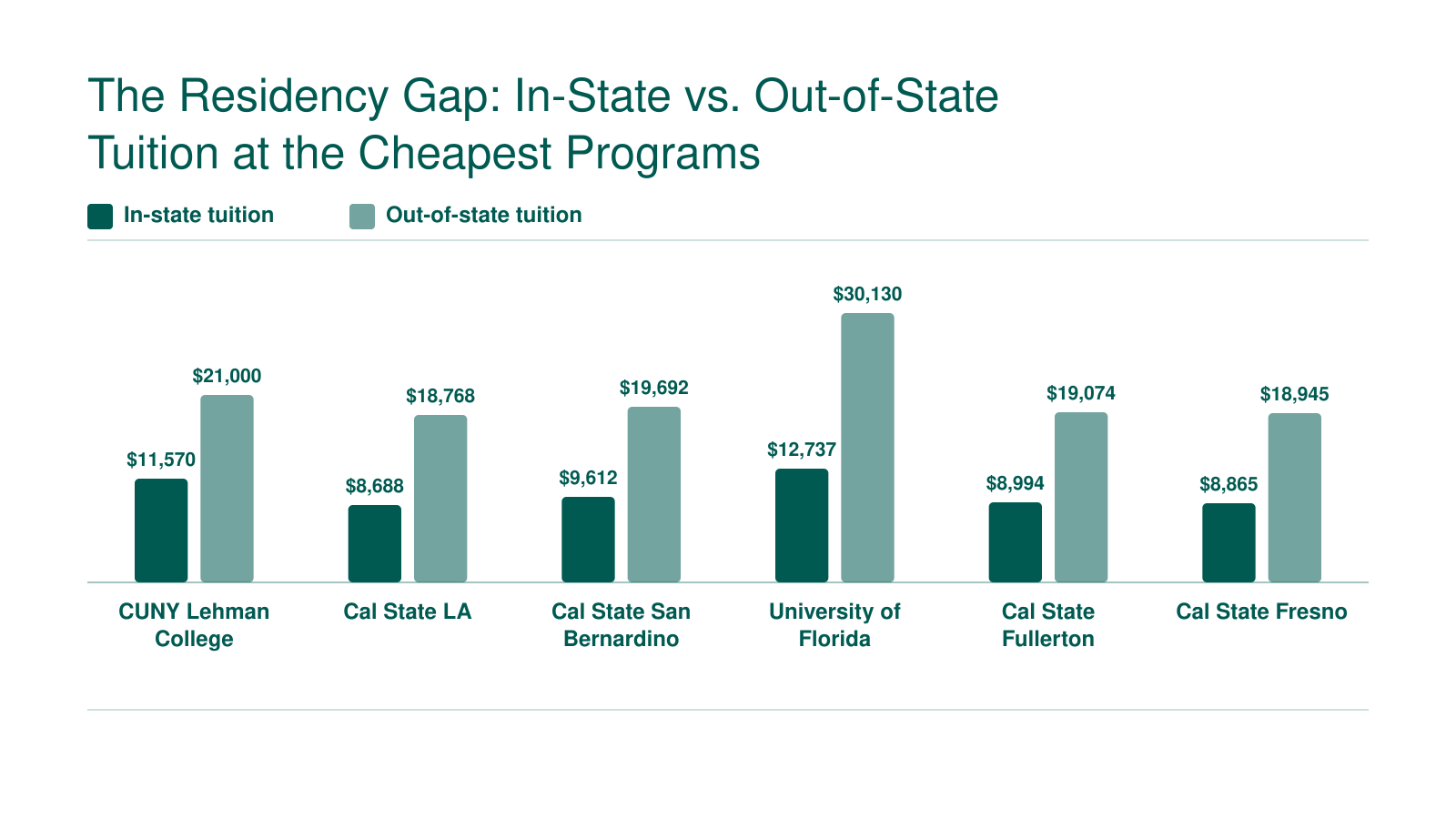
The Residency Gap: In-State vs. Out-of-State Tuition at the Cheapest Programs
Among the lowest-tuition health education master's programs shown here, out-of-state rates run meaningfully higher than in-state rates. CUNY Lehman's online program has the narrowest gap, and the California State campuses keep their nonresident premium lower than the University of Florida's online option. Before choosing, ask the program whether online learners can qualify for in-state or flat e-tuition billing.
Can You Earn a Health Education Master's Fully Online?
Both fully online and hybrid Online Master's in Health Education programs are available, so yes, you can complete the degree online. CUNY Lehman College and the University of Florida deliver their health education master's online. Cal State San Bernardino, Fresno State, New Mexico State and Sacramento State blend online coursework with campus sessions. Cal State LA, Cal State Fullerton, Cal State Long Beach and UTEP remain campus-based.
Live Classes or Self-Paced?
Synchronous courses meet live at set times. Asynchronous courses let you work through lectures and assignments on your own schedule, which usually suits working professionals better. Lehman offers both synchronous and asynchronous options, and New Mexico State pairs asynchronous online courses with evening classes.
Practicums Still Apply
Studying online rarely removes field experience. Among online MPH programs more broadly, practicum requirements vary widely, from 80 hours at Capella Online MPH to 260 at USC Online MPH Program. Some schools, such as Elmhurst, let you complete placements at an approved site in your own area1, and Lehman students do fieldwork in their home school. A capstone or thesis generally follows the practicum rather than replacing it.
Before enrolling, ask whether the program helps find and approve placement sites. Securing one on your own can delay graduation.
Related Articles
Among the programs below, the highest graduate earnings figure belongs to UC Berkeley.
Do You Need a Teaching License? School vs. Community Health Education Paths
Whether you need a teaching license depends on your path: community and public health educator roles generally do not, while K-12 health teaching requires state licensure.
- Community and public health rolesMost community and public health educator positions do not require a teaching license; the Certified Health Education Specialist (CHES) credential is often preferred by employers.
- K-12 health teachingK-12 health teachers need a state teaching license with a health endorsement, and requirements vary by state.
- Initial licensure vs. add-onSome master's programs lead to initial licensure, while others serve only already-licensed teachers.
- State-specific requirementsTexas uses Health Science 6-12 exams; New York requires the Health Education CST and edTPA; California requires CSET Health Science and CPR.
- Home-state approvalConfirm that a program is approved for licensure in your home state, especially for online students.
Health Education programs by state
Frequently Asked Questions About Affordable Health Education Master's Programs
Is a master's in health education worth it for salary growth?
How many transfer credits will affordable health education programs accept?
Should I consider an online MPH instead, and are scholarships available?
Compare Health Education programs on the data that matters
Explore more Healthcare specializations or browse every graduate field.
All Healthcare programs