Best Master's in Health Education Programs in Indiana
Compare 2 accredited Health Education programs in Indiana, with graduate earnings, cost, debt, and completion data from IPEDS and the U.S. College Scorecard.

Few Indiana master's degrees carry the literal title "health education." The real choice is an MPH in community health, an M.Ed. in health and wellness education, or an MS in health promotion, and that shapes job fit.
Campus and online options are ranked side by side. Several are fully online; GRE requirements are generally optional or absent. Cost and graduate earnings vary by school and residency.
Credentialing is the hard filter. The April 2026 CHES exam pass rate was 73.77%, so coursework alone does not guarantee certification.
Key Points
- Purdue charges Indiana residents $9,992 in tuition versus $28,794 for nonresidents.
- Most admissions pages that address the GRE make it optional or not required.
- Match your degree to the CHES credential, since about one in four candidates failed the April 2026 exam.
Ranked: Indiana's Best Master's in Health Education Programs
The top spot goes to the program that pairs CEPH-accredited public health training with a community-focused concentration, a high institution-wide graduation rate, and flexible online delivery. Graduation rates below describe the schools offering these programs, not a single cohort, and net price is an approximate institution-wide average, not a program quote.
Purdue University
#1West Lafayette, IN · ~$10,000/yr (est.)
Best for: Public health students focused on community programs
Purdue's online Master of Public Health is CEPH-accredited, and its family and community health concentration is the closest fit to health education in this ranking. Schools offering this program graduate about 83% of students, and approximate institution-wide net price is about $14,600. From July 1, 2026, the online MPH is listed at $718.80 per credit for Indiana residents and $818.80 for nonresidents. Purdue lists no CEPH expiration date in the sources we reviewed. The same 42-credit MPH also offers biostatistics and epidemiology concentrations.
- 42-credit online program, full-time or part-time
- CEPH accredited
- Focus on social determinants, program evaluation and health equity
- 200-hour practicum and capstone project
- Minimum 3.0 GPA, bachelor's degree required
- Same 42-credit online MPH with a statistics concentration
- Regression analysis and data management coursework
- Same 42-credit online MPH with an epidemiology concentration
- Prepares for epidemiologist roles
Indiana University-Bloomington
#2Bloomington, IN · $12,000 – $33,000/yr (est.)
Best for: Campus learners wanting health promotion training
Indiana University Bloomington offers a campus-based Health Promotion program, part of its M.S. in Applied Health Science, built for careers in health education. Schools offering it graduate about 80% of students, and approximate institution-wide net price is about $16,264. Median earnings are about $60,810 one year after completion. IU's School of Public Health is CEPH-accredited through December 31, 2027, but that listing is school-level, and we found no separate accreditation for this concentration.
- Campus-based, part of the M.S. in Applied Health Science
- Core courses on instructional strategies and behavioral health
- Research opportunities available
- Prepares graduates for health education roles in varied settings
Valparaiso University
#3Valparaiso, IN · ~$13,000/yr (est.)
Best for: Working adults needing part-time schedules
Valparaiso's online Master of Public Health is a 42-credit program at $650 per credit, with 24-month full-time and 36-month part-time tracks. Schools offering it graduate about 70% of students, and approximate institution-wide net price is about $18,578. The university is HLC-accredited, but we did not confirm CEPH accreditation for this MPH, so check before relying on it for public health credentials.
- 100% online, 42 credits at $650 per credit
- 24-month full-time or 36-month part-time track
- Bachelor's degree with a 2.75 GPA minimum
- Covers epidemiology, biostatistics, environmental health and policy
- Internships and capstone project
American College of Education
#4Indianapolis, IN · $5,000 – $10,000/yr (est.)
American College of Education's online M.Ed. in Health and Wellness Education is a teaching-oriented degree for school, community and healthcare settings, with a published total cost of $9,109. It is HLC-accredited, and we found no CEPH or CAEP accreditation for it. It prepares students for the CHES exam. A graduation rate is not available for this school.
- Online, 31 semester credits, about 12 months
- Total published cost of $9,109
- Minimum 2.50 GPA for full admission
- Prepares for the CHES exam
- Multiple start dates, no on-campus requirements
Purdue University Global
#5West Lafayette, IN · $10,000 – $15,000/yr (est.)
Purdue Global's online M.S. in Health Education and Promotion is the most directly named health education degree here. It is aligned with CHES certification, but we found no CEPH accreditation for it. Schools offering it graduate about 50% of students, and approximate institution-wide net price is about $7,770. Median earnings are about $55,250 one year after completion.
- 100% online, 48 credits at $420 per credit
- About 1.5 years average completion
- Designing and evaluating community health programs
- CHES exam preparation
- Bachelor's degree required, flexible start dates
Indiana Institute of Technology
#6Fort Wayne, IN · ~$14,000/yr (est.)
Indiana Tech's online M.S. in Global Health Leadership is a non-clinical management degree rather than a health educator track. It is not CEPH-accredited, and its listed business and health information accreditations apply to other programs. Schools offering it graduate about 48% of students, and approximate institution-wide net price is about $23,206.
- Fully online, 30 credit hours
- Covers global disease management and health care finance
- Admission requires a bachelor's degree, rolling start dates
- Credit transfer possible
University of Notre Dame
#7Notre Dame, IN · ~$65,000/yr (est.)
Notre Dame's M.S. in Global Health is a two-year campus program, but it is currently paused and not accepting new applications, so treat it as unavailable unless admissions reopen. Schools offering it graduate about 95% of students, and approximate institution-wide net price is about $26,780. We found no CEPH accreditation for it, and it is research-focused rather than a health educator track.
- Two-year, campus-based, STEM-designated
- Fully funded capstone research
- Policy and governance focus within the same two-year degree
- Small cohort with a mentoring network
- Analytics focus within the same two-year degree
- Access to faculty research
Cost & outcomes by school
Federal data for the highest-earning Health Education programs, independent of the ranking above. Earnings are this field's master's graduates four years after completing, where the Scorecard reports them.
| School | Earnings | Tuition / yr | Debt | Grads/yr | Format |
|---|---|---|---|---|---|
| Purdue University Global IN | $62,315 | $10,211 | $49,049 | 134 | Online |
| American College of Education IN | — | $6,600 | — | — | Online |
Sources: U.S. Department of Education. Tuition and graduates: IPEDS. Earnings and debt: College Scorecard, this field's master's graduates; a dash means no figure is reported.
M.Ed., MPH, or MS in Health Promotion: Which Indiana Master's Fits a Health Educator Career?
The degree title you choose matters less than whether its coursework matches the job you want, and among Master's Programs in Indiana the three common paths point in different directions.
What each degree does
- MPH: Population health, program evaluation, and intervention design, housed in CEPH-accredited public health schools. IU's M.P.H. in Behavioral, Social, and Community Health emphasizes determinants of health, intervention design, and program evaluation, and lists health education specialist among its career outcomes.
- M.Ed. or school health: Built for K-12 classroom teachers and licensure, with pedagogy at the center.
- MS in health promotion: Community and workplace wellness. IU Bloomington's M.S. in Health Promotion (33 credits)1 covers theory, foundations, instructional planning, and statistics, preparing graduates for educational, clinical, occupational, and community settings.
Match the curriculum, not the name
IU's M.S. in Health Promotion most closely tracks a dedicated health education degree through its program planning, evaluation, and health behavior theory coursework. One caution: NCHEC CHES eligibility rests on coursework in the health education competencies, not the degree title, so read each curriculum against those areas before enrolling.
Rule of thumb: choose an M.Ed. for school teaching, an MS in health promotion for community and workplace roles, and an MPH for public health agency work.
Online and Hybrid Master's in Health Education in Indiana
Can you earn a health education master's in Indiana without relocating? For most schools here, yes. Purdue University, Valparaiso University, American College of Education, Purdue University Global, and Indiana Institute of Technology all list online delivery, placing them among the Best Online Master's in Health Education Programs. Indiana University-Bloomington and the University of Notre Dame are campus-based.
Online students at Valparaiso, American College of Education, and Indiana Tech see a single published tuition figure for residents and non-residents, a cost structure worth comparing against the Most Affordable Master's in Health Education Programs. Purdue Global's out-of-state figure runs only slightly higher than its in-state one. Purdue's online MPH carries a separate, much higher out-of-state rate, so check which one applies to you.
American College of Education advertises flexible start dates and no on-campus requirements. For the other programs, confirm start terms and deadlines on each admissions page before planning around a fall start.
Online does not mean fieldwork-free. Purdue's MPH requires a 200-hour practicum, and Valparaiso's MPH highlights hands-on internships. Expect site-based experience in those programs.1
Related Articles
Which Indiana Health Education Master's Programs Waive the GRE?
Where a school's admissions page addresses the GRE, it is optional or not required in most cases here, and the one conditional requirement is tied to a low GPA. Minimum GPA, a bachelor's degree from an accredited school, and any math or statistics coursework usually decide admission more than test scores. Where a school's page gave no GRE language in the material we reviewed, the table says so and does not assume a waiver, so confirm with the program before applying.
| School | GRE Policy | Minimum GPA | Other Prerequisites |
|---|---|---|---|
| Indiana University-Bloomington (School of Public Health, all master's programs) | GRE scores are optional | N/A | Applications go through SOPHAS, which verifies coursework and GPA; transcripts and recommendation letters go directly to SOPHAS |
| Indiana University-Bloomington (M.S. in Health Promotion) | GRE optional for U.S. citizens with a 2.8 minimum GPA (an exception to the school-wide policy) | 2.8 for the GRE-optional route; 3.0 cumulative required to graduate | Apply through SOPHAS and also complete the IU Bloomington online graduate application |
| Indiana University-Bloomington (Environmental Health MPH) | GRE required only for applicants with a GPA below 2.8 | 2.8 | Bachelor's degree, official transcripts, resume, three recommendation letters, statement of purpose (600 words or fewer), TOEFL or IELTS for international applicants |
| Purdue University (Online Master of Public Health) | GRE or GMAT not required; scores may be uploaded if already taken | 3.0 | Completed application, professional resume, bachelor's degree from an accredited institution |
| Valparaiso University | No published policy | N/A | N/A |
| American College of Education | No published policy | N/A | N/A |
| Purdue University Global | No published policy | N/A | N/A |
| Indiana Institute of Technology | No published policy | N/A | N/A |
| University of Notre Dame | No published policy | N/A | N/A |
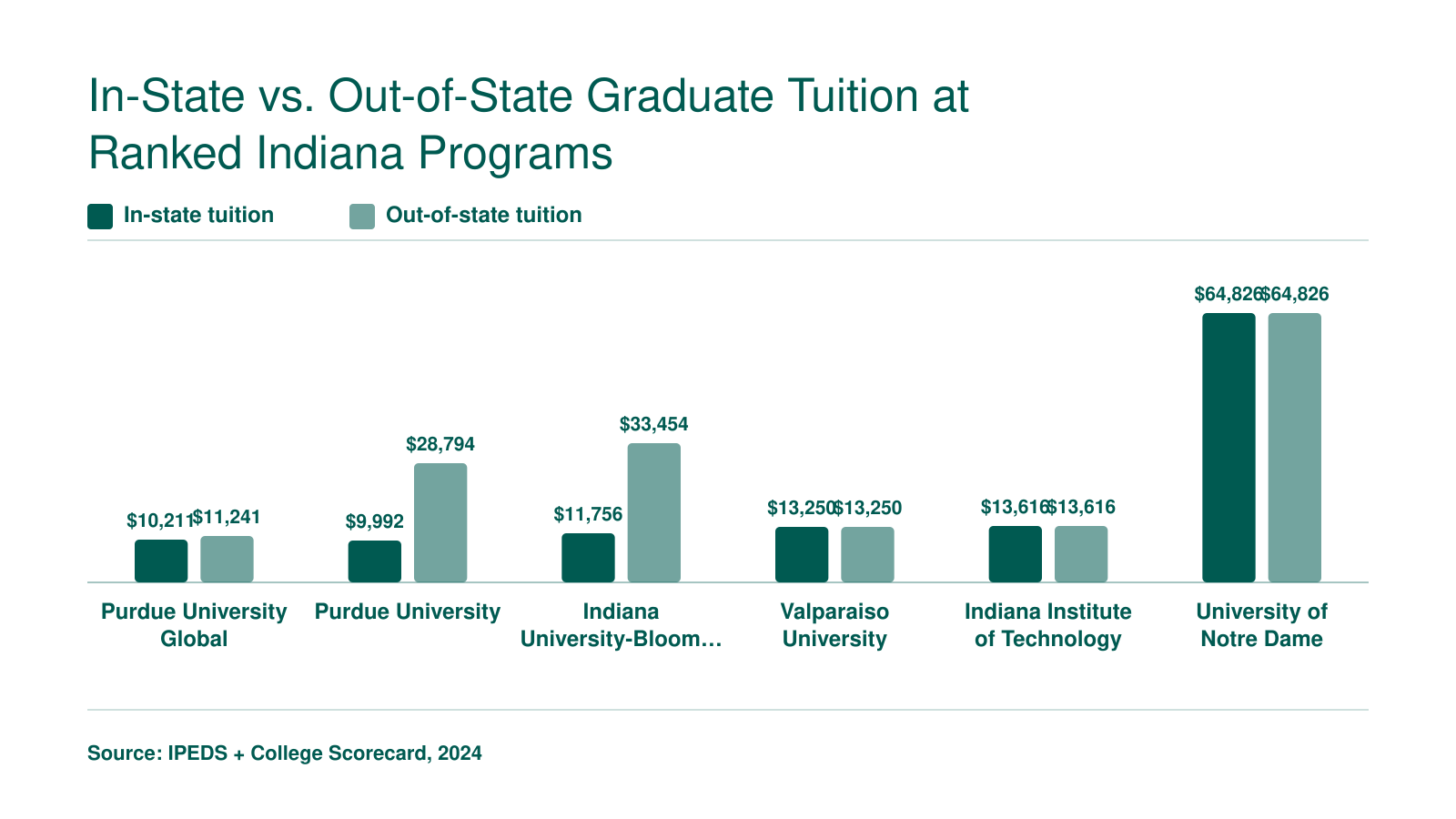
In-State vs. Out-of-State Graduate Tuition at Ranked Indiana Programs
The public universities split sharply by residency. Purdue University charges $9,992 to Indiana residents and $28,794 to nonresidents, and Indiana University-Bloomington charges $11,756 against $33,454. Purdue University Global shows a narrow gap ($10,211 and $11,241). Valparaiso University, Indiana Institute of Technology, and the University of Notre Dame charge one flat rate to everyone, so residency does not change the bill. Notre Dame's flat $64,826 is the highest figure here. Out-of-state applicants to the Purdue and IU programs should budget for the higher bar.
Cost, Earnings, and Health Educator Certification in Indiana
The cheapest per-credit rate is not always the cheapest degree, and neither guarantees the credential employers ask for. Compare totals and certification fit together.
What the programs cost
Purdue's online MPH, effective July 2026, is $718.80 per credit for Indiana residents ($30,189.60 total) and $818.80 for nonresidents ($34,389.60).1 Valparaiso's online MPH lists $650 per credit hour over 42 credits, roughly $27,300 before fees. Purdue University Global lists $420 per credit over 48 credits, about $20,160. Those two totals are estimates, so confirm with each bursar.
For earnings, Purdue University Global's public health field shows median graduate earnings of $63,927 five years after completion. That is a field-of-study figure, not a guarantee for this specific degree.
Certification in Indiana
Indiana does not license health educators. The main credential is CHES from NCHEC, and MCHES follows after five years of experience.4
- CHES eligibility: a degree plus either a health education major or 25 semester credits covering the Eight Areas, at least 12 of them process courses.2
- Fees: the prescreen is $25.2 I could not confirm the 2026 exam fee, so check NCHEC before budgeting.
- Maintenance: 75 continuing education hours every five years, plus a $60 annual renewal.3
K-12 health teachers need an Indiana Department of Education license ($35)5 and must pass a content test for each licensed area.6 School health services coordinators need school nurse licensure.7
According to the National Commission for Health Education Credentialing (NCHEC), more than 15,000 people actively hold the CHES or MCHES credential. The national CHES exam pass rate was 73.77% for the April 2026 sitting, so roughly one in four test takers did not pass.
How We Rank the Best Master's in Health Education Programs in Indiana
Every program on this list is scored against federal data: cost and net price, institution-wide graduation rates, and, where the government publishes them, graduate earnings and debt loads at the program level. Those figures come from the College Scorecard and IPEDS rather than from brochures or reputation surveys.
Online, hybrid, and campus programs compete in the same ranking, since an Indiana health educator's credential does not change with the delivery format. Only programs meeting our criteria are included.
Published figures are averages across a reporting year. Per-credit rates, program fees, and residency rules shift, so confirm current tuition directly with each school before you commit.
Frequently Asked Questions About Master's in Health Education in Indiana
Which Indiana master's program is the closest match to a dedicated health education degree?
How long does a master's in health education take in Indiana, full-time vs. part-time?
Can a master's in health education help me teach health in Indiana public schools?
Compare Health Education programs on the data that matters
Explore more Healthcare specializations or browse every graduate field.
All Healthcare programs