Best Master's in Health Education Programs in California
Compare 15 accredited Health Education programs in California at 13 schools, with graduate earnings, cost, debt, and completion data from IPEDS and the U.S. College Scorecard.

For California students, the real tradeoff in a health education master's is price against format and name recognition. Listed in-state tuition for the programs here runs from about $8,900 at Cal State Long Beach to nearly $30,000 at the University of San Francisco, and none is offered fully online.
Most options are MPH degrees with a community health or health promotion emphasis, not standalone health education degrees.
California does not appear to license community health educators, so the voluntary CHES credential often serves as the hiring signal employers look for.
Key Points
- Most California health education master's programs are MPH degrees with a community health or health promotion focus.
- Sacramento State requires no entrance exam, and UC Berkeley lists GRE scores as optional.
- California has no state license for health educators, but NCHEC offers voluntary CHES and MCHES certification.
Top-Ranked Master's in Health Education Schools in California
Health education at the master's level in California is mostly delivered as an MPH with a community health or health promotion focus. Each school below lists in-state graduate tuition and the institution's average net price, and graduation rates describe the whole school, not the program. Check CEPH status on the council's current accredited list before you apply.
University of California-Berkeley
#1Berkeley, CA · ~$16,000/yr (est.)
Best for: Working professionals seeking hybrid study
UC Berkeley offers a hybrid MPH in Health and Social Behavior, built around the social and behavioral determinants of health. In-state graduate tuition is $12,762 before fees, the university's average net price is $13,481, and the school's overall graduation rate is 93%. Berkeley is described as an accredited CEPH school of public health, though its current listing should be confirmed with the council.
- Hybrid online and campus format
- 48 units over a two-year, full-time schedule
- Required 12-week public health internship
- Capstone comprehensive exam required
- GRE scores optional
- Two years of health-related work experience expected
- Coursework in behavioral or social sciences required
University of California-Los Angeles
#2Los Angeles, CA · ~$14,000/yr (est.)
Best for: Aspiring health educators who prefer in-person study
UCLA's campus-based MPH in Community Health Sciences with a Health Promotion and Health Education concentration sits in Los Angeles. In-state graduate tuition is $12,762 before fees, the university's average net price is $12,548, and the school's overall graduation rate is 93%. It suits students who want a traditional in-person program in a large urban health market.
- Campus-based program in Los Angeles
- Concentration in Health Promotion and Health Education
- Housed in the Department of Community Health Sciences
- Faculty roster and course descriptions published online
University of California-San Diego
#3La Jolla, CA · $15,000 – $20,000/yr (est.)
Best for: Students drawn to health behavior research
UC San Diego, in La Jolla, offers a two-year campus MPH with a Health Behavior concentration covering behavioral, social, and cultural influences on health and disparities. In-state graduate tuition is $12,762 before fees, the university's average net price is $12,470, and the school's overall graduation rate is 86%.
- Campus-based, two-year program
- Health Behavior concentration
- Core public health disciplines included
- Bachelor's degree required
University of California-Irvine
#4Irvine, CA · ~$15,000/yr (est.)
UC Irvine offers a campus MPH with several concentration areas, including community health. In-state graduate tuition is $12,762 before fees, the university's average net price is $14,251, and the school's overall graduation rate is 87%. UC Irvine is listed as a CEPH member through its Joe C. Wen School of Population and Public Health.
- Campus-based program
- Six quarters full-time, with part-time enrollment allowed
- Multiple concentration areas
- Includes a practicum experience
- Described as CEPH accredited
- Prepares students for doctoral study
San Jose State University
#5San Jose, CA · ~$10,000/yr (est.)
San José State offers an MPH in Community Health Education on campus and online, with separate application pathways. In-state graduate tuition is $7,608, the university's average net price is $13,760, and the school's overall graduation rate is 69%. The MPH program has held CEPH program accreditation since 1974, currently through July 1, 2030.
- Community Health Education specialization
- CEPH accredited since 1974
- Focus on health equity and social justice
- Fieldwork and a culminating experience included
- Fall-only entry
- 42-unit, 24-month online format
- Synchronous web conferencing with live weekly sessions
- Annual on-campus meetings
- Courses run 5 to 7 weeks, taken sequentially
- Fieldwork and practicum component
San Diego State University
#6San Diego, CA · ~$10,000/yr (est.)
San Diego State offers an MPH in Health Promotion and Behavioral Science, designed around planning and evaluating health programs using behavioral science. In-state graduate tuition is $7,608, the university's average net price is $15,364, and the school's overall graduation rate is 76%. The program is described as CEPH accredited.
- 51-unit, campus-based program
- Supervised field placement
- Thesis or project options
- Seven-year time limit to finish
- Fully online, 22 months, full-time only
- Listed total cost of $32,079 ($629 per unit)
- Mostly asynchronous courses
- 180-hour field placement
- Requires a 2.85 GPA and three years of public health-related work
California State University-Fullerton
#7Fullerton, CA · $9,000 – $19,000/yr (est.)
Cal State Fullerton offers a 21-month campus MPH with concentrations in Community Health Promotion, Epidemiology, and Environmental and Occupational Health and Safety. In-state graduate tuition is $7,608, the university's average net price is $6,555, and the school's overall graduation rate is 70%. The program is described as CEPH accredited.
- Campus-based, 21-month program
- Community Health Promotion concentration
- Epidemiology and Environmental and Occupational Health and Safety options
- Emphasis on evidence-based practice, leadership, and policy
- Described as CEPH accredited
California State University-Long Beach
#8Long Beach, CA · $9,000 – $19,000/yr (est.)
Cal State Long Beach offers a campus MPH with a Community Health Education emphasis, focused on assessing community needs and building culturally competent interventions. In-state graduate tuition is $7,608, the university's average net price is $10,440, and the school's overall graduation rate is 69%. The Department of Health Science has held CEPH program accreditation since 1983.
- 42-unit program
- Campus-based in an urban, multiethnic setting
- CEPH accredited program
- Focus on health equity and cultural competence
- Hands-on internship opportunities
- Prepares students for community and school health roles
California State University-Sacramento
#9Sacramento, CA · $10,000 – $20,000/yr (est.)
Sacramento State offers a hybrid MPH in Health Promotion, Policy, and Leadership aimed at working professionals. In-state graduate tuition is $7,608, the university's average net price is $9,338, and the school's overall graduation rate is 56%. CEPH status for this program was not confirmed in our research, so verify it directly.
- 42-unit hybrid program, completed in two years
- Three intensive residency sessions
- Cohort-based learning
- 3.0 GPA minimum, work experience preferred
- Capstone project and public health practicum
University of San Francisco
#10San Francisco, CA · ~$30,000/yr (est.)
The University of San Francisco, a private university, offers a two-year hybrid MPH in Community and Public Health Practice with a health equity focus. Graduate tuition is $29,880, the university's average net price is $41,431, and the school's overall graduation rate is 70%. The MPH received seven-year CEPH program accreditation in January 2020, running through December 31, 2026, so confirm its renewal status.
- Two-year hybrid online and campus format
- 250 hours of applied practice experience
- Focus on health equity and social justice
- Small class sizes
- Flexible scheduling for working professionals
Cost & outcomes by school
Federal data for the highest-earning Health Education programs, independent of the ranking above. Earnings are this field's master's graduates four years after completing, where the Scorecard reports them.
| School | Earnings | Tuition / yr | Debt | Grads/yr | Format |
|---|---|---|---|---|---|
| University of California-Los Angeles CA | $110,900 | $14,476 | $52,445 | 198 | Campus |
| University of Southern California CA | $95,642 | $71,515 | $83,937 | 292 | Online or campus |
| Claremont Graduate University CA | $91,103 | $37,180 | $92,618 | 11 | Online |
| California State University-Long Beach CA | $88,743 | $8,898 | $26,210 | 40 | Campus |
| University of California-Berkeley CA | $86,225 | $15,866 | — | 322 | Hybrid |
| California State University-Northridge CA | $83,400 | $8,982 | $33,256 | 58 | Online |
| California Baptist University CA | $78,489 | $15,562 | $41,000 | 42 | Campus |
| Touro University Worldwide CA | — | $9,000 | — | — | Online |
| California State University-San Marcos CA | — | $9,606 | — | 66 | Online or campus |
| San Jose State University CA | — | $9,934 | — | 31 | Hybrid |
| University of California-San Diego CA | — | $15,097 | — | 60 | Campus |
| California State University-Fresno CA | — | $8,865 | — | 5 | Hybrid |
Sources: U.S. Department of Education. Tuition and graduates: IPEDS. Earnings and debt: College Scorecard, this field's master's graduates; a dash means no figure is reported.
Cost, debt & payoff
Median earnings of this field's master's graduates (4 yrs after completing) vs. their median federal loan debt · U.S. College Scorecard
Across these programs the median graduate earns about $89,923 and finishes with roughly $74,940 in debt — a ratio that clears a common rule of thumb (keep debt below first-year salary). Tuition and debt vary widely school to school, so check the per-school figures in the table above before you shortlist.
Online and Hybrid Master's in Health Education Programs in California
By format, none of the master's in health education programs here is listed as fully online. UC Berkeley, Sacramento State, and the University of San Francisco are hybrid. UCLA, UC San Diego, UC Irvine, San Jose State, San Diego State, Cal State Fullerton, and Cal State Long Beach are campus-based, though San Jose State's materials mention online options, so confirm directly.
Practicum rules vary, and most pages do not say whether remote students can complete hours near home. UC San Diego requires roughly 100 to 200 hours and lists local agencies and community organizations among acceptable sites.1 UC Irvine requires 180 hours after advancing to candidacy.2 USF cites 250 hours of applied practice. Berkeley's online MPH requires 130 hours, and staff and field consultants help match placements to a student's current job.
For working professionals, the likeliest fits among master's programs in California are the hybrid programs at Berkeley, Sacramento State (which includes residency sessions), and USF, which describes itself as flexible for professionals. UC Irvine allows part-time enrollment. Ask each program about evening courses and placement support before applying.
Which California Health Education Master's Programs Waive or Make the GRE Optional?
Sacramento State states plainly that its MPH requires no entrance exam, placing it among No-GRE master's programs; UC Berkeley lists GRE scores as optional for the Health and Social Behavior MPH program. UCLA's public health department page also indicates the GRE is not required1; its separate MPH for Health Professionals waives the test for applicants at or above a 3.0 GPA, with scores from the past five years expected below that threshold.2 Cal State Northridge still asks for GRE evidence for classified admission but approves waivers based on GPA, last-60-unit performance, or a prior advanced degree. San Jose State, UC Davis, UC San Diego, UC Irvine, San Diego State, Cal State Fullerton, Cal State Long Beach, and the University of San Francisco do not publish a clear GRE policy on their admissions pages, so contact the program directly.
- GPA: A 3.0 minimum is standard across CSUN, San Jose State, Sacramento State, UC Davis, and UCLA.
- Materials: Expect a statement of purpose, recommendations, and prerequisite coursework; Berkeley also requires a writing sample.
- Timing: Most admit fall only. Program length typically runs 21 to 24 months, with UC Davis at 12 to 14 months and 56 units3; CSUN and San Jose State each require 42 units.
Related Articles
What Does a California Master's in Health Education Cost, and Is Certification Required?
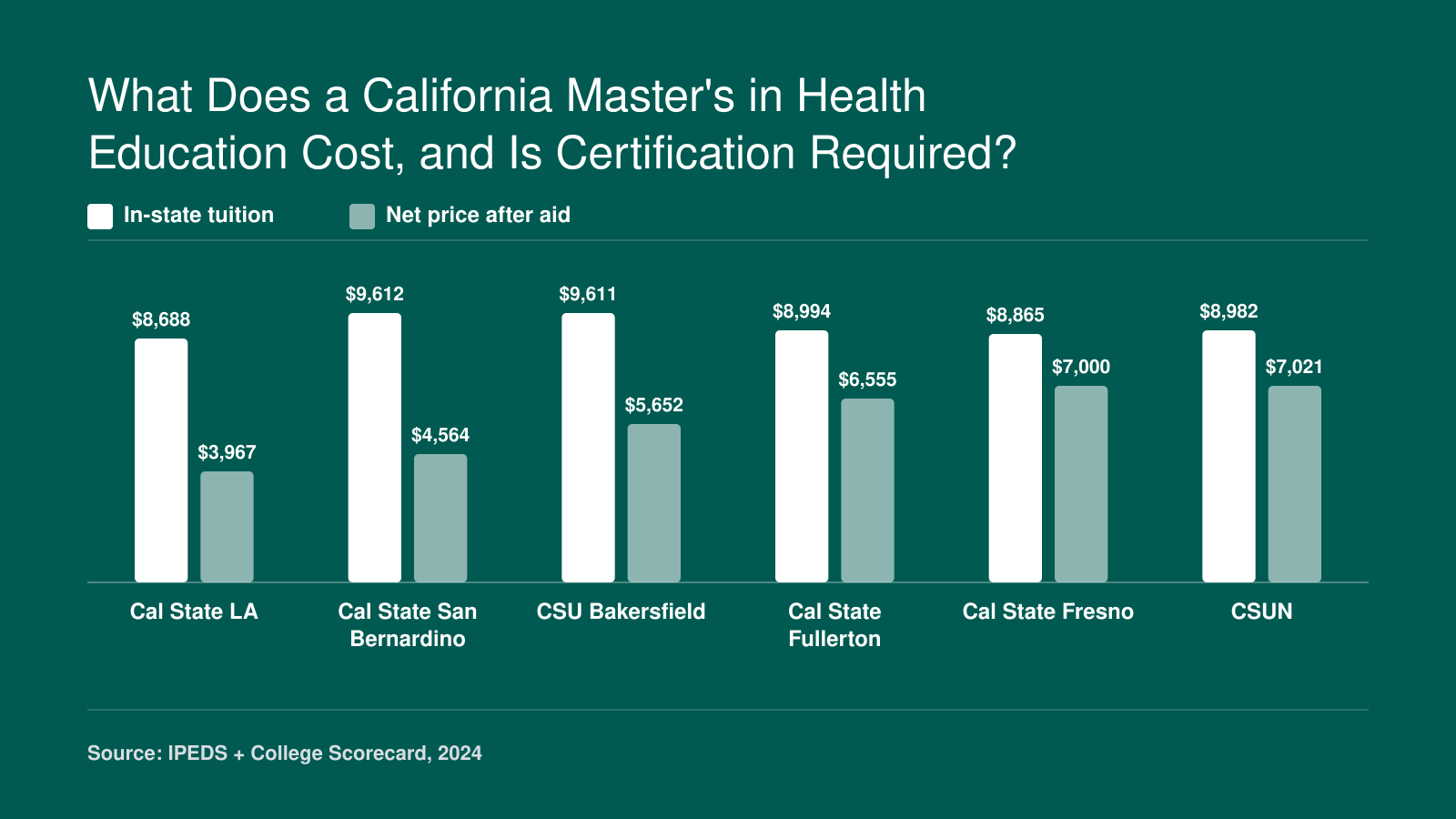
The chart shows in-state graduate tuition and net price for the lowest-cost campus and hybrid programs here. Net price is an institution-wide average after grant aid, not a quote for any single master's program, so your own cost will differ. Standard state-supported tuition is also a different pricing model from self-support or extended-education tuition, which is billed per unit. Cal State LA lists $525 per unit across 42 units, about $22,050 in total. UC San Diego's MPH is a self-supporting professional degree at a published $1,149 per unit, and its 2026-2027 amounts are subject to change. California has no state license for health educators. The main credential is CHES, covered in the certification box below.
CHES and MCHES Certification for California Health Educators
What Can You Do With a Master's in Health Education in California?
Graduates typically move into roles such as health education specialist, community health program manager, wellness coordinator, health promotion director, and public health educator.1
No program-level graduate earnings are published yet for the schools ranked here, so we can't give a one-year-after-graduation figure for any of them. We also can't confirm a current California median wage for health education specialists from the sources available, so check the latest state wage data before you budget.
On certification, the CHES exam had a 73.19% first-time pass rate in April 2025 (855 candidates) and 67.59% in October 2025 (617 candidates). Some sources say CHES is required or preferred in 40% or more of health educator postings1, but that claim is not well documented.
Is it worth it? Without program-level earnings and debt, no honest payback figure exists. Compare each school's tuition with the salaries in postings for the roles you want. Lower-cost public options such as San Jose State and San Francisco State carry less downside risk.
How We Rank the Best Health Education Master's Programs in California
Three financial measures anchor these rankings: net price, program-level graduate earnings, and student debt drawn from College Scorecard, combined with a return-on-investment proxy that weighs what you pay against what graduates earn. Campus, online, and hybrid programs compete on the same list, so you can compare value across formats directly.
Be aware of the limits. Graduation rate and net price are reported institution-wide rather than for the health education program specifically, and some programs have no published earnings yet, which can leave gaps in the comparison. Accreditation, GRE policies, and tuition figures were verified against each school's official pages as of October 2026.
Master's in Health Education FAQs
What is the difference between an MPH and a master's in health education?
How long does it take to earn a master's in health education in California?
Are health education master's programs in California CEPH accredited?
Compare Health Education programs on the data that matters
Explore more Healthcare specializations or browse every graduate field.
All Healthcare programs