Best Master's in Health Education Programs in Michigan
Compare 7 accredited Health Education programs in Michigan at 5 schools, with graduate earnings, cost, debt, and completion data from IPEDS and the U.S. College Scorecard.

In Michigan, the master's in health education usually means a public health degree shaped around community health and CHES readiness, and price varies more than prestige even among the Most Affordable Master's in Health Education Programs. In-state graduate tuition among the ranked programs runs from about $14,473 to $29,156 a year; net price after aid can drop to $7,007. Several programs are fully online or hybrid, a practical advantage for working adults who need to complete field experiences without relocating. The real tradeoff is choosing between a lower-cost regional public school and a research university with higher median earnings.
Key Points
- University of Michigan-Flint is cheapest, with a $7,007 net price and $14,473 in-state tuition.
- Central Michigan University leads graduate earnings at $67,581 five years after finishing.
- Michigan does not license health educators, so CHES through NCHEC is the key credential.
Ranked: The Best Master's in Health Education Programs in Michigan
Michigan's health education master's options are mostly public health degrees, with a few community health and teaching programs mixed in. Tuition spans a wide range, from about $13,900 to more than $28,000 a year for in-state students, so cost and format matter as much as name recognition.
University of Michigan
#1Ann Arbor, MI · $29,000 – $58,000/yr (est.)
Best for: Research-minded campus applicants
The University of Michigan in Ann Arbor offers a campus-based MPH with concentrations such as Environmental Health Sciences and Epidemiology. Graduate tuition is about $28,554 in-state and $57,444 out-of-state, the highest in Michigan, and the university graduates 93% of its students. Scholarship support is a real offset, with over $33 million awarded annually and automatic departmental scholarship consideration in some tracks.
- Campus-based program in Ann Arbor
- Concentrations include Environmental Health Sciences and Epidemiology
- Health Behavior and Health Equity track emphasizes field experience
- Over $33M in annual scholarships
- Bachelor's degree required for admission
- Fall application deadlines
Michigan State University
#2East Lansing, MI · $22,000 – $42,000/yr (est.)
Best for: Working adults needing online study
Michigan State University in East Lansing delivers its MPH fully online, with Generalist and Rural Public Health concentrations. Graduate tuition is about $21,432 in-state and $41,508 out-of-state, and the university graduates 81% of its students. Its Flint-area ties stand out, including the Flint Spartan MPH Scholarship that has covered tuition for eligible students who live or work in greater Flint.
- 100% online, no campus attendance needed
- Broad public health curriculum without specialization
- Bachelor's degree and relevant prerequisites required
- Flexible learning options for working students
- Online delivery with a Rural Public Health concentration
- Focus on health disparities
- Flexible for working students
- Same MSU MPH program, specialized track
Andrews University
#3Berrien Springs, MI · $25,000 – $30,000/yr (est.)
Best for: Faith-minded students wanting hybrid study
Andrews University in Berrien Springs offers an MPH with a Health Promotion and Health Education concentration, one of the most directly aligned programs in the state. Tuition is a flat $28,056 for in-state and out-of-state students, and the university graduates 72% of its students. The 45-credit hybrid format can be finished in 16 months full-time, with online asynchronous or face-to-face options.
- 45 credits, 16 months full-time
- Hybrid: online asynchronous or face-to-face
- Minimum 2.60 GPA, resume, two recommendations
- Statement of purpose required
- Covers grant writing, program planning, community needs assessment
- Includes a spiritual integration component
- TOEFL 80 or IELTS 6.5 if needed
Oakland University
#4Rochester Hills, MI · ~$22,000/yr (est.)
Oakland University in Rochester Hills offers a CEPH-accredited, 44-credit hybrid MPH with evening course options. Graduate tuition is about $21,960 in-state and $24,648 out-of-state, a narrow gap that favors nonresidents. The university graduates 58% of its students, and the program stresses service-learning and community-based research.
- 44 credits, hybrid format
- CEPH accredited
- Evening course offerings
- Service-learning and community-based research
- 3.0 GPA, goal statement, resume, three recommendations
- Scholarships available for eligible students
Grand Valley State University
#5Allendale, MI · $20,000 – $25,000/yr (est.)
Grand Valley State University in Allendale offers a CEPH-accredited hybrid MPH with a Health Promotion concentration. Tuition is a flat $20,030 for all students, so out-of-state applicants pay no premium. The university graduates 67% of its students, and the program lists eligibility for the CHES exam.
- 48 to 51 credits over five semesters
- Hybrid delivery with a low-residency option
- CPH and CHES exam eligible
- Practicum placements included
- $30 application fee
- Deadlines in November and March
- Epidemiology concentration, same 48 to 51 credit structure
- Hybrid with online and in-seat options
- Prepares for CPH and CHES certification
- Practicum experience included
- Same tuition for in-state and out-of-state students
Wayne State University
#6Detroit, MI · ~$18,000/yr (est.)
Wayne State University in Detroit has the strongest education-oriented lineup, with a Community Health M.S. and two Health and Physical Education Teaching M.S. tracks. Graduate tuition is about $15,937 in-state and $34,519 out-of-state, and the university graduates 58% of its students. Both teaching tracks list no GRE requirement and evening and online courses.
- 30 to 35 credits, campus-based in Detroit
- Thesis, project, or coursework plans
- Community health education specialization
- Includes a grant writing course
- Focus on health equity and behavior theories
- 30 credit hours
- Evening and online courses
- Undergraduate GPA of 2.75 required
- No GRE scores needed
- CAEP accredited, finish in under 2 years
- 51 credit hours for certified teachers
- K-12 health and physical education endorsement focus
- Minimum GPA 2.75, no GRE required
- Evening and online courses
- Accelerated pathway available
University of Michigan-Flint
#7Flint, MI · $14,000 – $21,000/yr (est.)
The University of Michigan-Flint offers the lowest in-state graduate tuition in this ranking, about $13,891, with out-of-state tuition near $20,808. Its online MPH has a named Health Education concentration and rolling admissions. The university graduates 40% of its students, the lowest institution-wide rate on this list, so ask about program-level completion.
- Health Education concentration
- 42 credit hours, 100% online option
- Asynchronous classes with synchronous options
- 3.0 GPA minimum, three recommendations
- No GRE required
- Rolling admissions with fall, winter, and summer starts
- Internship and capstone project
Central Michigan University
#8Mount Pleasant, MI · ~$17,000/yr (est.)
Central Michigan University in Mount Pleasant offers a campus-based MPH with a Health Education concentration, accredited by CEPH. Tuition is a flat $16,737 for in-state and out-of-state students, and the university graduates 59% of its students. Applicants need a 3.0 GPA and the program lists no GRE requirement.
- Health Education concentration, on campus
- CEPH accredited
- 3.0 GPA, resume, statement of purpose, two references
- No GRE required
- Fall (June 15) and spring (October 15) deadlines
- Up to 12 transfer credits allowed
Eastern Michigan University
#9Ypsilanti, MI · $15,000 – $20,000/yr (est.)
Eastern Michigan University in Ypsilanti offers a 36-credit MPH in Health Education built for working adults, with weekday evening classes. Graduate tuition is about $17,748 in-state and $30,758 out-of-state, and the university graduates 46% of its students. Graduates are eligible to sit for the CHES exam, and students can choose a thesis, project, or internship.
- 36 credit hours, campus-based
- Weekday evening classes
- Prepares for the CHES exam
- Thesis, project, or internship option
- About two years of full-time study
- Research core and electives
Cost & outcomes by school
Federal data for the highest-earning Health Education programs, independent of the ranking above. Earnings are this field's master's graduates four years after completing, where the Scorecard reports them.
| School | Earnings | Tuition / yr | Debt | Grads/yr | Format |
|---|---|---|---|---|---|
| Wayne State University MI | $84,780 | $17,960 | $37,639 | 57 | Campus |
| University of Michigan-Flint MI | $61,233 | $14,473 | $44,134 | 7 | Online |
| Central Michigan University MI | — | $17,187 | — | 27 | Online |
| Eastern Michigan University MI | — | $17,968 | — | 12 | Campus |
| Andrews University MI | — | $29,156 | — | 5 | Online or campus |
Sources: U.S. Department of Education. Tuition and graduates: IPEDS. Earnings and debt: College Scorecard, this field's master's graduates; a dash means no figure is reported.
Cost, debt & payoff
Median earnings of this field's master's graduates (4 yrs after completing) vs. their median federal loan debt · U.S. College Scorecard
Across these programs the median graduate earns about $84,780 and finishes with roughly $37,639 in debt — a ratio that clears a common rule of thumb (keep debt below first-year salary). Tuition and debt vary widely school to school, so check the per-school figures in the table above before you shortlist.
Most Affordable Health Education Master's Programs in Michigan
University of Michigan-Flint is the cheapest option here, with the lowest net price ($7,007) and the lowest in-state program tuition ($14,473) of the schools below. Net price is an institution-wide average after grant aid, not a quote for any individual student, so your own cost will differ. Use the credit totals to size up the full program, and confirm current per-credit rates with each bursar.
| School | Program | Format | Total credits | Program tuition (in-state) | Program tuition (out-of-state) | Net price after aid |
|---|---|---|---|---|---|---|
| University of Michigan-Flint | Master of Public Health, Health Education concentration | Online | 42 | $14,473 | $21,390 | $7,007 |
| Oakland University | Master of Public Health | Hybrid | 44 | $21,960 | $24,648 | $9,120 |
| Andrews University | Master of Public Health, Health Promotion and Health Education | Hybrid | 45 | $29,156 | $29,156 | $12,547 |
| Wayne State University | Community Health (M.S.) | Campus | 30 to 35 | $17,960 | $36,542 | $12,766 |
| University of Michigan | Master of Public Health (MPH) | Campus | N/A | $28,886 | $57,776 | $13,138 |
Online and Hybrid Master's in Health Education Options in Michigan
Fully online study offers flexibility, while campus programs offer built-in local placements across Master's Programs in Michigan. Students comparing the best online master's in health education programs will see that Michigan State University and the University of Michigan-Flint are the fully online options here. Andrews University, Oakland University, and Grand Valley State University are hybrid. The University of Michigan, Wayne State University, Central Michigan University, and Eastern Michigan University are campus-based.
Length and pacing
Michigan State lists five semesters full-time (9-plus credits each) and eight part-time, with a six-year cap. Eastern Michigan requires 36 credits and can be finished in about two years at 6 credits per semester.1 Flint requires 42 credits.2 Andrews requires 45 and advertises a 16-month full-time track, the closest thing to an accelerated path on this page. Grand Valley lists five semesters.
Thesis and field experience
Eastern Michigan students pick one 3-credit capstone: thesis, project, or community health internship.1 Wayne State offers thesis or project options. Flint includes an applied practice experience and an integrative learning experience, with an internship available.2 Online students should line up a local site early. Michigan State does not publish its internship details, so ask the program directly.
If you are searching for an online MPH or a master of health professions education, those are different degrees from health education. The FAQ explains the distinction.
Which Michigan Health Education Master's Programs Waive the GRE?
Do you need a GRE score to apply to the best master's in health education programs in Michigan? For most applicants here, no.
- University of Michigan: The School of Public Health neither requires nor reviews GRE or other standardized test scores for any master's program. Recommended coursework varies by department and can include college algebra, statistics, biology, and chemistry.
- Wayne State University: The MS in Community Health requires no entrance exam. Regular admission sits at a 3.0 undergraduate GPA, with a qualified-admission pathway for applicants in the 2.75 to 2.99 range.
- Michigan State University: The online MPH treats the GRE as optional and asks for a bachelor's degree from an accredited institution.
- Central Michigan University: The MPH keeps the GRE in its process but waives it for applicants holding a U.S. degree or a degree from a recognized foreign institution. The target GPA is 3.0, with alternate review paths tied to last-60-credit GPA and professional experience.
The sources reviewed do not state a clear health education GRE policy for Andrews University, Oakland University, Grand Valley State University, University of Michigan-Flint, or Eastern Michigan University.
Expect a personal statement and recommendation letters nearly everywhere. Confirm testing rules with the graduate admissions office before your cycle opens, since policies at No-GRE master's programs change often.
Related Articles
Michigan Health Education Certification and Teaching Endorsement
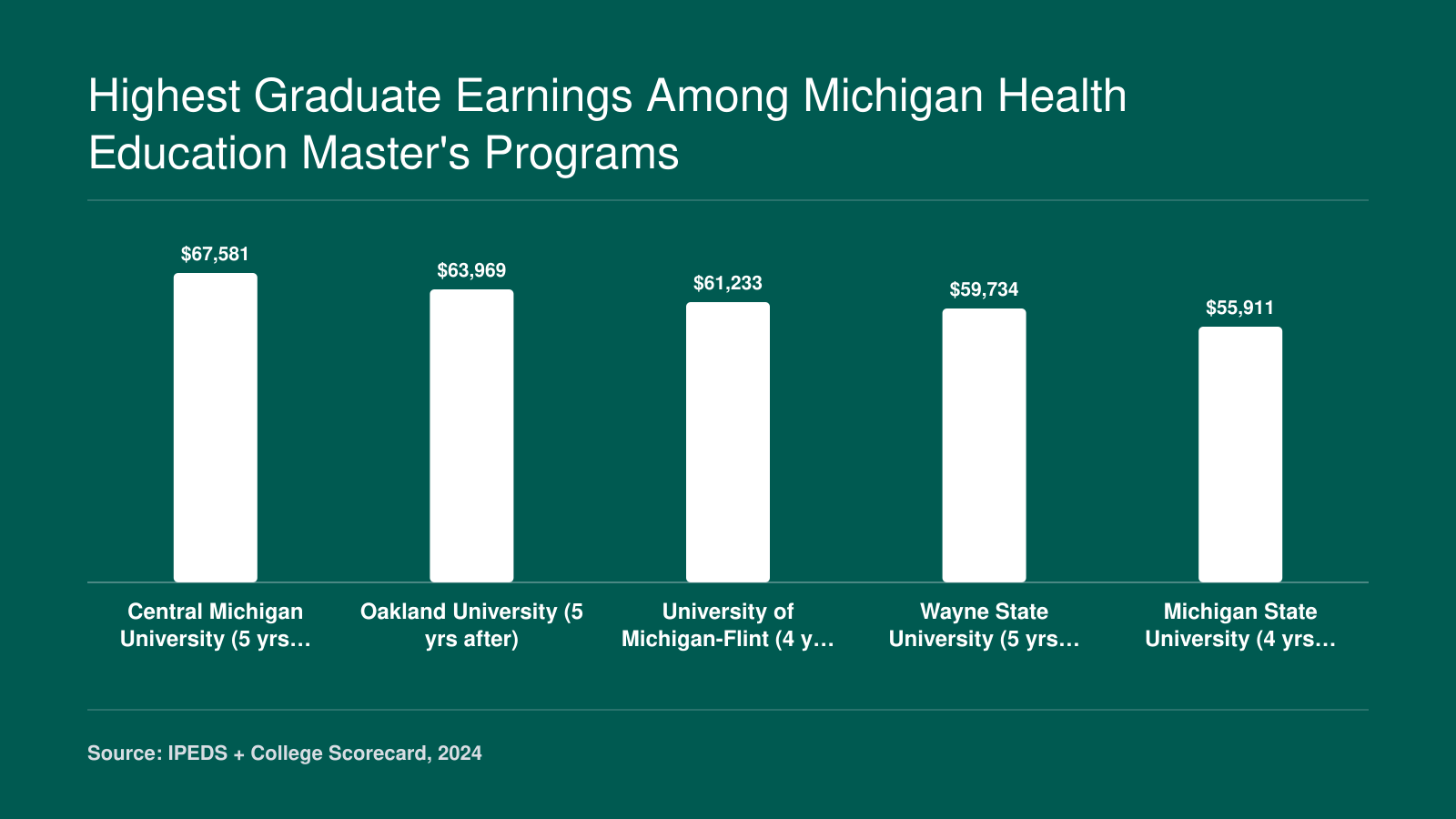
Highest Graduate Earnings Among Michigan Health Education Master's Programs
These are program-level median earnings for graduates, from federal College Scorecard data. Windows differ because the latest published figure varies by program, so each bar names its window. Central Michigan University leads at $67,581 five years after finishing. Its median graduate debt is $28,898, or about $329 a month on a 10-year plan. Oakland University graduates carry $33,079 in median debt, about $376 a month, against $63,969 in earnings.
Michigan Health Education Master's FAQs
What is the difference between a health education master's and a public health master's?
Can I take the CHES exam with an MPH instead of a health education master's?
How long does a master's in health education take in Michigan?
Is CEPH accreditation necessary for a health education master's?
Compare Health Education programs on the data that matters
Explore more Healthcare specializations or browse every graduate field.
All Healthcare programs