Best Master's in Health Education Programs in Arizona
Compare 3 accredited Health Education programs in Arizona, with graduate earnings, cost, debt, and completion data from IPEDS and the U.S. College Scorecard.

Published graduate tuition for health education and public health master's programs in Arizona runs from $5,910 at Aspen University to $49,369 at Midwestern University-Glendale. Arizona State University is the one school here offering a degree built specifically around community health education; the others are MPH programs that cover overlapping ground from a wider angle.
That distinction shapes the work more than the price tag does. Campus and online options share a single list below, and nearly all graduates enter a field where voluntary CHES certification, not a state license, signals credibility.
Key Points
- Arizona State University graduates report median earnings of $69,104 one year after finishing.
- Arizona has no state license for community health educators, so the national CHES credential is voluntary.
- Check each program's name, curriculum, and GRE policy before applying, since health education and MPH tracks differ.
Ranked: Best Master's in Health Education Programs in Arizona
Arizona has few degrees titled exactly "master's in health education," so this list pairs one community health education degree with online MPH programs that cover similar ground. Check each program's accreditation and fieldwork requirements before you apply, because they differ more than the names suggest.
Arizona State University
#1Scottsdale, AZ · ~$11,000/yr (est.)
Best for: Educators moving into wellness coordination
Arizona State University Online offers a 30-credit Master of Arts in Interdisciplinary Education on Community Health and Wellbeing, the closest title match to a health education master's in this state. The published online graduate rate is $605 per credit for 2026-2027, and the data lists no separate in-state rate. No programmatic accreditation (CEPH or CAEP) is published for this degree, and ASU's MPH is not on the CEPH list. The program ends in an applied project, and no practicum hours are published.
- 30 credit hours, fully online
- Community health and wellbeing focus drawing on education and public service courses
- Culminating applied project; no practicum hours published
- Bachelor's degree, minimum 3.0 GPA, personal statement and three recommendation letters
- Prepares for roles such as health promotions manager and wellness coordinator
Grand Canyon University
#2Phoenix, AZ · ~$10,000/yr (est.)
Best for: Career changers wanting supervised field experience
Grand Canyon University's online Master of Public Health is a 48-credit degree in eight-week courses, with an epidemiology and community health curriculum. Listed tuition runs about $600 to $625 per credit, with no separate in-state rate, so confirm the rate for your start date. The school's graduation rate is about 43 percent. The program requires 150 hours of supervised field experience. It is a CEPH applicant, not CEPH accredited, which matters for anyone who needs a fully accredited public health credential. It is listed as GRE-optional.
- 48 credits, online, eight-week courses
- 150 hours of supervised field experience plus a capstone project
- CEPH applicant status, not accredited
- Bachelor's degree with a 2.8 GPA minimum for admission
- Christian education integration; focus on epidemiology and data
Aspen University
#3Phoenix, AZ · ~$6,000/yr (est.)
Best for: Cost-conscious working adults
Aspen University's online Master of Public Health is a 12-course, two-year program in eight-week terms. Total cost is listed at $21,850 including tuition, fees and estimated textbooks, with no separate in-state rate. The school's graduation rate is about 27 percent. The program includes an internship and a capstone, but no CEPH accreditation is published in our data. It suits cost-conscious working adults who can accept those tradeoffs.
- 12 courses over two years, online, eight-week terms
- $17,100 tuition; $21,850 total with fees and textbooks
- Internship (listed as 120 hours; the handbook describes a three-credit internship) plus capstone
- Bachelor's degree with a 2.5 GPA minimum; no application fee
- Covers epidemiology, health policy, biostatistics and environmental health
University of Phoenix-Arizona
#4Phoenix, AZ · $15,000 – $20,000/yr (est.)
University of Phoenix-Arizona offers an online Master of Public Health with a Community Health Leadership concentration, which is the clearest community health focus among the MPH options here. Courses are priced at $2,289 each across 42 credits, with no separate in-state rate. The school's graduation rate is about 21 percent. A 12-week field practicum is required, and no CEPH accreditation is published in our data.
- Community Health Leadership concentration, online
- 42 credits at $2,289 per course
- 12-week field practicum
- Bachelor's degree with a 2.5 GPA; no GMAT or essay required
- Covers epidemiology, biostatistics and health policy
Midwestern University-Glendale
#5Glendale, AZ · ~$49,000/yr (est.)
Midwestern University-Glendale offers an online Master of Public Health built on a One Health approach, linking human, animal and environmental health. It can be taken standalone or as a dual degree alongside another health program. Tuition details come from the financial services office. The program includes a practicum and a culminating project, and no CEPH accreditation is published in our data.
- 56 quarter-credit hours, online; no concentration specified
- Standalone or dual degree options
- Practicum and culminating project required
- Bachelor's degree with a 2.75 GPA and personal statement
- Up to 10 transfer credits; 15 months to 3 years to finish
Cost & outcomes by school
Federal data for the highest-earning Health Education programs, independent of the ranking above. Earnings are this field's master's graduates four years after completing, where the Scorecard reports them.
| School | Earnings | Tuition / yr | Debt | Grads/yr | Format |
|---|---|---|---|---|---|
| Arizona State University AZ | $100,713 | $10,843 | $32,995 | 42 | Online |
| Arizona State University AZ | $100,713 | $13,587 | $32,995 | 1 | Online |
| University of Phoenix-Arizona AZ | — | $15,208 | — | 51 | Online |
Sources: U.S. Department of Education. Tuition and graduates: IPEDS. Earnings and debt: College Scorecard, this field's master's graduates; a dash means no figure is reported.
Online and Hybrid Master's in Health Education in Arizona
Can you earn a master's in health education in Arizona without setting foot on campus? For the schools ranked here, the answer is yes: their programs rank among the Best Online Master's in Health Education Programs. Arizona State University, Grand Canyon University, Aspen University, University of Phoenix-Arizona, and Midwestern University-Glendale all deliver their programs fully online, so coursework fits around a working schedule from anywhere in the state.
That online footprint does not erase geography. The home campuses cluster in the Phoenix metro: ASU in Scottsdale, Grand Canyon and the University of Phoenix in Phoenix, Aspen in Phoenix, and Midwestern in Glendale. Readers in Tucson or Flagstaff will not find a nearby campus among these Master's Programs in Arizona, but online delivery makes that moot.
One practical trade-off: several of these programs require a practicum or field experience, and online students usually arrange those placements with a local health organization themselves. Check each ranking card above for tuition, which can shift with your residency status.
Which Arizona Master's in Health Education Programs Waive or Make the GRE Optional?
A GRE policy tells you whether a program requires the test, accepts it as optional supporting evidence, or ignores it entirely; No-GRE master's programs vary in how they publish that policy. In Arizona, most Health Education and public health master's programs fall into the last two camps, but the published wording varies more than you would expect.
- Arizona State University: The degree handbook for the community health and wellbeing master's does not state a GRE requirement, waiver, or test-optional policy, so treat its stance as unpublished. It asks for a 3.0 GPA across the last 60 undergraduate credit hours, with below-minimum applicants still considered, and reviews completed files on a rolling basis for fall, spring, and summer starts.1
- Grand Canyon University: No universal GRE requirement is named. The standard route needs a bachelor's degree and a 2.8 GPA; applicants below that can use an alternative route requiring a 2.5 GPA plus a GMAT of 500 or a combined GRE of 300.2
Policies shift between admission cycles, and program-level rules can differ from college-wide ones. Email the graduate admissions office directly and ask them to confirm in writing before you pay for a test you may not need.
Related Articles
Cost of a Master's in Health Education in Arizona
Published costs for health education and community health master's programs in Arizona are not directly comparable, because each school prices and structures its program differently. The figures below are base tuition only and exclude fees, which vary by program and are not fully itemized in the sources we reviewed. Treat them as starting points and confirm current rates with each school before you budget.
| School | Program | Format | Total Credits | Published Rate | Estimated Base Tuition | Fees |
|---|---|---|---|---|---|---|
| Arizona State University | M.A. in Interdisciplinary Education on Community Health and Wellbeing | Online | 30 | $605 per credit (2026-27) | $18,150 | Program fees apply; amount not specified |
| Grand Canyon University | Master of Public Health | Online | 48 | $600 per credit | About $28,800 (calculated from rate and credits) | Not specified |
| University of Phoenix-Arizona | Master of Public Health, Community Health Leadership | Online | 42 | $2,289 per course | N/A | Not specified |
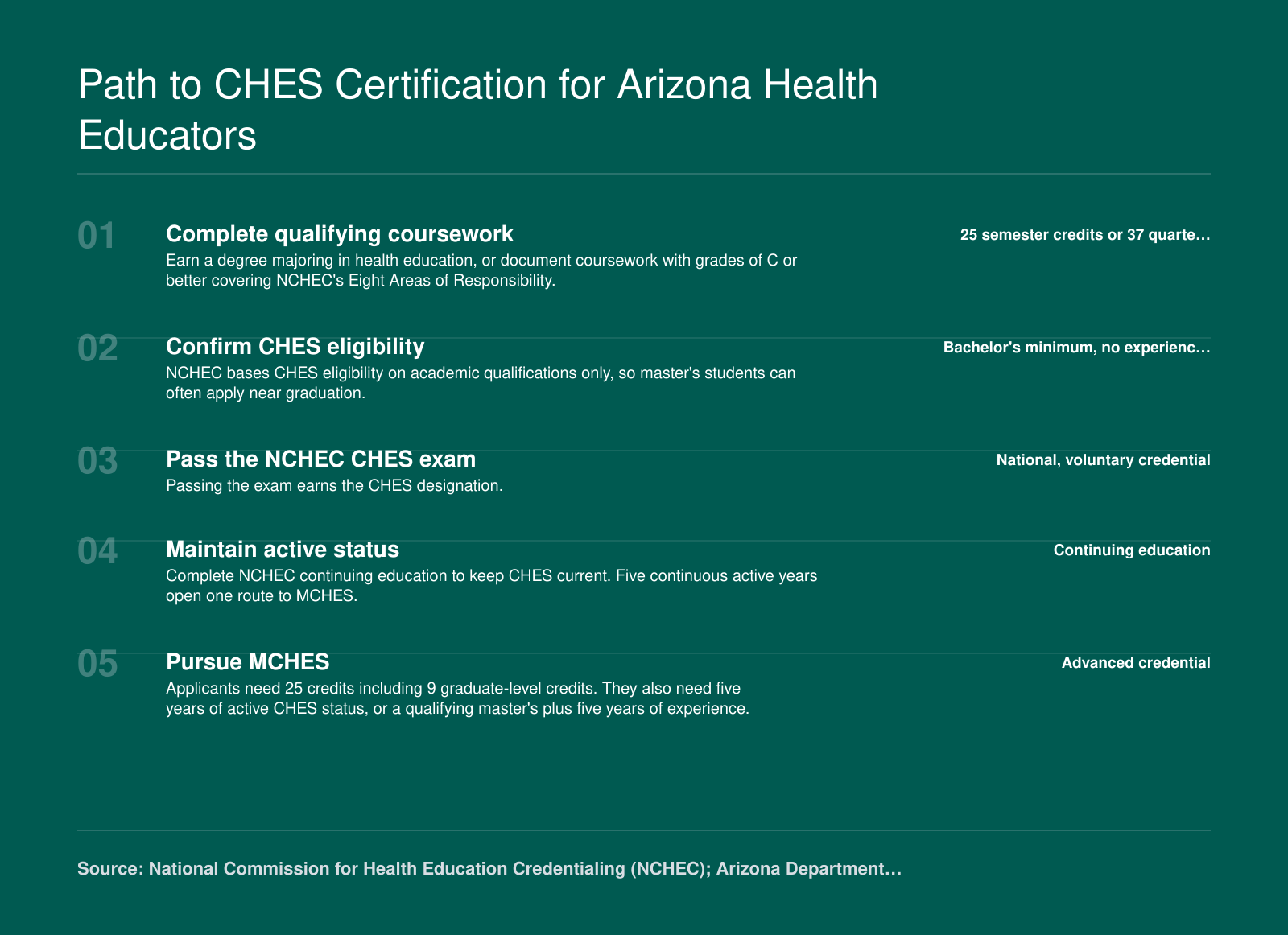
Path to CHES Certification for Arizona Health Educators
Arizona has no established state license for community health educators, so the national CHES credential from NCHEC is voluntary but widely used. K-12 health teachers need Arizona Department of Education certification, and CHES does not substitute for it. The research does not confirm which ranked programs state CHES alignment, so ask Arizona State University, Grand Canyon University, Aspen University, University of Phoenix-Arizona, or Midwestern University-Glendale for a curriculum map.
Career Outcomes and Salaries for Arizona Master's Graduates
A master's in health education pays off in Arizona less through a dramatic salary jump than through debt that stays modest against first-year pay. Arizona State University graduates report median earnings of $69,104 one year after finishing, with median debt of $32,995. Grand Canyon University graduates report $58,173 and $21,180 in debt. University of Phoenix-Arizona graduates report $63,712 and $38,450 in debt. The Grand Canyon and Phoenix figures sit under a different federal program category than ASU's, so compare them loosely.
For context, the Arizona median wage for health education specialists was $63,390 in May 2025 (mean $73,040, about 1,140 jobs).
Titles and Employers
Common titles include health education specialist, public health educator, health coach, wellness coordinator, and health program manager. Hiring comes from state and county public health agencies such as the Arizona Department of Health Services and Maricopa County Department of Public Health, plus health systems. Banner Health has advertised a Senior Health Plan Educator role at $26.82 to $40.22 an hour.1
Quick ROI Read
Grand Canyon's 48 credits at $600 each come to $28,800, roughly half of reported first-year earnings, a pattern reflected across the Most Affordable Master's in Health Education Programs. Debt at all three schools stays below that first-year figure.
How We Ranked These Arizona Programs
IPEDS and College Scorecard data anchor how these Arizona health education master's programs are compared. The rankings weigh graduate tuition, net price, institution-wide graduation rate, and program-level earnings and debt when the data allow. Graduation rates and net price are institution-wide averages, not program-specific figures, so they capture the broader school context rather than one degree's exact cohort. Only programs focused on health education were included; general MPH or health professions education degrees were excluded unless they specifically prepare health education specialists. The goal is to let prospective students compare cost and career outcomes against the same practical benchmarks.
Master's in Health Education in Arizona: FAQs
Does ASU offer a health education master's degree in Arizona?
Is a master's in health education different from an MPH in Arizona?
What can I do with a master's in health education in Arizona?
Can I earn CHES certification while still enrolled in an Arizona master's program?
Compare Health Education programs on the data that matters
Explore more Healthcare specializations or browse every graduate field.
All Healthcare programs