Best Master's in Health Education Programs in Minnesota
Compare 3 accredited Health Education programs in Minnesota, with graduate earnings, cost, debt, and completion data from IPEDS and the U.S. College Scorecard.

Health education work in Minnesota runs through schools, county public health departments, hospital systems, and nonprofits, and the CHES credential from NCHEC is the common thread for community-facing roles. Classroom teachers, community health workers, and career changers all arrive at the same decision: a public health degree with a community focus, or a narrower master's in health education.
The programs here include campus, hybrid, and online formats, from a flagship research university to a fully online for-profit option. Tuition gaps are wide, and CHES alignment is not guaranteed by every curriculum.
Teaching licensure runs through a separate state board, so a master's alone does not settle it.
Key Points
- Mankato is the lowest-cost option here, and the Twin Cities campus is the priciest.
- Saint Mary's and Walden offer online formats for working professionals who can't relocate.
- Check each admissions page for GRE rules, and confirm CHES eligibility before applying for 2027.
Best Master's in Health Education Programs in Minnesota, Ranked
Minnesota has only a handful of graduate programs that sit squarely in health education, and several of the strongest options are public health degrees with a community health focus. Below you will find a mix of campus, online, and hybrid choices, with notes on practicum and capstone requirements so you can compare the work involved, not just the names.
University of Minnesota-Twin Cities
#1Minneapolis, MN · ~$22,000/yr (est.)
Best for: Students pairing public health with social work
The University of Minnesota-Twin Cities offers its Master of Public Health in several online concentrations, and three of them fit health education goals: Community Health Promotion, Environmental Health, and Maternal & Child Health. The school's overall graduation rate is about 85%, the highest of the schools listed here. Community Health Promotion students can also pair the MPH with the university's Master of Social Work through an established MPH/MSW partnership, which suits community-based and behavioral health careers.
- Social and behavioral science methods for designing community interventions
- Typically two years, delivered online
- Applied practice experience in real-world settings
- Evaluation skills for program and policy interventions
- Optional MPH/MSW dual-degree pathway with the Master of Social Work
- Covers environmental infectious diseases, food safety, and occupational health
- Global environmental health focus
- Two-year online format with a required applied practice component
- Population health focus on mothers, children, and families
- Online and campus course options
- Comprehensive public health core alongside the concentration
- Applied practice experience required
Saint Mary's University of Minnesota
#2Winona, MN · ~$12,000/yr (est.)
Best for: Working adults wanting asynchronous online courses
Saint Mary's University of Minnesota in Winona delivers its Master of Public Health fully online, with asynchronous courses and several start dates a year. The program does not require the GRE, and its curriculum covers biostatistics, epidemiology, and health equity. The school's overall graduation rate is about 66%. Credit counts and per-credit pricing have differed between the program page and the university's 2025-26 tuition page, so confirm current figures before applying.
- Program page lists 42 credits; the 2025-26 tuition page lists 36, so verify
- Fully online, asynchronous coursework with flexible start dates
- Core covers public health history, epidemiology, and environmental determinants
- Capstone grant-writing project plus a 120-hour field experience
- No GRE required; minimum 2.75 GPA and prerequisites in human biology and statistics
- Selected employers may qualify for a 10% tuition discount and application-fee waiver
Minnesota State University-Mankato
#3Mankato, MN · $10,000 – $20,000/yr (est.)
Best for: Students aiming for rural public health careers
Minnesota State University, Mankato offers the Master of Science in Applied Health Science, formerly Community Health Education, which is the most traditional health education degree on this list. It has a fully online option and prepares graduates to apply for the CHES and MCHES credentials. The school's overall graduation rate is about 54%. The department works with local public health agencies in southwest and south-central Minnesota, including paid regional internships, and takes part in a rural public health workforce collaboration.
- 30 credits; older catalogs list 34 for the alternate plan paper route
- Thesis or alternate plan paper capstone required
- Core includes epidemiology, program planning and evaluation, and health behavior models
- Also covers health communication and advocacy, biostatistics, and research methods
- Six credits of restricted electives
- Health Science internship (HLTH 696) carries 1 to 6 credits
- Fully online option; six-year completion limit
- Prepares students to apply for the CHES exam
Walden University
#4Minneapolis, MN · ~$11,000/yr (est.)
Walden University's MS in Health Education and Promotion is an online program built to prepare health education specialists. The curriculum aligns with national health education standards and prepares graduates for the CHES exam. Specializations such as Emergency Preparedness and Health Policy let students tailor the degree. Walden is a fully online university with a Minneapolis address, so it suits students who want maximum scheduling flexibility.
- Fully online master's in health education and promotion
- Aligned with NCHEC competency standards
- Prepares graduates for the CHES certification exam
- Specializations include Emergency Preparedness and Health Policy
- Emphasis on communication, education, and preventive health models
Cost & outcomes by school
Federal data for the highest-earning Health Education programs, independent of the ranking above. Earnings are this field's master's graduates four years after completing, where the Scorecard reports them.
| School | Earnings | Tuition / yr | Debt | Grads/yr | Format |
|---|---|---|---|---|---|
| University of Minnesota-Twin Cities MN | $88,156 | $22,017 | $45,315 | 155 | Online or campus |
| Walden University MN | $72,906 | $10,885 | $60,029 | 111 | Online |
| Minnesota State University-Mankato MN | — | $10,449 | — | 2 | Online |
Sources: U.S. Department of Education. Tuition and graduates: IPEDS. Earnings and debt: College Scorecard, this field's master's graduates; a dash means no figure is reported.
Online and Hybrid Master's in Health Education Options in Minnesota
Flexibility and hands-on placement pull in different directions, and these master's programs in Minnesota balance them differently. Fully asynchronous formats suit working teachers who can't relocate. Hybrid formats may bring in-person courses or practicum sites.
Saint Mary's University of Minnesota offers an asynchronous online MPH with no on-campus residency, one of the online MPH programs in Minnesota. Terms run eight weeks, with entry in fall or spring. Fall deadlines are Aug 1 and Oct 1, and spring deadlines are Dec 1 and Feb 1. Field experience is completed in your own geographic area.
Minnesota State University-Mankato delivers its MPH in Health Behavior and Health Promotion as 100% asynchronous online coursework (43 credits) with fall, spring, and summer starts. U.S. applicants are reviewed on a rolling basis. No residency is identified, and the program prepares students for CHES.
The University of Minnesota-Twin Cities mixes online, hybrid, and in-person courses in its MEd in Physical Activity and Health Promotion, which takes three semesters. Spring applicants apply by Nov 1, summer by Mar 1, and fall by May 1 (preferred) or July 1, with rolling review.
Walden University's MS in Health Education and Promotion is also online and prepares students for the CHES exam.
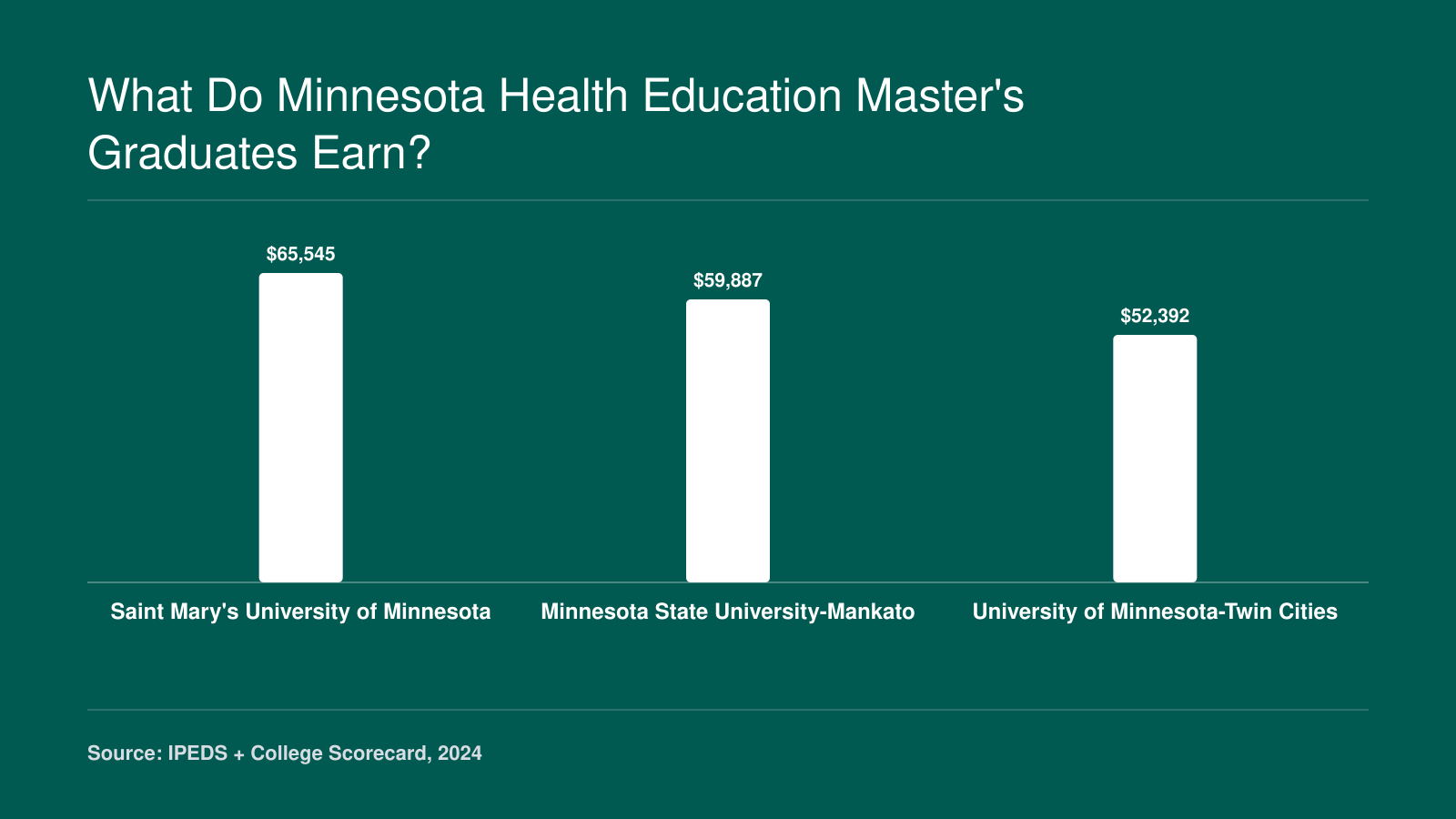
What Do Minnesota Health Education Master's Graduates Earn?
Median earnings below are program-level figures for graduates measured four years after finishing. Health education roles span schools, public health departments, and hospitals, so pay varies by setting. Walden University is listed without a figure.
Which Minnesota Master's in Health Education Programs Waive or Make the GRE Optional
Most master's programs in health education and public health put more weight on your GPA, personal statement, and professional experience than on a standardized test score. The table below reports only what each school's admissions page states, and it says "No published policy" where a page is silent on the GRE.
| School | GRE Policy | Minimum GPA | Prerequisites / License Required |
|---|---|---|---|
| Minnesota State University-Mankato (Applied Health Science MS) | No published policy | 2.85 | Bachelor's degree from an accredited university. Teaching license requirement not stated. |
| University of Minnesota-Twin Cities (Executive Public Health Practice MPH) | Not required | 3.25 cumulative | Advanced degree (such as MS, MD, DDS, DVM, PharmD, or PhD) or a Public Health Core Concepts certificate, plus some work experience in health or human services. Teaching license requirement not stated. |
Related Articles
Master's in Health Education Cost, Accreditation, and CHES Eligibility in Minnesota
How much does a master's in health education cost in Minnesota, and will it qualify you for the CHES exam? In Minnesota, cost runs from Minnesota State University-Mankato at the low end to the University of Minnesota-Twin Cities at the high end, and CHES language differs by school; for a national benchmark, see the Most Affordable Master's in Health Education Programs.
Tuition, Lowest to Highest
- Minnesota State Mankato: $10,449 in-state, $19,989 out-of-state.
- Walden University: $10,885 for all students.
- Saint Mary's University of Minnesota: $12,474 for all students.
- University of Minnesota-Twin Cities: $22,017 in-state, $33,249 out-of-state.
Per-credit rates give a truer total. Saint Mary's lists $560 per credit over 42 credits, about $23,520. Mankato lists $530 per credit, and with 30 credit hours in its catalog that is roughly $15,900 before fees; online candidates comparing options can also review the Best Online Master's in Health Education Programs. Mankato's listed fees are $909 full-time and $51 part-time, but the billing period is unclear, so confirm with the bursar. Net price, an approximate institution-wide average, is about $11,704 at Saint Mary's, $16,778 at Twin Cities, $19,139 at Mankato, and $33,817 at Walden.
Accreditation and CHES Eligibility
Mankato and Saint Mary's list institutional accreditation from the Higher Learning Commission. Saint Mary's describes a CEPH-aligned curriculum, which is not the same as CEPH accreditation, and no CEPH accreditation is established for Mankato's MS.
Mankato is the clearest on certification: its Applied Health Science students are eligible for the CHES exam in their last semester or after graduating, and MCHES requires five years of work experience as a health education specialist. Walden says its program prepares students for CHES and aligns with NCHEC standards.
Minnesota Health Education Teaching Licensure
Frequently Asked Questions About Health Education Master's Programs in Minnesota
These answers cover the questions prospective students ask most often when comparing a health education master's with related options. For program-specific details, see the sections above on admissions, cost, and certification.
What is the difference between a master's in health education and a master's in public health?
Do I need a teaching license to enroll in a health education master's program in Minnesota?
Can I sit for the CHES exam before I finish my master's degree?
How long does a health education master's take if I study part-time while working?
Compare Health Education programs on the data that matters
Explore more Healthcare specializations or browse every graduate field.
All Healthcare programs