Best Master's in Health Education Programs in Alabama
Compare 4 accredited Health Education programs in Alabama, with graduate earnings, cost, debt, and completion data from IPEDS and the U.S. College Scorecard.

A health education master's can point toward a hospital wellness office, a county health department, a high school classroom, or a corporate fitness program, and the cost of getting there varies widely. Tuition at the schools ranked here runs from $3,936 at Columbia Southern University to $26,228 at Tuskegee University.
Auburn, the University of Alabama, UAB, and South Alabama are ranked here alongside online and hybrid options. Credentials differ too: CHES eligibility suits public health roles, while school health work requires Alabama teacher certification.
Key Points
- The University of Alabama's online MPH requires at least 75 hands-on practice hours with a preceptor.
- Columbia Southern University and Spring Hill College charge in-state and out-of-state students the same tuition.
- Alabama Class A health education certification requires a state-approved master's, a Class B certificate, and a Praxis exam.
Top 9 Master's in Health Education Programs in Alabama for 2027
Nine Alabama universities offer ten master's programs in health education and closely related public health and community health fields, split across campus and online formats. Graduation rates below describe each university as a whole, not the individual program, and net price is an approximate institution-wide average after aid, not a quote for your situation.
Auburn University
#1Auburn, AL · $13,000 – $34,000/yr (est.)
Best for: Future strength and conditioning coaches
Auburn University graduates about 82% of its students, the highest institution-wide rate on this list. Its on-campus program in Exercise, Performance, and Health Optimization leans toward fitness, strength and conditioning, and cardiac rehabilitation settings rather than public health practice. Graduate tuition is roughly $11,016 in-state and $32,112 out-of-state, and the average net price after aid is about $24,323.
- On-campus program only
- Six-hour internship in commercial, corporate, or cardiac rehabilitation settings
- Thesis and non-thesis options
- Covers fitness assessment and behavioral strategies
- Graduate minor in sport management available
- Research methods and exercise psychology included
The University of Alabama
#2Tuscaloosa, AL · ~$12,000/yr (est.)
Best for: Working adults studying fully online
The University of Alabama in Tuscaloosa offers a fully online Master of Public Health with a Health Education and Promotion concentration. The university graduates about 73% of its students, and graduate tuition runs roughly $11,380 in-state and $33,372 out-of-state, with an average net price near $22,420. Students complete applied practice experiences with Alabama organizations they select and the program approves.
- 42 credit hours, delivered online
- Tuition listed at $480 per credit hour
- 3.0 undergraduate GPA and three recommendation letters required
- Coursework in health behavior theory, epidemiology, and program evaluation
- Applied practice experience with Alabama-based organizations
- Fall, spring, and summer application deadlines
- Prepares for CHES exam eligibility
University of Alabama at Birmingham
#3Birmingham, AL · ~$9,000/yr (est.)
Best for: Nonprofit staff pursuing community health work
The University of Alabama at Birmingham pairs a lower graduate price with a solid institution-wide graduation rate of about 64%. Graduate tuition is roughly $8,640 in-state and $21,168 out-of-state, and the average net price after aid is about $18,749. Its online Master of Arts in Education in Community Health suits students headed to health agencies, clinics, schools, and nonprofits.
- Online delivery
- Concentrations: Online Community Health, and Community Health with Nonprofit Management
- Thesis and non-thesis options
- Courses in health communications, health coaching, and program administration
- Graduate certificate opportunity
- Bachelor's degree required for admission
University of South Alabama
#4Mobile, AL · ~$9,000/yr (est.)
The University of South Alabama in Mobile offers the only teacher-licensure track on this list. Its campus-based M.Ed. in Health Education (6-12) leads to Class A certification and has a lower in-state graduate price of roughly $8,640 (about $17,280 out-of-state). The university graduates about 53% of its students, and the average net price after aid is near $17,648.
- 30 credit hours, campus-based
- Leads to Alabama Class A teaching certification
- Requires a Class B certificate in health education
- 2.5 GPA or qualifying test scores for admission
- Covers school health programs, substance abuse prevention, and nutrition
- CAEP accredited and Alabama state approved
Jacksonville State University
#5Jacksonville, AL · $10,000 – $15,000/yr (est.)
Jacksonville State University offers a campus-based Master of Public Health with a rural health emphasis. Graduate tuition is roughly $10,272 in-state and $16,704 out-of-state, a modest out-of-state premium, and the average net price after aid is about $14,279, the lowest on this list. The university graduates about 55% of its students.
- Campus-based delivery
- Internship and capstone project required
- Courses in epidemiology, biostatistics, health policy, and program evaluation
- Rural health opportunities
- Designed for mid to senior-level career paths
Columbia Southern University
#6Orange Beach, AL · ~$4,000/yr (est.)
Columbia Southern University, based in Orange Beach, delivers an online Master of Public Health with a Community Health Education concentration at about $359 per credit hour. Graduate tuition is roughly $3,756 per year with no in-state discount, and the average net price is near $14,580. The university graduates about 33% of its students, so confirm completion support before enrolling.
- Fully online with no on-campus requirements
- Community Health Education concentration
- Tuition of $359 per credit hour, with textbooks included
- Multiple start dates and transfer credits accepted
- Military discounts and scholarships available
Spring Hill College
#7Mobile, AL · ~$9,000/yr (est.)
Spring Hill College, a Jesuit institution in Mobile, offers an online Master of Public Health with a Community Engagement and Health Education concentration. Accelerated seven-week courses and six admission cycles a year suit working professionals. The college graduates about 52% of its students, and the average net price after aid is about $20,449.
- Online, two-year program
- Accelerated 7-week courses
- Six admission cycles each year
- SACSCOC accredited
- Focus on underserved areas
Tuskegee University
#8Tuskegee, AL · ~$26,000/yr (est.)
Tuskegee University, a historically Black university in Tuskegee, offers a campus-based Master of Public Health with a health disparities focus. Graduate tuition is roughly $21,906, and the average net price after aid is about $35,013, the highest on this list. The university graduates about 55% of its students.
- Campus-based, 46 total credit hours
- 3.0 GPA required
- GRE scores listed as required
- Foundational courses in epidemiology, environmental health, and health disparities
- Letters of recommendation and statement of purpose required
South University-Montgomery
#9Montgomery, AL · ~$17,000/yr (est.)
South University-Montgomery offers its Master of Public Health on campus and online. The school has the lowest institution-wide graduation rate on this list at about 9%, and its average net price after aid is near $27,807. Graduate tuition is roughly $16,056, so compare it carefully against the public universities above.
- Campus-based at Montgomery
- 56-credit program
- 2.5 GPA minimum and a statistics course prerequisite
- Practicum experience included
- Focus on health equity and community-based approaches
- Accreditation applicant status
- Online delivery of the MPH
- Flexible online learning
- Practicum experience included
Cost & outcomes by school
Federal data for the highest-earning Health Education programs, independent of the ranking above. Earnings are this field's master's graduates four years after completing, where the Scorecard reports them.
| School | Earnings | Tuition / yr | Debt | Grads/yr | Format |
|---|---|---|---|---|---|
| University of Alabama at Birmingham AL | $91,073 | $8,640 | $32,000 | 276 | Online |
| Columbia Southern University AL | $66,208 | $3,936 | $39,955 | 96 | Online |
| University of South Alabama AL | — | $9,360 | — | — | Campus |
| The University of Alabama AL | — | $11,980 | — | 65 | Online |
Sources: U.S. Department of Education. Tuition and graduates: IPEDS. Earnings and debt: College Scorecard, this field's master's graduates; a dash means no figure is reported.
Most Affordable Health Education Master's Programs in Alabama
These programs have the lowest graduate tuition among the schools ranked here, using federal IPEDS and College Scorecard figures. Columbia Southern University and Spring Hill College charge the same tuition to in-state and out-of-state students, which matters for anyone enrolling online from elsewhere. Net price is an institution-wide federal estimate, and per-credit rates come from school-level research that may not apply to every program, so confirm current rates and fees with each school before budgeting.
| School | Program | Graduate tuition (in-state / out-of-state) | Net price (institution-wide) | Per-credit rate and credit hours |
|---|---|---|---|---|
| Jacksonville State University | Master of Public Health (campus) | $11,488 / $17,920 | $14,279 | $428 per credit reported for online study school-wide; program credit hours not confirmed |
| Columbia Southern University | Master of Public Health, Community Health Education (online) | $3,936 / $3,936 | $14,580 | $359 per credit hour listed by the program |
| University of South Alabama | Health Education (6-12) M.Ed. (campus) | $9,360 / $18,000 | $17,648 | 30 credit hours; the 30-credit M.S. in Health Promotion is reported at $495 in-state and $990 out-of-state per credit |
| University of Alabama at Birmingham | Community Health, M.A.Ed. (online) | $8,640 / $21,168 | $18,749 | Per-credit rate for this program not confirmed |
| Spring Hill College | Master of Public Health, Community Engagement and Health Education (online) | $8,857 / $8,857 | $20,449 | Per-credit rate not confirmed; two-year program with 7-week courses |
Online and Hybrid Master's in Health Education Options in Alabama
The University of Alabama's online MPH in Health Education & Promotion requires at least 75 hands-on practice hours under a qualified preceptor, and students need no campus visits. UA's MA in Health Studies is also fully online, with no campus trips. South Alabama's 30-credit MS in Health Promotion offers a fully online route. Columbia Southern, Spring Hill College, and Jacksonville State also deliver online public health degrees, while Auburn, Tuskegee, and South University-Montgomery are campus-based master's programs in Alabama. UAB's MAEd in Community Health is blended, so expect on-campus requirements, though the program page doesn't say how often.
Official pages generally don't say whether online classes meet live or on your own schedule, so ask admissions before enrolling.
Internships and credentials
South Alabama requires a 125-hour internship (KIN 595, 3 to 6 credits) in settings such as county health departments, hospitals and wellness facilities. Those settings suggest you can often arrange a placement near home, but confirm that with the program. The UA MA in Health Studies lists a comprehensive exam and the CHES exam rather than an internship.
An online degree is the same degree, and online graduates remain CHES-eligible.
Related Articles
Which Alabama Health Education Master's Programs Are GRE-Optional?
Most health education master's programs in Alabama are now No-GRE master's programs, but the details vary by school, so check each one before you spend a dime on test prep.
School-by-School Breakdown
- The University of Alabama: The online Master of Public Health in Health Education & Promotion lists no GRE requirement; it asks for official transcripts, a statement of purpose, and three recommendation letters, with a 3.0 GPA expectation. UA's population health track does not require an admission test2, the health studies track does not state one, and the Accelerated Master's in Health Education Programs path sets a higher 3.7 GPA bar.
- Jacksonville State University: The population health track does not require the GRE or MAT.1 Standard admission expects a 3.00 undergraduate GPA (overall or last 64 credit hours), with conditional admission possible at 2.50.1
- Tuskegee University: Its public health program does require GRE scores, along with a 3.0 GPA, recommendation letters, transcripts, and a statement of purpose.
- Auburn, UAB, University of South Alabama, South University-Montgomery: Their published admissions pages do not clearly state a current GRE policy for these programs. Do not assume either way.
One Tip
Policies shift between cycles. Email the department and confirm in writing before you register for the test.
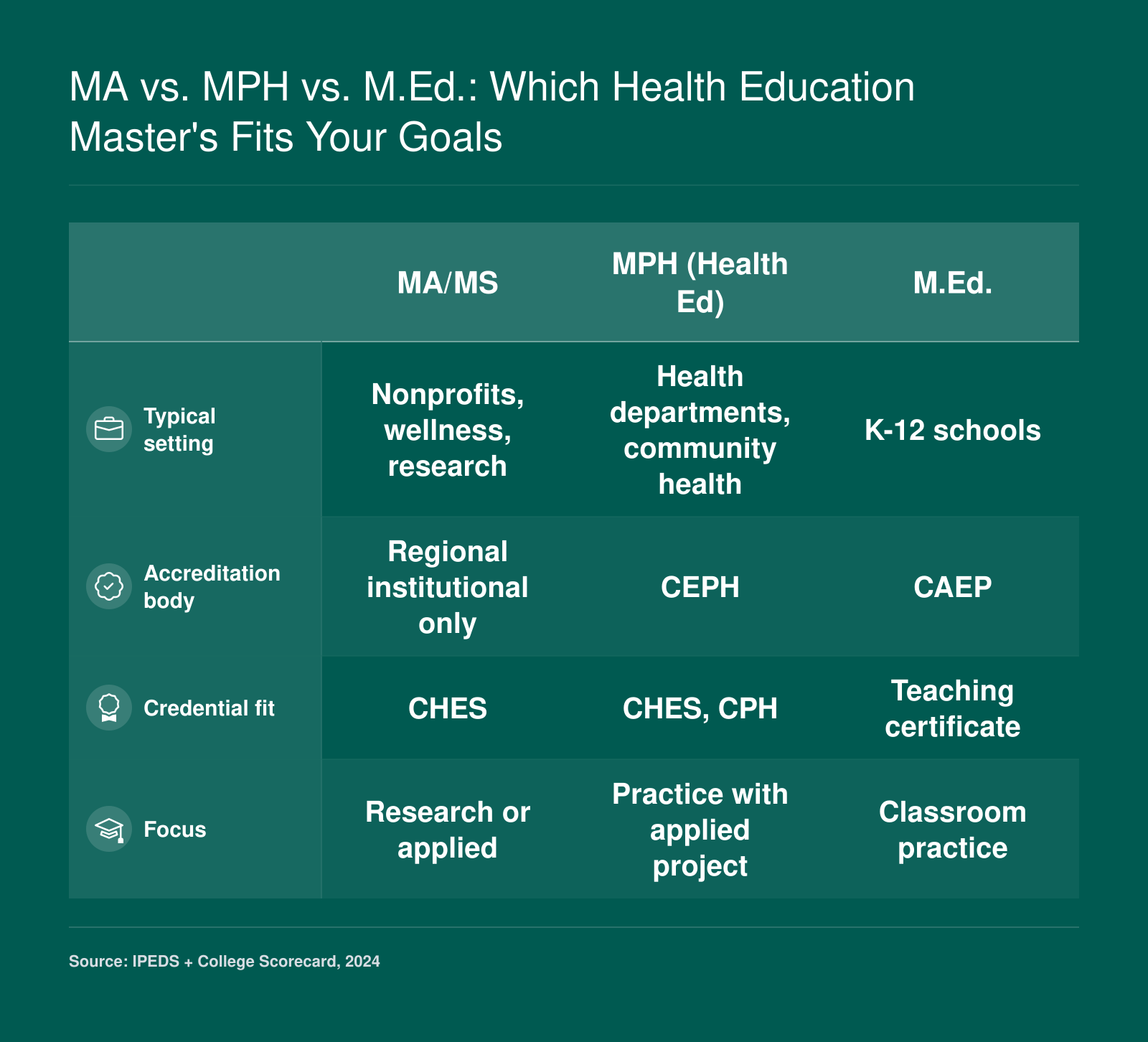
MA vs. MPH vs. M.Ed.: Which Health Education Master's Fits Your Goals
The three degree types lead to different workplaces and credentials, so match the letters to your goal before comparing price. Among the Alabama programs ranked here, the program names include a Master of Public Health, a Health Education (6-12) M.Ed., and a Community Health MAEd, plus an exercise and health optimization program at Auburn University.
Alabama Teacher Certification for Health Education M.Ed. Graduates
Frequently Asked Questions About Master's in Health Education in Alabama
These answers draw on published policies from the University of Alabama and the University of South Alabama. Policies can change and may differ by program, so confirm details with each graduate office before applying.
How long does it take to earn a master's in health education in Alabama?
When are application deadlines for Alabama health education master's programs?
Can I transfer graduate credits into an Alabama health education master's program?
What can you do with a master's in health education in Alabama?
Compare Health Education programs on the data that matters
Explore more Healthcare specializations or browse every graduate field.
All Healthcare programs