Best Master's in Health Education Programs in Washington
Compare 2 accredited Health Education programs in Washington, with graduate earnings, cost, debt, and completion data from IPEDS and the U.S. College Scorecard.

Do you want to teach health in a K-12 classroom, or run community health programs for a county health department? That choice shapes nearly every decision that follows.
Washington's options are limited, and they divide cleanly. Central Washington and Eastern Washington serve certified teachers pursuing the Health/Fitness endorsement; UW-Bothell and Gonzaga target community and public health work, the same terrain often covered by accredited MPH programs in Washington. Delivery ranges from fully asynchronous online to hybrid with weekly in-person classes.
With a pool this small, a mismatch in format or credential usually means looking out of state.
Key Points
- Central Washington has the lowest resident tuition at $13,220.
- Gonzaga, Central Washington, and Eastern Washington offer online health education master's degrees.
- Health/Fitness endorsement requires a bachelor's, approved prep program, and passing WEST-E/NES exam.
Best Master's in Health Education Programs in Washington: Our Rankings
Washington's health education master's programs split into two distinct paths: community health and public health degrees for broader public health careers, and licensure-focused health and physical education programs for current teachers. The four ranked options below vary in delivery, pace and admission requirements, so the right fit depends on whether you are building public health expertise or adding a Washington endorsement. We highlight what each school does well so you can compare costs, format and career fit at a glance.
University of Washington-Bothell Campus
#1Bothell, WA · ~$19,000/yr (est.)
Best for: Social-justice-focused public health aspirants
University of Washington-Bothell's Master of Science in Community Health & Social Justice takes an anti-racist, social-justice approach to health inequities. The hybrid program combines weekly in-person classes with online work, and students complete community-based capstone projects with Puget Sound health agencies. It suits students pursuing public health careers and certifications like CHES or CPH.
- 60 credits required
- 2 years full-time or 4 years part-time
- Hybrid format with weekly in-person class
- Anti-racist curriculum focused on social justice
- Prepares students for CHES and CPH exams
- Fall quarter entry with February 1 priority deadline
Gonzaga University
#2Spokane, WA · ~$22,000/yr (est.)
Best for: Online learners seeking flexible MPH study
Gonzaga University offers a fully online Master of Public Health that emphasizes community health, policy development and evidence-based strategies. The 42-credit program is asynchronous and can be completed in about two years, with real-world projects and grant writing built into the curriculum. It fits working professionals who want a flexible online MPH grounded in Jesuit values.
- 42 credits required
- Fully online asynchronous format
- Approximately two years to complete
- Real-world projects and grant writing skills
- Jesuit values integrated into coursework
- Rolling admission with bachelor's degree required
Central Washington University
#3Ellensburg, WA · ~$13,000/yr (est.)
Best for: Current K-12 teachers adding health endorsement
Central Washington University's Master of Science in Health and Physical Education is a fully online program for current K-12 educators pursuing a Washington State Health/Fitness endorsement. The 45-credit, five-quarter program uses asynchronous coursework and new cohorts begin each summer. Applicants should hold an undergraduate degree in education.
- 45 total credits
- Five quarters duration
- Fully online asynchronous learning
- Designed for current K-12 teachers
- Washington State Health/Fitness endorsement option
- Cohort starts each summer
- Undergraduate education degree required
Eastern Washington University
#4Cheney, WA · ~$14,000/yr (est.)
Eastern Washington University's Master of Education in Health and Physical Education is an online program for certified teachers who want to advance into health and physical education roles. The 49-credit degree can be completed in as few as 14 months, with project-based learning, internship hours, and a portfolio and comprehensive exam instead of a thesis. It serves both K-12 teaching and coaching paths.
- 49 credit hours required
- Can be completed in as few as 14 months
- Fully online format
- Requires bachelor's degree and 3.0 GPA
- Requires teacher certification for admission
- No thesis; portfolio and comprehensive exam
- Prepares for K-12 teaching or coaching roles
Cost & outcomes by school
Federal data for the highest-earning Health Education programs, independent of the ranking above. Earnings are this field's master's graduates four years after completing, where the Scorecard reports them.
| School | Earnings | Tuition / yr | Debt | Grads/yr | Format |
|---|---|---|---|---|---|
| Eastern Washington University WA | $68,517 | $14,106 | — | 149 | Online |
| Central Washington University WA | — | $13,220 | — | 7 | Online |
Sources: U.S. Department of Education. Tuition and graduates: IPEDS. Earnings and debt: College Scorecard, this field's master's graduates; a dash means no figure is reported.
How We Rank Washington's Health Education Master's Programs
Central Washington University has held regional NWCCU accreditation since 1918, and Eastern Washington University since 1919, both among accredited graduate programs in Washington. Both were found substantially compliant at their latest evaluations.12 CWU's next review is due Fall 2026,3 and EWU had a mid-cycle review in Spring 2026.2 The rankings draw on IPEDS and College Scorecard figures for these best master's in health education programs in Washington: graduate tuition, net price, institution-wide graduation rate, and program-level earnings where published.
Program-level status is less settled. EWU's MPH held CEPH probationary accreditation with a listed expiration of March 14, 2026, and its current standing is unconfirmed.4 CAEP status could not be verified for either school, and CEPH does not list CWU.4
Rankings data cannot replace due diligence. Check the NWCCU directory, CAEP and CEPH databases, then ask each admissions office to confirm in writing.
Online and Hybrid Master's in Health Education Options in Washington
Gonzaga University's Master of Public Health, Central Washington University's M.S. in Health and Physical Education, and Eastern Washington University's M.Ed. in Health and Physical Education are delivered online. The University of Washington-Bothell Campus program is hybrid, with weekly in-person classes. Confirm each format on the current program page before applying.
CWU runs an asynchronous cohort of 45 credits over five quarters, starting in summer, with no on-campus coursework. An in-person orientation is encouraged, but the sources don't say it is mandatory. The cohort dates on its page look outdated, so ask the department about the next start.
EWU's 49-credit degree uses six-week sessions with seven starts a year, like many accelerated health education master's programs. Its online calendar lists Fall I on September 21, 2026 and Fall II on November 2, 2026, though those dates aren't confirmed for this degree. A teaching certificate is required, and the internship needs an approved local placement.
Online master's in health education programs from regionally accredited Washington public universities carry the same diploma as campus degrees. For working teachers, CWU's summer-through-summer cohort and EWU's short sessions are the most workable formats.
Related Articles
Which Washington Master's in Health Education Programs Waive or Make the GRE Optional?
Standardized tests have faded from many graduate admissions pages, including those for No-GRE master's programs, but Washington schools still differ on the details.
Central Washington University's Graduate School does not require the GRE, though individual programs may request additional scores, so confirm with the health and physical education department. Applicants need a 3.0 GPA, measured over the last 90 quarter credits. Materials include the online application, a $75 fee, transcripts, a statement of objectives, a resume, and three recommendation letters. CWU's pages do not establish a teaching-certificate prerequisite, though the program is designed for teachers.
Eastern Washington University's online M.Ed. requires no GRE, recommendations, or writing sample. It does require a teaching certificate and a 3.0 GPA1, so it is not a career-changer route.
University of Washington-Bothell and Gonzaga University publish no GRE policy in the materials reviewed. Gonzaga lists a bachelor's degree as required, and neither school lists a teaching certificate, so check each admissions page directly.
Cost of a Master's in Health Education in Washington and Licensure
Tuition from lowest to highest
By benchmark resident tuition, Central Washington University is lowest at $13,220 ($28,031 nonresident), followed by Eastern Washington University at $14,106 ($29,892). University of Washington-Bothell comes next at $18,738 resident and $32,757 nonresident. Gonzaga University, a private school, charges $21,987 regardless of residency.
CWU's 2025-2026 graduate rate is $379.90 per credit for residents and $889.93 for nonresidents, and CWU describes its rates as estimates subject to change. EWU lists $427.47 and $940.921, plus a separate $345 online rate2. EWU's 49-credit M.Ed., one of the Best M.Ed. Programs in Washington, is advertised at $16,905 total. Multiply credits by the current rate for your own estimate, then confirm fees on each billing page.
Licensure versus certification
School-based teachers need a Washington teaching certificate plus the Health and Fitness endorsement from the Professional Educator Standards Board. The degree alone does not grant it. Since May 19, 2019, the endorsement requires an approved program plus a qualifying WEST-E score.3 The test-only route closed in 2019.
Community health educators usually skip that path and pursue the CHES credential instead.
Washington Health/Fitness Endorsement at a Glance
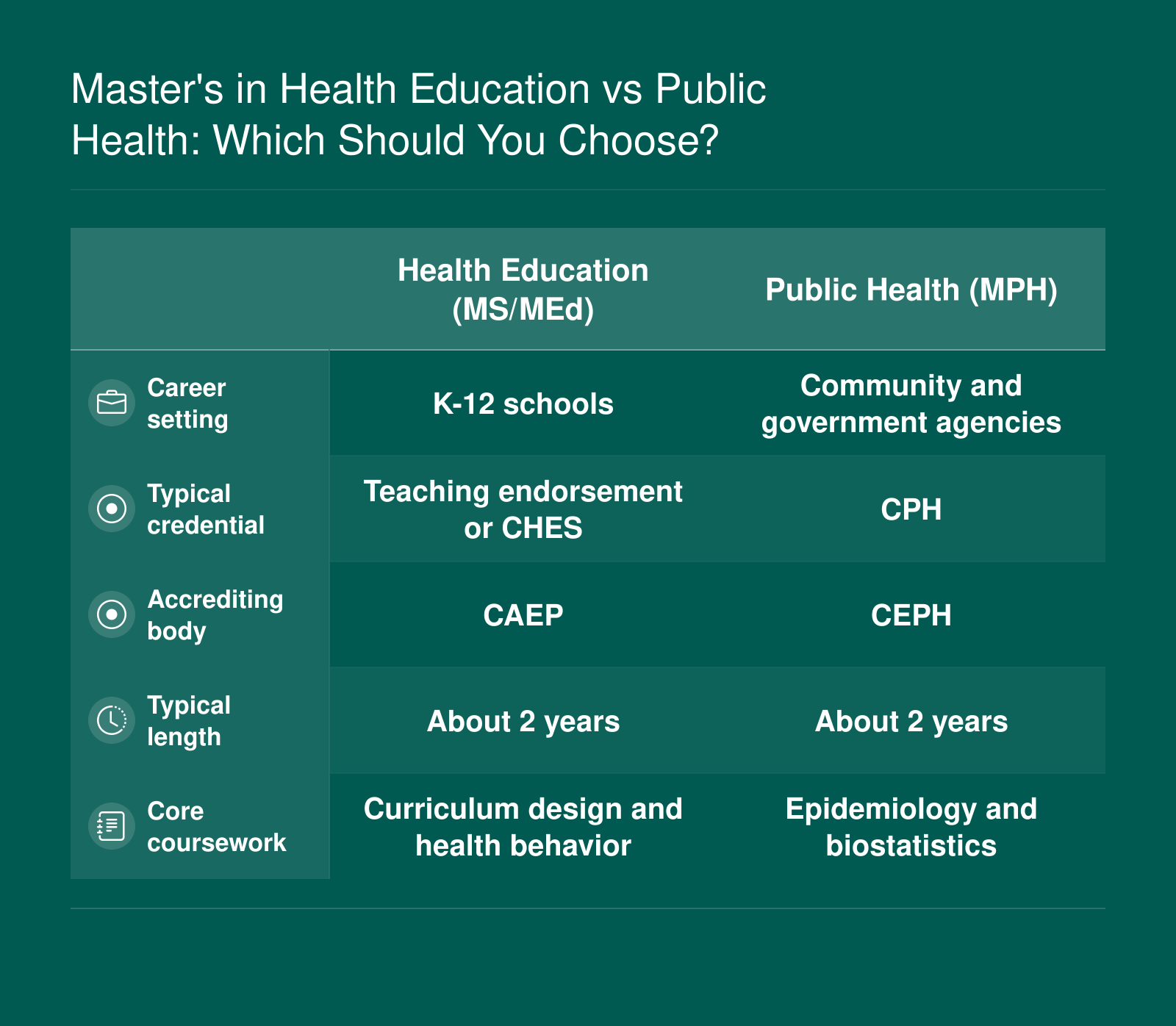
Master's in Health Education vs Public Health: Which Should You Choose?
Health education master's programs prepare graduates for school and clinical patient-education roles, while an MPH focuses on population-level prevention and policy. If your goal is community or government health work, weigh an MPH or a health education program without a teaching certification track. An MHA is a separate management-focused degree, not a substitute for either path.
Career Outcomes and Salaries for Washington Health Education Graduates
Career outcomes for a master's in health education come down to who hires graduates and what they earn. Typical employers in Washington include school districts, county health departments, hospitals, and nonprofits running community health programs.
What Graduates Earn
Among the schools here, the University of Washington-Bothell Campus reports program-level earnings for its Master of Science in Community Health & Social Justice. Graduates had median earnings of $70,125 one year after finishing, $92,611 four years after finishing, and $93,841 five years after finishing. Earnings can rise a lot in the first few years, so the one-year figure understates where graduates land.
Occupational Context
These figures describe a wage benchmark for the job, not what any program's graduates earn. Nationally, Health Education Specialists (SOC 21-1091)2 had a 2025 median wage of $64,070, with about 70,400 jobs.1 A Washington-specific median for this occupation, and for high school teachers (SOC 25-2031)2, could not be confirmed from the state data reviewed. Check the Washington Employment Security Department's wage tables for current local numbers before you compare programs on salary.
Common Questions About Health Education Master's Programs in Washington
Which Washington master's program is best for a non-teacher pursuing health education?
Which degrees qualify graduates for the Washington school-based Health/Fitness endorsement?
How much does a master's in health education cost in Washington?
Is a master's in healthcare administration (MHA), such as UW's Master of Health Administration, a good alternative to a health education master's?
Compare Health Education programs on the data that matters
Explore more Healthcare specializations or browse every graduate field.
All Healthcare programs