Best Master's in Health Education Programs in Ohio
Compare 4 accredited Health Education programs in Ohio, with graduate earnings, cost, debt, and completion data from IPEDS and the U.S. College Scorecard.

The first decision in health education isn't which school, it's which track. A community or public health program points you toward the CHES exam and roles in hospitals, worksites, and public health agencies. A school health track points toward an Ohio Multi-Age (PK-12) teaching license and a classroom.
That split shapes everything downstream: curriculum, field placement, even the exam you sit for. The programs ranked here are spread across seven Ohio schools and mix campus and online delivery, so format isn't the dividing line. The dividing line is where you want to work after graduation.
Key Points
- Miami University pairs the lowest median debt shown here at $20,500.
- Youngstown State's Master of Health and Human Services offers an online health promotion concentration.
- CHES certification suits community roles, while teaching health in Ohio schools requires a state PK-12 license.
Top-Ranked Health Education Master's Programs in Ohio
Ohio's health education master's options span three degree types: Master of Public Health tracks, Master of Education programs, and Master of Science concentrations. Several also offer licensure or CHES-aligned preparation. Graduation rates below describe each university as a whole, not the individual program, so use them as context rather than a program outcome.
Miami University
#1Oxford, OH · $17,000 – $38,000/yr (est.)
Best for: Future worksite and community program planners
Miami University in Oxford offers a campus-based M.S. in Kinesiology, Nutrition, and Health with a concentration in Public Health Education and Health Promotion. The curriculum takes an ecological view of health, covering psychosocial, behavioral, and cultural influences across the lifespan. It prepares graduates to plan and coordinate programs in community, worksite, clinical, and educational settings. The university graduates about 80% of its students, the highest institution-wide rate among the schools listed here.
- Campus-based program on the Oxford campus
- Public Health Education and Health Promotion concentration
- Ecological approach to behavioral and cultural determinants of health
- Prepares for program planning and coordination roles
- Settings covered: community, worksite, clinical, and educational
- Applications go through the Graduate School online
University of Cincinnati
#2Cincinnati, OH · ~$15,000/yr (est.)
Best for: Hospital-connected public health education seekers
The University of Cincinnati delivers its health education track as a Master of Public Health concentration in Health Education and Promotion. The program is partnered with UC's College of Medicine and Cincinnati Children's Hospital Medical Center, a clinical and pediatric-health connection few other Ohio programs advertise. It is campus-based, typically takes two years, and does not require the GRE. The university graduates about 75% of its students.
- Campus-based Master of Public Health with a health education focus
- Typically two years to complete
- No GRE required
- Includes practicum experiences
- Covers program planning, evaluation, and community engagement
- Partnered with the College of Medicine and Cincinnati Children's
Cleveland State University
#3Cleveland, OH · ~$11,000/yr (est.)
Best for: Experienced community health workers advancing careers
Cleveland State University offers a 31-credit Master of Education in Community Health Promotion for people who already work in health-related roles. Applicants need a bachelor's degree, two years of health-related experience, a resume, and a personal statement. Coursework covers health behavior theories, promotion strategies, and research methods, with electives and a capstone. The university graduates about 51% of its students.
- 31 credit hours, campus-based
- Requires a bachelor's degree and two years of health-related work
- Resume and personal statement required for admission
- Courses in health behavior theory, promotion strategies, and research methods
- Electives such as culture and health, environmental health, substance abuse education
- Capstone course included
University of Toledo
#4Toledo, OH · $18,000 – $29,000/yr (est.)
The University of Toledo offers a hybrid Master of Public Health with a Health Promotion and Education concentration. The 45-credit curriculum pairs epidemiology and biostatistics core courses with concentration study and field experience, with a focus on health equity. A hybrid format suits students who cannot be on campus full time. The university graduates about 57% of its students.
- Hybrid delivery combining online and campus components
- 45 credit hours
- Core courses in epidemiology and biostatistics
- Field experience included
- Bachelor's degree required for admission
- Focus on health equity and evidence-based practice
Kent State University
#5Kent, OH · ~$12,000/yr (est.)
Kent State University offers two separate paths in Health Education and Promotion: a Community Health concentration and a School Health Additional Licensure track. The community track prepares students for the CHES credential and for roles in government, healthcare, and nonprofits. The licensure track is for people who already hold an Ohio teaching license. Late afternoon and evening classes, some web-based courses, and part-time study suit working students. The university graduates about 64% of its students.
- 33 credit hours, campus-based with some web-based courses
- Minimum 3.0 undergraduate GPA
- Goal statement, transcripts, and two recommendation letters required
- Prepares for the CHES credential
- Late afternoon and evening courses, part-time option
- No thesis required
- 35 credit hours, campus program with web-based courses
- Requires an existing Ohio teaching license
- Minimum 3.0 GPA
- Focus on school health and preparation for licensure
- Courses in needs assessment, health behavior, evaluation, and advocacy
- Late afternoon and evening classes, part-time option
Youngstown State University
#6Youngstown, OH · ~$7,000/yr (est.)
Youngstown State University offers a fully online Master of Health and Human Services with three tracks relevant to this field: health promotion, health care administration, and health informatics. Each combines an 18-semester-hour core with 11 to 12 concentration hours and a thesis or non-thesis option. The format is built for working professionals who want supervisory or health promotion roles. The university graduates about 50% of its students.
- Online delivery for working professionals
- 18-semester-hour core plus 11 to 12 concentration hours
- Thesis or non-thesis option, with an internship option
- 3.0 GPA for admission, provisional admission possible
- Focus on community health and supervisory roles
- Fully online, no campus attendance required
- Covers health policy, fiscal management, and human resources
- Includes program planning and evaluation and health informatics components
- Thesis or non-thesis options with internships available
- 3.0 GPA admission requirement
- Online delivery with an 11 to 12 hour specialty track
- Internship required for the non-thesis option
- Provisional admission for GPAs of 2.7 to 2.99
- Research methodology and statistics prerequisites
- Health Informatics Certificate available
Miami University-Middletown
#7Middletown, OH
Miami University Middletown lists the same M.S. in Kinesiology, Nutrition, and Health with a Public Health Education and Health Promotion concentration. It is a 30-credit, campus-based program with thesis and non-thesis tracks and spring, summer, or fall starts. The campus is part of Ohio's 2025 to 2027 tuition reciprocity agreement with Indiana, though that does not confirm a reduced rate for this program. The university graduates about 32% of its students.
- 30 credit hours, campus-based
- Thesis or non-thesis options
- Spring, summer, or fall start terms
- Listed program length of 12 to 18 months
- In-state tuition listed at $726 per credit hour
- Bachelor's degree required for admission
Cost & outcomes by school
Federal data for the highest-earning Health Education programs, independent of the ranking above. Earnings are this field's master's graduates four years after completing, where the Scorecard reports them.
| School | Earnings | Tuition / yr | Debt | Grads/yr | Format |
|---|---|---|---|---|---|
| University of Toledo OH | $72,026 | $17,605 | $30,630 | 11 | Hybrid |
| University of Cincinnati OH | $62,353 | $14,902 | $27,750 | 35 | Campus |
| Miami University OH | — | $16,751 | — | — | Campus |
| Miami University-Middletown OH | — | — | — | — | Campus |
Sources: U.S. Department of Education. Tuition and graduates: IPEDS. Earnings and debt: College Scorecard, this field's master's graduates; a dash means no figure is reported.
Online and Hybrid Health Education Master's Programs in Ohio
Online and hybrid here means the coursework happens through a learning platform rather than a classroom, with any in-person requirement limited to a supervised field placement. Youngstown State's online Master of Health and Human Services, a health promotion master's degree online, includes an internship option plus a thesis or non-thesis route. Toledo's Master of Public Health, Health Promotion and Education concentration, runs as a 45-credit hybrid with field experience built in. Kent State stays campus-based but schedules late afternoon and evening classes, offers some web-based courses, and publishes a part-time study option.
Expect a hands-on component regardless of format: Cincinnati requires both a practicum and a culminating experience, and Toledo folds field experience into its curriculum. Programs commonly let students arrange placements at an approved agency near home, sometimes even a current employer, but approval is case by case, so confirm it with a faculty coordinator before you enroll.
One practical check: if you need an Ohio school health license, ask the program in writing whether its licensure track is state-approved. A health education degree alone does not automatically carry an Ohio teaching license.
Which Ohio Health Education Master's Programs Waive the GRE?
A school's GRE policy can be a quick yes/no or an admissions page that stays silent. For health education master's programs in Ohio, the practical question is whether test prep belongs on your timeline.
University of Cincinnati is the clearest among master's programs with no GRE required: its admissions page states no GRE requirement. The other schools on this list, including Miami University, Kent State University, Youngstown State University, University of Toledo, and Cleveland State's MEd in Community Health, do not publish a GRE policy or waiver criteria on their admissions pages.
Common prerequisites are straightforward. A bachelor's degree is standard, and Cincinnati, Kent State, and Youngstown State all list a 3.0 minimum GPA. Cleveland State's MEd also requires two years of health-related work experience. None of these programs lists required science or health coursework beyond the bachelor's degree.
Application timing varies. Cincinnati publishes fall, spring, and summer deadlines. Several other schools on this page do not post a single deadline, so check program pages directly. Transfer-credit maximums are not published for the schools here, so applicants with prior graduate credits should ask before applying.
Related Articles
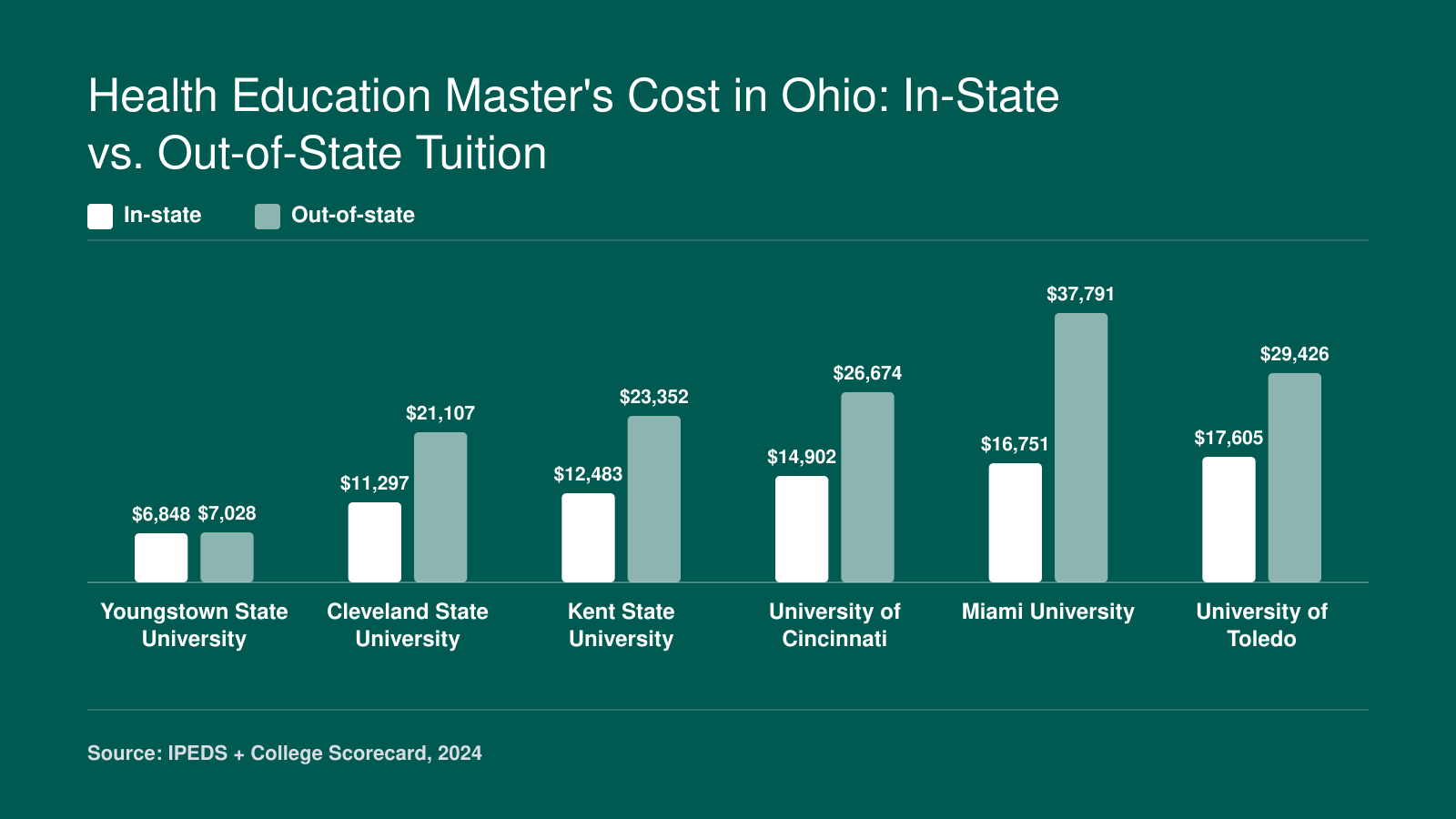
Health Education Master's Cost in Ohio: In-State vs. Out-of-State Tuition
Out-of-state students pay a steep premium at most of the schools here, though Youngstown State University's gap is small. Miami University-Middletown lists $726 per credit hour in-state for a 30-credit program, or about $21,780 in tuition before fees. Cleveland State University lists 31 credits, Kent State University 33 and the University of Toledo 45, so credit count shifts total cost as much as the rate does. Youngstown State delivers its program online, so ask its bursar whether a flat online rate applies to non-residents. Net price is an institution-wide average after aid, not a quote for any one program.
CHES Certification and Ohio School Health Licensure for Master's Students
CHES certification1 and an Ohio school health license lead to different careers. CHES fits community, hospital, and public health roles; the Ohio license is the requirement for teaching health in public schools.
CHES Eligibility at a Glance
NCHEC eligibility is based only on academic qualifications.2 You need a bachelor's degree or higher from an accredited institution, with either a major in a health education discipline such as Health Education, Community Health Education, Public Health Education, or School Health Education, or at least 25 semester credits or 37 quarter hours of coursework with a grade of C or better tied to the Eight Areas of Responsibility.2 The credit route requires at least 12 semester credits from process courses aligned with those Areas.2 Contact each program to confirm how its curriculum maps to the Eight Areas, since published alignment details vary.
School Health Licensure in Ohio
To teach health in Ohio public schools, you need an Ohio teaching license, a requirement covered in master of arts in teaching programs in Ohio. The route typically includes a content exam, but whether a given master's program requires an existing teaching license or leads to initial licensure is not uniform across the schools ranked here. Review the admissions and licensure pages for the program you are considering, and ask if the school health track includes initial licensure or is designed for licensed teachers adding a health endorsement.
Ohio Health Education Teaching License Requirements
Earnings and Debt for Ohio Health Education Master's Graduates
Figures come from IPEDS and College Scorecard (2024) and are program-level medians for master's completers, measured one year and four years after completing. Miami University pairs the lowest median debt shown here ($20,500, about $233 a month over 10 years) with the highest four-year earnings ($62,717). Kent State University and Cleveland State University graduates carry more debt ($30,947 and $32,587), so their monthly payments run higher at $352 and $371. University of Cincinnati graduates earn less one year out ($40,067) but reach $58,174 by year four, so the early payoff window matters when you judge value.
| School | Program | Median earnings 1 year after completing | Median earnings 4 years after completing | Median debt | Monthly payment (10-year plan) |
|---|---|---|---|---|---|
| Kent State University | Health Education and Promotion | $59,593 | $62,189 | $30,947 | $352 |
| Miami University | M.S. in Kinesiology, Nutrition, and Health (Public Health Education and Health Promotion) | $53,545 | $62,717 | $20,500 | $233 |
| University of Toledo | Master of Public Health (Health Promotion and Education) | $59,624 | |||
| Cleveland State University | M.Ed. in Community Health Promotion | $51,122 | $58,143 | $32,587 | $371 |
| Youngstown State University | Master of Health and Human Services (Health Promotion) | $53,170 | |||
| University of Cincinnati | Master of Public Health (Health Education and Promotion) | $40,067 | $58,174 | $29,125 | $331 |
FAQs About Health Education Master's Programs in Ohio
What is the difference between an MPH in health promotion and a master's in health education?
Can I complete a health education master's part time in Ohio?
Do I need a teaching license for school health education in Ohio?
Which Ohio master's in health education programs qualify for CHES certification?
Compare Health Education programs on the data that matters
Explore more Healthcare specializations or browse every graduate field.
All Healthcare programs