Best Public Health Nursing MSN Programs in Maryland
Compare 2 accredited Public Health programs in Maryland, with graduate earnings, cost, debt, and completion data from IPEDS and the U.S. College Scorecard.

Public health nursing occupies a narrow niche in Maryland graduate education: the work is population-level, yet few master's programs are built around it. The University of Maryland, Baltimore offers a dedicated MSN in Community/Public Health Nursing, while Johns Hopkins and the University of Maryland-College Park offer public health master's degrees outside nursing.
In-state graduate tuition across these programs spans $17,827 to $64,730, with hybrid and campus formats.
Either way, the degree adds specialization, not a license. Your authority to practice still rests on your Maryland RN license.
Key Points
- University of Maryland, Baltimore offers the only true public health nursing MSN here, in a hybrid format.
- Johns Hopkins and Maryland-College Park offer public health master's degrees outside nursing for RNs.
- Your Maryland RN license, not the MSN, grants authority to practice.
Best Public Health Nursing MSN Programs in Maryland, Ranked
Only one Maryland school in our data offers a true MSN in community and public health nursing, so it leads this list. The two schools that follow are public health master's degrees outside nursing. They suit RNs who want a broader public health credential or who plan to pair nursing with a second degree.
University of Maryland, Baltimore
#1Baltimore, MD · ~$18,000/yr (est.)
Best for: Licensed RNs targeting population health leadership
The University of Maryland School of Nursing in Baltimore offers the only MSN in Community/Public Health Nursing identified in Maryland. The hybrid program prepares RNs for population health leadership, with a focus on health disparities and social justice. Faculty have ties to more than 50 community programs, which supports practicum placements across Maryland. Nursing is accredited by CCNE and the institution by Middle States. The optional MSN/MPH is awarded jointly with the School of Medicine, whose MPH is CEPH-accredited through July 1, 2030.
- Hybrid: five online courses and five face-to-face courses
- 38 credits and 315 practicum hours across two practicum courses
- Full-time completion in as little as two years; part-time available
- Admission: BSN, 3.0 GPA, current RN license, essay, one recommendation
- Tuition: $926 per credit in-state, $1,643 per credit out-of-state
- Optional MSN/MPH; up to six MPH credits count toward MSN electives
- Competency-based curriculum focused on population health and equity
- Accredited by the Commission on Collegiate Nursing Education (CCNE)
University of Maryland-College Park
#2College Park, MD · ~$18,000/yr (est.)
Best for: Working professionals wanting a blended MPH
The University of Maryland, College Park offers a Master of Public Health in Public Health Practice and Policy through its School of Public Health, which is CEPH-accredited. It is not a nursing degree, so it fits RNs seeking policy and practice training rather than an MSN. The blended format is built for working professionals. The school has a graduation rate of 89%, and the program does not require GRE scores.
- Hybrid: online courses plus six residency weekends on campus
- GRE scores not required
- Minimum 3.0 undergraduate GPA and one undergraduate math course
- Three letters of recommendation; SOPHAS and UMD supplemental applications
- Fall and spring 16-week terms; summer has two 6-week sessions
- Starts fall, spring, or summer
- School of Public Health is accredited by CEPH
Johns Hopkins University
#3Baltimore, MD · ~$65,000/yr (est.)
Best for: Global health aspirants studying on campus
Johns Hopkins University offers an MSPH in International Health through the Bloomberg School of Public Health. It is an on-campus public health science degree, not an MSN, so it is best viewed as a global health option rather than a public health nursing route. The school has a graduation rate of 94%. Scholarships can cut tuition substantially for students in good standing.
- Five concentration options, including a Human Nutrition dietitian track
- Complete in 1.5 to 2 years; onsite and full-time
- Core training in epidemiology and biostatistics
- Required practicum in domestic or international settings
- 36-week dietetic practicum toward the Registered Dietitian credential
- 75% tuition reduction in year two for eligible students
- Need-based scholarships cover up to 50% of first-year tuition
- No prior international experience required
Cost & outcomes by school
Federal data for the highest-earning Public Health programs, independent of the ranking above. Earnings are this field's master's graduates four years after completing, where the Scorecard reports them.
| School | Earnings | Tuition / yr | Debt | Grads/yr | Format |
|---|---|---|---|---|---|
| University of Maryland, Baltimore MD | $100,525 | $17,827 | $76,133 | 178 | Hybrid |
| University of Maryland-College Park MD | — | $18,276 | — | — | Hybrid |
Sources: U.S. Department of Education. Tuition and graduates: IPEDS. Earnings and debt: College Scorecard, this field's master's graduates; a dash means no figure is reported.
How We Evaluated and Ranked These Master's Programs
Prestige and marketing tell one story; federal data often tell another. We leaned on the second story, using IPEDS and College Scorecard records to compare average net price, published graduate tuition, institution-wide graduation rates, and program-level earnings and debt where they are reported. Because students in online public health nursing MSN programs often take some courses in person, we ranked campus and online formats together rather than splitting them by delivery. To make the cut, a school had to be accredited and offer a public health nursing MSN program. A few limits matter: net price is an institution-wide average, not a personal quote, and graduation rate is not specific to this program. Read the list as a starting point, not a guarantee.
Online and Hybrid Public Health Nursing Master's Options in Maryland
The public health nursing MSN in this ranking is the University of Maryland, Baltimore (UMSON) hybrid MSN in Community/Public Health Nursing, which combines five online courses, five face-to-face courses, and two practicum courses. The ranked list also includes Johns Hopkins' campus-based MSPH and University of Maryland, College Park's hybrid Public Health Practice and Policy, but those are public health degrees rather than nursing MSN tracks.
UMSON's 38-credit program includes 315 service-learning hours and can be completed in as few as four semesters, full-time or part-time. The five face-to-face courses and the practicum require in-person attendance in Baltimore; placement is advisor-arranged.
Entry pathways
UMSON's RN-to-MSN pathway, listed among RN to MSN programs in Maryland, awards a BSN and MSN with the Community/Public Health specialization, applying six credits from two BSN-level courses and allowing completion within six years. Applicants without a bachelor's need all 59 prerequisite credits. A standard BSN-to-MSN entry follows the 38-credit sequence. For non-nursing majors, UMSON's Direct Entry MSN is the Clinical Nurse Leader track, not Community/Public Health, so it does not connect directly to this specialty.
Out-of-state enrollment
UMSON has not published a full state-by-state authorization list, so out-of-state students should confirm eligibility before applying. Maryland participates in NC-SARA, but clinical placements require Maryland Board of Nursing coordination and an approved preceptor. The in-person courses and 315 practicum hours may need to be completed in Maryland, so do not assume fully remote attendance or home-state placement.
Related Articles
Which Maryland Public Health Nursing Master's Programs Waive or Skip the GRE
Do you need a GRE score to apply for a public health nursing master's in Maryland? For most applicants, the answer is no. Nursing graduate programs have largely moved away from the exam over the past decade, and Master's Programs in Maryland reflect that shift toward master's programs with no GRE required. Still, policies change and admissions pages are the only reliable source, so confirm every detail directly before you apply.
- University of Maryland School of Nursing: The retrieved program page for the Community/Public Health Nursing MSN does not state a GRE requirement or waiver policy. Spring 2027 applications close December 15, 2026 (regular) and January 5, 2027 (final); Fall 2027 applications close July 15, 2027 (regular) and August 1, 2027 (final). The excerpt does not list RN license, GPA, essay, or reference requirements, so verify these with admissions.
- Johns Hopkins University School of Nursing: Official GRE scores are accepted but not required.1 The catalog directs applicants to the School of Nursing website for current deadlines and does not list additional required materials in the retrieved excerpt.
Confirm active RN licensure, minimum GPA, essays, and references with each school directly.
Cost, Financial Aid, and ROI of a Public Health Nursing Master's in Maryland
The most detailed published cost picture for a nursing-specific program comes from the University of Maryland School of Nursing's community/public health nursing MSN, a 38-credit program with 315 service-learning hours.
Tuition and Total Cost
For 2026-2027, residents pay $963 per credit and nonresidents pay $1,708, totaling $36,594 and $64,904 in tuition.1 Published four-year part-time totals add $8,557.25 in mandatory fees, bringing the estimate to $45,151.25 for residents and $73,461.25 for nonresidents.1 The school does not publish a fixed total for books, transportation, uniforms, or clinical travel, so budget those separately. The institution-wide average net price after aid is $15,678 at University of Maryland-College Park and $18,809 at Johns Hopkins.
Financial Aid to Offset Cost
Maryland nursing students comparing the Most Affordable Public Health Nursing MSN Programs can combine several sources. The Maryland Workforce Shortage Student Assistance Grant offers $2,000 per year full-time for nursing2, with a 2026-2027 deadline of October 15; recipients commit to work as a nurse in Maryland after graduation.3 The MHEC Graduate/Professional School Scholarship uses the FAFSA with a March 1 priority deadline.4 HRSA's Nurse Corps scholarship covers tuition and fees in exchange for two years of full-time service at a critical-shortage facility with a HPSA score of 14 or higher; the 2026 application opens March 10 and closes April 9.5 Employer tuition assistance and school nursing scholarships can fill remaining gaps.
Return on Investment
For public health master's programs at University of Maryland-College Park and Johns Hopkins, federal data report median debt of $19,000 and $10,250 and one-year median earnings of $72,607 and $70,790.
What Public Health Nurses Earn in Maryland
Public health nursing roles start from the RN wage baseline.
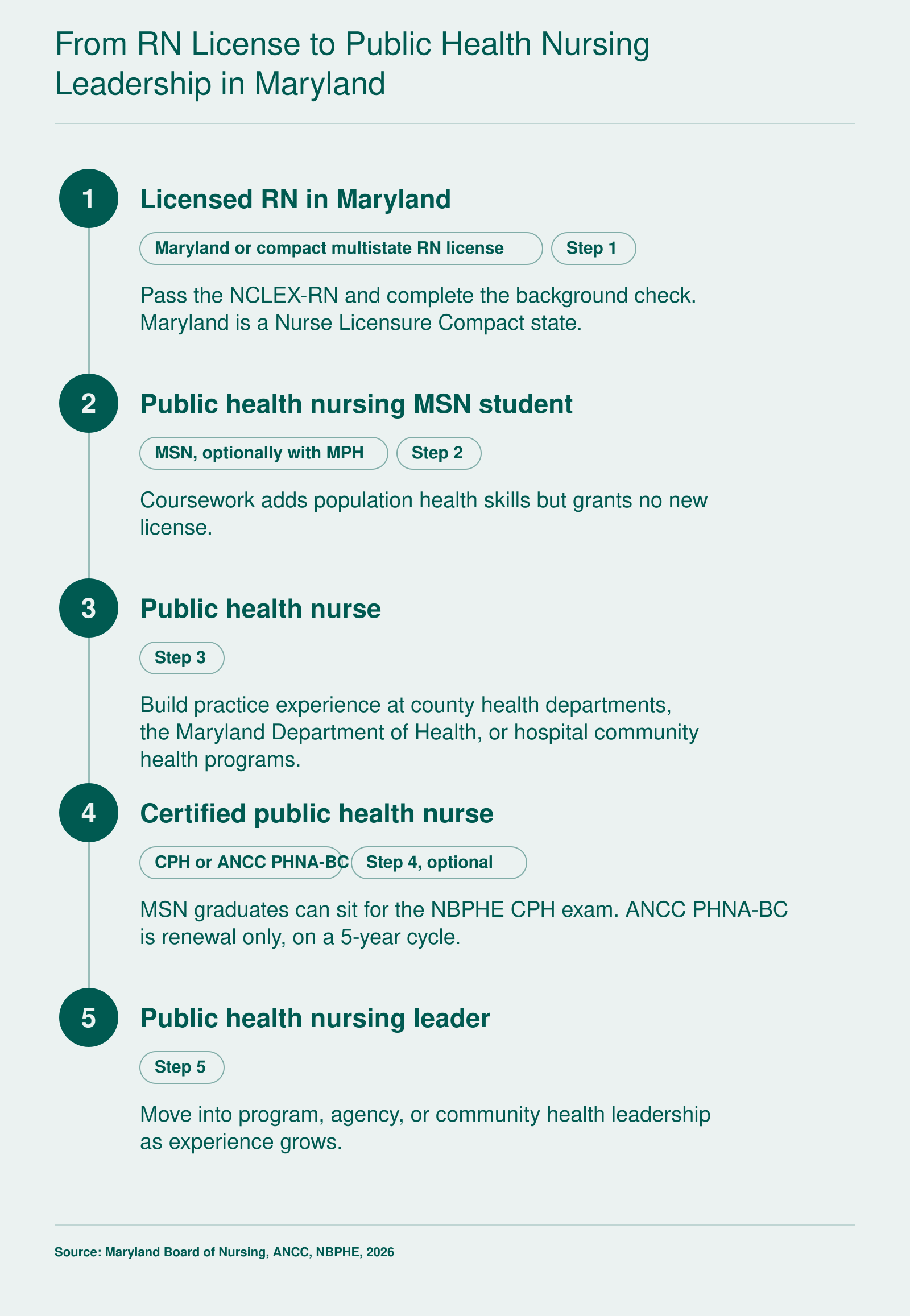
From RN License to Public Health Nursing Leadership in Maryland
The MSN is an academic specialization, not a separate state license. Your authority to practice rests on your RN license through the Maryland Board of Nursing.
Frequently Asked Questions About Public Health Nursing MSN Programs in Maryland
Is the University of Maryland the only Maryland MSN program focused on community or public health nursing?
Can I complete a Maryland public health nursing master's from outside the state?
Do any Maryland schools offer an MSN/MPH dual degree? Name the schools and whether the MPH side is CEPH-accredited
Does the MSN lead to a recognized public health nursing certification or only an academic specialization?
Compare Public Health programs on the data that matters
Explore more Nursing specializations or browse every graduate field.
All Nursing programs