Most Affordable Public Health Nursing MSN Programs
Compare 100+ accredited most affordable Public Health programs at 60+ schools, with graduate earnings, cost, debt, and completion data from IPEDS and the U.S. College Scorecard.
A hospital-based RN and a county public health nurse can hold the same license but land in different pay brackets; government and community roles often pay less than acute care. That gap makes tuition the deciding variable in whether a public health nursing MSN earns back its cost.
Among the schools ranked here, average annual net price after grant aid runs from roughly $2,984 at CUNY Hunter College to about $10,440 at Cal State Long Beach.
Clinical loads differ just as sharply: Hunter requires 501 clinical hours, while Aspen University's online MSN requires a 120-hour practicum.
Key Points
- Net prices range from $2,984 at Hunter College to $9,478.
- Employers can cover up to $5,250 in tuition tax-free.
- HRSA Nurse Corps Scholarship covers tuition, fees, and monthly stipend.
10 Most Affordable Public Health Nursing MSN Programs for 2027
These ten programs rank as the most affordable public health nursing MSN options for 2026 based on current tuition, net price, and cost-of-living adjustments. The list prioritizes schools that keep out-of-pocket costs low while offering formats and placements that fit working nurses. Each entry is paired with the program details that matter most for value.
CUNY Hunter College
#1New York, NY · ~$11,000/yr (est.)
Best for: Budget-conscious public health nurses in New York
Graduate in-state tuition is about $7,382 and out-of-state about $15,332, with an average net price near $2,984. The Community/Public Health Nursing MS combines online didactic courses with in-person practicums. The standalone MS is not currently accepting applications, but the dual MS/MPH options remain available. Value: very low net price and a public CUNY location for New York public-health nurses.
- 42-credit program with 501 clinical hours.
- Online didactic courses and in-person practicums.
- CEPH accredited with community and population health focus.
- Covers community health assessment, epidemiology, and health promotion.
- Prepares for clinics, public health agencies, and community programs.
- Dual MSN/MPH degree requiring 57 credits.
- Community Health Education concentration.
- Full-time in five semesters with part-time options.
- Late afternoon and evening courses available.
- CCNE accredited with BSN and 3.0 GPA admission requirements.
- New York nursing license, statistics, and research prerequisites.
- Low tuition as a tax-supported public institution.
- Environmental and Occupational Health concentration.
- 57-credit dual MSN/MPH degree.
- Full-time or part-time study options.
- CCNE accredited with BSN and 3.0 GPA requirements.
- New York nursing license, statistics, and research prerequisites.
- Public institution tuition keeps this dual degree affordable.
- Urban public health dual degree with Community Health Education concentration.
- 57-credit MSN/MPH pathway.
- Evening and late afternoon course offerings.
- Full-time in five semesters or part-time.
- CCNE accredited with BSN and 3.0 GPA requirements.
- GRE, New York nursing license, statistics, and research prerequisites.
- Prepares for Advanced Public Health Nurse certification.
- Urban public health dual degree with Environmental and Occupational Health concentration.
- 57-credit MSN/MPH pathway.
- Late afternoon and evening scheduling available.
- Full-time in five semesters or part-time.
- CCNE accredited with BSN and 3.0 GPA requirements.
- GRE, New York nursing license, statistics, and research prerequisites.
- Includes practicum experiences in community settings.
California State University-Los Angeles
#2Los Angeles, CA · ~$9,000/yr (est.)
Best for: Urban health students seeking community-based fieldwork
Graduate in-state tuition is about $7,160 and out-of-state about $19,760, with an average net price near $3,967. The MPH emphasizes urban community health and is offered in campus and hybrid formats. Its high Pell share and Los Angeles location make it a strong value for students committed to urban population health.
- 42-unit MPH with urban community health emphasis.
- 36 core units and 6 elective units.
- Field experience and capstone option included.
- Some courses may be taught online.
- Requires 3.0 GPA, statement of purpose, and two letters of reference.
- Focus on improving population health in Los Angeles.
California State University-San Bernardino
#3San Bernardino, CA · ~$10,000/yr (est.)
Best for: Inland Empire nurses wanting local practicums
Graduate in-state tuition is about $8,093 and out-of-state about $20,693, with an average net price near $4,564. Clinical practicums are arranged near students' homes, often in San Bernardino and Riverside counties, which can lower commuting costs.
- Hybrid MSN with Advanced Community/Public Health Nursing concentration.
- Full-time completion in 2 to 2.5 years.
- Online coursework with limited in-person sessions.
- CCNE accredited with BSN and RN licensure required.
- Clinical practicums arranged near students' residences when possible.
- Fall 2026 introduces a fully online format.
- Placements concentrated in San Bernardino and Riverside counties.
- Curriculum aligned with 2021 AACN Essentials.
California State University-Fullerton
#4Fullerton, CA · $9,000 – $19,000/yr (est.)
Graduate in-state tuition is about $7,470 and out-of-state about $20,070, with an average net price near $6,555. The MPH offers multiple concentrations and requires a culminating project or internship. The school's overall graduation rate is 70%, and its strong retention signals a supportive environment for public health students.
- 42-unit MPH in College of Health and Human Development.
- 30 core units include a six-unit internship.
- 9 elective units plus a culminating experience.
- Concentrations in health promotion, environmental and occupational health, gerontological health, and special studies.
- Requires 2.7 GPA, GRE, two recommendations, and public health experience.
- Fall entry only.
California State University-Fresno
#5Fresno, CA · ~$9,000/yr (est.)
Graduate in-state tuition is about $7,350 and out-of-state about $19,950, with an average net price near $7,000. The MPH is fully online, cohort-based, and focused on health promotion. Its online format and one start per year make it a flexible, low-cost option for working public health professionals.
- Fully online MPH with health promotion track.
- 42 credit hours, two-year cohort program.
- Fall start only with cohort-based structure.
- Includes field experience and a culminating thesis, project, or comprehensive exam plus PH 297.
- Requires three professional letters of recommendation and a statement of intent.
- Each admitted student receives a faculty advisor.
California State University-Northridge
#6Northridge, CA · ~$9,000/yr (est.)
Graduate in-state tuition is about $7,458 and out-of-state about $20,058, with an average net price near $7,021. The MPH in Community Health Education includes evening and afternoon classes plus internships across Los Angeles County. Its partnership with the county public health department gives students direct access to local field placements.
- MPH with Community Health Education option.
- Evening and afternoon course offerings.
- Internships and fieldwork in hospitals, public health departments, and community organizations.
- Coursework includes health behavior, disease prevention, environmental health, biostatistics, and research methods.
- Partnership with Los Angeles County Public Health.
- Prepares for roles as health educators, public health nurses, epidemiologists, and program managers.
California State University-Long Beach
#7Long Beach, CA · $9,000 – $19,000/yr (est.)
Graduate in-state tuition is about $7,350 and out-of-state about $19,950, with an average net price near $10,440. The combined Beach EDGE program awards a B.S. and an MPH in Community Health Education, letting students double-count 12 units. Regional clinical agreements with Long Beach Memorial, the VA, and other local providers strengthen placement options.
- Beach EDGE combined B.S. and MPH in Community Health Education.
- MPH requires 42 units; 12 units may double-count across degrees.
- Concentrations in Latino Health, Global Health, or Community Health.
- Requires 3.5 Health Science GPA and 3.0 overall CSULB GPA.
- Requires 1,000-word statement, two faculty recommendations, resume, and transcript.
- Spring deadline November 1; fall deadline April 1.
Aspen University
#8Phoenix, AZ · ~$6,000/yr (est.)
Aspen's online MSN with Public Health specialization advertises a total program cost of $21,850 with monthly payment plans, and graduate tuition is about $6,870 for in-state and out-of-state. The program requires 120 practicum hours and is CCNE accredited. Employer tuition discount partnerships may further reduce cost for working nurses.
- 36-credit online MSN with Public Health specialization.
- Total program cost $21,850.
- Monthly payment plan of $415 for 46 months available.
- Requires BSN, 2.5 GPA, RN license, and one year of nursing experience.
- 120-hour practicum in local settings.
- CCNE accredited and can be completed in two years.
- Covers epidemiology, school nursing, case management, and public health theory.
- 57-credit RN to MSN pathway with Public Health concentration.
- Total program tuition $25,395.
- Flexible start dates every two weeks.
- 95% job placement rate reported by program.
- Requires 2.5 GPA and work experience; no application fee.
- 120 clinical hours and 8-week course terms.
The University of Texas at El Paso
#9El Paso, TX · $5,000 – $10,000/yr (est.)
Graduate in-state tuition is about $9,744 and out-of-state about $25,502, with an average net price near $9,403. The MPH concentration in Hispanic and Border Health is unique and focused on health equity along the U.S.-Mexico border. Its high Pell share and test-optional admission make it accessible for students from the region.
- 42-credit MPH with Hispanic and Border Health concentration.
- Only MPH with this concentration according to program.
- 15 core credits, 9 concentration credits, 6 practicum hours, and electives.
- Fall only cohort with 3.0 GPA and three letters of recommendation.
- GRE and MCAT optional.
- Includes 500-word essay and Zoom or Skype interview.
- Focus on health equity in border communities.
American Public University System
#10Charles Town, WV · $5,000 – $10,000/yr (est.)
APUS offers an online MSN with Community and Public Health Nursing concentration at $455 per credit, and the RN-to-MSN pathway can save nine credit hours for associate or diploma nurses. The school reports a high retention rate and accepts up to 90 undergraduate transfer credits. Its low, flat tuition for in-state and out-of-state students makes it a strong online value for military and working nurses.
- 36-credit online MSN with Community and Public Health Nursing concentration.
- Cost per credit $455.
- BSN, active RN license, 3.0 GPA, and statistics course required.
- Courses start every other month; 8 to 16 week course lengths.
- Includes practicum in community settings.
- Military rate $250 per credit and APUS grant $409.50 per credit.
- RN to MSN pathway for diploma or associate degree nurses.
- Three BSN courses substitute for three MSN courses, saving nine credit hours.
- Accepts up to 90 undergraduate transfer credits.
- 147 total credit hours with community and public health focus.
- Capstone project required.
Cost & outcomes by school
Federal data for the highest-earning Public Health programs, independent of the ranking above. Earnings are this field's master's graduates four years after completing, where the Scorecard reports them.
| School | Earnings | Tuition / yr | Debt | Grads/yr | Format |
|---|---|---|---|---|---|
| California State University-Fullerton CA | $182,816 | $8,994 | $41,000 | 20 | Campus |
| San Diego State University CA | $165,564 | $10,252 | — | 31 | Campus |
| California State University-San Marcos CA | $148,800 | $9,606 | $60,000 | 31 | Hybrid |
| California State University-Fresno CA | $147,082 | $8,865 | — | 7 | Online |
| CUNY Hunter College NY | $142,731 | $11,398 | $20,500 | 143 | Campus |
| Rhode Island College RI | $138,536 | $10,112 | $41,000 | 25 | Hybrid |
| Wayne State University MI | $137,480 | $17,960 | $50,500 | 51 | Campus |
| University of Kansas KS | $136,168 | $11,971 | — | 13 | Hybrid |
| The University of Tennessee-Chattanooga TN | $131,034 | $11,110 | $61,063 | 24 | Campus |
| Commonwealth University of Pennsylvania PA | $129,202 | $12,140 | $50,714 | 22 | Online |
| Florida International University FL | $125,543 | $11,334 | $42,812 | 94 | Hybrid |
| University of North Carolina at Charlotte NC | $125,281 | $8,037 | $41,000 | 48 | Online |
Sources: U.S. Department of Education. Tuition and graduates: IPEDS. Earnings and debt: College Scorecard, this field's master's graduates; a dash means no figure is reported.
Cost, debt & payoff
Median earnings of this field's master's graduates (4 yrs after completing) vs. their median federal loan debt · U.S. College Scorecard
Across these programs the median graduate earns about $121,198 and finishes with roughly $40,934 in debt — a ratio that clears a common rule of thumb (keep debt below first-year salary). Tuition and debt vary widely school to school, so check the per-school figures in the table above before you shortlist.
What Earns a Program the 'Affordable' Label in Our Rankings
An affordable public health nursing MSN is the program with the lowest out-of-pocket cost after grants and scholarships. That is the question this ranking tries to answer, so average net price and financial aid measures carry the most weight. Graduate tuition and the school's overall graduation rate act as secondary checks, because a low price means less if students rarely finish.
The figures come from College Scorecard and IPEDS, the federal data sets that report tuition, net price, and student outcomes. Two limits are worth knowing. The net price figure is a school-wide average, mostly reflecting undergraduate aid, so your cost in an affordable MSN program may differ. Graduation rates also describe the entire school, not the nursing program itself. Treat both as a starting point, then confirm per-credit graduate tuition and fees with each school before you apply.
The True Cost of a Public Health Nursing MSN, Beyond the Sticker Price
The sticker price rarely matches what you pay for an online public health nursing MSN. Federal net price figures for affordable master's programs, which subtract typical grant aid, run from $2,984 at Hunter College to $9,478 at Rhode Island College, a gap of roughly $6,500 before program charges.
Total Program Cost
- Liberty BSN-to-MSN: 36 credits at $600 per credit (up to $665) is $21,600 for 2026-27.
- Liberty RN-to-BSN-to-MSN: $350 per credit across 159 credits is $55,650 with no transfer; transfer credit lowers it.
- Worcester State: 35 credits at $504 is $17,640, using Fall 2024 rates.
- Maryland RN-to-MSN (one of many affordable RN to MSN programs): $963 per credit in-state, $1,708 out-of-state, 38 to 40 credits. Published four-year totals run $45,151.25 to $73,461.25.
Normalize Your Credits
A quarter credit is about two-thirds of a semester credit. Purdue Global's 82 quarter credits equal roughly 55 semester credits, so compare on one scale.
Costs Outside Tuition
- Fees: technology and online delivery charges.
- Clinical compliance: background check, immunizations, liability insurance.
- Books: course texts and materials.
Related Articles
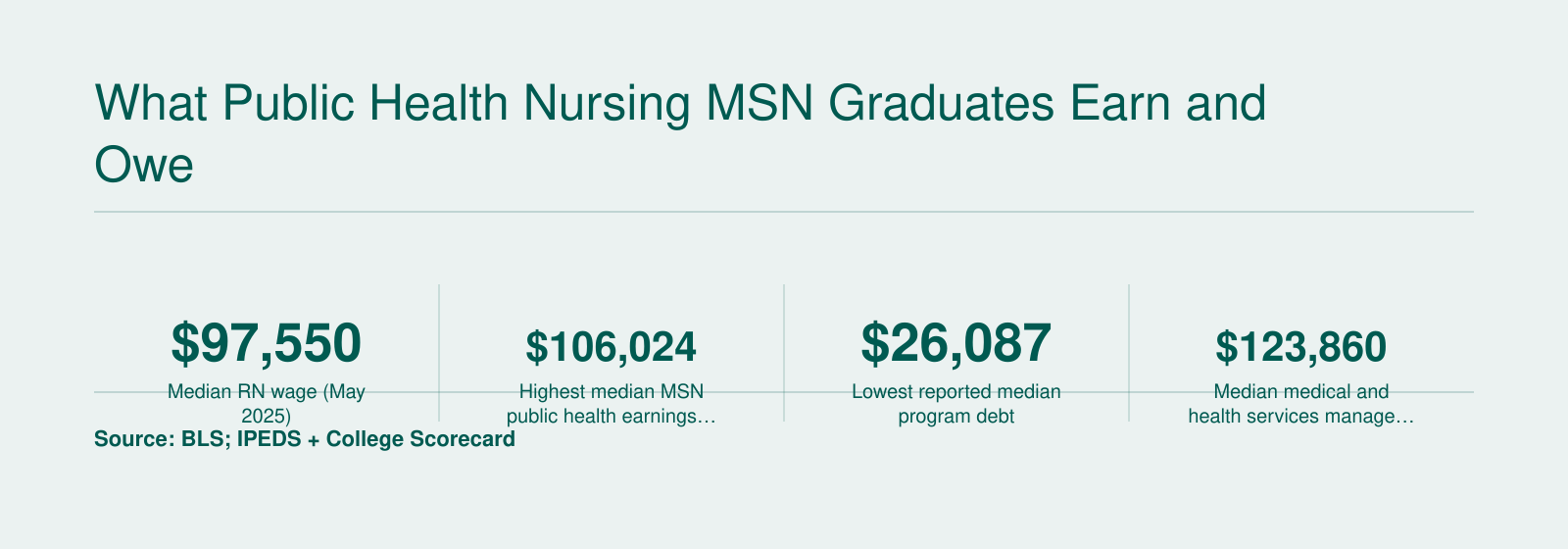
What Public Health Nursing MSN Graduates Earn and Owe
Federal data show the earnings and debt tradeoffs for public health nursing MSN graduates. These figures compare program-level outcomes with broad occupational benchmarks. The ANCC PHNA-BC credential can strengthen an MSN's value; confirm current eligibility directly with ANCC since status changes.
Public Health programs by state
Public Health Nursing MSN Questions, Answered
Prospective students often weigh tuition, clinical requirements, and career return before choosing a public health nursing MSN. These answers cover the most common questions about affordability, time commitment, and how this degree compares with a public health MPH.
What is the cheapest public health nursing MSN program?
How much does a public health nursing MSN cost?
How many clinical hours are required for a public health nursing MSN?
Is a public health nursing MSN worth it?
What's the difference between a public health nursing MSN and an MPH?
Can I finish a public health nursing MSN online without traveling for clinicals?
Compare Public Health programs on the data that matters
Explore more Nursing specializations or browse every graduate field.
All Nursing programs