Best Public Health Nursing MSN Programs in New York
Compare 5 accredited Public Health programs in New York at 1 schools, with graduate earnings, cost, debt, and completion data from IPEDS and the U.S. College Scorecard.

Which New York public health nursing master's pays off without burying you in debt? Tuition in the state runs from about $11,400 at CUNY Hunter College to well over $37,000 at private institutions, and only one school here offers a dedicated community and public health nursing MS.
That gap matters because many nurses end up in related public health master's degrees instead, with different curricula and different job targets. Campus, online, and hybrid formats are compared together, using net price, earnings, and debt rather than reputation.
New York employers still hire for population health roles, but the degree you choose shapes which ones you qualify for.
Key Points
- Hunter College offers the only dedicated community and public health nursing master's here.
- Hunter's hybrid format pairs online courses with 501 in-person clinical hours.
- Check CCNE or ACEN accreditation and NYSED registration before comparing price or GRE rules.
Top Public Health Nursing Master's Programs in New York, Ranked
Hunter College is the only school on this list with a dedicated community and public health nursing master's. The other schools offer public health or closely related master's degrees, which some nurses pursue instead of an MSN. We could not confirm CCNE or ACEN accreditation or NYSED registration for each nursing track, so verify both with the school before you apply. Program-level earnings are not yet available for these programs.
CUNY Hunter College
#1New York, NY · ~$11,000/yr (est.)
Best for: Working RNs seeking community health leadership
Hunter College, part of the public CUNY system, is the one school here with a dedicated Community/Public Health Nursing master's, plus dual MS/MPH options with CUNY's school of public health. Didactic courses are online with in-person practicums, which suits working nurses. The school graduates about 57% of its students institution-wide. Program materials describe the dual degrees as CCNE accredited; confirm that status and NYSED registration with the school.
- 42 credits with 501 clinical hours
- Online didactic courses with in-person practicums
- Covers community health assessment, epidemiology and health promotion
- Includes biostatistics, environmental health and health policy topics
- Contact the specialty director for current admission details
- 57-credit dual MSN/MPH degree
- Five semesters full-time, part-time options available
- Late afternoon and evening courses
- BSN with a 3.0 GPA and New York nursing license required
- Prepares for Advanced Public Health Nurse certification
- Materials list GRE as required; confirm the current policy
- 57-credit dual degree with an environmental and occupational health focus
- Five semesters full-time, part-time study available
- Includes practicum experiences in community settings
- Statistics and research course prerequisites
- Eligible for Advanced Public Health Nurse certification
Columbia University in the City of New York
#2New York, NY · ~$58,000/yr (est.)
Best for: Students leaning toward epidemiology research
Columbia's Mailman School of Public Health offers a Master of Public Health in Epidemiology, not a nursing MSN. It suits nurses who want a data and research career in population health rather than a nursing credential. The school graduates about 96% of its students institution-wide, though it is a high-cost private option.
- Two-year program with six epidemiology-related certificate options
- Applied Practice Experience required of every MPH student
- Accelerated one-year MPH option available
- Certificates include Global Health and Infectious Disease Epidemiology
- Campus-based delivery
New York University
#3New York, NY · ~$43,000/yr (est.)
NYU's School of Global Public Health awards a Master of Public Health, which is not a nursing degree. Nurses weighing an MPH against an MSN can use it as a benchmark for the public health route. The school graduates about 88% of its students institution-wide, and it is among the higher-cost options here.
- Applications filed through SOPHAS
- Three-stage review ending in an Admission Committee decision
- Fall start; the Fall 2027 application opens August 12, 2026
- Decisions are sent by email
- Campus-based delivery
Adelphi University
#4Garden City, NY · ~$33,000/yr (est.)
Adelphi offers a generalist Master of Public Health through its College of Nursing and Public Health, in person at Garden City or online. Its clinical and community partnerships with Long Island and New York-area health systems, plus internships such as the Nassau County Department of Health, give nurses practical exposure. The school graduates about 67% of its students institution-wide. This is an MPH, not an MSN.
- 42 credits, typically two to three years
- Fully online option or in-person at Garden City
- Electives in epidemiology, emergency management and community health
- Certificates available in emergency management or health promotion
- 2.85 GPA minimum and an undergraduate statistics course required
- Employees of Northwell, NYU Langone and Nassau County get a 15% discount
- Accredited by CEPH through July 1, 2027
Monroe University
#5Bronx, NY · ~$15,000/yr (est.)
Monroe University's King Graduate School offers a Master of Public Health in the Bronx with online and hybrid study. Its price is among the lowest on this list for a private school, and employer partnership grants can reduce it further. The school graduates about 57% of its students institution-wide. This is an MPH rather than a nursing MSN.
- 45 credits across five semesters, under two years full-time
- Concentrations in Community Health, Health Administration and Leadership, or Biostatistics and Epidemiology
- Three-credit semester-long internship required
- Pre-admission interview and 500-word essay required
- Corporate Partnership Grant of up to 20% of tuition for partner employees
- Fully online option available
SUNY Brockport
#6Brockport, NY · ~$12,000/yr (est.)
SUNY Brockport delivers a Master of Public Health entirely online, with a state-university price. Its curriculum emphasizes program planning, evaluation and community organizing, and prepares students for the CHES or MCHES health education credential. The school graduates about 55% of its students institution-wide. This is an MPH, not a nursing MSN.
- 100% online delivery
- Three-credit internship
- Covers program planning, evaluation and health communication
- Prepares for the National Health Education Specialist exam
- Anatomy and physiology and undergraduate statistics prerequisites
- Best consideration dates: April 1 for fall and summer, December 1 for spring
Long Island University
#7Brookville, NY · $25,000 – $30,000/yr (est.)
Long Island University offers a 42-credit Master of Public Health with full-time and part-time options and rolling admissions. The program materials say the GRE requirement is suspended. The school graduates about 57% of its students institution-wide. This is an MPH, so nurses seeking an APRN-style or nursing-specific credential should look elsewhere.
- 42 credits with a six-credit capstone and field practicum
- STEM-designated program
- GRE requirement suspended
- 3.0 GPA minimum and two letters of reference
- Rolling admissions with fall and spring starts
- Practicing U.S. physicians can finish in 12 to 18 months
Teachers College at Columbia University
#8New York, NY · $35,000 – $40,000/yr (est.)
Teachers College at Columbia University offers an MS in Nutrition and Public Health with Registered Dietitian Nutritionist preparation. It is relevant to nurses interested in food access and community nutrition, but it is not a nursing degree. Institution-wide graduation figures are not available for this school.
- 47 credits, full-time or part-time on campus
- Integrated MS-RDN track with dietitian preparation
- Fall start; priority deadline December 1, 2026, final deadline January 15, 2027
- Applications through DICAS with two recommendation letters
- Covers community nutrition assessment, advocacy and food systems sustainability
New York Medical College
#9Valhalla, NY · $25,000 – $30,000/yr (est.)
New York Medical College in Valhalla offers a generalist Master of Public Health with a one-year accelerated, blended track that starts in summer. Its Center for Disaster Medicine works with Yonkers Public Schools on emergency-preparedness training for school nursing staff, which may interest school-health nurses. Institution-wide graduation figures are not available. This is an MPH, not an MSN.
- 42 credits across 14 courses, with 18 to 21 elective credits
- One-year accelerated track must start in summer
- Optional advanced certificates in seven areas, including epidemiology and emergency management
- Joint D.P.T./M.P.H. and M.D./M.P.H. options
- 50+ practicum sites
- Comprehensive examination required
Cost & outcomes by school
Federal data for the highest-earning Public Health programs, independent of the ranking above. Earnings are this field's master's graduates four years after completing, where the Scorecard reports them.
| School | Earnings | Tuition / yr | Debt | Grads/yr | Format |
|---|---|---|---|---|---|
| CUNY Hunter College NY | $142,731 | $11,398 | $20,500 | 143 | Campus |
Sources: U.S. Department of Education. Tuition and graduates: IPEDS. Earnings and debt: College Scorecard, this field's master's graduates; a dash means no figure is reported.
Cost, debt & payoff
Median earnings of this field's master's graduates (4 yrs after completing) vs. their median federal loan debt · U.S. College Scorecard
Across these programs the median graduate earns about $142,731 and finishes with roughly $20,500 in debt — a ratio that clears a common rule of thumb (keep debt below first-year salary). Tuition and debt vary widely school to school, so check the per-school figures in the table above before you shortlist.
Online and Hybrid Public Health Nursing Master's Options in New York
Hunter College's Community/Public Health Nursing MS is the clearest hybrid-style public health nursing option on this page. The program requires in-person attendance, including the required clinical practicum. Hunter lists 42 total credits and 501 clinical hours, but the program does not publish whether the school arranges placements or students must secure a preceptor.
For comparison, several public health master's programs in Master's Programs in New York use hybrid or online delivery: Adelphi, Monroe, and New York Medical College are hybrid, and SUNY Brockport is online, while Columbia, NYU, LIU, and Teachers College are campus-based. Those programs are public health degrees, not nursing MSNs, so nursing-specific placement expectations differ.
Online delivery rarely means fully remote. Students in public health nursing MSN programs still complete practicum hours at health departments, community agencies, hospitals, or outpatient clinics. Hunter's materials do not confirm specific approved sites, so verify NYC agency or county health department options before enrolling.
GRE Requirements: Which New York Master's Programs Waive the GRE
Policies below come from admissions pages, and several apply to a school's MPH programs rather than a nursing MSN specifically. Treat them as signals, not guarantees for the nursing track.
- No GRE required: NYU is among No-GRE master's programs; it states the GRE is not required nor considered for its MPH. Long Island University lists its MPH GRE requirement as suspended.
- Optional or waivable: No school here publishes a clear waiver condition, such as a GPA threshold, that we could confirm for a nursing MSN.
- GRE required: Teachers College lists an entrance exam for its Nutrition and Public Health MS. Confirm which test it means.
- No published policy found: Hunter College (Community/Public Health Nursing MS), Columbia, Adelphi, Monroe University, SUNY Brockport, and New York Medical College. We did not infer a policy for any of them.
Before you apply, confirm the policy for your specific entry term. Nursing Master's Programs often change test requirements between cycles, and a program director can tell you quickly.
Related Articles
Cost, Licensure, and Certification for New York Public Health Nurses
What the programs cost
Graduate tuition across the schools here spans a wide range. CUNY Hunter College is the most affordable option on this list, with in-state graduate tuition near $11,400 (roughly $20,800 for out-of-state students). SUNY Brockport and Monroe University sit in the mid-teens, while Columbia University tops the range at close to $58,000, with NYU and Adelphi following. Net price figures tell a different story: Hunter's is under $3,000, while NYU's approaches $37,000. Treat net price as a rough signal only. It is an institution-wide average of what students actually pay after grants and scholarships, not a graduate nursing figure, so your own bill may look nothing like it.
Program-level median debt and monthly repayment amounts have not been published for these public health nursing tracks. Institution-wide debt averages are not a valid stand-in, so ask each admissions office for cohort-specific borrowing data before you commit.
Certification after graduation
ANCC's Advanced Public Health Nursing credential (APHN-BC) remains active; the older public health clinical nurse specialist certification has been retired. The NBPHE Certified in Public Health exam is also current, renewing on a two-year cycle1, but an MSN alone does not guarantee eligibility. Pathways run through CEPH-accredited program enrollment or alumni status, or work experience (five years with a bachelor's, three with a relevant graduate degree or graduate certificate) under the CPH eligibility requirements. Hunter-Bellevue's onsite community/public health nursing master's is listed as preparing graduates for APHN certification.
New York Licensure for Public Health Nurses
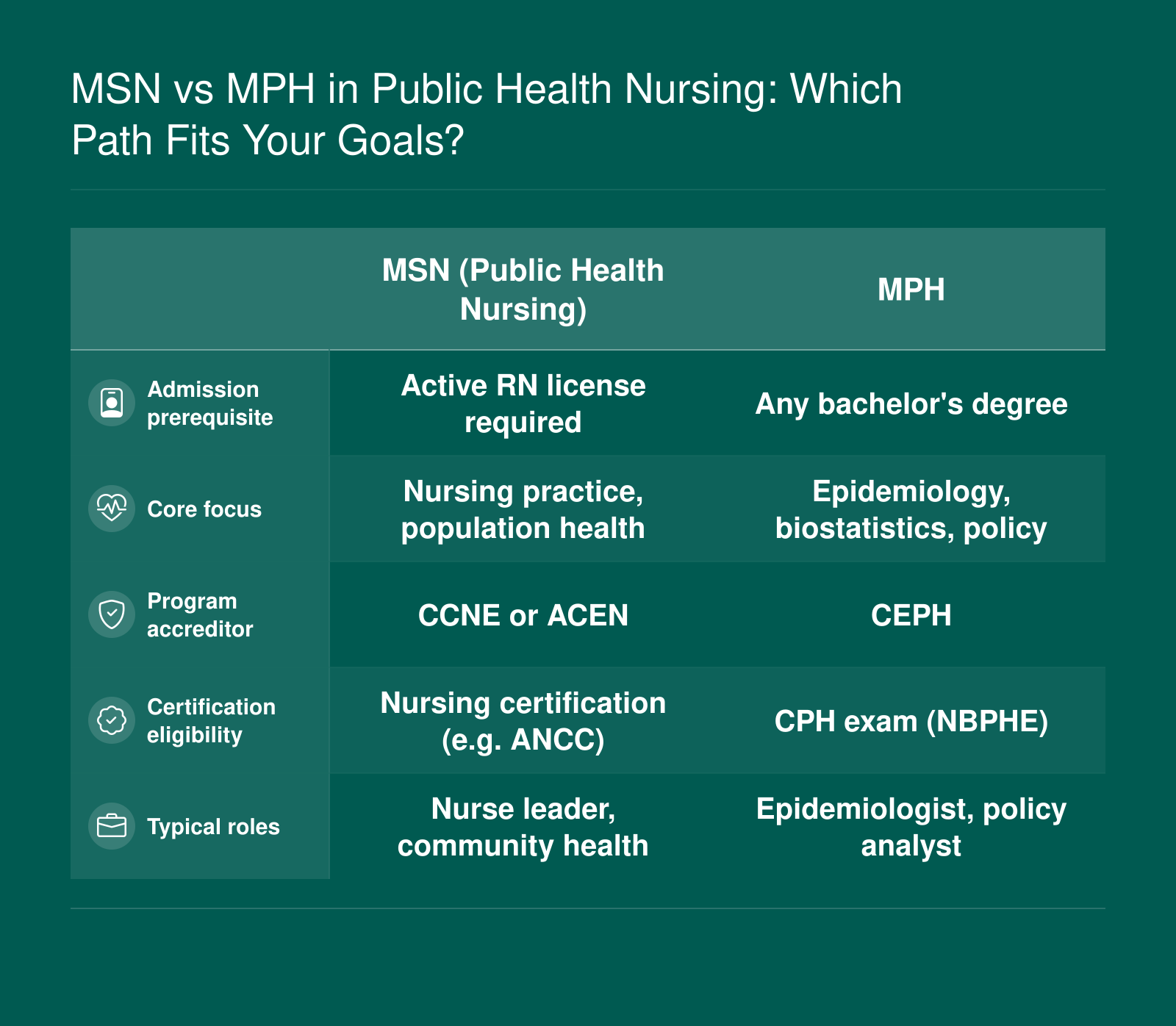
MSN vs MPH in Public Health Nursing: Which Path Fits Your Goals?
Both degrees prepare you to work on community and population health, but they start from different places and lead to different jobs. The MSN suits RNs who want to stay in nursing leadership, while the MPH suits those aiming at epidemiology or policy roles. Dual MSN/MPH degrees also exist at some New York institutions for students who want both credentials.
Admissions, Prerequisites, and RN-to-MSN Pathways
Requirements differ by school, so confirm each against the program's own admissions page before you apply.
- BSN and active New York RN licenseTraditional entry usually requires a BSN from an accredited nursing program (CCNE, ACEN, or CNEA) and an unencumbered New York RN license.
- Minimum GPAA 3.0 is the most common benchmark. Some schools admit applicants slightly below it on probation or provisionally.
- Prerequisites and experienceExpect a graduate-level or undergraduate statistics course. Some programs also ask for one or more years of RN practice.
- References and statementPlan on a résumé, transcripts, two recommendations, and a personal statement.
- Bridge and direct-entry routesRN-to-MSN bridges for associate-degree nurses and direct-entry tracks for non-nursing bachelor's holders exist only at some schools. Do not assume your target program offers either.
- Deadlines and transfer creditDeadlines and transfer-credit limits vary. Where a school does not publish them, ask the program director directly.
Frequently Asked Questions About Public Health Nursing Master's Programs in New York
These answers draw on the federal data behind our rankings and general New York licensing information. Program-level outcome data for nursing master's degrees is limited, so treat the figures as starting points and confirm details with each school.
Is an MSN in public health nursing worth it?
How much does a public health nursing MSN cost in New York?
Do I need an active RN license before starting a public health nursing master's in New York?
Can I keep working full-time as an RN during an online public health nursing MSN?
Compare Public Health programs on the data that matters
Explore more Nursing specializations or browse every graduate field.
All Nursing programs