Accelerated Public Health Nursing MSN Programs
Compare 100+ accredited fastest Public Health programs at 60+ schools, with graduate earnings, cost, debt, and completion data from IPEDS and the U.S. College Scorecard.
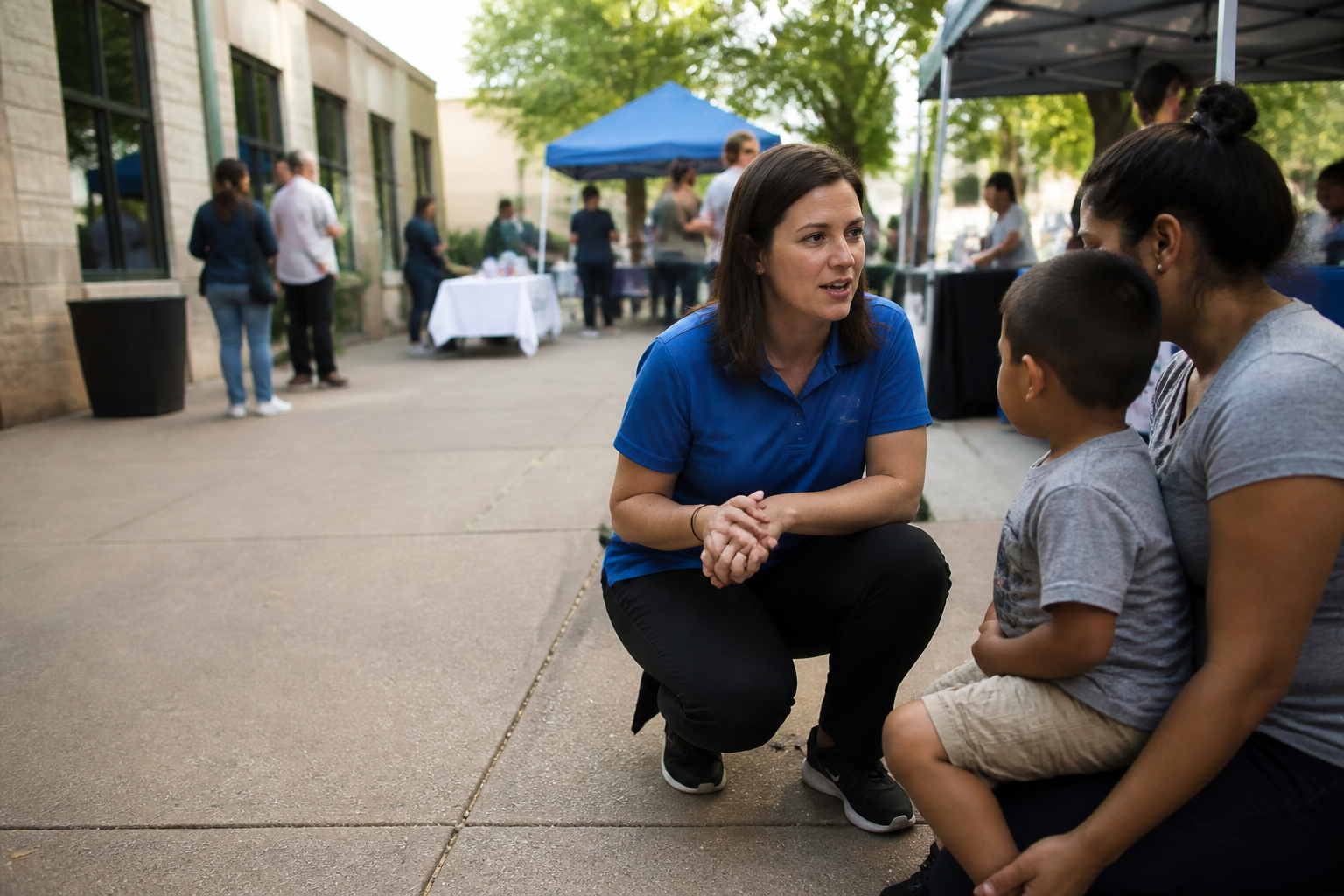
Public health nursing MSNs can be finished faster than the usual two to three years, but only when your starting credential matches the track.
"Accelerated" usually means a compressed RN-to-MSN program or a full-time BSN-to-MSN sequence. Timelines swing widely between associate-degree nurses, BSN holders, and career changers.
Speed carries a tradeoff: faster tracks compress practicum scheduling, and health department roles still depend on state-specific requirements.
Key Points
- In-state tuition spans $3,648 at UNC Pembroke to $11,679 at Portland State.
- Clinical placements, not coursework, set the real pace of accelerated degrees.
- RN-to-MSN, BSN-to-MSN, and direct entry all lead to the same master's degree.
Fastest Accelerated Public Health Nursing MSN Programs for 2027
Speed was the first filter; cost, completion, and graduate payoff sorted the rest. Because this category mixes direct public health nursing MSNs with accelerated MPH programs, this list puts the confirmed nursing MSN first and keeps the fastest MPH options that working nurses often compare. Accreditation notes are limited to programs we could verify.
University of Kansas
#1Lawrence, KS · $12,000 – $27,000/yr (est.)
Best for: RNs seeking public health specialty
University of Kansas offers a Master of Science in Nursing with a Public Health Nursing specialty, making it the most direct match in this group for nurses who want community-based and population-focused advanced practice. The hybrid MSN requires at least 39 credits and combines online and campus work on the Kansas City campus. It expects a BSN, current RN license, a 3.0 GPA, and clinical experience, with fall and spring starts. The university reports a 69% institution-wide graduation rate.
- 39 credit hour MSN specialty
- Hybrid format with online and campus components
- Focuses on health promotion and disease prevention
- Includes epidemiology and environmental health topics
- Requires BSN, RN license, 3.0 GPA
- Fall and spring application deadlines
- Emphasizes community-based interventions
Columbia University in the City of New York
#2New York, NY · ~$58,000/yr (est.)
Best for: Experienced clinicians wanting accelerated MPH
Columbia's Mailman School of Public Health houses an accelerated one-year MPH option in epidemiology for students who want intensive training. The program requires substantial health-related work experience, a distinction that matters for experienced nurses considering an MPH. It also offers six epidemiology-related certificates and an Applied Practice Experience. Columbia's institution-wide graduation rate is about 96%.
- Accelerated one-year MPH option
- Applied Practice Experience required
- Six epidemiology-related certificate programs
- Requires substantial health-related work experience
- Full-time on-campus cohort
Florida International University
#3Miami, FL · ~$11,000/yr (est.)
Best for: Online learners needing one-year MPH
Florida International University's Robert Stempel College offers a 45-credit MPH that can be completed in as little as one year through an accelerated track, with fully online and in-person formats. The public health program includes nine concentration areas and reports more than 200 South Florida partnerships. FIU's institution-wide graduation rate is 74%.
- 45 total credit hours
- Accelerated track finishes in one year
- Fully online option available
- Nine concentration areas
- Over 200 South Florida partnerships
- Domestic deadline June 1
- International deadline February 15
Harvard University
#4Cambridge, MA · $55,000 – $60,000/yr (est.)
Harvard Chan School offers a Master of Public Health in Health and Social Behavior with 45-credit and 65-credit variants. The 45-credit track can be completed in one year full time for established professionals and medical students, while the 65-credit track serves early career professionals in 1.5 years. Both start on campus in fall and include an applied practice experience. Harvard's institution-wide graduation rate is about 98%.
- 45-credit track takes one year full time
- 65-credit track takes 1.5 years full time
- Two variants for different experience levels
- Fall start on campus
- No entrance exam required; test optional
- Focus on health disparities and social determinants
- Careers in government, advocacy, community health
Tufts University
#5Medford, MA · ~$51,000/yr (est.)
Tufts University School of Medicine runs a 42-credit Master of Public Health on campus in Boston and online, with an accelerated pathway available in either format. Admission is test optional and does not require a specific major or work experience. Tufts reports a 94% institution-wide graduation rate.
- 42 total credit hours
- Accelerated online or on-campus pathway
- 25% tuition scholarship for admitted students
- Test optional; GRE, MCAT, GMAT accepted
- No specific major or work experience required
- Fall and spring application deadlines
Virginia Polytechnic Institute and State University
#6Blacksburg, VA · ~$19,000/yr (est.)
Virginia Tech offers a Master of Public Health with concentrations in infectious disease, environmental health, and public health education. The program includes an accelerated MPH option and can be combined with DVM or doctoral degrees. Full-time students start in fall, while part-time students may enter year-round. The institution-wide graduation rate is 86%.
- Three concentration options
- Accelerated MPH degree option
- Combined MPH-DVM and MPH-doctoral pathways
- Full-time fall admission
- Part-time entry any time of year
- 3.0 GPA over last 60 undergraduate hours
- 800-word personal statement required
University of California-San Diego
#7La Jolla, CA · $15,000 – $20,000/yr (est.)
UC San Diego offers a Master of Public Health with six concentrations, including epidemiology, health behavior, public mental health, and health policy. The program is on campus and has priority and standard fall deadlines, with no GRE requirement since 2022. The institution-wide graduation rate is 86%.
- Six concentration options
- No GRE scores required since 2022
- Fall 2027 applications open September 2, 2026
- Priority deadline December 2, 2026
- Standard deadline February 3, 2027
- 3.3 GPA in last two years preferred
- One year practical experience preferred
Loyola University Chicago
#8Chicago, IL · ~$22,000/yr (est.)
Loyola University Chicago's Parkinson School offers a 42-credit MPH with tracks in epidemiology, public health policy and management, global health equity, and biostatistics. The hybrid program has fall, spring, and summer starts and an accelerated pathway. Loyola's institution-wide graduation rate is 73%.
- 42 total credit hours
- Four concentration tracks
- Hybrid, in-person, or online delivery
- Fall, spring, and summer starts
- Accelerated Master's Pathway available
- 3.0 GPA recommended
- Practicum and capstone required
Colorado State University-Fort Collins
#9Fort Collins, CO · ~$14,000/yr (est.)
Colorado State University-Fort Collins offers an MPH through the Colorado School of Public Health with an accelerated plan that finishes in as few as 15 months. Seven concentrations are available, and part-time students can take up to five years. The institution-wide graduation rate is 67%.
- Seven concentration options
- Accelerated plan finishes in as few as 15 months
- Part-time students get up to five years
- Mix of in-person and online courses
- Option to start remotely
- Dual-degree options include MD, DVM, MBA, MSW
Concordia University-Wisconsin
#10Mequon, WI · ~$13,000/yr (est.)
Concordia University Wisconsin offers a 42-credit MPH in Applied Community and Population Health that is fully online with accelerated 8-week courses. The program requires a bachelor's degree and two letters of recommendation. Concordia's institution-wide graduation rate is 68%.
- 42 total credit hours
- Fully online format
- Accelerated 8-week courses
- 3.0 GPA minimum
- Personal essay and resume required
- Focus on systems thinking, implementation science, informatics
Cost & outcomes by school
Federal data for the highest-earning Public Health programs, independent of the ranking above. Earnings are this field's master's graduates four years after completing, where the Scorecard reports them.
| School | Earnings | Tuition / yr | Debt | Grads/yr | Format |
|---|---|---|---|---|---|
| Everglades University FL | — | $24,080 | — | — | Hybrid |
Sources: U.S. Department of Education. Tuition and graduates: IPEDS. Earnings and debt: College Scorecard, this field's master's graduates; a dash means no figure is reported.
Cost, debt & payoff
Median earnings of this field's master's graduates (4 yrs after completing) vs. their median federal loan debt · U.S. College Scorecard
Across these programs the median graduate earns about $121,198 and finishes with roughly $40,934 in debt — a ratio that clears a common rule of thumb (keep debt below first-year salary). Tuition and debt vary widely school to school, so check the per-school figures in the table above before you shortlist.
RN-to-MSN, BSN-to-MSN, or Direct Entry: Picking Your Accelerated Route
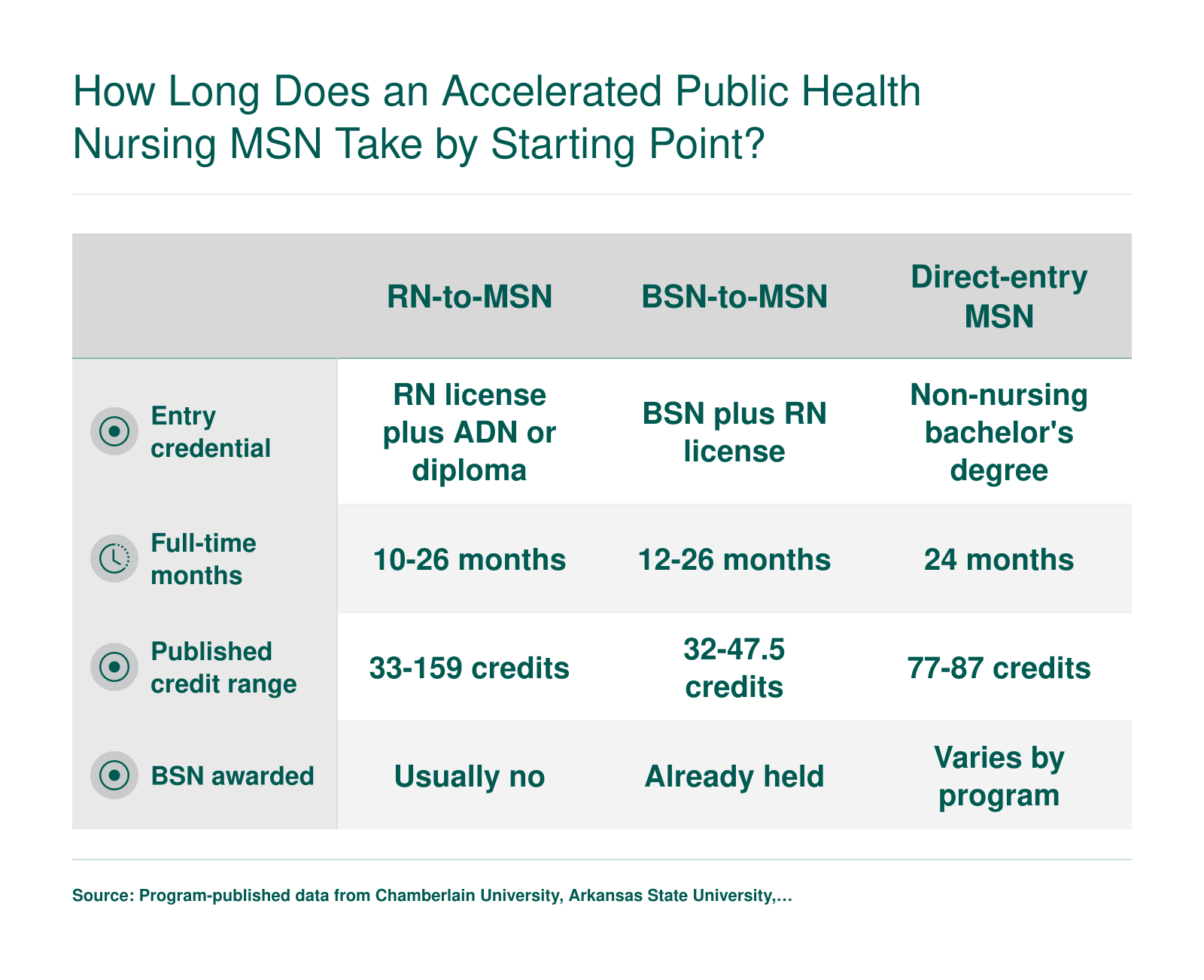
Three different starting points lead to the same master's degree. RN-to-MSN is built for nurses holding a diploma or associate degree. BSN-to-MSN assumes you already hold a conferred bachelor's in nursing. A Direct Entry MSN serves people with a bachelor's in another field who are not yet nurses.
Do you get a BSN along the way?
It depends entirely on the school. American Public University's RN-to-MSN in Community and Public Health Nursing awards the BSN at 120 credits, before you finish the 147-credit MSN sequence; three substituted courses trim 9 credits. Liberty's RN-BSN-MSN in Community Health also confers the bachelor's en route. Drexel's Dual Accelerated RN-BSN-MSN awards both degrees at the same time and requires 18 quarter credits of BSN-level work plus a portfolio. Chamberlain's Accelerated RN-to-MSN takes diploma and ADN nurses straight to the master's with no BSN conferred, in under 12 months full-time, versus under 36 months for its RN-BSN-to-MSN option.
That distinction matters. Some employers, state public health nursing certification rules, and doctoral programs expect a conferred BSN. Programs like Arkansas State's MSN require one at admission.
If you want credentials on both sides, an MSN/MPH dual degree is a longer but broader alternative.
How Long Does an Accelerated Public Health Nursing MSN Take by Starting Point?
Full-time timelines depend on the credential you bring. Part-time enrollment and clinical placement scheduling can stretch every track below.
Related Articles
Public Health Nursing MSN Tuition and Cost Comparison: Three Lowest-Price Options
In-state graduate tuition and fees range from $3,648 at the University of North Carolina at Pembroke to $11,679 at Portland State University, while out-of-state graduate tuition and fees range from $7,648 to $31,074. Net price figures are institution-wide averages after grant or scholarship aid and are not a per-degree quote. A shorter accelerated timeline can also lower total cost because living expenses and fees accrue over fewer terms even when per-credit tuition is similar.
| School | In-state graduate tuition and fees | Out-of-state graduate tuition and fees | Average net price after aid (institution-wide) |
|---|---|---|---|
| Florida International University | $6,565 | $18,964 | $9,288 |
| Portland State University | $11,679 | $31,074 | $9,552 |
| University of North Carolina at Pembroke | $3,648 | $7,648 | $10,260 |
Clinical Hours, Preceptors, and Online Flexibility in Accelerated Tracks
Online coursework and in-person practicum are two different commitments, and the second is where accelerated tracks get tested. Most public health nursing MSN programs deliver classes online, but the hours happen at a real site. Required hours vary widely. Aspen University lists a minimum of 120 public health hours1, American Public University System requires 1602, and University of Maryland builds in 315 across two practicum courses. Florida State sets 500 hours, and St. Joseph's College sets 480 hours in its 2026-2027 handbook.3
Placement rules differ too. Chamberlain expects students to find their own preceptor and site, and it allows a current employer only in a different department with a preceptor who is not your supervisor. APUS offers coordinator or advisor help2, Maryland does too, and Walden's Field Placement Team steps in if you cannot secure a site.4 Several programs do not state whether your employer qualifies, so ask before applying.
The main risk for working nurses is delay. St. Joseph's, for example, bars hours until the site, preceptor, and affiliation agreement are approved.3 Start paperwork early, because stalled placements are the usual reason accelerated timelines slip.
Placements, not coursework, set the real pace of an accelerated degree, so ask how a program secures your preceptors before you compare anything else.
Public Health Nursing MSN Jobs and State Certification Eligibility
Public health nursing MSN programs lead to roles that generalist RNs rarely step into without the credential:
- Health department nurse manager
- Epidemiology or infection prevention nurse
- Community health program director
- Policy or emergency preparedness specialist
Some states issue their own public health nurse certificate or registration, which can be required for several of those positions. California's Board of Registered Nursing issues a Public Health Nurse Certificate tied to an active California RN license.1 It requires a baccalaureate or entry-level master's in nursing from an NLN or CCNE-accredited program, public health nursing coursework, and 90 supervised clinical hours.1 A post-BSN MSN is not automatically sufficient unless transcripts show that content, and work experience cannot substitute.1 Out-of-state graduates need seven hours of child neglect and abuse training.1
Minnesota's Board of Nursing issues a Public Health Nurse Registration, statutorily required for public health duties.3 Applicants need an active Minnesota RN license and a baccalaureate or higher degree with a nursing major, including public health nursing theory and clinical practice.2 A BSN is not specifically required if the MSN meets those tests.2
Direct-entry and RN-to-MSN students completing the BSN en route can hit eligibility gaps. California accepts an entry-level master's only when it includes required coursework and clinical hours. Confirm your state board of nursing's rules before enrolling in an accelerated MSN program.
Harvard University’s Master of Public Health in Health and Social Behavior leads this comparison.
Public Health programs by state
Compare Public Health programs on the data that matters
Explore more Nursing specializations or browse every graduate field.
All Nursing programs