Best Public Health Nursing MSN Programs in Arizona
Compare 3 accredited Public Health programs in Arizona at 2 schools, with graduate earnings, cost, debt, and completion data from IPEDS and the U.S. College Scorecard.

How does an Arizona nurse move into population health when county health departments serve sprawling rural, tribal, and border communities with limited local care teams? The need is real and the geography is punishing. Campus and online public health nursing master's and MPH programs in Arizona are ranked here together, with in-state tuition from $5,910 at Aspen University to $15,208 at University of Phoenix-Arizona, more than double before clinical fees or travel. Across the ranked profiles, format flexibility, GRE barriers, tuition, and licensing tradeoffs shape the value calculation.
Key Points
- Only two schools here offer a true public health nursing MSN.
- Grand Canyon University's MSN Bridge requires 100 practicum hours, half in community health.
- Arizona sets no mandatory public health nursing certification; the RN license is what matters.
Arizona's Top Public Health Nursing Master's Programs, Ranked
Think of this list as a cost-and-outcomes scorecard for Arizona nurses weighing a public health master's. Only two schools here offer a nursing-specific MSN with a public health focus, so they come first. The rest are Master of Public Health (MPH) options, and we say plainly where an accreditation status could not be confirmed.
Aspen University
#1Phoenix, AZ · ~$6,000/yr (est.)
Best for: Working RNs wanting flexible online starts
Aspen University, based in Phoenix, offers fully online nursing master's tracks built around public health practice, including epidemiology, school nursing and case management. Both listed nursing programs show CCNE accreditation verified through the federal accreditation database. Admission asks for a BSN, current RN licensure and one year of nursing experience, and a local practicum is part of the degree. Aspen's graduation rate is an institution-wide figure and does not describe these programs.
- 36 credits, 12 courses, finishable in about two years
- Total program cost listed at $21,850
- 120-hour practicum in local settings
- Requires BSN, 2.5 GPA, active RN license
- Epidemiology, school nursing and case management coursework
- CCNE accredited, verified via federal database
- Bridge route for RNs, 57 credits across 19 courses
- Total program tuition listed at $25,395
- 120 clinical hours, work experience required
- 2.5 GPA minimum, no application fee
- Rolling starts every two weeks, 8-week terms
- CCNE accredited, verified via federal database
Grand Canyon University
#2Phoenix, AZ · ~$10,000/yr (est.)
Best for: Nurses prioritizing extended hands-on practicum
Grand Canyon University's Phoenix-based online MSN with a Public Health Nursing emphasis targets nurses who want population-based care, epidemiology and health policy skills. Its CCNE accreditation is verified in the federal accreditation database. The program is priced per credit and has the longest practicum in this group. It is a private university with a Christian worldview built into the curriculum, which suits some students and not others.
- 40 credits delivered online in 8-week sessions
- $600 per credit tuition, up to 12 transfer credits
- 200 practicum hours completed locally
- Requires bachelor's in nursing and current RN license
- Covers epidemiology, population assessment and program evaluation
- Evidence-based practice project included
- CCNE accredited, verified via federal database
University of Arizona
#3Tucson, AZ · ~$15,000/yr (est.)
Best for: Nurses eyeing population-health leadership pathways
The University of Arizona in Tucson is the state's flagship public option. Its College of Nursing MSN is listed as CCNE accredited, with the next review in 2030. The card below is the online MPH from the Zuckerman College of Public Health, which is CEPH accredited through the end of 2027. We could not confirm a public health nursing specialization within the nursing MSN. Nurses who want population-health leadership can also look at the coordinated DNP/MPH option, and a 2026 agreement with the Arizona Department of Health Services broadens practicum opportunities.
- Six concentrations, including Applied Epidemiology and Global Health
- Fully online, with fall, spring and summer starts
- No GRE or MCAT required
- 3.0 GPA and one college math course required
- Two recommendations, resume, statement of purpose and mission statement
- Zuckerman College of Public Health is CEPH accredited (a public health body, not a nursing one)
Northern Arizona University
#4Flagstaff, AZ · ~$13,000/yr (est.)
Northern Arizona University in Flagstaff offers a Master of Public Health with a Health Promotion concentration, delivered on campus or online. It is not a nursing degree, so CCNE and ACEN do not apply. Our data could not verify its public health accreditation status, though NAU's catalog describes the program as CEPH accredited, so confirm on the school's site. The Indigenous Health emphasis, offered only at Flagstaff, is a distinctive fit for northern Arizona and tribal health work.
- 49 units: 37 common health sciences plus 12 emphasis or elective
- Hybrid delivery, with campus and online study
- Required fieldwork experience or internship
- 3.0 GPA and one statistics course required
- Graduates are eligible for the Certified Health Education Specialist exam
- Indigenous Health emphasis offered at Flagstaff only
Bryan University
#5Tempe, AZ · ~$14,000/yr (est.)
Bryan University's Tempe-based online MPH is a short, certification-oriented degree rather than a nursing master's. Accreditation could not be confirmed in our data, so check it directly before applying. Its distinguishing feature is built-in preparation for national public health certification exams.
- 42 credits completed in about 13 months
- 3.0 cumulative GPA needed to graduate
- One REHS or CHES exam attempt included in tuition
- Capstone with an external public health organization
- Covers biostatistics, epidemiology and the 10 Essential Public Health Services
University of Phoenix-Arizona
#6Phoenix, AZ · $15,000 – $20,000/yr (est.)
University of Phoenix-Arizona offers an online MPH with a Community Health Leadership concentration, aimed at working adults moving into program management or administration. It is not a nursing degree, and we could not confirm its accreditation status. The concentration centers on community assessment, health promotion and addressing health disparities.
- Fully online format
- Core coursework in epidemiology, biostatistics and health policy
- Concentration in community assessment and program planning
- Emphasis on ethical leadership and program evaluation
- Career paths include health education specialist and program coordinator
The University of Arizona Global Campus
#7Chandler, AZ · $10,000 – $15,000/yr (est.)
The University of Arizona Global Campus, in Chandler, offers a hybrid MPH with an in-person practicum. Its published materials do not list total credits, tuition or length, and we could not confirm accreditation. It is the least documented option here, so ask for those details before comparing it with the programs above.
- Hybrid delivery with an in-person public health practicum
- Capstone completed under faculty direction
- Core courses in public health systems and program evaluation
- Coursework in epidemiology and behavioral science
- Practicum requires site approval and is closed to non-degree students
Cost & outcomes by school
Federal data for the highest-earning Public Health programs, independent of the ranking above. Earnings are this field's master's graduates four years after completing, where the Scorecard reports them.
| School | Earnings | Tuition / yr | Debt | Grads/yr | Format |
|---|---|---|---|---|---|
| Grand Canyon University AZ | $123,688 | $10,015 | $32,443 | 1,394 | Online |
| Aspen University AZ | $106,024 | $5,910 | $26,087 | 517 | Online |
Sources: U.S. Department of Education. Tuition and graduates: IPEDS. Earnings and debt: College Scorecard, this field's master's graduates; a dash means no figure is reported.
Cost, debt & payoff
Median earnings of this field's master's graduates (4 yrs after completing) vs. their median federal loan debt · U.S. College Scorecard
Across these programs the median graduate earns about $106,024 and finishes with roughly $26,087 in debt — a ratio that clears a common rule of thumb (keep debt below first-year salary). Tuition and debt vary widely school to school, so check the per-school figures in the table above before you shortlist.
Online and Hybrid Public Health Nursing Master's Options in Arizona
Grand Canyon University's MSN Bridge requires 100 practicum hours, split evenly between leadership (50) and community/public health (50). These hours are completed locally, and students usually identify their own preceptor and site with support from faculty and the Office of Field Experience, which must approve the site before hours begin. The preceptor must be a licensed clinician.
Arizona State University lists its graduate nursing coursework online, and students generally arrange clinical hours at approved facilities in or near their home community rather than traveling to the main campus. University of Arizona and Northern Arizona University describe hybrid formats that combine local clinical hours with periodic on-campus sessions or weekend intensives, though public health nursing MSN placement policies are not always published.
Across Arizona, public health nursing students commonly complete practicum hours at county health departments, the Arizona Department of Health Services, Indian Health Service and tribal clinics, and federally qualified health centers. Before enrolling in an out-of-state online program on this list of best online public health nursing MSN programs, confirm Arizona clinical placement authorization, and check whether the format requires short campus immersions.
Which Arizona Programs Waive or Skip the GRE
For master's programs with no GRE required, the reliable answer sits on each school's official admissions page, and it can change from one cycle to the next. Check the Master's Programs in Arizona pages for the University of Arizona, Northern Arizona University, and Grand Canyon University directly. Search each page for "GRE," "admission requirements," and "application checklist," then note whether the test is required, optional, or waived for your intended start term.
What We Could Confirm
Grand Canyon University says requirements vary by degree level, program, modality, and transfer status, and some programs may ask for a higher GPA. Its general MSN page indicates admission can rest on a minimum GPA or a qualifying GRE or GMAT score, depending on academic background. That is not a specific GRE ruling for the public health nursing track. For the University of Arizona and Northern Arizona University, we could not confirm a current GRE policy, so treat both as unverified.
How to Verify
- Ask staff: Email or call graduate admissions and ask about GRE policy, minimum GPA, required RN experience, deadlines, and start terms. Request written confirmation or an official link.
- Use context sources: BLS.gov, the Arizona State Board of Nursing, and the Arizona Nurses Association help with workforce and licensure questions, not admission rules.
- Discount secondhand claims: Rankings, forums, and old blog posts are leads only. Record the academic year of whatever you confirm.
Related Articles
What a Public Health Nursing Master's Costs in Arizona, and How to Get Licensed
Tuition among the MSN programs in Arizona below varies by residency and program format. In the ranking data, the lowest listed tuition figure is $10,015 at Grand Canyon University, while the highest out-of-state figure is $34,110 at the University of Arizona. GCU also publishes a program-specific rate of $600 per credit across 40 credits, which comes to about $24,000 before fees; Arizona State University's online MSN requires 30 credits but does not publish a current per-credit rate in the materials reviewed. Average net price figures shown for each school are institution-wide after all aid, not a program-specific quote.
Paying for It
- Employer tuition reimbursement: Many Arizona health systems offer this, though annual limits and service commitments vary.
- HRSA Nurse Corps Scholarship: 2026 applications are closed;1 when open, it covers tuition, fees, other educational costs, and a monthly stipend, with a two-year service commitment at an eligible critical-shortage facility. The award is taxable.3
- HRSA Nurse Corps Loan Repayment: Repays up to 85% of unpaid nursing education debt for two years of qualifying service.2
- Graduate assistantships and federal loans: Assistantships vary by campus; Direct Unsubsidized and Grad PLUS loans remain the main federal borrowing options.
Licensure and Certification
You practice under your active Arizona RN license or a multistate compact license. Public health certification, such as the CPH or Advanced Public Health Nursing credential, is an optional add-on, not a requirement for most public health nursing roles.
Arizona Licensure and Public Health Nursing Certification
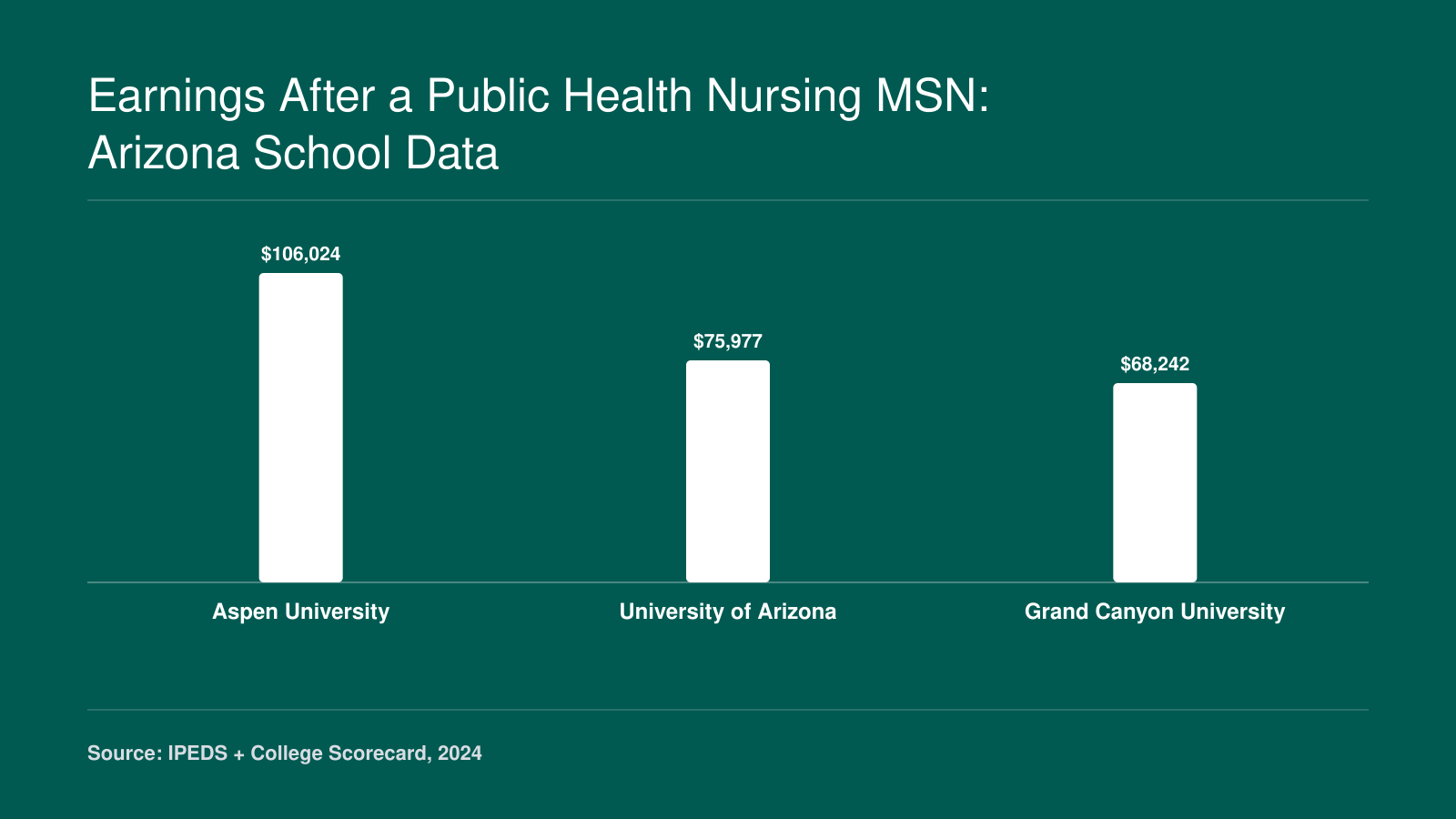
Earnings After a Public Health Nursing MSN: Arizona School Data
The chart shows median earnings four years after finishing, using College Scorecard program-level figures for each school's public health master's field of study. Set them against typical federal debt at graduation: about $26,087 at Aspen University, $47,242 at the University of Arizona, and $45,080 at Grand Canyon University. Aspen's earnings are highest and its debt is lowest, but these are field-level medians, so confirm your own program's outcomes.
How We Built This Arizona Ranking
Every school here earned its place on public federal data that an applicant can look up independently, not on brand recognition or advertising. Graduate tuition, institution-wide net price, and graduation rate come from IPEDS. Program-level earnings, debt, and completions come from College Scorecard.
Campus, hybrid, and online programs are ranked together, since a nurse in Phoenix or Flagstaff may reasonably consider any of these MSN programs in Arizona. Accreditation status and GRE policies were checked separately on each school's own pages, because the federal datasets do not capture either reliably.
Know the limits. Graduation rates and net price are institution-wide, not public health nursing track-specific, so treat them as context. Some programs have no published earnings, and we did not estimate to fill those gaps. Those schools are judged on the measures that are available. Confirm tuition, CCNE status, and admissions requirements with the school before you apply, and compare costs against the most affordable public health nursing MSN programs.
Quick Answers for Arizona Nurses Weighing a Public Health Master's
These short answers cover timelines, practicum requirements, and career paths. Arizona-specific benchmarks are limited, so treat the figures as typical ranges and confirm details with each school.
How long does a public health nursing MSN take in Arizona?
What can you do with a public health nursing MSN?
Does a public health nursing MSN qualify me to work as a nurse practitioner?
Compare Public Health programs on the data that matters
Explore more Nursing specializations or browse every graduate field.
All Nursing programs