Best Family Nurse Practitioner (FNP) MSN Programs in Michigan
Compare 15 accredited Family Nurse Practitioner (FNP) programs in Michigan at 10 schools, with graduate earnings, cost, debt, and completion data from IPEDS and the U.S. College Scorecard.

Family nurse practitioner tuition across Michigan's schools runs from roughly $8,364 a year at Spring Arbor University to about $35,410 at Concordia University Ann Arbor, a four-fold spread for the same credential among nurse practitioner programs in Michigan.
For a working RN, the tension is rarely the degree itself. It's reconciling cost, clinical placement support, and admissions rules against a full-time job. Some schools arrange statewide clinical rotations; others expect you to secure your own preceptor, which can quietly reshape how long enrollment actually takes.
Key Points
- Michigan requires national FNP certification plus a state specialty certification, applied for online through MiPLUS.
- Clinical hours total at least 500 nationally, but placement help varies widely by school.
- Graduate earnings are program-level medians, so compare them with net price before choosing a school.
Michigan's 10 Standout FNP Master's Programs, Ranked for 2027
For a working Michigan RN, the real question is what a program costs, how much of it you can do while still employed, and what graduates earn afterward. The cards below put format, tuition, net price and admissions basics side by side. The graduation rate on each card is schoolwide, not specific to the FNP program. None of these listings is an acute care track, so readers looking for MSN acute care nurse practitioner programs will need to search elsewhere. Where a school's admissions page did not publish an item, we say so rather than guess.
University of Michigan
#1Ann Arbor, MI · $29,000 – $58,000/yr (est.)
Best for: Hybrid learners wanting a research university
The University of Michigan School of Nursing delivers its primary care FNP master's in a hybrid format that pairs online coursework with a few required campus days each term. It is the flagship option for nurses who want a research university name without relocating to Ann Arbor full time. The school also pairs the FNP with nurse-midwifery in a combined MSN. Its published pages did not confirm a minimum GPA, an RN experience requirement or an application deadline, so check those directly before applying.
- Hybrid delivery with three on-campus days per term
- Two-year and three-year plans, full-time and part-time options
- Minimum GPA, RN experience and deadline not published on pages reviewed
- Clinical experience and prerequisite coursework required for admission
- Capstone required; prepares for FNP certification
- CCNE accredited
- Combined MSN preparing for dual certification
- Hybrid delivery; three-year plan available
- Covers care across the lifespan, including pregnancy and childbirth
- A distinct track from the standard FNP; it adds midwifery content
- CCNE accredited
Michigan State University
#2East Lansing, MI · $22,000 – $42,000/yr (est.)
Best for: Nurses needing arranged clinical rotations
Michigan State University offers a hybrid FNP master's with about 15 total days on campus, synchronous and asynchronous options, and both full-time and part-time pacing. The school arranges clinical rotations through statewide partnerships, which matters for nurses who cannot source their own preceptors. Recent admits averaged roughly a 3.48 GPA and 4.5 years of experience, so the pool is competitive even though no RN experience minimum is stated.
- Hybrid format, about 15 campus days in total
- Minimum 3.0 GPA, based on the second half of the BSN
- Deadlines of Dec. 1 and Apr. 1; the admission cycle is not identified
- Requires a BSN and a statistics course taken within five years
- Unrestricted RN license; Michigan licensure needed before clinical courses
- No minimum RN experience stated
- Clinical rotations arranged through statewide partners
University of Detroit Mercy
#3Detroit, MI · ~$23,000/yr (est.)
Best for: Seasoned RNs eyeing a DNP exit option
University of Detroit Mercy runs a cohort-based hybrid FNP program with a Jesuit and Mercy mission and a focus on underserved communities. Admission is selective, with rolling review and an interview. The published criteria are labeled for the post-BSN-to-DNP route, so confirm that they apply if you want to stop at the MSN.
- Hybrid; 47 credits and 750 clinical hours for the MSN
- Minimum 3.0 GPA and an active Michigan RN license
- 2,000 RN hours preferred, not mandatory
- Fall start only; rolling admissions with no fixed deadline published
- Three recommendation letters and an interview required
- Full-time in two years or part-time in three
- Eligible for ANCC or AANPCB certification
- 71 total credits for the DNP; MSN awarded before the DNP core
- Four clinical practica of 250 hours each
- Cohort-based; part-time plan finishes in three years
- Post-master's FNP certificate option also offered
Oakland University
#4Rochester Hills, MI · ~$22,000/yr (est.)
Oakland University's on-campus FNP track in Rochester Hills admits twice a year, in Fall and Winter, which gives working nurses a second chance to enter within the same year. Selection is competitive and includes a faculty interview. The school's pages did not provide specific deadlines, a minimum GPA or an RN experience requirement in the sources reviewed.
- Campus-based delivery
- Fall and Winter start terms; applications prioritized by deadline
- Application dates, minimum GPA and RN experience not published in sources reviewed
- Faculty interview required
- Clinical primary care experiences
- Prepares for ANCC or AANP certification
- CCNE accredited
Madonna University
#5Livonia, MI · $15,000 – $20,000/yr (est.)
Madonna University in Livonia offers an on-campus FNP master's with a small, personalized format. It reportedly places students at community partner clinical sites across southeast Michigan. The admissions details retrieved covered post-master's certificates rather than the MSN, so contact graduate admissions for GPA, deadlines and start terms.
- Campus-based delivery
- Approved by the Michigan Board of Nursing; CCNE accredited
- Care across the lifespan: assess, diagnose and treat acute and chronic conditions
- Reported community clinical sites in southeast Michigan
- GPA, RN experience, start terms and deadline not confirmed; contact admissions
Spring Arbor University
#6Spring Arbor, MI · ~$8,000/yr (est.)
Spring Arbor University is built for nurses who need to keep working full time, with asynchronous online classes and a one-course-at-a-time 7-1-7 model. It reports more than 600 clinical partners, including Michigan sites, so students can often arrange local preceptors. It offers six start dates a year, which is unusual flexibility. The school does not charge an application fee.
- Online, asynchronous; 52 credits, about two years and five months
- $810 per credit listed
- Six start dates per year; $0 application fee
- Minimum 3.0 GPA; RN experience minimum and deadlines not published
- 625 clinical hours with a large Michigan partner network
- Student success coach and small classes of 20 to 25
- Prepares for ANCC or AANP certification
- Online bridge for RNs without a BSN; 87 credits, as few as four years
- Earns both BSN and MSN degrees
- Four start dates per year
- Four-day campus residency
- Minimum 3.0 GPA; 625 clinical hours
University of Michigan-Flint
#7Flint, MI · $14,000 – $21,000/yr (est.)
The University of Michigan-Flint offers FNP study as combined MSN and DNP pathways rather than a standalone master's, so read each entry point carefully. Delivery is online or hybrid, with minimal campus visits. It is one of the more flexible entry points for ADN-prepared nurses. Admission thresholds differ sharply by pathway.
- Hybrid; one campus visit per semester
- MSN portion is 53 to 55 credits, then 18 DNP credits
- Certification exam eligibility after the MSN portion
- Early Assurance Admission for eligible BSN students
- Full-time or part-time pacing
- Online with minimal campus visits; mandatory campus orientation
- 3.2 GPA in the last 60 hours; unencumbered RN license
- One year of RN experience preferred
- Deadlines: Feb. 1 early and Apr. 1 final for fall; Aug. 15 for winter
- $55 application fee; three letters and a goal statement
- Online path for ADN-prepared nurses with a current RN license
- 3.5 GPA admission requirement; prerequisite coursework required
- No GRE requirement
- Clinical placement assistance; cohort-based
- $55 application fee; three letters of recommendation
Davenport University
#8Grand Rapids, MI · ~$20,000/yr (est.)
Davenport University in Grand Rapids delivers its FNP master's fully online, with full-time or part-time pacing and a low barrier to apply. Clinical placements can reportedly be arranged near a student's home, which suits nurses who must stay employed locally. Members of the Michigan Health and Hospital Association get a tuition discount.
- 100% online with full-time or part-time options
- BSN, 3.0 GPA, RN license and one recommendation
- Application fee waived
- 20% tuition discount for MHA members
- Capstone required; clinical placements included
- Start terms and deadlines not retrieved; confirm with admissions
Saginaw Valley State University
#9University Center, MI · $15,000 – $20,000/yr (est.)
Saginaw Valley State University is a lower-cost public option in University Center, with in-state tuition well below the private schools on this list. The primary care FNP concentration is 50 credits with 600 clinical hours and rolling admissions. An optional dual FNP/PMHNP track is available for students interested in mental health. Applicants must complete prerequisite courses, including statistics.
- Hybrid delivery; 50 credits and 600 clinical hours
- BSN and minimum 3.0 GPA; statistics prerequisite
- Fall start; rolling admissions with no fixed deadline listed
- RN experience minimum not stated
- Entrance exam listed: TOEFL or IELTS
- Background check and immunizations required
- Advanced standing for prior graduate credits
- Optional dual FNP/PMHNP track
Concordia University Ann Arbor
#10Ann Arbor, MI · ~$16,000/yr (est.)
Concordia University Ann Arbor offers an online, faith-based FNP master's with fall and spring starts and no GRE requirement. Its published tuition is $800 per credit, but its schoolwide graduation rate and net price are the weakest on this list, so weigh cost carefully. The school reports a 100% first-time certification pass rate.
- Online with synchronous and asynchronous options; 41 credits
- $800 per credit listed; $0 application fee
- Fall and spring starts; deadlines not published
- Minimum 3.0 GPA; work experience required, length not stated
- 750 clinical hours in approved primary care settings
- No GRE or entrance exam required
- Prerequisite courses required; no thesis or capstone
- Prepares for AANP or ANCC certification
Cost & outcomes by school
Federal data for the highest-earning Family Nurse Practitioner (FNP) programs, independent of the ranking above. Earnings are this field's master's graduates four years after completing, where the Scorecard reports them.
| School | Earnings | Tuition / yr | Debt | Grads/yr | Format |
|---|---|---|---|---|---|
| University of Michigan-Flint MI | $129,633 | $14,473 | $45,578 | 95 | Hybrid |
| University of Detroit Mercy MI | $125,601 | $22,544 | $71,750 | 65 | Hybrid |
| Spring Arbor University MI | $120,740 | $8,364 | $53,555 | 222 | Online |
| Michigan State University MI | $118,130 | $21,772 | $48,355 | 43 | Hybrid |
| Madonna University MI | $118,011 | $18,000 | $50,187 | 23 | Campus |
| Eastern Michigan University MI | $117,970 | $17,968 | $39,156 | 18 | Hybrid |
| Oakland University MI | $117,829 | $21,960 | $44,928 | 60 | Campus |
| Davenport University MI | $112,459 | $20,098 | $49,934 | 4 | Online |
| University of Michigan MI | $109,684 | $28,886 | $51,923 | 115 | Hybrid |
| Concordia University Ann Arbor MI | — | $15,870 | — | — | Online |
Sources: U.S. Department of Education. Tuition and graduates: IPEDS. Earnings and debt: College Scorecard, this field's master's graduates; a dash means no figure is reported.
Cost, debt & payoff
Median earnings of this field's master's graduates (4 yrs after completing) vs. their median federal loan debt · U.S. College Scorecard
Across these programs the median graduate earns about $119,435 and finishes with roughly $50,061 in debt — a ratio that clears a common rule of thumb (keep debt below first-year salary). Tuition and debt vary widely school to school, so check the per-school figures in the table above before you shortlist.
Most Affordable Michigan FNP Master's Programs, Ranked for 2027
These are the lowest-cost options among the schools ranked here, ordered by average annual net price, which is the sticker price minus typical grant aid. The figures are institution-wide, drawn from IPEDS and College Scorecard (2024), so your own program cost will depend on credit load and aid. Four of the five offer a hybrid format, which can cut commuting costs for working nurses.
| School | City | Average Annual Net Price | Program Format |
|---|---|---|---|
| University of Michigan-Flint | Flint | $7,007 | Hybrid |
| Oakland University | Rochester Hills | $9,120 | Campus |
| Saginaw Valley State University | University Center | $10,775 | Hybrid |
| University of Michigan | Ann Arbor | $13,138 | Hybrid |
| University of Detroit Mercy | Detroit | $15,232 | Hybrid |
Online and Hybrid FNP Master's Options for Working Michigan Nurses
"Online" rarely means you never set foot on campus. For online family nurse practitioner programs in Michigan, it describes a spectrum: some tracks run fully online and asynchronous, while others blend digital coursework with required visits for labs, simulation, and skills check-offs. The programs ranked here include fully online options at Spring Arbor, Davenport, and Concordia Ann Arbor, campus-based tracks at Oakland and Madonna, and hybrids elsewhere.
The hybrid programs vary in how often you travel. Michigan State's FNP runs online for core courses but brings students to campus roughly four to five days per semester for seminars, simulation, and exams. University of Michigan's primary-care FNP has students come up to three days each term for competency and skills work. University of Detroit Mercy's hybrid pairs online coursework with on-campus components toward its 750 clinical hours.
Even fully online programs require in-person clinical hours, and out-of-state enrollment for online master's programs in Michigan depends on your state's authorization and licensure rules. One practical step before you apply: confirm a part-time pacing option exists if you plan to keep working.
Related Articles
Which Michigan FNP Master's Programs Skip or Waive the GRE?
For many Michigan FNP applicants, the GRE decision comes down to one question: does a standardized test outweigh years of bedside nursing? Across the programs below, the answer increasingly favors GPA and RN experience, a pattern shared by many No-GRE master's programs, though a few schools still attach conditions.
- No published 2026 policy: Michigan State University, the University of Michigan, Saginaw Valley State University, the University of Michigan-Flint, Davenport University, Spring Arbor University, and Concordia University Ann Arbor do not state a current GRE requirement on the admissions pages reviewed.
- Conditional or waivable: Oakland University's 2025 advising flyer conditions the GRE on a cumulative GPA below 3.2, while a separate information-session page says "GRE not required" and lists a 3.0 BSN GPA. Madonna University requires the GRE for applicants below a 3.25 overall GPA. University of Detroit Mercy says the GRE "may be required" only for students petitioning with a GPA below 3.0 in its post-BSN to DNP pathway, not a separate MSN-FNP policy.1
- Blanket GRE required: We did not find a program here that publishes a universal GRE requirement for 2026. Where a policy is absent, confirm with admissions rather than assuming a waiver.
What an FNP Master's Costs in Michigan, Plus Licensure and Certification
How much does an FNP master's in Michigan really cost? The Most Affordable Family Nurse Practitioner MSN Programs show it depends on residency and sector. Among the lowest-cost schools here, listed graduate tuition is $14,473 in-state and $21,390 out-of-state at University of Michigan-Flint, and $21,960 and $24,648 at Oakland University. Saginaw Valley State charges $18,360 for both groups, while University of Michigan lists $28,886 in-state and $57,776 out-of-state. Detroit Mercy, the private option, lists $22,544 for everyone.
To estimate a full program, multiply credits by the per-credit rate. SVSU's 2025-2026 rate of $800 across 50 to 53 credits gives roughly $40,000 to $42,400, though credit totals and rates can change. Detroit Mercy's MSN exit lists 47 total credits; the full DNP runs 71. Net price is an approximate institution-wide figure, not an FNP-specific one: about $7,007 at Flint, rising to $15,232 at Detroit Mercy.
From Graduation to Practice
First, pass a national FNP exam through AANPCB or ANCC. Next, apply to the Michigan Board of Nursing through LARA for Nurse Practitioner Specialty Certification, submitting proof of your graduate program, national certification, and the application and fee. National certification alone does not satisfy Michigan. Once certified, you may prescribe Schedules 2 to 5 within your specialty without physician delegation.
Michigan Nurse Practitioner Specialty Certification at a Glance
FNP Clinical Hour Requirements and Who Arranges Placements
Schools that place you at a site and schools that expect you to find your own preceptor can produce very different experiences, even when the hour totals look alike. The national floor for FNP certification eligibility is 500 supervised direct-care hours, and the MSN programs in Michigan on this page generally exceed it.
Oakland University lists 630 direct clinical hours, with at least 210 direct patient-contact hours in each clinical course. Students are encouraged to find placements, but the School facilitates and helps identify a preceptor when needed. Michigan State University's figures conflict: a 2026 summary says 630, while another source totals 765 across five courses. MSU assists with placements, but published materials do not clearly say whether students must secure their own. Wayne State is not among this page's ranked schools, so confirm any outside claims directly.
For the remaining schools here, placement policies were not clearly published in the material reviewed, so ask admissions directly; Saginaw Valley State lists 600 hours and Detroit Mercy lists 750. Also ask whether online students may complete rotations outside Michigan. Self-arranged preceptors are the most common cause of delayed graduation, so get placement commitments in writing early.
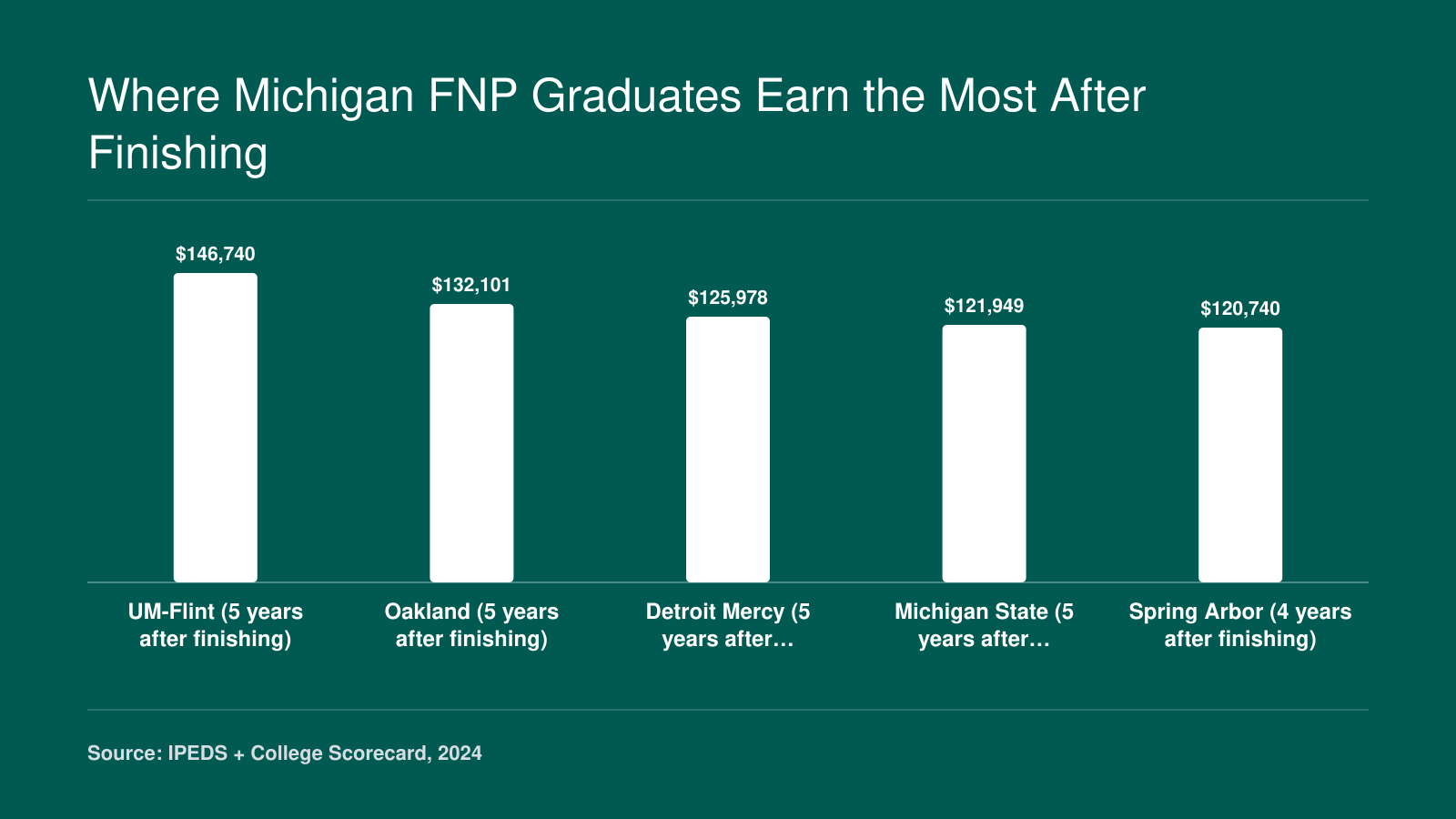
Where Michigan FNP Graduates Earn the Most After Finishing
These are median earnings for people who completed each school's FNP master's program, not statewide nurse practitioner wages. Four schools report earnings five years after finishing, while Spring Arbor reports four years, so read that bar as a slightly earlier snapshot. Median debt and the 10-year monthly payment: UM-Flint $45,578 ($518), Oakland $44,928 ($511), Detroit Mercy $71,750 ($816), Michigan State $48,355 ($550), Spring Arbor $53,555 ($609).
How These Michigan FNP Master's Programs Earned Their Spots
A low sticker price and a flexible schedule don't always arrive in the same program, so the order here weighs both. Each school was judged on graduate tuition, net price after aid, institution-wide graduation rate, format flexibility, and, where available, program-level earnings and debt.
Campus and online options share one list because working nurses often compare them directly. Only programs with a Michigan presence were considered.
Two limits matter. Graduation rates and net price describe the whole institution, not the FNP track. Certification pass rates were left out as a ranking factor because few schools publish them.
Fast Answers About FNP Master's Programs in Michigan
Which Michigan FNP master's program has the lowest total cost?
Do Michigan FNP schools find clinical preceptors for students, or do students arrange their own?
Which Michigan FNP schools publish their AANP or ANCC certification pass rates?
Compare Family Nurse Practitioner (FNP) programs on the data that matters
Explore more Nursing specializations or browse every graduate field.
All Nursing programs