Best Master's in Health Informatics Programs in Arizona
Compare 5 accredited Health Informatics programs in Arizona, with graduate earnings, cost, debt, and completion data from IPEDS and the U.S. College Scorecard.

Health informatics sits where clinical care meets management information systems: managing electronic health records, standardizing patient information, and turning that data into decisions hospitals can act on. Arizona's large healthcare management sector and a fast-growing telehealth sector keep demand steady for people who can bridge medicine and IT.
The state's master's options in this field are few, and all run online. Arizona State University, Grand Canyon University, The University of Arizona Global Campus, and University of Phoenix-Arizona each offer a path, though they differ in credit load, accreditation, and cost.
One caveat shapes the whole choice: CAHIIM accreditation and the specific certification a program feeds vary, so the right fit depends on the credential you intend to pursue.
Key Points
- Arizona has no state license for health informatics, so credentials come from national bodies.
- Check CAHIIM accreditation directly in the CAHIIM directory before you enroll.
- Arizona State University is the one school whose tuition differs by residency.
Best Master's in Health Informatics Schools in Arizona, Ranked
Arizona's master's in health informatics options are mostly online, so format matters less than accreditation and fit. Graduation rates on each card are institution-wide, not specific to the program. Check CAHIIM status directly in the CAHIIM directory before enrolling, because it affects RHIA eligibility.
Arizona State University
#1Tempe, AZ · ~$14,000/yr (est.)
Best for: Working professionals seeking specialization electives
Arizona State University offers a 30-credit online Master of Advanced Study in Health Informatics built for working professionals, with electives in clinical informatics, population health, biostatistics, and healthcare AI. The College of Health Solutions has ties to Mayo Clinic, Banner Health, HonorHealth, and Dignity Health, and a Mayo Clinic Alix School of Medicine dual-degree pathway uses this master's. We could not confirm a current CAHIIM listing for this program, so graduates should not assume a CAHIIM-linked route to the RHIA exam. ASU is accredited by the Higher Learning Commission as an institution.
- 30 total credit hours with a required applied project capstone
- Flexible online format with multiple start dates each year
- 3.0 GPA minimum and one letter of recommendation
- No GRE required
- Electives in clinical informatics, population health, biostatistics, and healthcare AI
- CAHIIM listing not confirmed; matters for RHIA eligibility
- Not eligible for the STEM-OPT extension
Grand Canyon University
#2Phoenix, AZ · ~$10,000/yr (est.)
Best for: Career changers from non-healthcare backgrounds
Grand Canyon University's online Master of Science in Health Informatics accepts a bachelor's in any field, which makes it practical for career changers. Courses run in 8-week blocks, and the final 16 weeks include an applied project and a 150-hour practicum. CAHIIM lists the program with an Initial accreditation award, and its progress report is in process, so a final continuing award is not yet established. Confirm current status before you apply if RHIA eligibility matters to you.
- 42 credit hours at $610 per credit
- CAHIIM Initial accreditation award; progress report in process in 2026
- 150-hour practicum within the final 16 weeks
- 8-week online courses; fully online option available
- 2.8 GPA minimum; bachelor's in any field accepted
- Transfer up to 12 credits; no application fee
- Covers EHR implementation, data analytics, and information security
The University of Arizona Global Campus
#3Chandler, AZ · $10,000 – $15,000/yr (est.)
Best for: Adult learners taking one course at a time
The University of Arizona Global Campus, based in Chandler, delivers its Master of Science in Health Informatics and Analytics fully online as a national program. Its curriculum emphasizes data governance, privacy and security, biostatistics, and epidemiology. We could not establish CAHIIM accreditation for this master's, and a CAHIIM record tied to UAGC appears to cover a baccalaureate program, so do not assume RHIA eligibility. Institutional accreditation is through WSCUC.
- 39 total credit hours with a required capstone
- Accelerated 6-week courses, taken one at a time
- 3.0 GPA minimum; no application fee
- Transfer up to 9 approved credits
- Focus on health data governance and patient information policy
- CAHIIM accreditation for this master's not established
University of Phoenix-Arizona
#4Phoenix, AZ · $15,000 – $20,000/yr (est.)
University of Phoenix-Arizona's entry is a Master of Science in Nursing with an informatics concentration, so it suits registered nurses rather than general career changers. It runs about 16 months in six-week courses, with a locked tuition rate and a practicum in your local community. The program materials cite CCNE nursing accreditation, not CAHIIM, so this is not a route to the RHIA credential.
- 34 total credit hours at $540 per credit with a locked tuition rate
- About 16 months in six-week courses, one at a time
- 60 clinical practicum hours in your local community
- 3.0 GPA minimum; no entrance exam required
- Program materials cite CCNE accreditation, not CAHIIM
- Employer reimbursement and military benefits accepted
Cost & outcomes by school
Federal data for the highest-earning Health Informatics programs, independent of the ranking above. Earnings are this field's master's graduates four years after completing, where the Scorecard reports them.
| School | Earnings | Tuition / yr | Debt | Grads/yr | Format |
|---|---|---|---|---|---|
| Grand Canyon University AZ | — | $10,015 | — | — | Online |
| Arizona State University AZ | — | $10,843 | — | — | Online |
| Arizona State University AZ | — | $13,587 | — | — | Online |
| University of Phoenix-Arizona AZ | — | $15,208 | — | — | Online |
| The University of Arizona Global Campus AZ | — | $12,930 | — | 43 | Online |
Sources: U.S. Department of Education. Tuition and graduates: IPEDS. Earnings and debt: College Scorecard, this field's master's graduates; a dash means no figure is reported.
Online and Hybrid Master's in Health Informatics Options in Arizona
Every health informatics program here is delivered online, so the real differences are workload, pacing, and whether you must find a clinical site. None is listed as campus-only or hybrid.
All four schools are Arizona-based and offer master's programs in Arizona: Arizona State University, Grand Canyon University, The University of Arizona Global Campus, and University of Phoenix-Arizona. An online program run from outside Arizona is a different proposition. State authorization rules can limit enrollment, and in-state tuition rarely applies to an online student of an out-of-state school.
Credits, pacing, and experiential requirements
- ASU: 30 credits, about 18 months, 7.5-week sessions, and a 3-credit applied project.1 No practicum is listed.
- UAGC (online MS in health informatics and analytics): 39 credits, six-week courses taken one at a time, and a required capstone. No practicum is listed.
- GCU: 42 credits in eight-week courses. The final 16 weeks include a practicum, with 150 clinical hours.
- University of Phoenix-Arizona: a 34-credit Nursing Informatics MSN, about 16 months, six-week courses, and 60 clinical hours.
For full-time workers, ASU and UAGC are the easiest fits because neither requires placement. GCU and Phoenix practicums need a local healthcare site, so line one up before you enroll.
Which Arizona Health Informatics Master's Programs Waive the GRE?
Graduate admissions in health informatics have shifted toward test-optional policies, but Arizona's programs still differ from what you'll find in Master's in Health Informatics Programs With No GRE Required.
- Arizona State University: The Health Informatics MAS does not list a GRE or GMAT requirement on its degree page. The minimum GPA is 3.0, and applicants need a related bachelor's or master's.1
- Grand Canyon University: The standard admission route waives the GMAT and GRE, aligning it with many No-GRE master's programs. Applicants with a GPA below 2.8 can use an alternative route with a 2.5 GPA and a GMAT of 500 or a GRE of 300. No healthcare work experience is required.
- The University of Arizona Global Campus: The MS in Health Informatics and Analytics does not list a GRE or GMAT requirement in its published program details.
- University of Phoenix: The MSN with an informatics concentration states that no entrance exam is required.
Other Common Requirements
Most programs here expect a bachelor's degree and many set a 3.0 GPA floor. ASU asks for a related bachelor's or master's. Prerequisite coursework in statistics or anatomy is not uniformly spelled out, but a background in healthcare or IT strengthens an application. Ask about letters of recommendation and a statement of purpose, since GCU's online MS does not require a personal statement while other options may.
Waiver rules can change by start term, so verify the current test policy on the program's admissions page before you apply.
Related Articles
What a Master's in Health Informatics Costs in Arizona
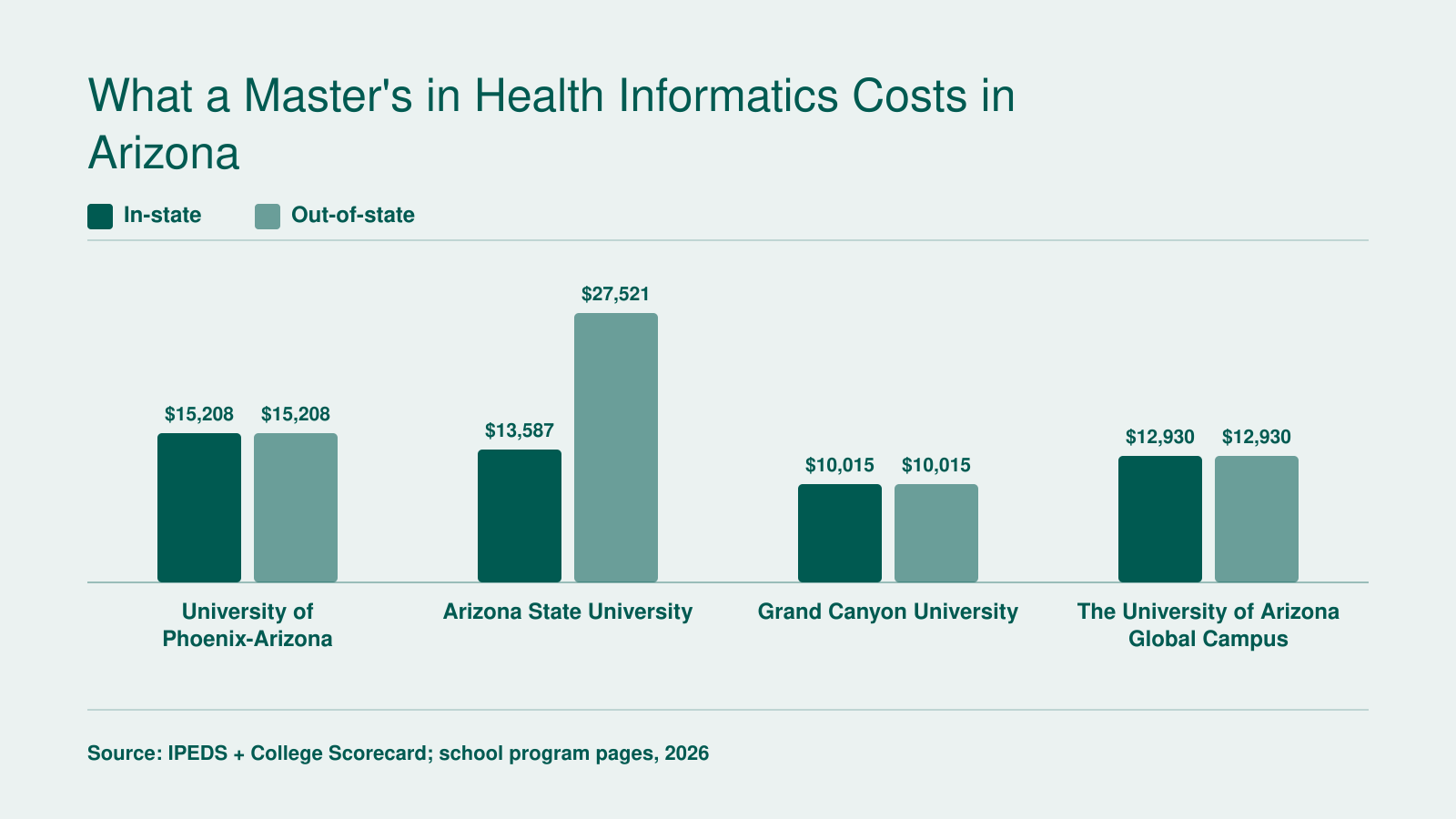
The chart shows graduate tuition and fees for in-state and out-of-state students at each school. Where the two bars match, the school charges one rate regardless of residency. Arizona State University is the exception, and its online Master of Advanced Study in Health Informatics lists the same published tuition for residents and non-residents. That program runs 30 credits at an estimated $1,096 per credit, or about $32,880 in total. ASU's handbook also lists a $350 per-credit program fee, and sources do not say whether it is already included, so confirm the full cost with ASU before budgeting. Published program rates elsewhere are $540 per credit over 34 credits at University of Phoenix-Arizona and $610 per credit over 42 credits at Grand Canyon University. The University of Arizona Global Campus lists a 39-credit program but no per-credit rate in the research. Net price figures are institution-wide averages, not program quotes. They run from about $13,520 at University of Phoenix-Arizona to $31,266 at The University of Arizona Global Campus. For savings, ask your employer's tuition assistance office, since University of Phoenix-Arizona notes employer reimbursement support. Scholarships are listed at University of Phoenix-Arizona and Grand Canyon University. ASU lists College of Health Solutions scholarships and Graduate College fellowships, but no published award amounts.
Arizona Licensure and Health Informatics Certification
Career Outcomes for Arizona Health Informatics Graduates
A health informatics master's pays off through the roles it qualifies you for, and those roles look much the same across Arizona's programs. Four takeaways matter most when you compare options.
- Typical roles: Graduates move into clinical informatics analyst, EHR specialist, health data analyst, and informatics manager positions, a skill set also taught in data analytics master's programs in Arizona. Nursing-focused tracks, such as the informatics concentration at University of Phoenix-Arizona, point toward clinical manager and clinical director titles, roles often prepared by nurse administrator MSN programs in Arizona.
- Who hires: Arizona hospital systems, health insurers and other payers, and public health agencies all need people who can manage clinical data and electronic records, skills also emphasized by MPH programs in Arizona.
- Hands-on experience: Grand Canyon University includes 150 clinical hours and a practicum, and its program is CAHIIM accredited. Arizona State University and The University of Arizona Global Campus both require a capstone, which gives you a project to show employers.
- Specialty fit: The University of Arizona Global Campus emphasizes health data governance, biostatistics, and epidemiology, which suits analyst and compliance-leaning careers. EHR implementation coursework at Grand Canyon University suits system-focused roles.
Choose the program whose practical component matches the job you want.
How We Rank Arizona Master's in Health Informatics Programs
Choosing among the best online master's in health informatics programs and Arizona campus options means weighing a school's reputation against what graduates actually earn and owe. This ranking uses verifiable federal data, mainly College Scorecard and IPEDS, for cost, graduation, earnings, and debt, and it skips reputation surveys. Graduation rate and net price reflect the whole institution, while earnings and debt figures are program-level where published. Accreditation status, GRE policies, and tuition details were checked against school websites as of October 2026. That lets readers compare upfront cost with long-term salary potential among the most affordable master's in health informatics programs, not just name recognition. For students balancing aid, location, and career goals, that evidence is more useful than a generic prestige score. Requirements and prices shift, so confirm the latest details with admissions before applying.
Compare Health Informatics programs on the data that matters
Explore more Healthcare specializations or browse every graduate field.
All Healthcare programs