Best Online Master's in Health Informatics Programs
Compare 180+ accredited online Health Informatics programs, with graduate earnings, cost, debt, and completion data from IPEDS and the U.S. College Scorecard.

A health informatics master's typically runs 30 to 39 credits, and most of these programs are built for people already working in hospitals, payer organizations, or health IT vendors. A clinical background is not always required; Cincinnati's program accepts applicants with no healthcare experience at all.
Every program here is delivered 100% online, with hybrid degrees and campus residencies excluded. Price is where they diverge: in-state graduate tuition runs from roughly $8,480 at UT Tyler to $22,017 at Minnesota, and out-of-state rates climb past $40,000 at some flagships.
CAHIIM accreditation and practicum placement rules vary more than tuition does, and both shape what the credential is worth once you finish.
Key Points
- In 2024, 99.4% of acute care hospitals used certified EHR technology.
- UTHealth Houston graduates' median pay reaches $105,837 by year four.
- Confirm whether a fully online program still requires live sessions or practicum.
Top 10 Best 100% Online Master's in Health Informatics Programs
This list is limited to fully online master's in health informatics programs; hybrid options are excluded. The order reflects a mixed quality composite of cost, institutional outcomes, and program-level earnings and debt where available. Each card below highlights what makes the program distinctive, along with published tuition, net price, and graduation data where reported.
University of North Carolina at Chapel Hill
#1Chapel Hill, NC · ~$13,000/yr (est.)
Best for: Clinicians seeking mentored informatics training
UNC-Chapel Hill's online Master of Professional Science in Biomedical and Health Informatics offers clinical informatics and public health informatics concentrations. The 35-credit curriculum requires a 400-hour mentored internship and offers full-time or part-time pacing with rolling admissions. Graduate tuition is $8,994 in state and $41,203 out of state, net price is $11,655, and the institution reports a 91% graduation rate. The fast-track option can be completed in one year.
- Clinical Informatics concentration
- 35 total credit hours
- 400-hour mentored internship
- No entrance exam required
- Rolling admissions with spring, summer, fall starts
- Full-time and part-time options
- NC Research Triangle Park connections
- Fast-track completion in one year
- Public Health Informatics concentration
- Hands-on analytics and machine learning experience
- Interdisciplinary faculty from multiple departments
- Three completion pace options
- Required mentored internship of 400+ hours
- 100% online courses
- Prepares for analyst, manager, researcher roles
- Ties to NC Research Triangle Park companies
Florida International University
#2Miami, FL · ~$11,000/yr (est.)
Best for: Business-focused health IT professionals
Florida International University's MS in Health Informatics and Analytics is a 17-month, fully online cohort that is CAHIIM accredited and housed in a business school. Students choose between a health informatics and analytics major or a health informatics and AI major, with a capstone or proposed practicum. Graduate tuition is $6,565 in state and $18,964 out of state, net price is $9,288, and the graduation rate is 74%. Federal outcomes data show median first-year earnings around $81,148 and median debt of $35,248.
- CAHIIM-accredited program housed in a business school
- Two majors: analytics and artificial intelligence
- 17-month cohort-based, lock-step format
- Starts in September
- Capstone or proposed practicum option
- Transfer up to 6 graduate credits
- HIMSS South Florida Chapter partnership
- Joint MBA/MSHIA and MD/MSHIA options
University of Wisconsin-Madison
#3Madison, WI · ~$12,000/yr (est.)
Best for: Working adults pacing study around employment
The University of Wisconsin-Madison's Clinical and Health Informatics MS is a 30-credit, fully online program that can take 18 months to four years. Delivery is paced for full-time employment, with fall, spring, and summer starts and a $1,600 per-credit rate. Graduate tuition is $11,603 in state and $42,103 out of state, net price is $17,354, and the graduation rate is 90%.
- $1,600 per credit
- 18-month to four-year timeline
- 30 total credit hours
- Fall, spring, and summer starts
- Fully online with no on-campus component
- 3.0 GPA minimum
- Two letters of recommendation required
- Paced for full-time employment
The University of Texas Health Science Center at Houston
#4Houston, TX · $11,000 – $34,000/yr (est.)
UTHealth Houston's McWilliams School of Biomedical Informatics offers a CAHIIM-accredited MS in Biomedical Informatics with research and applied tracks, both fully online. The 39-credit program includes a practicum and offers concentrations in bioinformatics, clinical informatics, health data science and AI, human factors engineering, and public health informatics. The school reports 90% of graduates employed or studying at graduation and 51% in informatics jobs. Federal outcomes data show median earnings of $97,173 one year after graduation and median debt of $20,500.
- CAHIIM accredited through 2030
- 39 total semester credit hours
- Research and applied tracks
- Five concentration areas
- Practicum supervised by a preceptor
- Master's credits transfer to doctoral program
- 90% job placement rate
- 51% of graduates employed in informatics
University of Minnesota-Twin Cities
#5Minneapolis, MN · ~$22,000/yr (est.)
The University of Minnesota-Twin Cities MS in Health Informatics is entirely online with no on-campus component. The 36-credit program blends health informatics and biostatistics, offers a thesis or additional coursework option, and reports a median salary of $90,000 for graduates. Graduate tuition is $17,214 in state and $38,362 out of state, net price is $16,778, and the graduation rate is 85%.
- $1,665 per credit
- 36 total credit hours
- Average graduation time of 2.3 years
- Fall and spring starts
- 3.3 GPA minimum
- Thesis or additional coursework option
- No on-campus component
- Median salary of $90,000 per year
University of North Florida
#6Jacksonville, FL · $10,000 – $15,000/yr (est.)
The University of North Florida's MS in Health Informatics is an interdisciplinary online program across health, business, and computing. The 33-credit curriculum covers health IT systems, EHRs, data governance, and healthcare analytics and prepares students for board certification. Graduate tuition is $6,389 in state and $20,793 out of state, net price is $10,154, and the graduation rate is 69%.
- 33 total credit hours
- Interdisciplinary program across three colleges
- Prerequisites in statistics and medical terminology
- Employer tuition reimbursement supported
- $30 application fee
- Letter of intent and resume required
- Prepares for board certification
- Fall and spring starts
Charter Oak State College
#7New Britain, CT · $10,000 – $15,000/yr (est.)
Charter Oak State College's MS in Health Informatics is a streamlined 33-credit online program with no elective credits. It covers health data analytics, clinical database management, information systems analysis, and security, ending in a capstone. In-state and out-of-state graduate tuition are both $8,506, net price is $15,815, and the graduation rate is 67%.
- 33 total credit hours
- No elective credits in degree
- Capstone required
- 3.0 GPA minimum
- Minimum B- grade per course
- Interdisciplinary health IT and patient care
- Covers data analytics, database management, and security
The University of Texas at Tyler
#8Tyler, TX · ~$8,000/yr (est.)
UT Tyler's MSN in Informatics, Quality and Safety is a 36-credit, CCNE-accredited online nursing program with 500 practice hours. It maps to AACN Essentials and QSEN competencies and prepares students for the ANCC Informatics Nursing board certification exam. Graduate tuition is $9,736 in state and $25,494 out of state, net price is $13,323, and the graduation rate is 54%.
- CCNE accredited
- 36 total credit hours
- 500 practice hours
- 12 MSN core credits
- 18 specialization credits
- Nine elective credits
- ANCC Informatics Nursing board certification exam
- Multiple start dates year-round
University of Kansas
#9Lawrence, KS · $12,000 – $27,000/yr (est.)
The University of Kansas MS in Health Informatics is a 31-credit, CAHIIM-accredited online program delivered in eight-week blocks. It covers health data theory, analytics, information governance, leadership, and quality management and includes a capstone. Graduate tuition is $12,102 in state and $30,432 out of state, net price is $18,059, and the graduation rate is 69%.
- CAHIIM accredited
- 31 total credit hours
- Can be completed in about two years
- Fall and spring starts
- 8-week course blocks
- 3.0 GPA minimum
- Two letters of recommendation required
- Capstone scholarly project
University of Cincinnati
#10Cincinnati, OH · ~$15,000/yr (est.)
The University of Cincinnati's Master of Health Informatics is a CAHIIM-accredited, fully online 33-credit program that can be completed in as little as two years. It covers data management, analytics, AI, cybersecurity, project management, and leadership, and requires a practicum. Graduate tuition is $13,976 in state and $29,310 out of state, net price is $25,648, and the graduation rate is 75%. Federal outcomes data show median first-year earnings of $74,584 and median debt of $47,296.
- CAHIIM accredited
- 33 total credit hours
- No entrance exam required
- 85% job placement rate
- HIMSS Approved Education Partner
- Practicum project included
- No healthcare experience required
- Average completion 24-28 months
Cost & outcomes by school
Federal data for the highest-earning Health Informatics programs, independent of the ranking above. Earnings are this field's master's graduates four years after completing, where the Scorecard reports them.
| School | Earnings | Tuition / yr | Debt | Grads/yr | Format |
|---|---|---|---|---|---|
| Duke University NC | $163,348 | $66,523 | $45,810 | 33 | Hybrid |
| The University of Texas Health Science Center at Houston TX | $105,837 | $11,367 | $20,500 | 80 | Online |
| Columbia Southern University AL | — | $3,936 | — | — | Online |
| Georgia Southwestern State University GA | — | $4,626 | — | — | Online |
| Middle Georgia State University GA | — | $4,534 | — | — | Online |
| Northeastern State University OK | — | $5,771 | — | — | Online or campus |
| Georgia Southern University GA | — | $6,646 | — | — | Online |
| Fayetteville State University NC | — | $6,791 | — | — | Online |
| The University of Findlay OH | — | $18,706 | — | 104 | Hybrid |
| Arkansas Tech University AR | — | $7,670 | — | — | Online |
| Louisiana Tech University LA | — | $7,995 | — | — | Online |
| Southwestern Oklahoma State University OK | — | $8,086 | — | — | Online |
Sources: U.S. Department of Education. Tuition and graduates: IPEDS. Earnings and debt: College Scorecard, this field's master's graduates; a dash means no figure is reported.
Cost, debt & payoff
Median earnings of this field's master's graduates (4 yrs after completing) vs. their median federal loan debt · U.S. College Scorecard
Across these programs the median graduate earns about $104,317 and finishes with roughly $41,000 in debt — a ratio that clears a common rule of thumb (keep debt below first-year salary). Tuition and debt vary widely school to school, so check the per-school figures in the table above before you shortlist.
How We Rank the Best Fully Online Health Informatics Master's Programs
Every program on this list is delivered fully online, with no required campus residencies or in-person intensives. Hybrid programs and those that force students onto campus for labs or clinicals are excluded, so working professionals can complete the degree from anywhere.
What Goes Into the Score
Our ranking of the best master's in health informatics programs blends three things that actually affect your finances and career:
- Affordability: We look at graduate tuition for the specific degree level and the net price students actually pay after aid, not the sticker figure a brochure quotes.
- Institution-wide outcomes: Graduation and first-year retention rates signal whether a school supports students through to the finish.
- Program-level results: Where federal data publishes them, we factor in median graduate earnings and typical debt for health informatics graduates specifically.
Read the Numbers Correctly
Graduation rate and net price are institution-wide figures, covering the whole school rather than the health informatics program alone. Earnings and debt, where available, are tied to the program itself. Treat the campus-wide numbers as context, not a guarantee of your experience in one department.
Where the Data Comes From
The figures here come from federal sources (IPEDS and College Scorecard), not from school marketing or admissions copy. No school paid for placement or influenced its rank.
How to Use This
Use this ranking to build a shortlist of three to five affordable online master's in health informatics programs that fit your budget and career goals. Then verify current accreditation and format details directly with each school before you apply.
Most Affordable Fully Online Health Informatics Master's: Total Cost Compared
The table below shows published graduate in-state and out-of-state tuition and the institution-wide net price for the most affordable fully online programs in this comparison. Online students at public universities should confirm whether the program charges a single online rate or separate in-state and out-of-state tuition; net price is an average after aid, not a personal quote. To see full-degree cost rather than annual tuition, compare published per-credit totals where available: Texas State lists $502 per credit for 30 credits, about $15,060 before BookSmart fees, while George Mason lists $800 per credit plus a $35 distance fee, or $25,050 to $30,060. Private programs can run higher, such as Meharry Medical College at $950 per credit for 35 credits, or $33,250 before fees.
| School | Graduate in-state tuition | Graduate out-of-state tuition | Net price (institution-wide average after aid) |
|---|---|---|---|
| Marshall University | $9,162 | $20,342 | $7,502 |
| Florida International University | $6,565 | $18,964 | $9,288 |
| University of Illinois Springfield | $12,252 | $22,017 | $9,833 |
Health Informatics Master's Salary and ROI: Debt vs. Earnings by School
A school-wide earnings number and a program-level one can tell very different stories. For health informatics master's salary and job outcomes, the program-level figure is the one to trust, and it comes with a time window attached.
What the Program-Level Earnings Show
The median salary for health informatics master's programs online depends on how long after graduation you measure. Federal Scorecard data gives program-level medians for only some schools here.
- UTHealth Houston (MS in Biomedical Informatics): $97,173 one year after completion, $105,837 four years out, and $123,632 five years out.
- Florida International University (MS in Health Informatics & Analytics): $81,148 one year after completion. No later window is reported.
The other schools ranked here do not publish program-level earnings or debt, so we leave them out rather than guess. Ask their admissions offices for outcome reports before you compare them.
Debt and Monthly Payments
UTHealth Houston graduates finish with median federal debt of $20,500, which works out to about $233 a month on a 10-year repayment plan. At FIU, median debt is $35,248, or roughly $401 a month. UTHealth's debt equals about a fifth of first-year earnings. FIU's is closer to 43 percent. On this evidence UTHealth pays back faster, though FIU's debt is still manageable.
Reading the ROI Ratio
The ratio shown for each school divides institution-wide 10-year earnings by median graduate debt. It describes the whole university, not the informatics degree. UTHealth Houston scores 6.79 and FIU 3.65. Use those numbers as background on how a school's graduates fare overall, and don't treat them as this program's own return.
A Practical Rule of Thumb
Try to keep total borrowing below your expected first-year salary. Both UTHealth Houston and FIU clear that bar by a wide margin. If you are weighing a program that publishes no outcomes, compare its full tuition against a realistic starting salary near the $81,000 to $97,000 range seen above, and borrow less than that.
Where Online Health Informatics Graduates Earn the Most
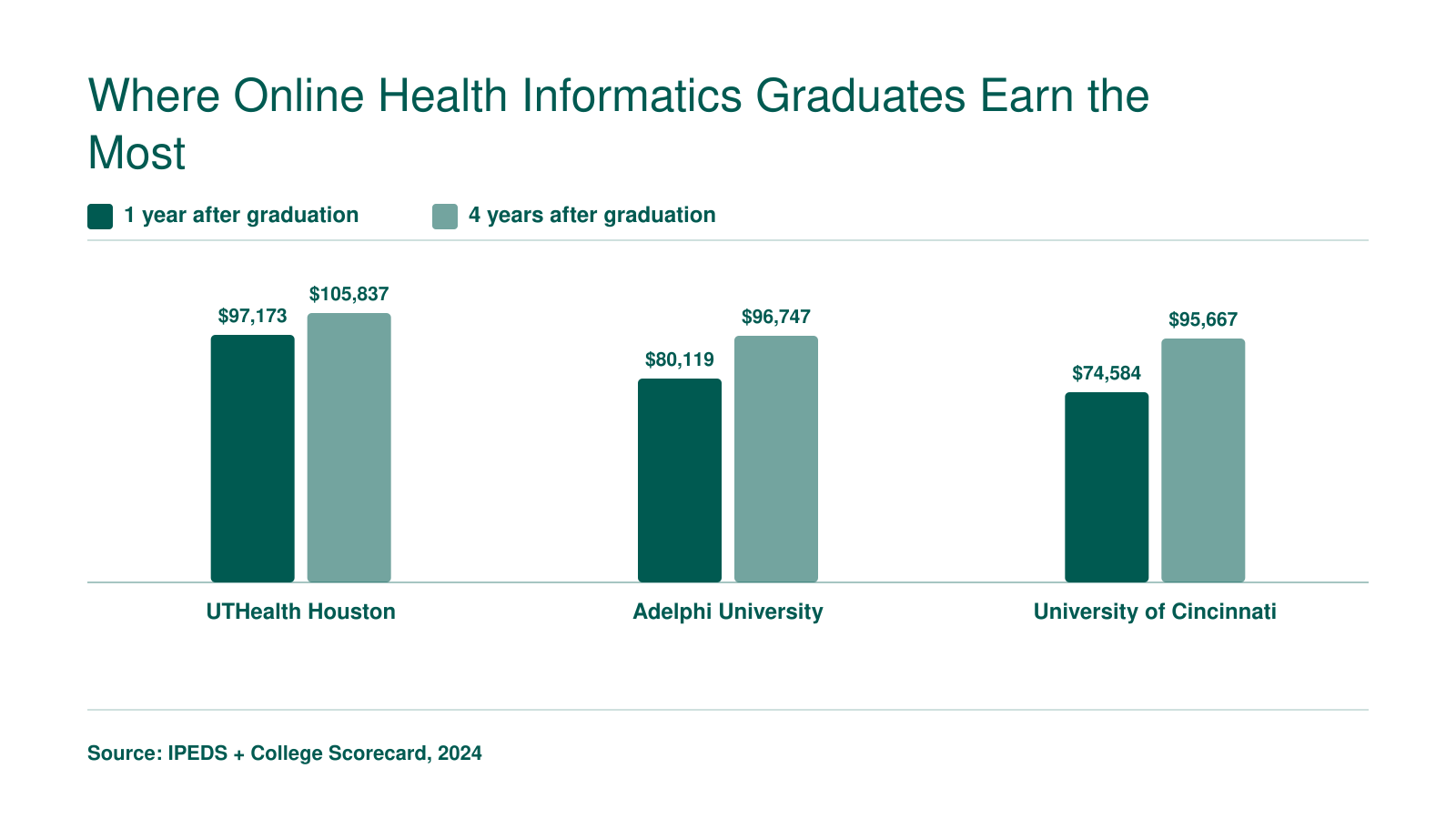
Earnings data show strong growth between the first year after graduation and four years out. UTHealth Houston's median rises from $97,173 to $105,837, while Adelphi and Cincinnati both clear $95,000 by the four-year mark.
Related Articles
In 2024, 99.4% of U.S. non-federal acute care hospitals had adopted certified electronic health record technology, according to ONC Health IT data. That near-universal digital footprint makes hospitals depend on informatics professionals who can manage and exchange patient data securely.
Before you compare tuition, confirm whether a fully online health informatics master's still demands live class sessions or a practicum at a site near you.
Admission Requirements for Online Health Informatics Master's Programs
Requirements vary by program, but the application process usually centers on a few common materials and academic thresholds.
- Undergraduate GPACommon minimums run from 2.75 to 3.0. Texas State and Adelphi use 2.75; Grand Canyon asks for 2.8, or 2.5 with a GMAT 500 or GRE 300. Cincinnati, Missouri, UC Davis, and George Mason often list 3.0, with conditional admission or a GPA addendum possible below that.
- GRE/GMATMany online programs are test-optional or do not require the GRE/GMAT. The GRE or GMAT is not required at Texas State, Cincinnati, Adelphi, Missouri, UC Davis, and Norfolk State, while Grand Canyon accepts scores only as an alternative for lower GPAs.
- Clinical backgroundA clinical, nursing, or healthcare degree is usually not required. Cincinnati and Adelphi accept applicants from any bachelor’s field, George Mason does not consider major a criterion, and Northwestern notes that student backgrounds vary.
- Technical preparationCheck for statistics, programming, or database prerequisites. Texas State lists statistics, anatomy and physiology, pathophysiology, pharmacology, medical terminology, and microcomputer applications; missing work may lead to conditional admission with assigned coursework. George Mason expects basic computer science, math, and statistics and encourages nontechnical applicants to take a Python and SQL course.
- Application materialsA résumé or CV, statement of purpose, and letters of recommendation are common. Texas State, for example, requires a resume, statement of purpose, and three recommendations. Some programs may prefer relevant healthcare or technology experience.
Health Informatics programs by state
Frequently Asked Questions About Online Health Informatics Master's Degrees
Choosing between a full master's, a graduate certificate, and employer-funded study usually comes down to cost, time, and career goals. These answers cover the questions prospective students ask most before applying.
How much does an online master's in health informatics cost?
Do I need a clinical background to earn a health informatics master's degree?
Is a health informatics online certificate a good alternative to a master's?
Are there scholarships for health informatics master's students?
Compare Health Informatics programs on the data that matters
Explore more Healthcare specializations or browse every graduate field.
All Healthcare programs