Master's in Health Informatics Programs With No GRE Required
Compare 230+ accredited no-gre Health Informatics programs at 200+ schools, with graduate earnings, cost, debt, and completion data from IPEDS and the U.S. College Scorecard.

"No GRE required" and "GRE waived if you qualify" are different admissions policies. Several programs here, including Boston University's and Northeastern's, state outright that no entrance exam is needed; others waive the test only for applicants clearing a 3.0 GPA or a set number of years in clinical or IT work.
That distinction matters for working nurses (including those in Nursing Informatics MSN programs), analysts, and career changers who would otherwise lose a semester to test prep. Cost spreads just as widely, from public per-credit rates to private program totals above $40,000, and CAHIIM accreditation is not universal.
Key Points
- Indiana University-Indianapolis charges nonresidents $1,201.50 per credit in 2026-27.
- Texas State lists a $502 online rate with no residency differential.
- CAHIIM's directory listed 346 programs on October 24, 2026.
Best No-GRE Health Informatics Master's Programs: Top 10
This ranking focuses on master's in health informatics programs that do not require the GRE or make the test optional. It orders programs by a composite of test-waiver eligibility, student retention, completion, and moderate cost and earnings factors.
Northeastern University
#1Boston, MA · ~$29,000/yr (est.)
Best for: Career changers pursuing health analytics
Northeastern University offers a STEM-certified Master of Science in Health Informatics that combines health sciences and computer science. The program includes a capstone project and can provide up to 12 months of co-op experience. Admission is rolling, with no GRE required and a 3.0 GPA minimum.
- STEM-certified program combining health sciences and computer science
- No GRE required and test optional
- Rolling admissions with fall and spring starts
- 3.0 GPA minimum and two recommendation letters
- Co-op provides up to 12 months of professional experience
- Joint program with Khoury College of Computer Sciences
Boston University
#2Boston, MA · $65,000 – $70,000/yr (est.)
Best for: Working professionals needing online flexibility
Boston University offers a CAHIIM-accredited Master of Science in Health Informatics through Metropolitan College, available online or on campus. The standard track is 32 credits and can be completed in 8 to 16 months, with no thesis or capstone required. No GRE or GMAT is required, and merit scholarships are considered.
- CAHIIM-accredited program offered online or on campus
- 32 total credit hours; complete in 8 to 16 months
- No GRE or GMAT required
- No thesis or capstone required
- Full-time and part-time options with fall, spring, and summer starts
- Merit scholarships automatically considered
- 24:1 student-to-instructor ratio
- Applied Data Analytics concentration
- 40 total credit hours; complete in 12 to 20 months
- Test-optional admission for this track
- Offered online and on campus
- STEM-designated program
- 24:1 average class ratio
University of North Carolina at Chapel Hill
#3Chapel Hill, NC · ~$13,000/yr (est.)
Best for: Clinical informatics students seeking internships
The University of North Carolina at Chapel Hill offers an online Master of Professional Science in Biomedical and Health Informatics with Clinical Informatics and Public Health Informatics tracks. The 35-credit program requires a mentored internship of at least 400 hours and supports full- or part-time study. Rolling admissions are available, with no GRE required.
- Clinical Informatics concentration
- 35 total credit hours; complete in 1 to 3 years
- Required mentored internship of at least 400 hours
- Rolling admissions with no GRE required
- Full-time and part-time options
- Three start dates per year
- 3.0 GPA minimum
- 100% online courses
- Public Health Informatics concentration
- Hands-on analytics and machine learning experience
- Interdisciplinary faculty and NC Research Triangle Park ties
- Three completion pace options
- 100% online with residential option available
- Required 400-hour mentored internship
Michigan Technological University
#4Houghton, MI · $25,000 – $30,000/yr (est.)
Michigan Technological University offers an MS in Health Informatics on campus or fully online, organized around stackable graduate certificates in areas such as AI in healthcare, security, and public health informatics. The 30-credit program can be completed in about 12 months full time, with thesis, report, or coursework-only options. No GRE is required.
- No GRE required for admission
- 30 total credit hours; 12-month full-time option
- Stackable 9-credit certificates in AI, security, and public health informatics
- Thesis, report, or coursework-only options
- 3.0 GPA minimum and three recommendation letters
- $0 application fee
- Free HIMSS student membership
- Fully online option with secure virtual lab
Bryant University
#5Smithfield, RI · ~$50,000/yr (est.)
Bryant University offers a STEM-designated Master of Science in Healthcare Informatics and AI in a hybrid format. The 30-credit program can be completed in 12 or 18 months and includes a capstone or internship using real healthcare data. Admission is rolling and does not require the GMAT or GRE.
- No GMAT or GRE required
- 30 total credit hours; complete in 12 to 18 months
- Hybrid learning format
- Capstone or internship using real healthcare data
- STEM-designated program
- $31,350 total program tuition
- 8 required courses plus 2 electives
Saint Louis University
#6Saint Louis, MO · ~$26,000/yr (est.)
Saint Louis University offers a 30-credit Master of Science in Health Informatics that can be completed fully online or fully in person. Coursework covers health data management, analytics, clinical systems, machine learning, and project management, with a capstone or internship experience. The GRE is not required.
- No GRE required; test optional
- 30 total credit hours
- Fully online or fully in person
- Capstone or health informatics internship option
- $42,000 total on-ground program tuition
- Covers HIPAA, HITECH, and EHR implementation
- Machine learning and project management coursework
University of Massachusetts-Lowell
#7Lowell, MA · ~$16,000/yr (est.)
UMass Lowell offers an online Master of Science in Health Information Management with a Health Informatics option that is CAHIIM-accredited. The 36-credit program includes a capstone project and can be finished in as little as 18 months. It offers rolling admissions and does not require the GRE.
- CAHIIM-accredited program
- No GRE required; rolling admissions
- 36 total credit hours; 12 courses
- Complete in as little as 18 months
- Capstone project with real-world case study
- $610 per credit
- Eligible for AHIMA RHIA and RHIT exams
- First CAHIIM-accredited program in New England
Indiana University-Indianapolis
#8Indianapolis, IN · $11,000 – $29,000/yr (est.)
Indiana University-Indianapolis offers a CAHIIM-accredited and AMIA-approved Master of Science in Health Informatics. The 36-credit program includes core courses, electives, and a professional or thesis track with a real-world project or thesis. Partnerships with organizations like The Polis Center provide hands-on experience in Indianapolis's healthcare hub.
- CAHIIM-accredited and AMIA-approved
- 36 total credit hours; 12 courses
- Professional or thesis track option
- Thesis or capstone option with internship opportunities
- 3.0 GPA minimum
- 2 start dates per year; fall and spring
- Scholarships from $500 to $2,250 per semester
- Real-world projects at The Polis Center
Loyola University Chicago
#9Chicago, IL · ~$22,000/yr (est.)
Loyola University Chicago offers a fully online MS in Health Informatics with full- and part-time options over approximately two years. The program combines core courses, data analysis training, and electives, followed by a two-semester capstone or an internship with a capstone report. The GRE is not necessary.
- 100% online program
- Full- and part-time options; about 2 years
- Core 15 credits, data analysis 6 credits, electives 12 credits
- Two-semester capstone or internship with capstone report
- 3.0 GPA minimum
- Two recommendation letters minimum
- Fall start; August 10 deadline
- No GRE necessary
Temple University
#10Philadelphia, PA · $23,000 – $30,000/yr (est.)
Temple University offers a CAHIIM-accredited Master of Science in Health Informatics online and in person. The 36-credit program lets students choose a project track with a capstone or a thesis track, with full- and part-time options. Admission is GRE-optional for applicants with at least a 3.0 undergraduate GPA; applicants below that threshold must submit GRE or GMAT scores.
- CAHIIM-accredited program
- 36 total credit hours
- No GRE or GMAT above a 3.0 undergraduate GPA
- Full-time and part-time options
- Synchronous and asynchronous online options
- 3.0 GPA minimum and three recommendation letters
- Transfer up to 6 graduate credits
- Non-matriculated students can take up to 9 credits
- Project Track with required capstone
- Online and in-person formats
- Accelerated +1 program available
- Laptop required for incoming students
- Thesis Track with required thesis
- No prior healthcare experience required
- 5-year time limit to complete degree
- Application through SOPHAS
- Limited assistantships for full-time students
Cost & outcomes by school
Federal data for the highest-earning Health Informatics programs, independent of the ranking above. Earnings are this field's master's graduates four years after completing, where the Scorecard reports them.
| School | Earnings | Tuition / yr | Debt | Grads/yr | Format |
|---|---|---|---|---|---|
| Middle Georgia State University GA | — | $4,534 | — | — | Online |
| Georgia Southern University GA | — | $6,646 | — | — | Online |
| Louisiana Tech University LA | — | $7,995 | — | — | Online |
| Columbus State University GA | — | $8,268 | — | — | Online |
| University of Alabama at Birmingham AL | — | $8,640 | — | — | Hybrid |
| Liberty University VA | — | $8,730 | — | — | Online |
| American Public University System WV | — | $8,700 | — | — | Online |
| Texas State University TX | — | $8,997 | — | — | Online |
| Touro University Worldwide CA | — | $9,000 | — | — | Online |
| Hood College MD | — | $9,470 | — | — | Hybrid |
| San Jose State University CA | — | $9,934 | — | — | Online |
| University of Houston TX | — | $10,051 | — | — | Online |
Sources: U.S. Department of Education. Tuition and graduates: IPEDS. Earnings and debt: College Scorecard, this field's master's graduates; a dash means no figure is reported.
Cost, debt & payoff
Median earnings of this field's master's graduates (4 yrs after completing) vs. their median federal loan debt · U.S. College Scorecard
Across these programs the median graduate earns about $104,317 and finishes with roughly $41,000 in debt — a ratio that clears a common rule of thumb (keep debt below first-year salary). Tuition and debt vary widely school to school, so check the per-school figures in the table above before you shortlist.
How We Ranked These No-GRE Programs
Dropping the GRE has become standard practice across health informatics programs, so a test waiver alone says little about whether a program is worth your money. Our composite score starts with GRE-waiver eligibility, confirmed on each program’s own admissions page, then centers on student retention and completion. Health informatics master’s degree cost and graduate earnings carry moderate weight, enough to reward strong value without letting a single number decide the order.
Cost, retention, completion, and earnings figures come from federal IPEDS and College Scorecard data. One limit matters: graduation rates and net price are institution-wide averages, not figures specific to the health informatics master’s. Treat them as a signal of the school’s overall track record rather than a program guarantee.
No school paid for placement on this list. That sets it apart from university marketing pages, which present their own programs on their own terms.
Lowest-Cost No-GRE Health Informatics Master's Options
Per-credit rates vary by residency and format. Texas State lists a $502 online rate with no stated residency differential, while Indiana University-Indianapolis lists $430.50 per credit for Indiana residents and $1,201.50 for nonresidents in 2026-27. Multiply the per-credit rate by required credits to estimate total tuition before fees. Net price below is the institution-wide average after aid, not a per-student quote.
| School | Graduate tuition (in-state) | Graduate tuition (out-of-state) | Net price after aid (institution-wide average) |
|---|---|---|---|
| University of Central Florida | $8,872 | $28,657 | $10,411 |
| University of North Carolina at Chapel Hill | $12,751 | $31,408 | $11,655 |
| Indiana University-Indianapolis | $11,180 | $28,964 | $11,668 |
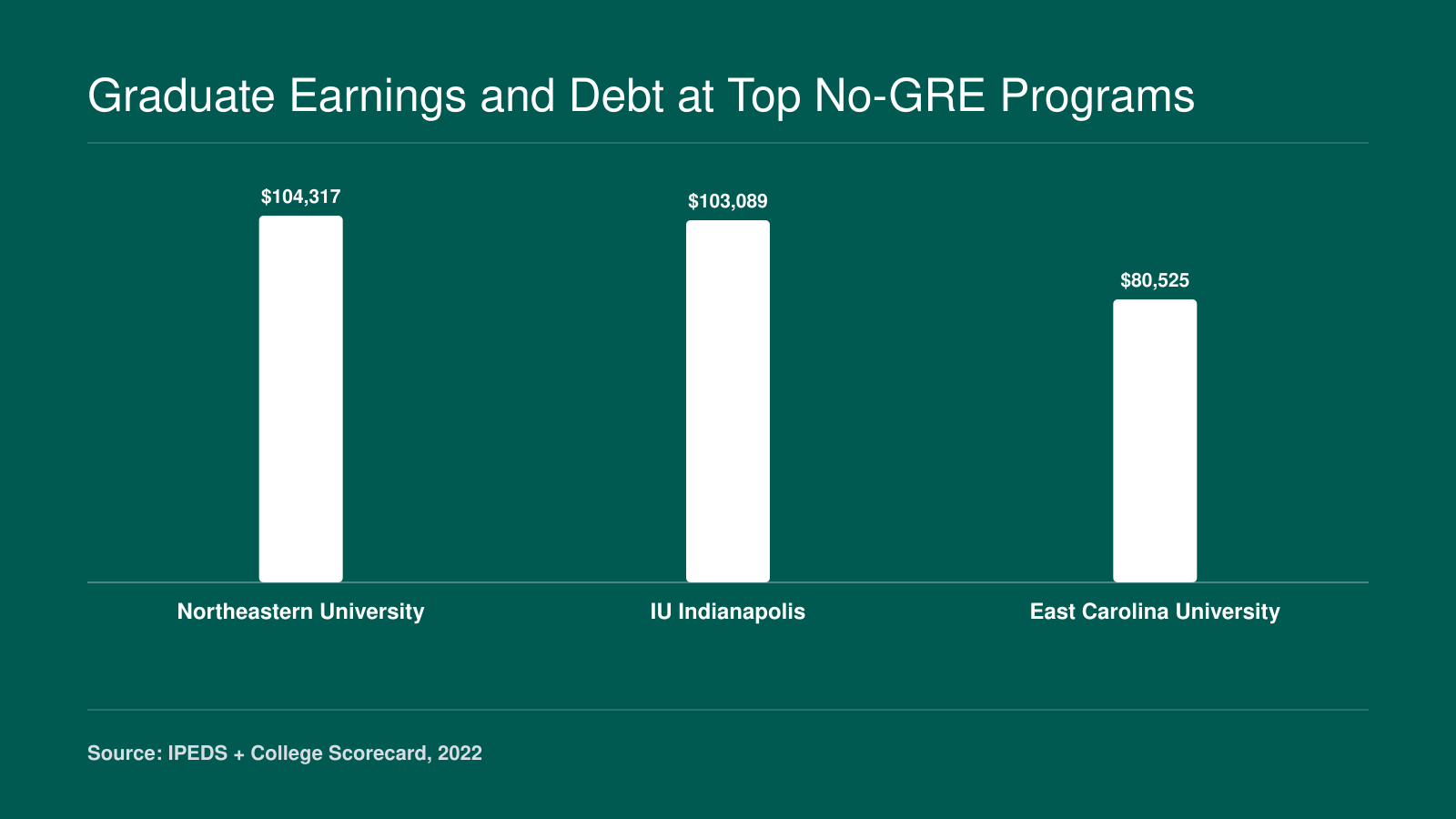
Graduate Earnings and Debt at Top No-GRE Programs
Four years after finishing, median earnings separate the programs that publish this measure. The bars below compare the published four-year figures for three programs.
Related Articles
Asynchronous, Synchronous, or Hybrid: How No-GRE Programs Deliver Classes
No-GRE health informatics master's programs are offered in several delivery patterns, from fully asynchronous online classes to scheduled live online sessions and hybrid formats with in-person components. The right choice depends on how much scheduled interaction you can manage and whether you want campus contact. The table below compares the main formats using program examples with confirmed delivery details.
| Delivery format | How classes run | Required live sessions or campus visits | Example program | Best for |
|---|---|---|---|---|
| Fully asynchronous online | Online coursework is self-paced with no scheduled class meeting times, offering maximum schedule flexibility. | No campus visits or live sessions required. | University of Missouri Master of Science in Health Informatics; Morehouse School of Medicine Master of Science in Health Informatics | Students who need maximum schedule flexibility and cannot attend live classes. |
| Synchronous or live online | Online classes meet at scheduled times with a professor and classmates, so flexibility depends on choosing session times you can attend. | No on-campus attendance required, but scheduled live online class time is required. | University of Pittsburgh Online Master of Science in Health Informatics | Students who want real-time interaction while avoiding a commute or relocation. |
| Hybrid with in-person and online options | Beginning with the Autumn 2026 cohort, students meet five Saturdays each quarter, online or in person on the Seattle campus, in addition to a weekly evening webinar. | Saturday sessions may be held on campus or online; campus attendance is not specified as required. | University of Washington Master of Health Informatics and Health Information Management | Working professionals who want flexible live instruction and optional in-person contact. |
| Primarily online with recurring residencies | Courses combine asynchronous and synchronous work, typically one night per week per course, balancing flexibility with set class time. | Two residential visits are required each year, in fall and spring. | University of Alabama at Birmingham Master of Science in Health Informatics | Students who want online convenience plus periodic in-person immersion and live class components. |
CAHIIM Accreditation vs. HIMSS Approval and Certification Eligibility
Accreditation, endorsement, and credentials get lumped together in program marketing, but they are three separate things.
CAHIIM is programmatic accreditation. It attaches to a specific degree, not to a university's whole informatics offering. CAHIIM accredits Health Informatics and Health Information Management programs, and its directory lists active master's listings at Adelphi, Indiana, UIC, University of Kansas Medical Center, and University of Maryland Global Campus; several of those are online master's in health informatics programs.1 Pittsburgh's Health Informatics master's appears with an initial status dated August 29, 2025, so confirm where that stands.2 UMass Lowell, Minnesota, Mississippi Medical Center, and Puerto Rico are also listed, but check their current enrollment status.1 The directory does not tell you any school's no-GRE policy.
HIMSS approval or curriculum alignment is an endorsement, not accreditation. No HIMSS source reviewed confirms it for any program here.
Credentials
CAHIIM's 2026 standards materials say HIM graduates of CAHIIM-accredited programs qualify for the AHIMA credential exam, which is the RHIA route.3 That points toward the HIM degrees at UIC and UMGC.1 CPHIMS and CAHIMS come from HIMSS, and their education and experience rules should be confirmed with HIMSS directly.
If RHIA eligibility matters to you, check the CAHIIM directory before you enroll.
CAHIIM's accredited program directory listed 346 programs when we checked on October 24, 2026. That total may cover more than one degree level and discipline, so filter the directory for master's-level health informatics before assuming a program qualifies.
No-GRE Admissions Checklist: Waiver Conditions, GPA, and Deadlines
Admission rules vary by program, some remove the GRE entirely, while others waive it only for applicants who meet GPA, experience, or prior-degree thresholds.
- GRE dropped for everyoneCincinnati and Yale's MS Health Informatics do not require the GRE; Yale does not accept it for this program in the current cycle.
- Waiver conditionsMinnesota requires the GRE unless you hold a regionally accredited master’s, have 10+ years in the field, or completed advanced calculus, statistics, or programming coursework. UAB waives the GRE but encourages it for applicants with below 3.0 GPA and limited healthcare or public-health experience.
- GPA and conditional admissionA 3.0 cumulative GPA is common. Cincinnati offers conditional admission below 3.0; Temple requires GMAT or GRE if your GPA is below 3.0.
- Start terms and deadlinesCincinnati has multiple start dates and waives the Spring 2027 application fee for applications submitted by November 1, 2026. Minnesota sets February 15, June 15, and October 15 deadlines; UAB lists April 1, July 1, and November 1; Temple's fall deadline is March 1.
- Common materialsPlan to submit transcripts, a resume, a statement of purpose, recommendations, and evidence of any required statistics or programming coursework.
Health Informatics programs by state
Frequently Asked Questions About No-GRE Health Informatics Master's Programs
Are GRE and GMAT requirements waived for every applicant or only under specific conditions?
Does HIMSS-approved status mean accreditation, endorsement, or alignment?
Can international students earn a health informatics master's in the USA without the GRE?
Which no-GRE health informatics master's programs are fully online for working professionals?
Compare Health Informatics programs on the data that matters
Explore more Healthcare specializations or browse every graduate field.
All Healthcare programs