Best Master's in Health Informatics Programs in Michigan
Compare 4 accredited Health Informatics programs in Michigan, with graduate earnings, cost, debt, and completion data from IPEDS and the U.S. College Scorecard.

How many health informatics master's programs can you actually choose from in Michigan? Fewer than most states, which raises the stakes on each option. Graduate tuition across the ranked schools runs from roughly $20,100 a year at the lower end to about $57,800 for nonresidents at the costliest, a spread wide enough to reshape a borrowing plan on its own.
Format splits the field too: one program is fully campus-based, another runs on campus or entirely online, and a third is online only. The RHIA pathway and CAHIIM accreditation sit with just one school, so credential goals narrow the choice as sharply as price does.
Key Points
- University of Michigan graduates reported $85,811 median earnings one year out and $124,262 four years out.
- Davenport's 33-credit MSHIIM runs fully online, and Michigan Tech's 30-credit MS offers campus and online formats.
- Michigan Tech and Davenport charge one tuition rate regardless of residency, so out-of-state students pay no premium.
Top Master's in Health Informatics Programs in Michigan
This list covers campus, hybrid, and online programs together and is ranked on verifiable federal outcomes data rather than university marketing. Only one Michigan master's program has confirmed CAHIIM accreditation in the sources we reviewed, so check each school's status before you apply if licensure or certification eligibility matters to you.
University of Michigan
#1Ann Arbor, MI · $29,000 – $58,000/yr (est.)
Best for: Full-time students wanting interdisciplinary campus study
The University of Michigan in Ann Arbor offers its Master of Health Informatics jointly through the School of Information, the School of Public Health, and the Medical School, with access to Michigan Medicine. The university graduates about 93% of its students, an institution-wide figure, and federal data shows median earnings of roughly $85,800 one year after completion. We could not confirm a current CAHIIM accreditation entry for this program, so do not assume it is accredited. It suits full-time students who want a research-rich, interdisciplinary campus experience and can absorb the highest sticker price on this list.
- Offered jointly by the School of Information, School of Public Health, and Medical School
- Two informal specializations: Big Data and AI in Healthcare, and Management and Leadership
- About two years on the Ann Arbor North Campus, with a fall start
- Bachelor's degree and a recommended 3.0 GPA; no GRE required
- Client-based projects and credit-based internships build a portfolio
- CAHIIM accreditation status not confirmed
Michigan Technological University
#2Houghton, MI · $25,000 – $30,000/yr (est.)
Best for: Remote learners across the Upper Peninsula
Michigan Technological University in Houghton runs its MS in Health Informatics from the Department of Data Science, on campus or fully online with a browser-based virtual lab. The university graduates about 68% of its students, an institution-wide figure. We found no published CAHIIM accreditation status for this program, so it should not be treated as accredited. It fits working professionals and Upper Peninsula residents who need remote access, plus Michigan Tech undergraduates who can use the accelerated pathway to finish in one additional year.
- Minimum of 30 credits, built from stackable graduate certificates
- Foundations certificate plus two of: AI, Security and Privacy, or Public Health Informatics
- Thesis, report, or coursework-only options
- Campus or fully online delivery; full-time students can finish in three semesters
- 3.0 GPA, three recommendation letters, and a résumé; no GRE required
- Accelerated pathway for current Michigan Tech undergraduates
- CAHIIM accreditation status not confirmed
Davenport University
#3Grand Rapids, MI · ~$20,000/yr (est.)
Best for: Aspiring health information management leaders
Davenport University in Grand Rapids delivers its Master of Science in Health Informatics and Information Management fully online. CAHIIM's directory lists the program with continuing (full, not candidate) accreditation under the Health Information Management type, last awarded June 2025, and Davenport describes it as the only CAHIIM-accredited master's of its kind in Michigan. Davenport cites accreditation reaffirmed through 2028, while CAHIIM lists the next review cycle as 2032 to 2033. The university graduates about 57% of its students, an institution-wide figure. It fits working professionals aiming at health information management roles and the RHIA credential.
- 33 credit hours, 100% online
- Seven-week course sessions
- Thesis or capstone option
- Minimum 2.8 GPA; prerequisite courses required
- Prepares graduates for the RHIA exam
- CAHIIM continuing accreditation, Health Information Management type
- Military benefits accepted; scholarships available
Cost & outcomes by school
Federal data for the highest-earning Health Informatics programs, independent of the ranking above. Earnings are this field's master's graduates four years after completing, where the Scorecard reports them.
| School | Earnings | Tuition / yr | Debt | Grads/yr | Format |
|---|---|---|---|---|---|
| University of Michigan MI | $124,262 | $28,886 | $41,000 | 47 | Campus |
| Davenport University MI | — | $20,098 | — | — | Online |
| Grand Valley State University MI | — | $20,030 | — | — | Online or campus |
| Michigan Technological University MI | — | $25,916 | — | 28 | Hybrid |
Sources: U.S. Department of Education. Tuition and graduates: IPEDS. Earnings and debt: College Scorecard, this field's master's graduates; a dash means no figure is reported.
Online and Hybrid Master's in Health Informatics Options in Michigan
Davenport University's 33-credit MSHIIM is delivered online through its Global Campus in seven-week sessions, and Michigan Tech offers its 30-credit MS in Health Informatics both on campus and fully online. The University of Michigan's 50-credit MHI is a two-year on-campus program. None of the programs here is described as hybrid.
Format and structure
Michigan Tech's online page lists a 2 to 3 year timeline, which suggests part-time pacing. Davenport's short sessions let you take one course at a time. The official pages do not say whether any program is synchronous or asynchronous, and none describes a required campus residency, so confirm live-session expectations with admissions before you apply.
Specializations and capstones
Michigan Tech builds the degree on a 12-credit foundational certificate plus focus areas such as artificial intelligence in healthcare, security and privacy in healthcare, and public health informatics. Students can finish through research, thesis, report, or coursework only. Davenport requires a capstone, and no separate internship is described. Michigan offers up to 9 internship credits, typically taken in the summer between years, though these are not shown as mandatory. The pages do not explain how online students arrange practicums.
Which format fits working professionals
For full-time workers, Michigan Tech's online route offers the most flexibility in pacing and project choice among online master's in health informatics programs. Davenport suits those who want a fixed capstone and a short-session rhythm. Michigan fits students who can study on campus full time.
Which Michigan Health Informatics Master's Programs Waive the GRE?
The University of Michigan pages we checked mostly drop the GRE, though the Master of Health Informatics page publishes no GRE policy at all. Where a GPA is stated it sits near 3.0 and is treated as a preference, not a hard cutoff, and the cited pages list a bachelor's degree rather than healthcare or IT experience or required statistics or programming coursework. The Master of Health Informatics page welcomes international bachelor's equivalents but does not list TOEFL or IELTS minimums, so confirm English proficiency rules with the school. Admissions policies for Michigan Technological University and Davenport University were not captured here, so check their admissions pages directly before applying.
| School | GRE Policy | Minimum GPA | Prerequisites / Experience | Application Deadline |
|---|---|---|---|---|
| University of Michigan, Master of Health Informatics | No published policy | 3.0 preferred; applicants below 3.0 may be admitted | Bachelor's degree, or international equivalent, from a recognized college or university | January 15 priority deadline (admission and scholarships); May 1 final deadline |
| University of Michigan, Health Infrastructures & Learning Systems Online MS | Optional; neither the program nor Rackham requires GRE scores | N/A | Academic statement of purpose, personal statement, resume or CV, quantitative statement, official transcript, three letters of recommendation | Rolling review; deadline not stated on the cited page |
| University of Michigan School of Public Health, master's programs | Not required for master's or doctoral programs (stated for the academic year beginning Fall 2022) | N/A | N/A | Priority deadline December 1, 2025; final deadline varies by department |
Related Articles
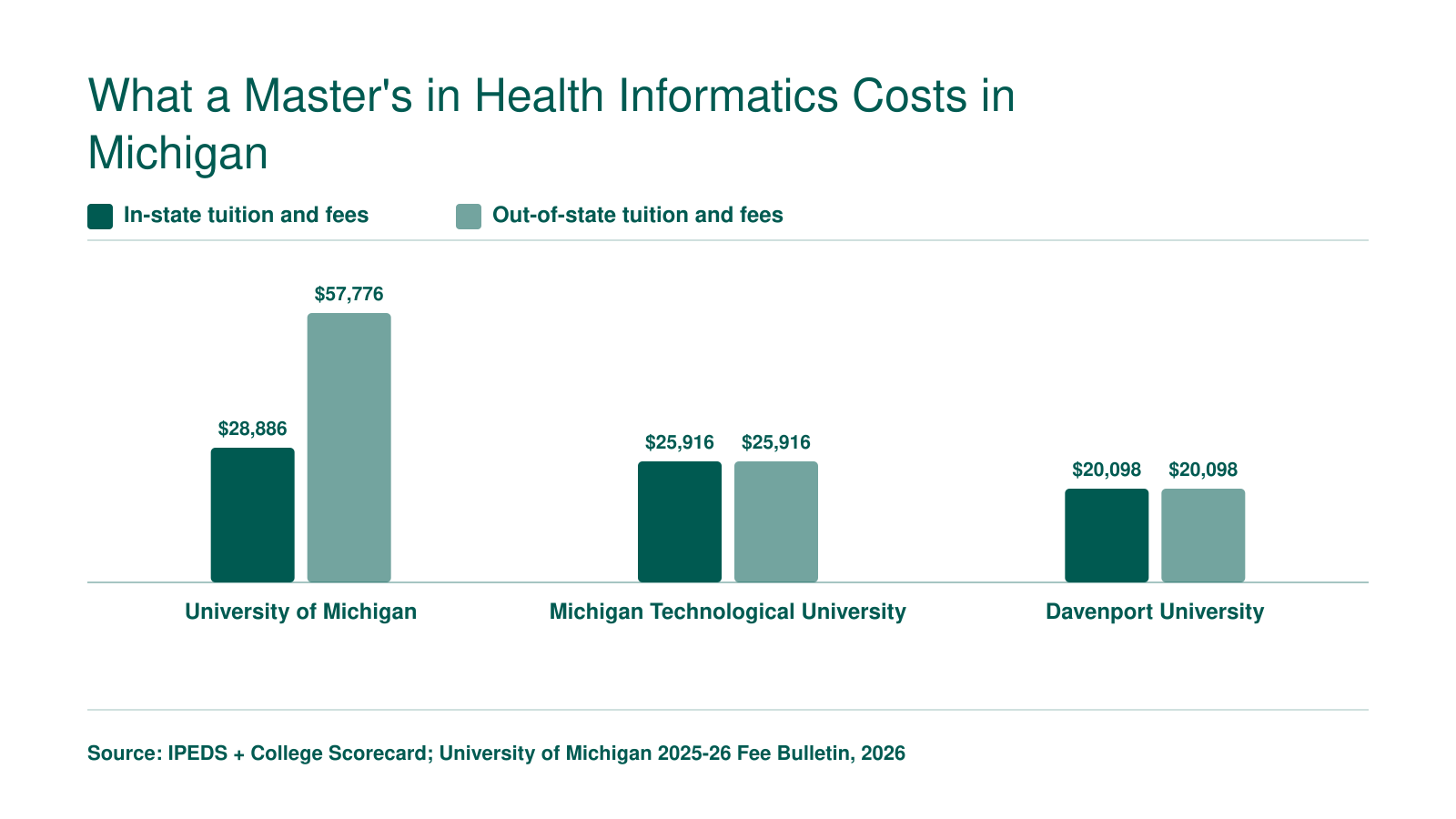
What a Master's in Health Informatics Costs in Michigan
The chart compares graduate tuition and fees for in-state and out-of-state students at each ranked school. Michigan Tech and Davenport charge one rate regardless of residency, so their bars match. University of Michigan's 2025-26 fee bulletin lists a resident rate of $1,577 for the first credit hour and $1,321 for each additional hour, and $2,156 for the first nonresident hour. Its Master of Health Informatics requires 45 credits, and one external estimate puts total tuition near $61,364, though that source does not say whether it is a resident rate or includes fees. Michigan Tech's online M.S. requires at least 30 credits and Davenport's M.S. requires 33, but current per-credit rates for both should be confirmed with each bursar before you budget. Institution-wide average net price after aid is $13,138 at University of Michigan, $14,182 at Michigan Tech and $17,707 at Davenport. These are averages across each university, not a quote for this degree. Michigan has no state license for health informatics, so the value of these degrees comes from program accreditation and certification eligibility, which the career section covers.
Highest Early-Career Earnings Among Ranked Programs
Among the schools here, the University of Michigan's Master of Health Informatics shows the highest program-level earnings.
Is a Master's in Health Informatics Worth It in Michigan? Careers and Salary
Among masters programs in Michigan, University of Michigan health informatics master's graduates reported median earnings of $85,811 one year after finishing and $124,262 four years out, against median debt of $41,000 and a typical monthly payment of $466. Debt is under half of first-year pay, so the payback case is strong for students also considering the Most Affordable Master's in Health Informatics Programs. With only 34 completers, treat these results as a signal, not a promise. Michigan Technological University and Davenport University have no program-level earnings or debt figures reported here, so those comparisons rest on tuition and program design instead.
Certifications and why accreditation matters
AHIMA grants RHIA eligibility through health information management degrees, not health informatics degrees.1 Davenport's program is CAHIIM accredited and the school states it prepares students for the RHIA exam. Even so, accreditation does not guarantee eligibility; AHIMA makes that call, so confirm with the program before enrolling.2
The AHIMA CPHI credential has a route for candidates with a bachelor's degree and two years of health informatics experience, based on AHIMA's November 2024 comparison.3 Check AHIMA for current rules. For HIMSS CPHIMS, verify eligibility on the HIMSS site. Michigan Tech does offer students free HIMSS membership.
Employers and placement
U-M lists client-based projects, credit internships and career coaching. Davenport reports a 100% job placement rate. Neither listing names specific Michigan health system partners, so ask admissions which employers hire their graduates.
How We Rank Michigan Health Informatics Master's Programs
Our rankings rest on verifiable federal data, not university marketing copy. We pull from the U.S. Department of Education's IPEDS and College Scorecard data.
The Factors We Weigh
We look at several things together, described qualitatively rather than with fixed numeric weights:
- Cost: Published graduate tuition and the estimated net price after typical aid.
- Completion: The institution-wide graduation rate, a signal of whether students finish what they start.
- Outcomes: Program-level graduate earnings and median debt, where published.
- Delivery: Whether a program runs on campus, online, or in a hybrid format.
What the Numbers Do and Don't Cover
Be clear on the scope. Graduation rate and net price are institution-wide figures, so they describe the whole university, not the informatics program alone. Earnings are program-level only when College Scorecard publishes them for that specific degree, which it does not for every program here. We weigh what the data supports and leave gaps as gaps rather than filling them with guesses.
One step the data cannot do for you: confirm current accreditation and the GRE policy directly with each admissions office before you apply, and consult our Master's in Health Informatics Programs With No GRE Required list for programs that do not require the exam, since both can change between publication cycles.
Compare Health Informatics programs on the data that matters
Explore more Healthcare specializations or browse every graduate field.
All Healthcare programs