Most Affordable Master's in Health Informatics Programs
Compare 230+ accredited most affordable Health Informatics programs at 200+ schools, with graduate earnings, cost, debt, and completion data from IPEDS and the U.S. College Scorecard.

Health informatics pays well, but master's tuition does not: across the programs below, published graduate tuition runs from $4,626 in-state at Georgia Southwestern State University to $31,408 out-of-state at UNC-Chapel Hill, and net price after aid ranges from $3,103 at CUNY Brooklyn College to $15,815 at Charter Oak State College.
Median earnings ten years after entry reach $80,838 at UC Davis, so the payoff is real. Total cost, CAHIIM accreditation, admissions fit, and graduate earnings, not brand, should drive the choice.
Key Points
- A typical master's requires 30 to 36 credits, so per-credit rates compound.
- CAHIIM accreditation alone does not guarantee RHIA eligibility.
- Stony Brook graduates earn $99,289 four years after finishing.
The 10 Most Affordable Master's in Health Informatics Programs of 2027
These ten health informatics master's programs stand out for pairing relatively low published graduate tuition and net price with targeted training in clinical systems, data analytics, and population health. Most offer some online or hybrid structure, and several add employer reimbursement support or certification preparation that can lower the real cost of attendance. Students who compare the per-credit and program-level details below can identify a value-focused path without sacrificing the informatics skills employers need.
CUNY Brooklyn College
#1Brooklyn, NY · $10,000 – $15,000/yr (est.)
Best for: New York residents seeking urban internship access
CUNY Brooklyn College's M.S. in Computer Science with a Health Informatics concentration pairs core computing coursework with health and nutrition sciences, giving students database, security, and project management skills for clinical settings. The program's exit options include a thesis, comprehensive exam, or a preferred health informatics internship, and students can tap the Magner Career Center and New York City's healthcare and tech employers. Its New York residency tuition advantage and relatively low average net price make it a high-value urban option.
- 30 credit hours with thesis, exam, or preferred internship exit
- Three health science courses plus Computer Applications in Health Sciences
- Rolling admissions with fall and spring starts
- Two letters of recommendation required
- Prerequisite coursework required; conditional acceptance possible
- Magner Career Center internship support
- Nondegree applicants accepted
- Employers include AT&T, CBS, and Citibank
Florida International University
#2Miami, FL · ~$11,000/yr (est.)
Best for: Fully online students wanting health analytics
Florida International University's fully online M.S. in Health Informatics and Analytics offers concentrations in Health Informatics and Analytics or Health Informatics and Artificial Intelligence. It uses a 17-month cohort structure and is CAHIIM accredited; the program is housed in a business school, unusual for health informatics, and connects students to HIMSS South Florida. Its resident and nonresident program pricing is close, so out-of-state online learners aren't heavily penalized.
- CAHIIM-accredited program housed in a business school
- Two concentrations: Health Informatics and Analytics or Health Informatics and Artificial Intelligence
- 17-month fully online cohort-based format
- Capstone or optional health informatics practicum
- Transfer up to 6 graduate credits
- Joint MBA/MSHIA and combined MD/MSHIA options
- Advanced Certificate in Global Healthcare Analytics available
- Partnership with HIMSS South Florida Chapter
University of North Florida
#3Jacksonville, FL · $10,000 – $15,000/yr (est.)
Best for: Employed clinicians needing interdisciplinary online training
The University of North Florida's online M.S. in Health Informatics is an interdisciplinary collaboration across health, business, and computing, covering EHRs, data governance, and healthcare analytics. The 33-credit program is designed for working professionals and clinical or non-clinical backgrounds, with employer reimbursement support and board certification preparation.
- 33 credit hours with statistics and medical terminology prerequisites
- Interdisciplinary collaboration across health, business, and computing
- Primarily online delivery for working professionals
- Employer tuition reimbursement supported
- Prepares for board certification
- $30 application fee and two recommendations required
- Letter of intent and resume required
- Starts fall and spring
University of California-Davis
#4Davis, CA · $15,000 – $20,000/yr (est.)
UC Davis's M.S. in Health Informatics emphasizes public health applications, including surveillance, prevention, and health promotion, within a clinical and translational research environment. Students receive both a research professor mentor and an academic advisor, and work on team-based projects across disciplines. The campus's research strengths make it a fit for students aiming at health data analysis and population health management roles.
- Focus on public health informatics, surveillance, and prevention
- Research professor mentor plus academic advisor
- Interdisciplinary team science with clinical and translational research
- Data-driven health research emphasis
University of North Carolina at Chapel Hill
#5Chapel Hill, NC · ~$13,000/yr (est.)
UNC-Chapel Hill's online Master of Professional Science in Biomedical and Health Informatics offers Clinical Informatics and Public Health Informatics tracks. The 35-credit program includes a 400-hour mentored internship and full-time or part-time pacing, with rolling admissions and no GRE required. Graduates work as analysts, managers, and researchers in the Research Triangle and beyond.
- Clinical Informatics track for managing and analyzing health data
- 35 credit hours with 400-hour mentored internship
- No GRE required; test optional
- Rolling admissions with spring, summer, and fall starts
- Full-time and part-time options; can finish in one year
- 100% online coursework
- Public Health Informatics track with analytics and machine learning
- 35-credit curriculum with 400-hour internship
- No entrance exam required; test optional
- Rolling admissions; spring, summer, and fall starts
- Hands-on analytics and machine learning experience
- Interdisciplinary faculty and Research Triangle connections
Georgia Southwestern State University
#6Americus, GA · under $5,000/yr (est.)
Georgia Southwestern State University's online MSN in Nursing Informatics is built for working registered nurses, blending nursing, computer, and information science. The CCNE-accredited program includes a capstone project, flexible full-time or part-time pacing, and three start dates per year. It prepares graduates for clinical analyst, informatics nurse specialist, and director of clinical informatics roles.
- CCNE-accredited MSN for registered nurses with current RN license
- 22-month program with full-time and part-time options
- Three start dates per year: fall, spring, and summer
- Capstone project applies skills to real-world challenges
- 100% online coursework through Georgia On My Line / GoVIEW
- Three letters of recommendation and $25 application fee
- Blends nursing, computer, and information science
- Prepares for clinical analyst and informatics nurse roles
The University of Texas at Tyler
#7Tyler, TX · ~$8,000/yr (est.)
The University of Texas at Tyler's online MSN in Informatics, Quality and Safety is a CCNE-accredited, 36-credit program with 500 practice hours. Coursework maps to AACN Essentials and QSEN competencies and prepares students for the ANCC Informatics Nursing board certification exam. Admission requires a BSN, an unencumbered RN license, and a 3.0 GPA in the last 60 undergraduate credits.
- CCNE-accredited 36-credit online MSN
- 500 clinical/practice hours required
- 12 credits MSN core, 18 specialization, 9 electives
- Maps to AACN Essentials and QSEN competencies
- Prepares for ANCC Informatics Nursing board certification
- 3.0 GPA in last 60 undergraduate credits and BSN required
- Unencumbered RN license required
- Courses year-round with multiple start dates
Charter Oak State College
#8New Britain, CT · $10,000 – $15,000/yr (est.)
Charter Oak State College's online M.S. in Health Informatics offers a focused 33-credit path with no electives, covering health data analytics, clinical database management, information systems analysis, and security. The program requires a 3.0 GPA and a B- or better in each course, and ends with a capstone. Its uniform graduate tuition rate makes it an appealing choice for out-of-state online learners.
- 33 credit hours with no elective credits
- Covers health data analytics, clinical database management, and security
- Core courses include epidemiology, statistical research, and project management
- Capstone required
- 3.0 GPA minimum and B- or better in each course
Marshall University
#9Huntington, WV · $5,000 – $10,000/yr (est.)
Marshall University's M.S. in Health Informatics is an interdisciplinary, CAHIIM-accredited program and the only one of its kind in West Virginia. The STEM-designated degree covers healthcare systems, analytics, and database management, and is offered online. Graduates pursue roles in hospitals, clinics, IT companies, government agencies, and insurance firms.
- CAHIIM-accredited and STEM-designated
- Only health informatics program of its kind in West Virginia
- Interdisciplinary curriculum: healthcare systems, analytics, database management
- 2.5 GPA minimum; provisional admission available
- Online delivery for working professionals
Augusta University
#10Augusta, GA · $7,000 – $21,000/yr (est.)
Augusta University's Master of Public Health with a Health Informatics concentration is a two-year hybrid program that is 90% online. Core public health courses are paired with computerized health information systems, public health informatics, and health data management, and students complete an internship and capstone. The CEPH-accredited MPH prepares graduates for leadership roles in public health agencies, healthcare organizations, pharmaceutical and IT companies.
- CEPH-accredited MPH with health informatics concentration
- 45 credit hours, hybrid format that is 90% online
- Internship and capstone project required
- Covers computerized health information systems and public health informatics
- Designed for working professionals
Cost & outcomes by school
Federal data for the highest-earning Health Informatics programs, independent of the ranking above. Earnings are this field's master's graduates four years after completing, where the Scorecard reports them.
| School | Earnings | Tuition / yr | Debt | Grads/yr | Format |
|---|---|---|---|---|---|
| Duke University NC | $163,348 | $66,523 | $45,810 | 33 | Hybrid |
| The University of Texas Health Science Center at Houston TX | $105,837 | $11,367 | $20,500 | 80 | Online |
| Columbia Southern University AL | — | $3,936 | — | — | Online |
| Middle Georgia State University GA | — | $4,534 | — | — | Online |
| Georgia Southwestern State University GA | — | $4,626 | — | — | Online |
| Northeastern State University OK | — | $5,771 | — | — | Online or campus |
| University of the Potomac-Washington DC Campus DC | — | $5,850 | — | — | Campus |
| Clayton State University GA | — | $6,493 | — | — | Campus |
| Georgia Southern University GA | — | $6,646 | — | — | Online |
| Fayetteville State University NC | — | $6,791 | — | — | Online |
| North Carolina Central University NC | — | $7,638 | — | — | Campus |
| Arkansas Tech University AR | — | $7,670 | — | — | Online |
Sources: U.S. Department of Education. Tuition and graduates: IPEDS. Earnings and debt: College Scorecard, this field's master's graduates; a dash means no figure is reported.
Cost, debt & payoff
Median earnings of this field's master's graduates (4 yrs after completing) vs. their median federal loan debt · U.S. College Scorecard
Across these programs the median graduate earns about $104,317 and finishes with roughly $41,000 in debt — a ratio that clears a common rule of thumb (keep debt below first-year salary). Tuition and debt vary widely school to school, so check the per-school figures in the table above before you shortlist.
What a Health Informatics Master's Really Costs: Per-Credit Rates, Fees, and Residency Pricing
The sticker per-credit price rarely equals the final bill. A master's in health informatics typically requires 30 to 36 credits, so a modest per-credit rate compounds quickly, and mandatory technology, distance-learning, and graduation fees often sit outside the advertised tuition line. A missing fee line in a program's published materials should not be read as a zero.
Low per-credit prices in practice
- Texas State University: 30 credits at $502 per credit totals $15,060 before automatically added course-material fees are considered.
- UMass Lowell: 36 credits at $610 per credit in Fall 2026 totals $21,960, plus a $30 per-term registration fee.
- George Mason University: 36 credits at $800 per credit plus a $35 per-credit distance-learning fee totals $30,060 in 2025-2026.
- University of Minnesota: 36 credits at $1,665 per credit for residents totals $59,940; nonresidents pay $2,601 per credit, or $93,636.
Residency pricing is not one-size-fits-all
Several programs below publish a single online rate, including UMass Lowell, George Mason, and MUSC, though not every source labels that rate as flat e-tuition. Minnesota, by contrast, charges out-of-state students about $936 more per credit, adding tens of thousands to the total. If you live out of state, ask directly whether the published online rate applies to you. Before applying, request the program's full cost sheet and confirm whether the degree is an online master's in health informatics or includes campus visits.
CAHIIM Accreditation and RHIA or CHDA Certification Eligibility
Does a CAHIIM-accredited health informatics master's qualify you to sit for the RHIA exam? Not by itself, and that distinction can change which program is worth your money.
Two Different Accreditations
CAHIIM accredits programs in two related fields: Health Informatics and Health Information Management (HIM). The label matters for certification. AHIMA, which issues the Registered Health Information Administrator (RHIA) credential, accepts only CAHIIM-accredited HIM coursework, completed at the baccalaureate or master's level, or through an approved post-baccalaureate certificate.1 A health informatics degree, even an accredited one, is not currently a supported path to RHIA eligibility.1 CAHIIM Programs Overview notes that accreditation does not guarantee exam eligibility, so read the field name, not just the accreditation seal.
The Certified Health Data Analyst (CHDA) credential rests on a combination of education and experience. AHIMA lists the specific current criteria, and because the credential has been under revision, you should confirm the active requirements directly with AHIMA before enrolling.1
Verify Before You Commit
Several low-cost programs carry CAHIIM accreditation, including options at Adelphi University, Boston University, Johns Hopkins University, and Kent State University, with HIM-track accreditation at schools like the University of Massachusetts Lowell.2 Accreditation status changes, so always confirm a program in the CAHIIM program directory first.2
If you plan to sit for RHIA, an accredited HIM program at a slightly higher price beats a cheaper unaccredited one that leaves you ineligible.
Related Articles
Admission Requirements for Affordable Health Informatics Master's Programs
Most programs below keep applications straightforward, but requirements vary by school.
- Bachelor's degree and GPAA bachelor's is required, with minimum GPAs typically between 2.75 and 3.0. Texas State uses 2.75, while Cincinnati, Minnesota, MUSC and Michigan Tech list 3.0.
- GREMost programs here do not require the GRE; Texas State, Cincinnati, MUSC and Michigan Tech waive or skip it. Minnesota requires it unless you qualify for a waiver.
- Application feeFees range from about $55 to $100 where they apply. Michigan Tech and Grand Canyon charge no standard fee, and Cincinnati waives fees for military, veterans and Spring 2027 applicants.
- Transfer creditsLimits vary, typically 6-12 graduate credits. Cincinnati allows 6; Grand Canyon allows 12 or one-third of the program; Minnesota offers 11 for PharmD/MHI students.
- PrerequisitesSome programs expect a statistics course or a healthcare/IT background; confirm the specific prerequisite list before applying.
- Supporting materialsPrepare a resume, statement of purpose, and recommendation letters as part of the application.
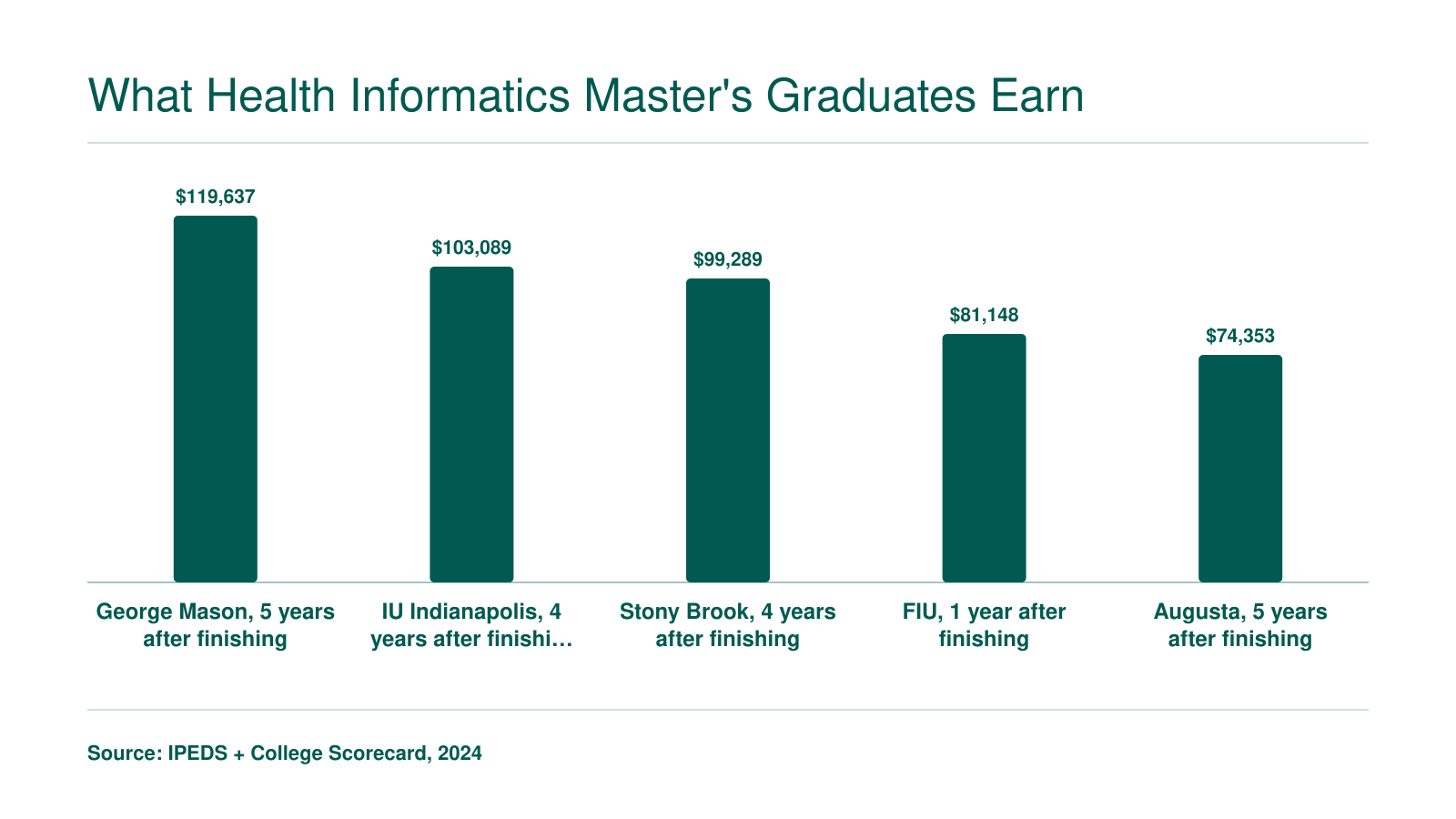
What Health Informatics Master's Graduates Earn
Median earnings rise with time after finishing, so the chart compares each program on the basis it reports: one, four, or five years out. Where median program debt is published, Stony Brook graduates earn $99,289 four years after finishing while carrying $33,177 in debt, and FIU graduates earn $81,148 one year after finishing with $35,248 in debt.
Health Informatics programs by state
Frequently Asked Questions About Affordable Health Informatics Master's Programs
Prospective students often ask how affordability affects format, pace, and pay. Here are the most useful answers based on the program data in this ranking.
What is the cheapest online master's in health informatics?
How long does an affordable health informatics master's take to complete?
Can I work full-time while earning an online health informatics master's?
What is the average salary with a master's in health informatics?
Compare Health Informatics programs on the data that matters
Explore more Healthcare specializations or browse every graduate field.
All Healthcare programs