Best Master's in Health Informatics Programs in New York
Compare 18 accredited Health Informatics programs in New York at 17 schools, with graduate earnings, cost, debt, and completion data from IPEDS and the U.S. College Scorecard.

Health informatics is the work of managing clinical data: electronic health records, analytics, and the systems hospitals use to track quality and cost, a focus shared with Nursing Informatics MSN programs.
In New York, tuition for a health informatics master's varies widely. Graduate tuition runs from $11,524 in-state at CUNY Brooklyn College to $45,813 at Weill Cornell.
The state requires no license to practice health informatics. Practicum hours, technical skills, and CAHIIM accreditation tend to carry more weight with employers than a school's name, whether you're considering health informatics or a Master's in Healthcare Management in New York.
Key Points
- CUNY Brooklyn College is the cheapest option here at $11,524 in-state.
- New York requires no state license for health informatics, so cost drives the decision.
- Several schools skip the GRE, but some publish no policy, so confirm with admissions.
Top 10 Master's in Health Informatics Programs in New York
New York's health informatics master's options range from low-cost SUNY programs to private, industry-connected degrees in New York City. Each card below shows the program's format, city, and tuition alongside our summary. CAHIIM accreditation is noted only where the CAHIIM directory confirms it, which is currently the case for Adelphi University and SUNY Oswego. For every other school, confirm status directly with the program or the CAHIIM directory.
Stony Brook University
#1Stony Brook, NY · ~$14,000/yr (est.)
Best for: Data-focused career changers choosing a specialization
Stony Brook's Master of Science in Applied Health Informatics is a 48-credit program with two specializations, Clinical Systems Lifecycle Management and Data Analytics. It is offered in HyFlex or fully online formats, and every student finishes with a 360-hour practicum or a quality improvement project. Applied projects with community and corporate partners make it a practical choice for building a portfolio, and it requires no entrance exam.
- 48 credit hours with a required capstone
- Concentrations: Clinical Systems Lifecycle Management or Data Analytics
- Capstone is a 360-hour practicum or a quality improvement project
- HyFlex hybrid or fully online synchronous formats
- No entrance exam required
- 3.0 GPA minimum and three letters of recommendation
- Summer start only; full-time or part-time
- Core coursework includes Python and R data science
SUNY Downstate Health Sciences University
#2Brooklyn, NY · $12,000 – $25,000/yr (est.)
Best for: Working clinicians seeking evening classes
SUNY Downstate's STEM-designated Master of Science in Health Informatics pairs clinical knowledge with data science in Brooklyn. Students can attend evening classes in person or study online, and the program includes an internship in New York hospitals. That mix suits working professionals who want hands-on exposure to large-scale EHR work.
- 39 credit hours, STEM designated
- 120-hour internship in New York hospitals
- Evening in-person classes or online study
- Optional live sessions for online students
- Partnership with NYC Health + Hospitals
- Full-time and part-time options
Fordham University
#3Bronx, NY · ~$27,000/yr (est.)
Best for: International students needing flexible delivery
Fordham's Master of Science in Applied Health Informatics is a 36-credit program that can be finished in one year full-time or at a part-time pace. Classes run online or in person at Lincoln Center, with capstone projects built around real organizations. It is a private option with a strong health-tech industry orientation and a largely international cohort.
- 36 credit hours with a required capstone
- One-year full-time path; part-time available
- Online or in person at Lincoln Center
- Listed entrance exam (GRE, GMAT, or MCAT), waivable with experience
- Rolling admissions, fall start
- Two letters of recommendation; $80 application fee
University at Buffalo
#4Buffalo, NY · $10,000 – $15,000/yr (est.)
The University at Buffalo offers its health informatics degree as a Master of Science in Biomedical Informatics through the Jacobs School of Medicine and Biomedical Sciences. The program leans toward research and leadership in clinical informatics, bioinformatics, and public health informatics. It is hybrid, so some requirements can be completed online, but it is not fully online.
- 36 credit hours over two years
- Hybrid format with some requirements online
- Full-time and part-time options
- Offered through the Jacobs School of Medicine
- Registered with the New York State Education Department
- $85 application fee
CUNY Brooklyn College
#5Brooklyn, NY · $10,000 – $15,000/yr (est.)
CUNY Brooklyn College delivers health informatics as a concentration within its Master of Science in Computer Science. It suits students with a technical bent who want database, security, and project management skills alongside health science coursework. Tuition is the lowest of the ranked private and public options in New York City.
- 30 credit hours, on campus
- Three health and nutrition science courses required
- Exit option: thesis, comprehensive exam, or internship
- Prerequisite courses required
- Rolling admissions with fall and spring starts
- Magner Career Center internship support
Adelphi University
#6Garden City, NY · ~$33,000/yr (est.)
Adelphi's online Master of Science in Healthcare Informatics is listed as active and CAHIIM accredited in the 2026 CAHIIM directory. Applicants can hold a bachelor's degree in any field and do not need the GRE or GMAT. A 100-hour practicum adds applied experience to a fully online format.
- CAHIIM accredited (active in the 2026 directory)
- Fully online format
- 100-hour practicum
- No GRE or GMAT required
- Bachelor's degree in any field accepted
- 2.75 undergraduate GPA minimum
- Coursework covers telemedicine, EHRs, and clinical decision support
Hofstra University
#7Hempstead, NY · $30,000 – $35,000/yr (est.)
Hofstra's Master of Science in Health Informatics is a 36-credit, on-campus, STEM-designated program on Long Island. It combines health care, information science, and data analytics, including AI and health information exchange, with an integrated practicum. A partnership with Northwell Health gives students regional industry connections, and evening classes support working adults.
- 36 credit hours, on campus, about two years
- STEM designated, which matters for international students on OPT
- Integrated practicum
- Partnership with Northwell Health
- Evening classes available
- Scholarships and financial aid available
State University of New York at Oswego
#8Oswego, NY · ~$13,000/yr (est.)
SUNY Oswego's health informatics master's is listed as active and CAHIIM accredited in the 2026 CAHIIM directory, in both campus-based and online delivery. It is STEM designated, offers an Artificial Intelligence concentration, and carries a low per-credit rate for a SUNY program. Rolling admissions, multiple start dates, and a test-optional GRE policy add flexibility.
- CAHIIM accredited (active in the 2026 directory)
- Artificial Intelligence concentration
- $471 per credit
- GRE test optional; rolling admissions
- Fall, spring, or summer start
- 3.0 GPA minimum and prerequisite courses required
- Online or Syracuse campus options
- Over 120 graduate assistantships
- Health Informatics concentration
- Online or in-person format
- Spring start
- Interdisciplinary curriculum
- Partnership with Upstate Medical University
SUNY Polytechnic Institute
#9Utica, NY · ~$13,000/yr (est.)
SUNY Polytechnic Institute offers an accelerated online BS/BPS to MS pathway in Health Information Management and Health Informatics. It is built for students who start at the undergraduate level and want to save time and credits, not for those who already hold a bachelor's degree. The combined track typically takes five years.
- Combined bachelor's-to-master's pathway
- 145 total credits, including 33 graduate credits
- Typically five years; transfer students may finish in three
- Up to 12 graduate credits count toward both degrees
- Online format
- 3.0 GPA and a statistics prerequisite required
Weill Medical College of Cornell University
#10New York, NY · ~$46,000/yr (est.)
Weill Cornell Medicine's MS in Health Informatics is a campus-based program in Manhattan that blends IT, data science, and human behavior. It includes an Artificial Intelligence Pathway and a capstone with industry partners. It is the highest-priced option on this list, so weigh it against your funding and goals.
- 36 credit hours, completed in 12 months
- Full-time and part-time options
- Artificial Intelligence Pathway available
- Capstone with industry partners
- Hospital immersion opportunities
- Statistics placement test can waive coursework
Cost & outcomes by school
Federal data for the highest-earning Health Informatics programs, independent of the ranking above. Earnings are this field's master's graduates four years after completing, where the Scorecard reports them.
| School | Earnings | Tuition / yr | Debt | Grads/yr | Format |
|---|---|---|---|---|---|
| Stony Brook University NY | $99,289 | $14,222 | $33,177 | 38 | Hybrid |
| Adelphi University NY | $96,747 | $32,822 | $52,433 | 12 | Online |
| Roberts Wesleyan University NY | — | $15,580 | — | — | Online |
| St. Thomas Aquinas College NY | — | $22,050 | — | — | Online |
| Manhattan University NY | — | $25,485 | — | — | Online |
| Molloy University NY | — | $27,520 | — | — | Online |
| State University of New York at Oswego NY | — | $12,580 | — | 25 | Online |
| CUNY Graduate School and University Center NY | — | $10,294 | — | 16 | Online |
| SUNY Downstate Health Sciences University NY | — | $11,982 | — | 20 | Hybrid |
| SUNY Polytechnic Institute NY | — | $12,865 | — | 15 | Online |
| St. John's University-New York NY | — | $36,227 | — | — | Online |
| University at Buffalo NY | — | $14,530 | — | 11 | Hybrid |
Sources: U.S. Department of Education. Tuition and graduates: IPEDS. Earnings and debt: College Scorecard, this field's master's graduates; a dash means no figure is reported.
Cost, debt & payoff
Median earnings of this field's master's graduates (4 yrs after completing) vs. their median federal loan debt · U.S. College Scorecard
Across these programs the median graduate earns about $99,289 and finishes with roughly $33,177 in debt — a ratio that clears a common rule of thumb (keep debt below first-year salary). Tuition and debt vary widely school to school, so check the per-school figures in the table above before you shortlist.
How We Ranked New York's Health Informatics Master's Programs
Prestige versus proof: we chose proof. Instead of reputation, we weighed what actually affects your finances and career. We looked at health informatics masters program cost and net price, plus program-level earnings and debt wherever those figures are published.
A note on the numbers: graduation rates and net price are institution-wide averages, not figures specific to a single health informatics program, so read them as context rather than exact outcomes for your degree.
We ranked campus, online, and hybrid master's programs in New York together on one list, so you can compare every format side by side without jumping between pages.
Online and Hybrid Health Informatics Master's Options in New York
New York health informatics master's programs increasingly use flexible distance formats, but delivery details vary by school. Adelphi University's M.S. in Healthcare Informatics, CUNY Graduate School of Public Health and Health Policy's M.S. in Population Health Informatics, and CUNY School of Professional Studies' M.S. in Health Information Management can each be completed fully online. CUNY SPH uses asynchronous and/or synchronous courses, while Adelphi and CUNY SPS do not clearly specify pacing. Stony Brook's online M.S. in Applied Health Informatics is mostly synchronous and requires either a 360-hour practicum or a quality-improvement capstone, with no campus requirement. Fordham's M.S. in Applied Health Informatics is available online or in person at Lincoln Center. By contrast, Manhattan University's M.S. in Healthcare Informatics is hybrid low-residency and includes required three-day on-campus summative experiences. Distance learners should verify practicum placement rules: Adelphi's practicum may be remote or in person, and Stony Brook faculty match students to internship sites.
Related Articles
Which New York Health Informatics Master's Programs Waive the GRE?
Among the schools here that publish a policy, most do not require the GRE, which puts them among master's programs with no GRE required. Several do not publish one, so confirm with admissions before you plan around a test.
- GRE not required: Stony Brook (Applied Health Informatics) does not require an entrance exam. Adelphi's program listing says the same. Brooklyn College is reported to accept applications without the GRE, but that comes from a nonofficial source, so verify it.
- GRE optional: SUNY Oswego lists its online program as test optional. No waiver criteria are stated, and the program lists a 3.0 GPA minimum.
- GRE required: Fordham's online Applied Health Informatics listing shows an entrance exam requirement, accepting the GRE, GMAT, or MCAT. Confirm whether waivers exist.
- No policy found: SUNY Downstate, University at Buffalo, Hofstra, SUNY Polytechnic Institute, and Weill Cornell have no GRE policy that we could confirm. Weill Cornell mentions a statistics placement test, which is a different thing.
Policies change by admissions cycle, so check each program's current admissions page.
What Health Informatics Master's Graduates Earn in New York
College Scorecard has not yet published program-level earnings for the health informatics master's programs here, so a federal range across them is not available.
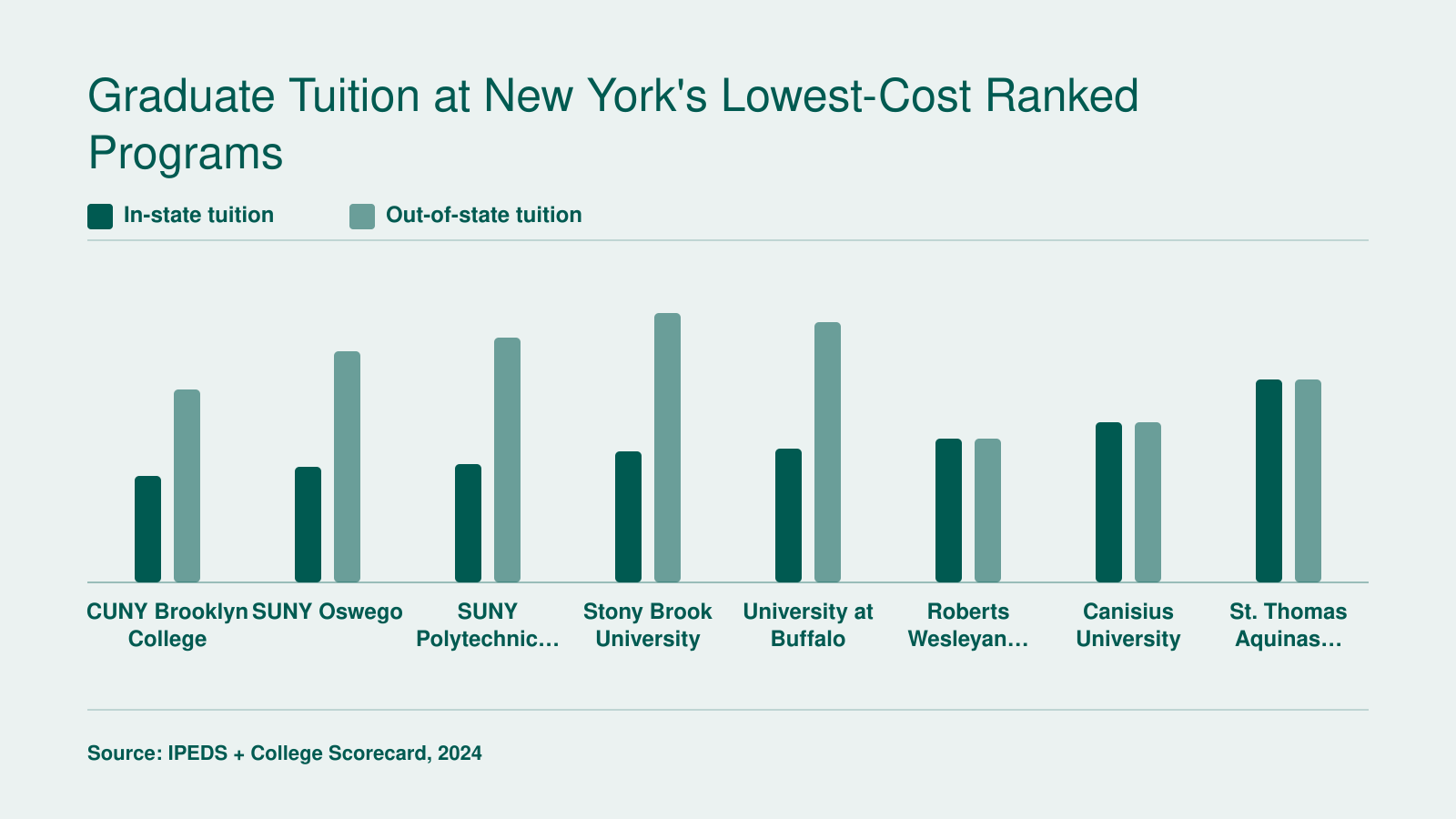
Graduate Tuition at New York's Lowest-Cost Ranked Programs
CUNY Brooklyn College is the cheapest program in this comparison at $11,524 in-state, about $10,526 below St. Thomas Aquinas College at $22,050. Public schools charge out-of-state students much more, while Canisius, St. Thomas Aquinas, and Roberts Wesleyan charge one rate to everyone. Published tuition is not what you pay: net price after aid, assistantships, and scholarships will differ, so check each school's aid office before comparing.
Cost, Financial Aid, and New York Certification for Health Informatics
Brooklyn College is the cheapest program here, and New York asks nothing of you in licensing, so cost is the real decision.
Tuition and Debt
Brooklyn College's Computer Science MS with a health informatics concentration is 30 credits at $11,524 in listed in-state tuition. Cornell sits at the top: a 36-credit MS at $30,160. SUNY Oswego publishes $471 per credit. Stony Brook requires 48 credits, and its online out-of-state rate runs only 20% above the resident rate. No program-level median debt or 10-year monthly payment figures are available for these programs, and mandatory fees are generally not included in the listed figures, so confirm totals with each bursar.
Aid Worth Pursuing
- Assistantships: SUNY Oswego lists over 120 graduate assistantships and a Diversity Graduate Fellowship.
- Scholarships: Oswego and Roberts Wesleyan both list scholarships.
- Employer benefits: Canisius and Roberts Wesleyan are built for working professionals, so ask your employer about tuition assistance.
Certification
New York has no state license for health informatics professionals. Credentials are voluntary: AHIMA's CHDA and RHIA, and HIMSS's CPHIMS. RHIA currently requires an AHIMA-accepted health information management degree, so a general informatics master's may not qualify. CAHIIM accreditation, held by SUNY Oswego, Stony Brook, and SUNY Polytechnic, is the program-quality signal to check.
How to Choose the Right Master's in Health Informatics in New York
Health informatics admissions in New York increasingly reward applicants who arrive with technical footing, not just clinical experience. CUNY SPH expects a 3.0 GPA plus programming coursework or prior experience.1 SUNY Poly is open to all majors3 and Adelphi sets a 2.75 minimum. At CUNY SPS, students without a health information management background may need additional prerequisite coursework.2
Timing varies, too. Adelphi admits on a rolling basis with a January 15, 2027 priority date. CUNY SPS lists a November 5, 2026 spring priority deadline and a December 3 regular deadline.2 CUNY SPH's December 1, 2026 date is a priority scholarship deadline, so apply early if funding matters.1
Working clinicians often do best with asynchronous online study. Career changers tend to gain more from hands-on placements: SUNY Downstate requires an 80-hour internship in a healthcare setting, and Manhattan University's capstone is a consulting project with a real healthcare organization. If your target employers care about CAHIIM accreditation, confirm each program's status directly before applying.
Frequently Asked Questions About Health Informatics Master's Programs in New York
How long does it take to complete a master's in health informatics in New York?
Is CAHIIM accreditation important for New York health informatics programs?
What is the average salary for a health informatics master's graduate in New York?
Can you complete a health informatics master's while working full-time?
Compare Health Informatics programs on the data that matters
Explore more Healthcare specializations or browse every graduate field.
All Healthcare programs