Best Master's in Nutrition Programs in Arizona
Compare 7 accredited Nutrition programs in Arizona at 4 schools, with graduate earnings, cost, debt, and completion data from IPEDS and the U.S. College Scorecard.

Since January 2024, new RDN candidates need a master's degree, which has changed what Arizona applicants ask of a nutrition program.
Arizona's field is small: the University of Arizona, Arizona State University, and Grand Canyon University, with campus and online programs on one list. The choice turns on credential goal (RDN or CNS), format, and cost.
Arizona does not license dietitians, so the credentials that matter come from national bodies, not the state.
Key Points
- Arizona has no state license for dietitians, so employers set credential requirements.
- University of Arizona charges residents $14,856 yearly in graduate tuition; Grand Canyon charges $10,015 to everyone.
- Online options exist, but RDN eligibility depends on ACEND accreditation, so verify before applying for 2027.
Ranked: Arizona's Best Master's in Nutrition Programs
Arizona's master's in nutrition options split into two paths: programs built to lead toward the RDN credential, and programs aimed at broader clinical or wellness careers. Two of the three schools below deliver coursework online, so location matters less than which credential you want and how much supervised practice you need.
University of Arizona
#1Tucson, AZ · ~$15,000/yr (est.)
Best for: Working professionals wanting employer-based capstones
The University of Arizona in Tucson offers two separate master's tracks in applied nutrition, and schools offering this program graduate 68% of students overall. The Dietetics track is a hybrid, 12-month route with 1,000 supervised hours that prepares you for the RDN credential exam, while the Nutrition & Wellness track is fully online over 18 months with a 270-hour practicum aimed at wellness, community, and corporate health roles. Both are 30-credit Professional Science Master's degrees, and the wellness capstone can be completed with an organization, including your employer.
- Online Professional Science Master's, 30 total credits
- 18-month program designed for working professionals
- 11-unit graduate practicum totaling 270 clinical hours
- 6 units of PLUS professional development coursework
- Capstone required; $500 per credit
- ACEND accredited
- Hybrid format: online coursework plus clinical placements
- As few as 12 months; 30 total credits
- 1,000 hours of supervised experiential learning
- Prepares for the RDN credential exam
- ACEND accredited Future Education Model; $650 per credit
Arizona State University
#2Scottsdale, AZ · ~$11,000/yr (est.)
Best for: Aspiring clinical and medical nutrition specialists
Arizona State University's Master of Science in Medical Nutrition is delivered through ASU Online by the College of Health Solutions, with a clinical focus on assessing and prescribing nutrition practices to prevent disease. The program has ties to Mayo Clinic, Banner Health, HonorHealth, and Dignity Health, which helps with healthcare networking. Graduates reported median earnings of $53,540 one year after completion, and a Be Well Solutions Dietetic Internship partnership lets interns pursue the degree.
- Master of Science delivered through ASU Online
- Focus on assessing and prescribing nutrition practices
- Applicants generally need a 3.0 GPA in the last 60 undergraduate credits
- Intro nutrition and physiology expected; gaps can be filled in semester one
- Application requires personal statement, résumé or CV, and a recommendation
- Dietetic internship partnership with Be Well Solutions
Grand Canyon University
#3Phoenix, AZ · ~$10,000/yr (est.)
Best for: Career changers from non-nutrition backgrounds
Grand Canyon University in Phoenix offers an online MS in Nutrition and Dietetics for bachelor's degree holders, and schools offering this program graduate 43% of students overall. The 30-credit curriculum covers medical nutrition therapy, counseling, food and nutrition management, and community nutrition, and includes 1,000 hours of supervised experiential learning. Admission is open to applicants from other fields who have relevant coursework, which suits career changers.
- Fully online option; 30 credits across 8 courses
- $610 per credit; up to 12 transfer credits accepted
- 1,000 supervised in-person experiential learning hours
- Capstone required; prerequisite courses required
- Prepares for the CDR exam to become an RDN
- Program materials cite ACEND accreditation; confirm status with ACEND
Cost & outcomes by school
Federal data for the highest-earning Nutrition programs, independent of the ranking above. Earnings are this field's master's graduates four years after completing, where the Scorecard reports them.
| School | Earnings | Tuition / yr | Debt | Grads/yr | Format |
|---|---|---|---|---|---|
| Arizona State University AZ | $65,743 | $13,587 | $29,120 | — | Campus |
| Arizona State University AZ | $65,743 | $10,843 | $29,120 | 48 | Online |
| Grand Canyon University AZ | — | $10,015 | — | — | Online |
| University of Arizona AZ | — | $14,856 | — | 31 | Online |
Sources: U.S. Department of Education. Tuition and graduates: IPEDS. Earnings and debt: College Scorecard, this field's master's graduates; a dash means no figure is reported.
Cost, debt & payoff
Median earnings of this field's master's graduates (4 yrs after completing) vs. their median federal loan debt · U.S. College Scorecard
Across these programs the median graduate earns about $65,743 and finishes with roughly $29,120 in debt — a ratio that clears a common rule of thumb (keep debt below first-year salary). Tuition and debt vary widely school to school, so check the per-school figures in the table above before you shortlist.
RDN or CNS: Which Arizona Master's in Nutrition Fits Your Credential Goal?
The RDN and CNS paths reward different master's choices: dietetics licensure runs through ACEND accreditation, while the CNS credential runs through BCNS coursework and supervised practice.
RDN route
For prospective registered dietitian nutritionists, the 2024 CDR rule raised the requirement: a graduate degree is now needed to sit for the RDN exam. That makes an accredited master's in nutrition program the most direct route. The University of Arizona's Professional Science Master's in Applied Nutrition, Dietetics is ACEND-accredited; verify Arizona State University's current accreditation and program type directly with the school before applying. Check Grand Canyon University and any other master's programs in Arizona on this page the same way.
CNS route
For the Certified Nutrition Specialist path, a clinical nutrition or research MS can fit if it covers BCNS-required coursework and supports 1,000 supervised practice hours. The available source material did not confirm which of the schools on this page builds those hours into the program, so ask specifically about supervised practice placement. Some programs may integrate clinical hours, while others leave the remaining hours to you; either way, confirm the details before enrolling.
The plain decision rule: choose an ACEND-accredited program for hospital or clinical dietitian jobs, or choose a CNS-aligned program for integrative or functional nutrition practice.
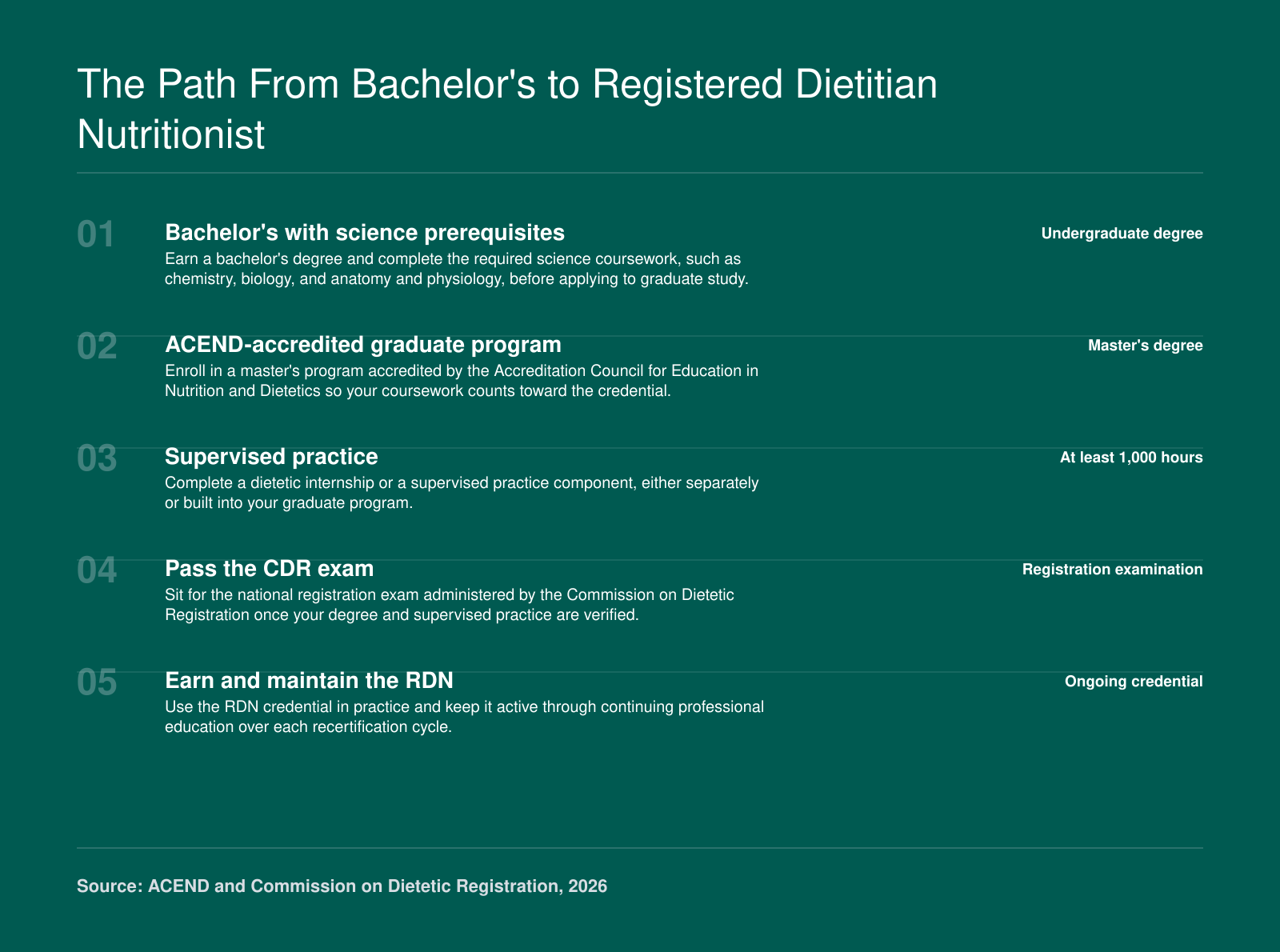
The Path From Bachelor's to Registered Dietitian Nutritionist
Becoming a registered dietitian nutritionist follows a fixed order, and a master's degree is one stage in it. Each step must be completed before the next, so plan the sequence before choosing a program.
Online and Hybrid Master's in Nutrition Options in Arizona
Online convenience and RDN eligibility pull in different directions in Arizona. Arizona State's Medical Nutrition master's is delivered through ASU Online, and Arizona's Applied Nutrition: Nutrition & Wellness is an online professional science master's. Grand Canyon's MS in Nutrition and Dietetics also offers a fully online option.
But "online" rarely means fully remote for dietetics tracks. Grand Canyon's ACEND-accredited program lists 1,000 clinical hours. Arizona's Dietetics Emphasis requires at least 1,000 supervised-practice hours at student-secured sites in clinical, community, and food-service settings. ASU's dietetic internship track builds in about 1,100 hours at program-arranged sites in the Phoenix area.
For online students outside Arizona, check placement geography. Several programs list Arizona rotation sites, so out-of-state learners may need to relocate or confirm local placements before enrolling.
The practical tradeoff: online wellness or applied nutrition degrees like Arizona's Nutrition & Wellness offer the most flexibility, but they usually do not lead to RDN eligibility on their own unless paired with supervised practice.
Related Articles
Which Arizona Master's in Nutrition Programs Waive or Make the GRE Optional?
No, the University of Arizona does not require the GRE for either of its nutrition master's programs, and applicants to the MS in Nutritional Sciences may choose to submit scores. Arizona State University is split: one program requires the GRE, while the other publishes no policy on its program page. Check each admissions page before applying, since requirements can change.
| School | Program | GRE Policy | Key Prerequisites | Application Deadline |
|---|---|---|---|---|
| University of Arizona | Professional Science Masters in Applied Nutrition-Dietetics | GRE is not required | Bachelor's degree; GPA over 3.0 | Applications open in August and are due January 15 for fall admission |
| University of Arizona | Master of Science in Nutritional Sciences | GRE not required; applicants may submit scores | BS in a life science such as nutritional sciences, health sciences, or physiological sciences, or a related field; 3.0/4.0 minimum GPA | Fall admission only; deadline is early December before the intended academic year |
| Arizona State University | Medical Nutrition, MS | No published policy | Bachelor's or master's in nutrition, public health, biology, chemistry, or a related field preferred; 3.00 GPA in the last 60 hours of the first bachelor's degree, or 3.00 in a master's degree | Online Session A/C priority deadlines: July 15, November 15, and April 15 |
| Arizona State University | Nutritional Science, MS | GRE General Test required; applications cannot be processed without scores | Bachelor's degree from a regionally accredited U.S. institution or equivalent international degree; 3.00 GPA in the last 60 semester hours or 90 quarter hours | Fall term admission; dates are listed on ASU's application deadline page |
What a Master's in Nutrition Costs in Arizona
Public universities price by residency. Grand Canyon University, a private school, does not. At the University of Arizona, annual graduate tuition is $14,856 for Arizona residents and $34,110 for nonresidents. Grand Canyon charges $10,015 regardless of where you live. Average net price after aid is about $16,674 at Arizona and $22,472 at Grand Canyon, but treat both as rough institution-wide averages rather than program quotes; compare the most affordable master's in nutrition programs and best online master's in nutrition programs rankings for broader context.
Sticker Price by Program
- University of Arizona Applied Nutrition PSM: $500 per credit across 30 credits, about $15,000 total, with one online rate for every student.
- Grand Canyon MS in Nutrition and Dietetics: $610 per credit for 30 credits, roughly $18,300 in tuition before fees.
- ASU Nutritional Science (Dietetics) MS: a $225-per-credit program fee, or $6,750 over 30 credits, on top of tuition that ASU quotes through its cost calculator.1 Eligible students from other western states may pay a reduced nonresident rate of 150 percent of resident tuition plus fees.
Paying for It
ASU's dietetics handbook points students to College of Health Solutions scholarships, Graduate College fellowships, loans and grants.1 Grand Canyon advertises scholarships, and the Academy of Nutrition and Dietetics Foundation funds dietetics students nationally. Ask about graduate assistantships early. A tuition waiver shifts the math more than any per-credit gap.
Arizona Licensure and Certification for Nutrition Professionals
Arizona Nutrition Master's Programs: Common Questions
Are there ACEND-accredited nutrition master's programs in Arizona?
Can I complete a master's in nutrition online in Arizona and still become an RDN?
Can I apply to an Arizona nutrition master's without a nutrition bachelor's degree?
Compare Nutrition programs on the data that matters
Explore more Healthcare specializations or browse every graduate field.
All Healthcare programs