Best Master's in Nutrition Programs in Georgia
Compare 7 accredited Nutrition programs in Georgia at 3 schools, with graduate earnings, cost, debt, and completion data from IPEDS and the U.S. College Scorecard.

Every Georgia nutrition master's now leads to the same requirement. Since January 2024, the Commission on Dietetic Registration has required a graduate degree before anyone can sit for the registered dietitian exam.
The programs here span both formats and several concentrations, from integrative and functional nutrition on campus to community nutrition and health sciences online. Not every master's satisfies the requirement, though, and a degree without the right accreditation can leave a graduate short of RDN eligibility after paying full tuition.
Key Points
- UGA's online community nutrition master's runs about $19,920 in total tuition for 30 credits.
- A graduate degree has been required for the RDN exam since January 2024.
- UGA makes the GRE optional, so check each school's admissions page for its policy.
Top-Ranked Master's in Nutrition Programs in Georgia for 2027
These Georgia programs are compared on approximate average net price, institution-wide graduation rate, and delivery format. Graduation rates describe the whole university, not the nutrition program alone, and net price is a rough average that will vary with your aid and residency. Accreditation matters here: a master's degree does not by itself make you eligible for the registered dietitian exam, so each entry below notes which pathways are ACEND-accredited and which are not.
University of Georgia
#1Athens, GA · ~$11,000/yr (est.)
Best for: Working professionals studying online
The University of Georgia pairs a flexible online Master of Science in Nutritional Sciences (Community Nutrition) with a campus-based thesis and dietetic internship track. Its institution-wide graduation rate is about 90%, and approximate average net price is near $14,000 a year, which is low for a flagship. The online degree alone does not confirm RDN exam eligibility, so aspiring dietitians must also complete ACEND-accredited coursework and supervised practice. UGA's dietetic internship is ACEND-accredited, and successful graduates of the master's-plus-internship pathways are eligible for the CDR registration exam.
- Online, asynchronous, 30-credit non-thesis curriculum
- Community Nutrition emphasis for public health, Extension, and school nutrition careers
- Three start dates a year: fall, spring, and summer
- Full-time and part-time options; no entrance exam required
- 3.0 GPA minimum, three recommendation letters, prerequisite courses required
- Pathway toward Georgia School Nutrition Director certification
- Does not alone confirm RDN exam eligibility; separate ACEND coursework and practice needed
- Campus-based, two-year program of 57 credit hours; starts each fall
- ACEND-accredited internship; successful graduates are eligible for the CDR RDN exam
- 1,200 clinical hours with practice sites in Athens and Atlanta
- Thesis required; emphasis on medical nutrition therapy
- Small cohort of about six interns accepted each year
- Assistantships with $14k to $30k stipends and tuition waivers are noted
Life University
#2Marietta, GA · ~$11,000/yr (est.)
Best for: Chiropractors and RDNs adding functional nutrition
Life University in Marietta offers a Master of Science in Clinical Nutrition built around integrative and functional nutrition, with research and practitioner tracks. Its institution-wide graduation rate is about 38%, and approximate average net price is near $30,000 a year, higher than the public options in this list. Our research did not confirm that this degree leads to RDN exam eligibility, so check directly with the school if that is your goal. Transfer credit for registered dietitians and chiropractors suggests it suits professionals adding functional training.
- Campus-based, 52 credit hours with prerequisite courses required
- Thesis or capstone option across two tracks
- Transfer credits available for RDNs and chiropractors
- Courses in nutritional epigenetics and global health policy
- Electives include herbs, spices, oils, and an advanced culinary nutrition lab
- Thesis required, with eight thesis credits
- Formal thesis defense and committee supervision
- IRB approval required for research
- Prerequisites available for non-science backgrounds
- Capstone required instead of a thesis
- Field experiences in clinical, management, community, and teaching settings
- Courses in therapeutic diets and menu planning
Georgia State University
#3Atlanta, GA · $9,000 – $25,000/yr (est.)
Best for: Aspiring dietitians seeking a coordinated pathway
Georgia State University in Atlanta offers two distinct routes. The online M.S. in Health Sciences with a Nutrition concentration is a lower-cost academic degree that does not qualify graduates to become registered dietitians. The hybrid Master of Science Coordinated Program is ACEND-accredited through June 30, 2027, and is designed to prepare students for the CDR exam; confirm eligibility details with the program. Institution-wide graduation rate is about 53%, and approximate average net price is near $16,000 a year.
- Fully online, 36 credit hours at about $464 per credit
- Thesis or capstone option; starts fall, spring, and summer
- 3.0 GPA minimum; science prerequisites required
- Does not qualify graduates as registered dietitians
- Useful for RDs deepening expertise or preparing for doctoral study
- ACEND-accredited through June 30, 2027; hybrid online and on-campus format
- Includes 1,000 clinical hours; prepares for the CDR credentialing exam
- Full-time and part-time options; part-time runs roughly seven to 11 semesters
- Advises students not to work during the full-time track
- Program reports a 95% exam pass rate
- 3.0 GPA minimum; prerequisite courses required
Cost & outcomes by school
Federal data for the highest-earning Nutrition programs, independent of the ranking above. Earnings are this field's master's graduates four years after completing, where the Scorecard reports them.
| School | Earnings | Tuition / yr | Debt | Grads/yr | Format |
|---|---|---|---|---|---|
| Georgia State University GA | — | $8,664 | — | — | Online |
| University of Georgia GA | — | $11,002 | — | — | Online |
| Life University GA | — | $10,806 | — | 3 | Campus |
Sources: U.S. Department of Education. Tuition and graduates: IPEDS. Earnings and debt: College Scorecard, this field's master's graduates; a dash means no figure is reported.
Online and Hybrid Master's in Nutrition Options in Georgia
Online master's in nutrition programs now make RDN eligibility feasible without moving to Athens or Augusta, but the supervised practice piece still requires in-person logistics. Emory's online M.S. in Clinical Nutrition combines distance coursework with required in-person intensives and more than 1,000 supervised clinical hours.1 Emory's placement team arranges sites and preceptors, though students should suggest nearby options and placements are not guaranteed.1 No specific partner hospitals or public health agencies are named.
Georgia State's coordinated M.S. in Nutrition is among the hybrid master's programs in Georgia and runs 17 to 24 months. The program does not publish total supervised practice hours, and site assignments depend on student preference and preceptor availability. Working professionals who need RDN eligibility should ask pointed questions: Emory suits students who want placement help, while Georgia State may require more local networking to secure rotations. If a program is vague about hours or site placement, get written confirmation before enrolling.
Which Georgia Nutrition Master's Programs Waive the GRE?
The University of Georgia has largely dropped the GRE, while Georgia State's position is less clear.
- UGA Online MS in Community Nutrition: GRE optional, making it one of many No-GRE master's programs. Deadlines are July 1 (fall), October 15 (spring), and April 1 (summer), and international dates differ. Minimum GPA is 3.0. No DPD verification statement is needed.
- UGA MS Dietetic Internship: GRE no longer required, though submitting scores is encouraged. GPA minimum is 3.0, and a DPD verification statement is required. No deadline was published on the admissions page.
- UGA MS Non-Thesis DPD Add-On: GRE optional, with the same deadlines as above. No DPD statement is required, since the add-on is how you earn one.
- Georgia State University MS in Nutrition: The current program page states no GRE policy, but a Georgia On My Line listing says it is required, with an analytical writing score of 3.5 or higher. Deadlines are not published. A 3.0 GPA is expected, and prerequisites include chemistry, anatomy and physiology, and nutrition. No DPD statement is required.
- Life University: No GRE policy or deadline is published for the Clinical Nutrition master's, though prerequisite courses are required.
Confirm the policy with each program office before applying; GRE rules change between admission cycles.
ACEND accreditation matters more than the GRE when choosing a Georgia nutrition master's program, because accreditation controls RDN eligibility.
Cost of a Master's in Nutrition in Georgia and Dietitian Licensure
University of Georgia’s online M.S. in Nutritional Sciences (Community Nutrition) is the clearest published-cost benchmark: 30 credits, an estimated $19,920 total tuition, roughly $664 per credit, plus $431 per semester in fees.
Published graduate tuition across the programs
Among the programs on this page, institution-wide graduate tuition varies. Georgia State University shows the lowest published in-state rate at $8,664, with out-of-state at $24,840. UGA lists $11,450 in-state and $31,688 out-of-state, while Life University lists a single $15,036 rate. These are institutional averages, not program-specific totals, and net price figures are similarly institution-wide.
Internship and licensure costs
For UGA’s thesis/dietetic internship pathway, the full price is harder to calculate: 31 degree credits plus 26 supervised-practice credits, with no published per-credit rate. Budget beyond tuition for about $2,200 in annual fees, a $42 liability policy, a $100 background check, an $85 CPR certification, and transportation estimates of $300 to $750 in year one. Assistantships paying $14,000 to $30,000 can waive tuition.
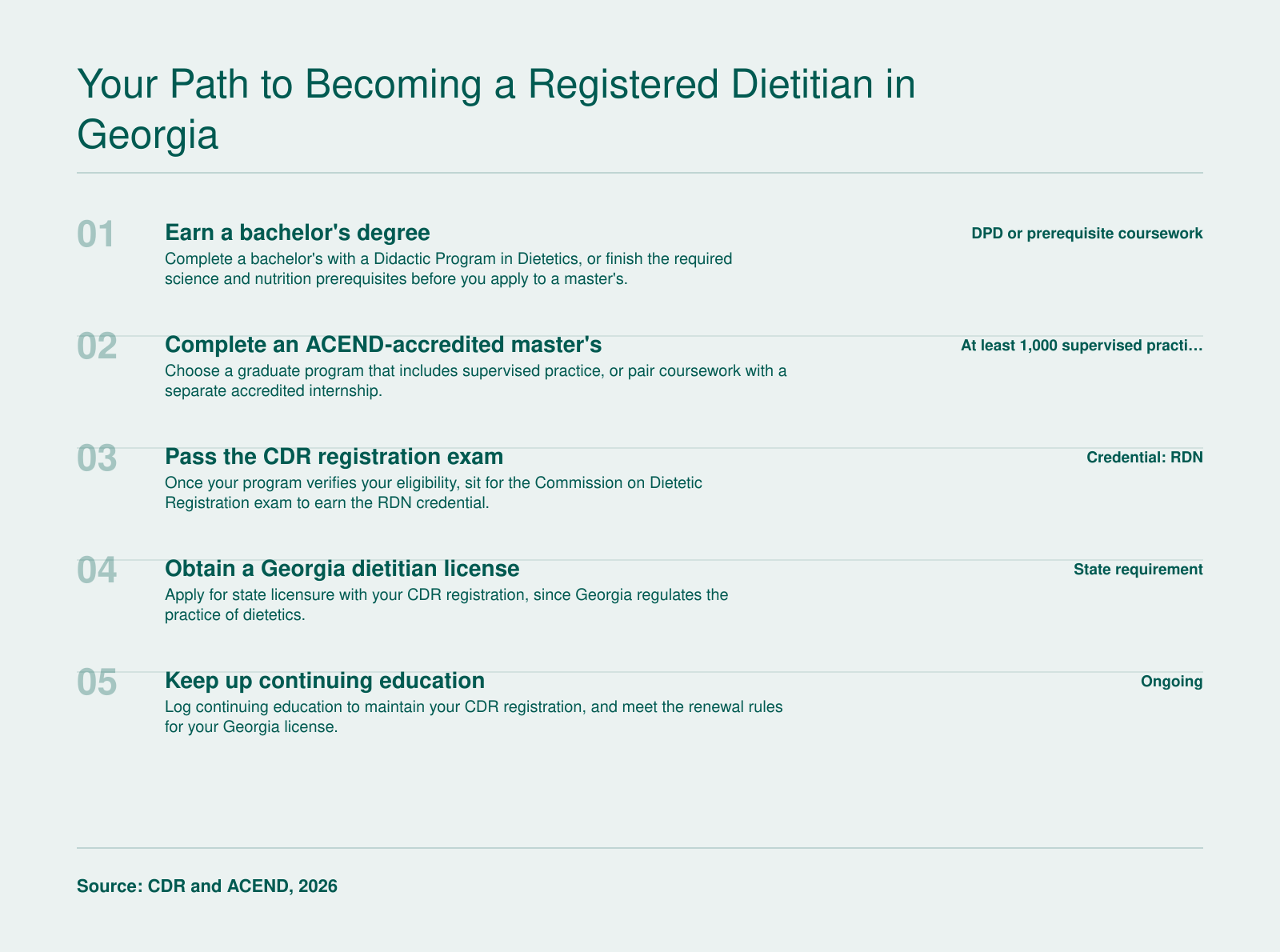
Georgia requires a dietitian license from the Georgia Board of Examiners of Licensed Dietitians. Applicants must be at least 18, hold a bachelor’s or higher in a qualifying nutrition major, complete an ACEND-accredited supervised-practice component of at least 900 hours, and pass the CDR exam. The Application for Licensure lists an $85 application fee, but confirm directly with the Board.
Your Path to Becoming a Registered Dietitian in Georgia
Caption: A graduate degree has been required to be eligible for the CDR registration exam since January 2024, so the master's step is now a requirement for new dietitians, not an optional upgrade.
Related Articles
Earnings and Outcomes for Georgia Nutrition Master's Graduates
The University of Georgia's thesis and dietetic internship track reports a 100% RD exam pass rate within one year of first attempt, against its own objective of at least 80%. Its employment objective is 70% of job-seekers placed in nutrition, dietetics, or related work within 12 months of graduation, but the program does not publish an achieved rate. Outcome data are available on request.
Georgia State's ACEND-accredited coordinated program lists "0" for both its 2021 pass rate and the national average. Those zeros are unexplained and may reflect missing data, so don't read them as real results. The page publishes no employment rate. Ask the program directly for current figures.
The ranked master's in nutrition programs do not yet publish program-level earnings or debt, so earnings-to-debt comparisons are not reliable. Institution-wide numbers would be misleading, and we haven't substituted them.
UGA's online community nutrition M.S., Georgia State's online health sciences nutrition M.S., and Life University's clinical nutrition M.S. report no RD exam or ACEND employment figures, so ask each for its own graduate outcomes.
FAQs About Master's in Nutrition Programs in Georgia
Can I become a registered dietitian with a master's in nutrition in Georgia?
Can I enroll in a Georgia nutrition master's program without a dietetics undergraduate degree?
Are there online master's in nutrition programs in Georgia?
What prerequisite courses do career changers need before applying?
Compare Nutrition programs on the data that matters
Explore more Healthcare specializations or browse every graduate field.
All Healthcare programs