Best Master's in Nutrition Programs in Connecticut
Compare 7 accredited Nutrition programs in Connecticut at 4 schools, with graduate earnings, cost, debt, and completion data from IPEDS and the U.S. College Scorecard.
A master's in nutrition program in Connecticut can lead to three very different places: RDN eligibility through an ACEND-accredited track, the Certified Nutrition Specialist credential through a different pathway, or a research or wellness role that needs no license at all. Accreditation, not reputation, determines which credentials you can earn.
That makes the credential question the first filter. The University of New Haven's program is ACEND accredited and built around the RDN exam; the University of Bridgeport prepares graduates for the CNS instead. Pick the wrong accreditation and the degree won't qualify you for the job you had in mind.
Key Points
- None of the ranked nutrition programs require the GRE for 2027 admission.
- University of Bridgeport's fully online nutrition M.S. requires 44 credits.
- ACEND requires at least 1,000 supervised practice hours for RDN eligibility.
Top-Ranked Master's in Nutrition Programs in Connecticut
This list ranks Connecticut's master's in nutrition programs by graduation outcomes, accreditation, and flexibility. The cards highlight what each school does well, including RDN pathways, online delivery, and application timing, so you can compare options side by side without overspending.
University of Connecticut
#1Storrs, CT · ~$23,000/yr (est.)
Best for: Aspiring nutrition scientists seeking flexible research pathways
The University of Connecticut offers both a campus Master of Science in Nutritional Sciences and a fully online Master of Science in Personalized Nutrition. Both are ACEND-accredited, and the campus program includes four concentration areas, including biochemical and molecular nutrition and human nutrition and metabolism. UConn undergraduates can use a fast-track 4+1 pathway to earn both degrees in five years. The online program is asynchronous and fulfills Certified Nutrition Specialist academic requirements.
- ACEND-accredited campus program with four concentration options
- Complete in about two years and 30 credit hours
- Choose thesis or capstone track for research or applied focus
- Interdisciplinary research opportunities with UConn Health
- Expedited 4+1 BS/MS pathway for UConn undergraduates
- Comprehensive written exam required before completion
- Concentration in biochemical and molecular nutrition
- Laboratory-based research focus within nutritional sciences
- Ties into interdisciplinary research opportunities
- Concentration in human nutrition and metabolism
- Focus on human studies and metabolism trials
- Recommended prerequisites: nutrition, biochemistry, physiology
- Fully online asynchronous master's program
- Three start dates each year in fall, spring, and summer
- Fulfills Certified Nutrition Specialist academic requirements
- Two-year completion timeline
- Requires 3.0 GPA and prerequisite coursework
- Focus on nutrigenomics and clinical nutrition
University of Bridgeport
#2Bridgeport, CT · ~$22,000/yr (est.)
Best for: Career changers pursuing CNS certification online
University of Bridgeport's online Human Nutrition M.S. is a 24-month pathway built around clinical nutrition and Certified Nutrition Specialist preparation rather than RD licensure. Its Virtual Clinic capstone provides 200 to 255 supervised clinical hours, a distinctive experiential component for an online program. Three start dates each year and year-round admissions make it a flexible option for working students.
- 24-month online program with three start dates per year
- Prepares for Certified Nutrition Specialist (CNS) certification
- Virtual Clinic capstone with 200 to 255 supervised clinical hours
- World's first Virtual Clinic capstone experience
- Dual degree with chiropractic available
- Accelerated BS-to-MS option for undergraduates
- Advanced standing for physician assistant students
- Taught by doctoral and clinical faculty
University of New Haven
#3West Haven, CT · ~$20,000/yr (est.)
Best for: Future dietitians needing supervised clinical training
University of New Haven's Master of Science in Nutrition Sciences is a campus-based, 52-credit program with a structured pathway to Registered Dietitian Nutritionist credentialing. Students complete supervised experiential learning at clinical sites including Hartford HealthCare and prepare for the CDR credentialing exam. The program admits one fall cohort each year and integrates Planetree certification in person-centered care.
- 52-credit, two-year campus program with fall start
- Prepares for CDR credentialing exam for RD or RDN
- Supervised experiential learning included
- Clinical site: Hartford HealthCare
- Planetree certification in person-centered care
- February 1 application deadline
- Prerequisite courses in anatomy, chemistry, and microbiology
- Career outcomes include clinical nutrition director and school food service director
Cost & outcomes by school
Federal data for the highest-earning Nutrition programs, independent of the ranking above. Earnings are this field's master's graduates four years after completing, where the Scorecard reports them.
| School | Earnings | Tuition / yr | Debt | Grads/yr | Format |
|---|---|---|---|---|---|
| University of Bridgeport CT | $61,710 | $21,786 | $38,270 | 76 | Online |
| University of Saint Joseph CT | — | $17,604 | — | — | Online |
| University of New Haven CT | — | $19,916 | — | — | Campus |
| University of Connecticut CT | — | $22,872 | — | 7 | Campus |
Sources: U.S. Department of Education. Tuition and graduates: IPEDS. Earnings and debt: College Scorecard, this field's master's graduates; a dash means no figure is reported.
Online and Hybrid Master's in Nutrition Options in Connecticut
Working adults in Connecticut now enter graduate nutrition study mainly online, and Connecticut's online master's programs divide by format.
The University of Bridgeport's M.S. in Nutrition is fully online, including the comprehensive final exam. It requires 44 credits across three 15-week terms a year, and the school cites completion in as few as 23 to 24 months, depending on prerequisites and course load. UConn's M.S. in Nutritional Sciences is campus-only at Storrs and requires 30 credits. UConn also lists a separate online M.S. in Personalized Nutrition, but its catalog entry does not detail schedule or completion time, so ask the department directly. None of the programs here offer a hybrid format.
Can you finish while working full time? Bridgeport's online format and year-round terms are built for flexibility, but it does not publish a formal part-time policy or a typical part-time timeline. Confirm your pacing with admissions before enrolling.
Online coursework does not replace hands-on training. Bridgeport's supervised training hours must be completed in person, and students may need to arrange a site near home. Connecticut residents can also look at out-of-state options in the Best Online Master's in Nutrition Programs, as long as accreditation and supervised practice requirements check out.
Which Connecticut Nutrition Master's Waive or Make the GRE Optional?
None of the Master's in Nutrition Programs With No GRE Required ranked here require the GRE. UConn dropped the test for admission to its Nutritional Sciences M.S. and its online Personalized Nutrition M.S. beginning with Fall 2022 entry, and the University of Bridgeport has removed it from its M.S. in Nutrition entirely, evaluating applicants on transcripts and a personal statement instead.
GPA and coursework
UConn's Department of Nutritional Sciences sets no minimum GPA for the in-person program, though it weighs academic record and course rigor; the Graduate School's general standard is a 3.0 cumulative average. The online Personalized Nutrition M.S. sets a 3.0 minimum and requires college-level biochemistry; physiology and nutrition are recommended. Bridgeport asks for a 2.75 cumulative undergraduate GPA and a bachelor's degree in any field.
Career changers
Neither school requires a nutrition bachelor's. UConn recommends nutrition, biochemistry and human physiology, and admits applicants missing one on the condition they complete it in the first semester before advanced coursework. Bridgeport may assign up to nine credits of graduate prerequisites in anatomy and physiology, biochemistry and nutrition fundamentals, offered online and waivable with comparable undergraduate work. UConn's in-person program also asks for three letters of recommendation, transcripts and a personal statement.
Related Articles
Both paths demand serious hands-on time: ACEND requires at least 1,000 supervised practice hours for RDN eligibility, and the BCNS requires 1,000 supervised practice experience hours for the CNS credential. Some Connecticut programs coordinate clinical placements for you, so confirm whether a program assigns your site or expects you to find one.
Cost of a Master's in Nutrition in Connecticut
Costs below combine each school's published graduate tuition with net price, which is an institution-wide average rather than a program-specific price. Fee and funding notes show where assistantships or named scholarships can change what a student actually pays.
| School | In-state graduate tuition | Out-of-state graduate tuition | Institution-wide average net price | Total estimated program cost | Fees and funding notes |
|---|---|---|---|---|---|
| University of Connecticut | $22,872 | $44,784 | $25,097 | Not published; 9-credit semester totals are $11,699 in-state, $22,655 out-of-state, or $17,147 New England Regional | Mandatory fees: $1,943 per semester at 9+ credits; $25 per credit online fee; $400 continuous registration fee. Graduate assistants at 6+ credits receive a tuition waiver and pay $1,173 in fees per semester. |
| University of Bridgeport | $21,786 | $21,786 | $27,807 | $30,360 tuition before fees (44 x $690) from an older 2023-2024 guide; current credit total not published | General fee $1,100 per term at 9+ credits; $100 program fee; $65 exam fee. Named nutrition scholarships (Bland, Moss, Brady) have no published award amounts or eligibility. |
| University of New Haven | $19,916 | $19,916 | $34,192 | Not published | No per-credit rate or fee schedule published in the provided data. |
What Connecticut Nutrition Master's Graduates Earn
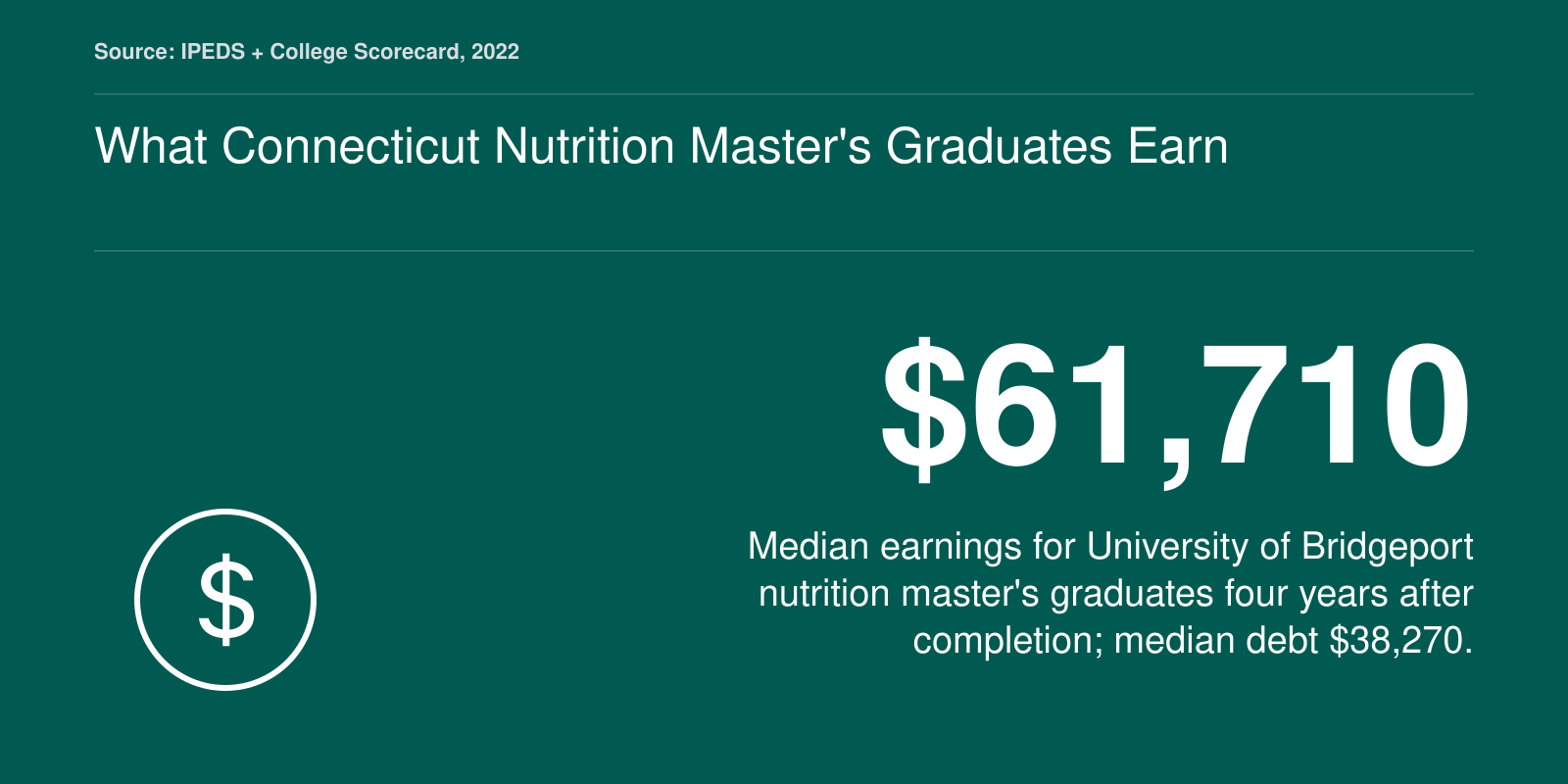
For the University of Bridgeport nutrition master's program, median earnings are $54,775 one year after completion and $61,710 four years after completion. The published median loan debt is $38,270.
Compare Nutrition programs on the data that matters
Explore more Healthcare specializations or browse every graduate field.
All Healthcare programs