Best Master's in Nutrition Programs in North Carolina
Compare 18 accredited Nutrition programs in North Carolina at 8 schools, with graduate earnings, cost, debt, and completion data from IPEDS and the U.S. College Scorecard.

Since January 2024, a graduate degree is required to sit for the Commission on Dietetic Registration exam for registered dietitian nutritionists. That recasts the North Carolina choice: a nutrition science degree for research and industry, or a dietetics-focused program with supervised practice leading to the RDN credential.
Graduate tuition across these ranked programs runs from roughly $6,700 in-state to more than $45,000 for private or out-of-state options, so residency can shift the value equation. The ranked comparison below weighs cost, delivery, admissions, and licensure against the credential path.
Key Points
- A graduate degree has been required to sit for the RDN exam since January 2024.
- North Carolina licenses dietitians and nutritionists (LDN) through its Board of Dietetics/Nutrition, with no compact privilege.
- GRE policies and residency-based tuition vary by school, so check each admissions page before applying for 2027.
Top-Ranked Master's in Nutrition Schools in North Carolina
North Carolina offers several distinct master's-level nutrition paths: ACEND-accredited supervised-practice programs, combined master's and dietetic internship tracks, and research-based or online nutrition science degrees. Compare the credential path, delivery format, and cost carefully before choosing.
University of North Carolina at Chapel Hill
#1Chapel Hill, NC · ~$13,000/yr (est.)
Best for: Research-driven applicants seeking public health depth
The University of North Carolina at Chapel Hill houses nutrition study within the Gillings School of Global Public Health, a setting that connects public health and medicine. Its research-based nutrition master's exists alongside an ACEND-accredited Future Education Model MPH in Nutrition and Dietetics that integrates supervised practice and leads to CDR RDN exam eligibility. The university graduates about 91% of students overall.
- 39 total credit hours
- Research-oriented thesis curriculum
- Prerequisites include biochemistry and human nutrition
- Dual degree option with BSPH in Nutrition
- Only U.S. nutrition department housed in both public health and medicine
- 42 total credit hours
- No entrance exam required
- 2-year program with fall start
- Hybrid delivery format
- ACEND-accredited Future Education Model program
- Combines coursework and supervised practice
- Prepares for CDR RDN exam
- Cohort-based structure
- 2-year completion timeline
East Carolina University
#2Greenville, NC · ~$8,000/yr (est.)
Best for: Working dietitians needing online flexibility
East Carolina University offers an online Master of Science in Nutrition Science designed for working nutrition professionals and current Registered Dietitians seeking career advancement. The program carries an ACEND-accredited listing, but it is not described as a supervised-practice pathway to RDN eligibility. The university graduates about 63% of students overall.
- Fully online delivery
- 33 total credit hours
- Thesis and non-thesis tracks
- 3.0 GPA minimum
- 2 letters of recommendation required
- Maximum 6 years to complete
- Designed for Registered Dietitians seeking advancement
Meredith College
#3Raleigh, NC · ~$14,000/yr (est.)
Best for: Raleigh-area learners seeking accelerated dietetics training
Meredith College offers an ACEND-accredited Master of Science in Nutrition with multiple tracks, including a didactic program in dietetics and an accelerated dietitian nutritionist track. The program reports a 94% CDR credentialing exam pass rate and a 100% dietetic internship match rate, though the accelerated track's exact ACEND category and supervised-practice hours are not published. The college graduates about 70% of students overall.
- 3 concentration options
- GRE optional with no entrance exam required
- 94% CDR credentialing exam pass rate
- 100% dietetic internship match rate
- Full-time and part-time options
- 30 to 47 credit hours depending track
- ACEND-accredited dietetics track
- 47 total credit hours
- Cohort-based fall start
- Combines didactic and supervised experiential learning
- Prepares for CDR credentialing exam
- $50 application fee
- 36 total credit hours
- 1,000 supervised practice hours required
- Maximum enrollment of 66 students
- Capstone required
- Prepares for RDN credentialing exam
North Carolina A & T State University
#4Greensboro, NC · ~$8,000/yr (est.)
North Carolina A&T State University offers a campus-based Master of Science in Food and Nutritional Sciences with a concentration in Nutrition. The dietetics concentration is in the ACEND candidacy process, so full accreditation and RDN exam eligibility are not yet confirmed. The university graduates about 57% of students overall.
- Nutrition concentration
- Coursework in food chemistry and microbiology
- Covers nutritional biochemistry and metabolism
- Prepares for academia, industry, and government roles
- Dietetics concentration is in ACEND candidacy
- Full accreditation not yet established
University of North Carolina at Greensboro
#5Greensboro, NC · ~$9,000/yr (est.)
UNC Greensboro offers an ACEND-accredited, campus-based Master of Science in Nutrition with thesis, non-thesis, and combined M.S./Dietetic Internship tracks. The combined track integrates supervised practice and is designed to prepare students for the RDN credentialing exam. The university graduates about 56% of students overall.
- ACEND accredited
- 3 concentration options
- No GRE required
- Campus-based delivery
- 37 total credit hours
- Thesis required
- Research-based with faculty mentors
- Contemporary subjects include sports nutrition and culinary medicine
- 40 total credit hours
- No thesis or capstone required
- Prepares for RDN credential
- Assistantship consideration available
- 38 total credit hours
- No GRE required and test optional
- Combines M.S. with dietetic internship
- Prepares for national registration exam for RDN
- 2-year program
North Carolina Central University
#6Durham, NC · $5,000 – $10,000/yr (est.)
North Carolina Central University provides online Master of Science in Nutritional Sciences pathways focused on community nutrition education, gerontological nutrition, and obesity and weight management. The school also offers an ACEND-accredited Future Education Model dietetics concentration with at least 1,075 supervised experiential hours, and successful graduates of that pathway are CDR RDN-exam eligible. The university graduates about 42% of students overall.
- Community and public health nutrition focus
- Thesis or capstone option
- 3.0 GPA minimum
- 2 letters of recommendation required
- Fully online format
- Aging and nutrition coursework emphasis
- Registered dietitians can earn 6 internship credits
- Estimated in-state tuition near $9,517
- Personal statement required for admission
- Two-year program
- Weight management and obesity prevention focus
- Meets 2024 RD master's requirement
- Credit reduction for registered dietitians
- Financial aid available
- Scholarships available
Cost & outcomes by school
Federal data for the highest-earning Nutrition programs, independent of the ranking above. Earnings are this field's master's graduates four years after completing, where the Scorecard reports them.
| School | Earnings | Tuition / yr | Debt | Grads/yr | Format |
|---|---|---|---|---|---|
| East Carolina University NC | $58,562 | $7,658 | — | 14 | Online |
| Meredith College NC | $48,669 | $14,020 | $34,200 | 30 | Hybrid |
| North Carolina Central University NC | — | $7,638 | — | — | Online |
| Appalachian State University NC | — | $8,570 | — | — | Online |
| University of North Carolina at Greensboro NC | — | $8,614 | — | — | Campus |
| North Carolina State University at Raleigh NC | — | $12,101 | — | — | Online or campus |
| University of North Carolina at Chapel Hill NC | — | $12,751 | — | — | Campus |
| North Carolina A & T State University NC | — | $8,368 | — | 10 | Campus |
Sources: U.S. Department of Education. Tuition and graduates: IPEDS. Earnings and debt: College Scorecard, this field's master's graduates; a dash means no figure is reported.
Cost, debt & payoff
Median earnings of this field's master's graduates (4 yrs after completing) vs. their median federal loan debt · U.S. College Scorecard
Across these programs the median graduate earns about $48,669 and finishes with roughly $34,200 in debt — a ratio that clears a common rule of thumb (keep debt below first-year salary). Tuition and debt vary widely school to school, so check the per-school figures in the table above before you shortlist.
Online and Hybrid Master's in Nutrition Programs in North Carolina
If you need to keep working while you study, the tradeoff is flexibility against the hands-on hours a dietetics credential still demands. Several of the online master's in nutrition programs below deliver coursework online or in a hybrid format, but none of them is fully remote once supervised practice enters the picture.
- Appalachian State University: The Public Health Nutrition options, including the dietetics track, run fully online and asynchronous, so you work on your own schedule. Published completion is about two years; no separate part-time timeline is posted. The dietetics option adds 1,080 supervised experiential-learning hours at rotation sites arranged near you.
- NC State University: The Master of Nutrition is offered through distance education with lecture videos and online activities.1 The program lists at least 36 credits, including a 4 to 6 credit practicum. Delivery is available on campus, online, or in a hybrid format, and full-time completion typically runs 18 to 24 months.
- North Carolina Central University: The M.S. in Nutritional Sciences is an online distance program; all students complete an internship or thesis, and the Future Education Model track runs four semesters.
- East Carolina University: Offered online for working registered dietitians, with up to six years to finish.
GRE Requirements and Admissions at Ranked North Carolina Nutrition Schools
GRE policies vary across the schools ranked here, so check each program's admissions page before you plan your testing. The table shows the policy as published, key prerequisites, and the primary fall deadline. UNC Chapel Hill's MPH programs in nutrition also do not require GRE scores.
| School | GRE Policy | Key Prerequisites | Fall Deadline |
|---|---|---|---|
| North Carolina State University, Master of Nutrition | Waived for applicants with a credential requiring a board-certifying test (such as MD, RDN, or RN), a previous master's degree, or at least 9 graduate credits completed with a B or better | Biology and organic chemistry; 3.0 undergraduate GPA | June 25 (U.S. applicants); March 1 (international applicants) |
| East Carolina University, MS in Nutrition | Not published | Required prerequisite courses are listed on the department website; specific courses not published on the admissions page; 2.7 overall GPA | Not published |
| East Carolina University, MS in Nutrition Science | Required (minimum 30th percentile average of verbal and quantitative); waiver available with an undergraduate GPA above 3.5 or a current RD credential | Nutrition Foundation requirements or a BS in Nutrition from an accredited program; 3.0 GPA | March 1 |
| University of North Carolina at Chapel Hill, MS in Nutrition | Optional (GRE not required) | Not published | January 12, 2027 |
Related Articles
Cost and North Carolina Licensure for Master's in Nutrition Graduates
The sticker price of a nutrition master's in North Carolina depends heavily on residency and where the program lives, so cost planning should start with published graduate tuition rather than program name.
Public university tuition and the residency gap
Across the ranked schools, listed graduate tuition begins around $7,600 at North Carolina Central University and reaches about $14,000 at Meredith College. The public in-state versus out-of-state gap is substantial: East Carolina University lists roughly $7,700 in state and $20,800 out of state, while UNC-Chapel Hill lists about $12,800 in state and $31,400 out of state.
Per-credit and total program costs
North Carolina Central's online M.S. in Nutritional Sciences publishes a two-year tuition-and-fees estimate near $10,000, though out-of-state students may see a different figure. North Carolina A&T's summer 2026 graduate tuition schedule lists $294 per credit in state and $1,005 per credit out of state, but those summer rates do not establish a nutrition-specific total. UNC-system campuses cap most full-time graduate tuition at nine credits a semester1, which can make the full-time rate lower than per-credit arithmetic suggests.
The net price shown in the ranking is an institution-wide average after grants and aid, not a nutrition program quote.
Budget for licensure
Tuition is not the final bill. North Carolina requires a state license to practice medical nutrition therapy, so cost planning should also include the CDR registration exam and state licensing fees.
North Carolina Dietitian and Nutritionist Licensing
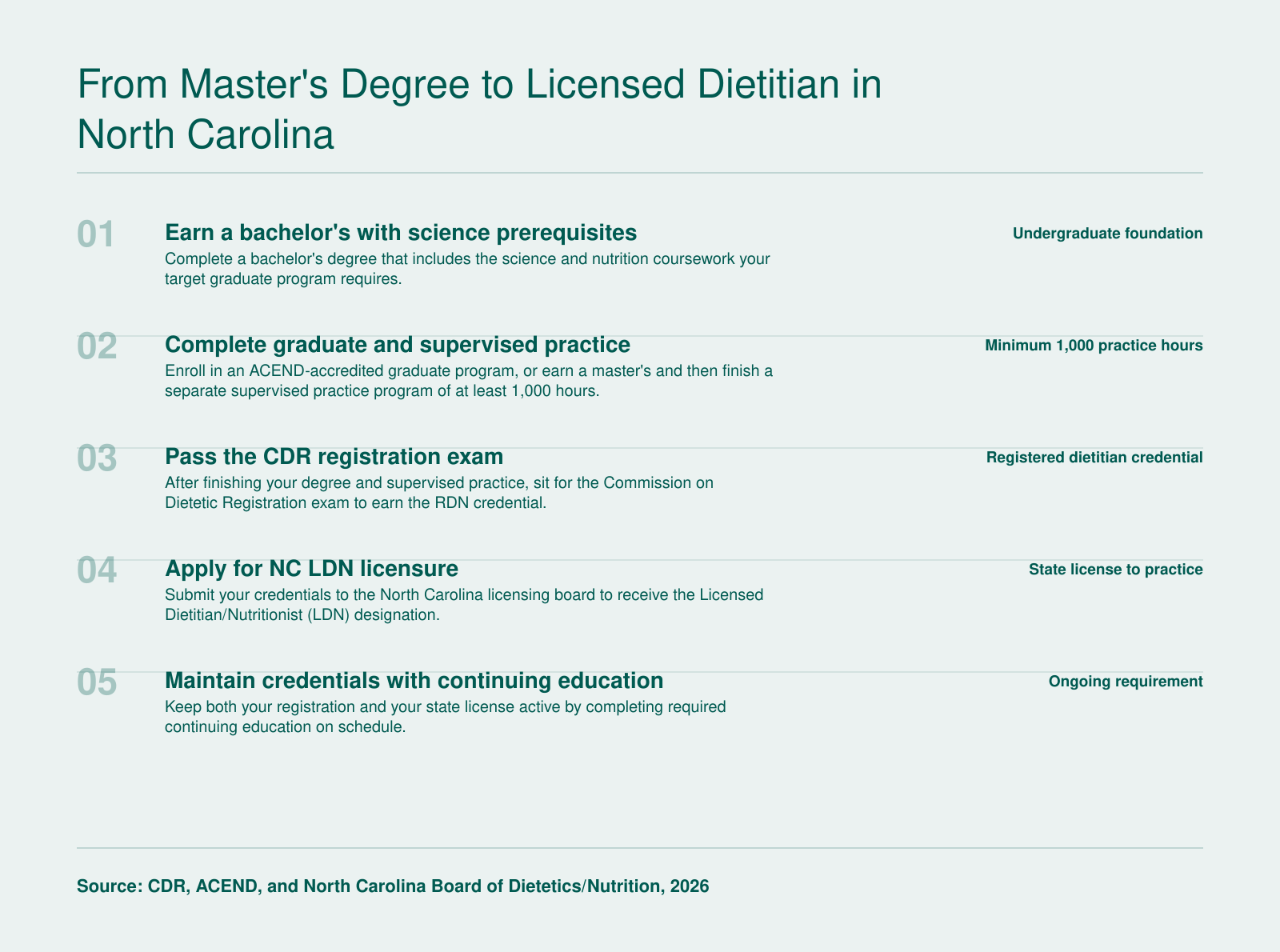
From Master's Degree to Licensed Dietitian in North Carolina
The route to practicing as a dietitian in North Carolina follows a fixed order. A graduate degree has been required to sit for the RDN exam since January 2024, so the master's is now a core step rather than an optional upgrade.
Career Paths and Earnings for Nutrition Master's Graduates in North Carolina
The field increasingly rewards clinical specialization, as a graduate degree becomes the entry bar for registered dietitians under current credentialing rules.
A master's in nutrition opens several directions beyond the clinic. Graduates work as clinical dietitians in hospitals and outpatient care, in community and public health nutrition, in food service management, in sports and performance nutrition, in research, and in industry roles covering food development, safety, and regulatory affairs. Programs here lean toward different ends of that range: some emphasize lab and population research, while others, like North Carolina A&T State University, point students toward food development, government, and public health work.
What the earnings picture shows
Program-level median earnings for these North Carolina nutrition master's degrees are not yet published, so there is no reliable figure to report by graduation window. We will not substitute campus-wide earnings as a stand-in, since those blend every major and overstate what a nutrition graduate can expect.
For a quick read on cost against future income, program-level median debt helps: graduates carry roughly $14,000 at UNC-Chapel Hill, climbing toward $27,000 to $28,250 at North Carolina A&T and North Carolina Central University.
Master's in Nutrition in North Carolina: FAQs
Do I need a dietetics background for a master's in nutrition?
How long does it take to complete a master's in nutrition in North Carolina?
Can I become a registered dietitian with a nutrition science master's that isn't ACEND-accredited?
When should I apply to a master's in nutrition program in North Carolina?
Compare Nutrition programs on the data that matters
Explore more Healthcare specializations or browse every graduate field.
All Healthcare programs