
University of Southern California Master's Programs
USC conferred 9,331 master's degrees in 2025, 52% of the 17,982 degrees and certificates it awarded that year, and enrolled 28,882 graduate students in 2024, per IPEDS / U.S. Department of Education College Scorecard. A master's at USC is a school-level product: each school sets its own tuition, deadlines, test policy, and funding.
The school-wide graduate tuition and fees average is $71,515 a year, but individual programs charge their own rates, and requirements differ by school. Length runs from 12 months to four years.
Decentralization, not prestige, is the variable that matters. Two applicants can face different price tags and calendars for degrees that both say USC.
Key Points
- USC awarded 9,331 master's degrees in 2025, 52% of all degrees conferred.
- Each USC school sets its own 2026 deadlines, tuition, and admission standards.
- Computer science master's graduates report median earnings of $188,871; social work, $73,829.
Master's programs at University of Southern California
Arts & Design All programs in this field →
Business & Management All programs in this field →
Communications & Media All programs in this field →
Computers & IT All programs in this field →
Counseling All programs in this field →
Criminal Justice & Law All programs in this field →
Education & Teaching All programs in this field →
Healthcare All programs in this field →
Nursing All programs in this field →
Psychology All programs in this field →
Science & Engineering All programs in this field →
Social Work & Social Sciences All programs in this field →
In the 2025 IPEDS completions data, University of Southern California awarded 9,331 master's degrees across 177 fields of study in 27 subject areas. Computer & Information Sciences accounts for the most, 1,625 (17%), led by Computer Science with 1,126. 53% of graduates were women and 44% were international students. That is down 15% from 10,921 in 2023.
Computer & Information Sciences 1,625 degrees · 17%
- Computer Science 1,12631% women
- Informatics 32551% women
- Data Modeling/Warehousing and Database Administration 6224% women
- Modeling, Virtual Environments and Simulation 3614% women
- Computer and Information Systems Security/Auditing/Information Assurance 3318% women
- Artificial Intelligence 2417% women
- Information Science/Studies 1833% women
- Computer Systems Networking and Telecommunications 10% women
Business & Management 1,617 degrees · 17%
- Management Science 66741% women
- Business Administration and Management, General 23342% women
- Human Resources Management/Personnel Administration, General 17470% women
- Management Sciences and Quantitative Methods, Other 14461% women
- Project Management 11557% women
- Entrepreneurial and Small Business Operations, Other 10359% women
- Business Administration, Management and Operations, Other 5321% women
- Business Statistics 4468% women
- Marketing/Marketing Management, General 3468% women
- Hospitality Administration/Management, General 2752% women
- Non-Profit/Public/Organizational Management 1362% women
- Taxation 1040% women
- Also reported, no graduates in 2025: Business, Management, Marketing, and Related Support Services, Other; Restaurant/Food Services Management
Engineering 1,164 degrees · 12%
- Electrical and Electronics Engineering 27622% women
- Engineering, Other 19633% women
- Aerospace, Aeronautical, and Astronautical/Space Engineering, General 17327% women
- Mechanical Engineering 12524% women
- Computer Engineering, General 9416% women
- Bioengineering and Biomedical Engineering 5657% women
- Electrical and Computer Engineering 3824% women
- Systems Engineering 3526% women
- Industrial Engineering 3135% women
- Structural Engineering 3033% women
- Construction Engineering 2638% women
- Materials Engineering 1735% women
- Chemical Engineering 1644% women
- Operations Research 1362% women
- Petroleum Engineering 1010% women
- Energy Systems Engineering, General 956% women
- Transportation and Highway Engineering 813% women
- Environmental/Environmental Health Engineering 667% women
- Civil Engineering, General 30% women
- Aerospace, Aeronautical, and Astronautical/Space Engineering, Other 10% women
- Water Resources Engineering 10% women
- Also reported, no graduates in 2025: Electrical, Electronics, and Communications Engineering, Other; Engineering Physics/Applied Physics
Health Professions 757 degrees · 8%
- Public Health, General 24185% women
- Health/Health Care Administration/Management 9068% women
- Marriage and Family Therapy/Counseling 6488% women
- Physician Assistant 5383% women
- International Public Health/International Health 4873% women
- Family Practice Nurse/Nursing 4791% women
- Pharmacoeconomics/Pharmaceutical Economics 4159% women
- Pharmaceutical Sciences 2972% women
- Occupational Therapy/Therapist 2781% women
- Clinical and Industrial Drug Development 2361% women
- Speech-Language Pathology/Pathologist 23100% women
- Oral Biology and Oral and Maxillofacial Pathology 1963% women
- Pharmaceutical Marketing and Management 1145% women
- Dental Public Health and Education 989% women
- Health Professions and Related Clinical Sciences, Other 978% women
- Industrial and Physical Pharmacy and Cosmetic Sciences 650% women
- Medical/Health Humanities 5100% women
- Clinical and Translational Science 425% women
- Pharmacy Administration and Pharmacy Policy and Regulatory Affairs 367% women
- Long Term Care Administration/Management 250% women
- Medical Science/Scientist 2100% women
- Medical Informatics 10% women
- Also reported, no graduates in 2025: Advanced/Graduate Dentistry and Oral Sciences, Other
Public Administration & Social Work 600 degrees · 6%
- Social Work 41881% women
- Public Administration 11060% women
- Public Policy Analysis, General 4144% women
- Public Policy Analysis, Other 2654% women
- International Policy Analysis 540% women
- Also reported, no graduates in 2025: Public Administration and Social Service Professions, Other
Communication & Journalism 590 degrees · 6%
- Digital Communication and Media/Multimedia 24281% women
- Communication and Media Studies, Other 17780% women
- Public Relations, Advertising, and Applied Communication 9178% women
- Journalism 3871% women
- International and Intercultural Communication 2976% women
- Speech Communication and Rhetoric 1182% women
- Public Relations/Image Management 250% women
Interdisciplinary Studies 488 degrees · 5%
- Business Analytics 28159% women
- Gerontology 10555% women
- Nutrition Sciences 3494% women
- International/Globalization Studies 2282% women
- Dispute Resolution 1464% women
- Multi-/Interdisciplinary Studies, Other 1369% women
- Sustainability Studies 989% women
- Historic Preservation and Conservation, General 667% women
- Mathematics and Computer Science 4100% women
- Also reported, no graduates in 2025: Science, Technology and Society
Law & Legal Studies 455 degrees · 5%
- Programs for Foreign Lawyers 25763% women
- Advanced Legal Research/Studies, General 12667% women
- International Business, Trade, and Tax Law 4163% women
- Legal Research and Advanced Professional Studies, Other 2171% women
- Arts and Entertainment Law 560% women
- Legal Professions and Studies, Other 540% women
- Also reported, no graduates in 2025: Comparative Law
Education 418 degrees · 4%
- Teacher Education and Professional Development, Specific Subject Areas, Other 17476% women
- Counselor Education/School Counseling and Guidance Services 9883% women
- Higher Education/Higher Education Administration 4986% women
- Teaching English as a Second or Foreign Language/ESL Language Instructor 4183% women
- College Student Counseling and Personnel Services 3974% women
- Learning Sciences 1788% women
- Also reported, no graduates in 2025: Urban Education and Leadership
Visual & Performing Arts 372 degrees · 4%
- Cinematography and Film/Video Production 14351% women
- Playwriting and Screenwriting 2972% women
- Music, Other 2638% women
- Music Management 2236% women
- Game and Interactive Media Design 2129% women
- Film/Cinema/Media Studies 2040% women
- Design and Visual Communications, General 14100% women
- Voice and Opera 1164% women
- Fine/Studio Arts, General 1080% women
- Stringed Instruments 1030% women
- Acting 956% women
- Arts, Entertainment, and Media Management, General 933% women
- Woodwind Instruments 933% women
- Brass Instruments 729% women
- Fine Arts and Art Studies, Other 786% women
- Jazz/Jazz Studies 729% women
- Keyboard Instruments 771% women
- Music Theory and Composition 580% women
- Art History, Criticism and Conservation 3100% women
- Music Performance, General 3100% women
- Also reported, no graduates in 2025: Film/Video and Photographic Arts, Other; Music History, Literature, and Theory; Percussion Instruments
Social Sciences 330 degrees · 4%
- Econometrics and Quantitative Economics 17846% women
- Research Methodology and Quantitative Methods 9586% women
- Geographic Information Science and Cartography 4551% women
- International Relations and Affairs 743% women
- Anthropology, General 580% women
- Also reported, no graduates in 2025: Urban Studies/Affairs
Mathematics & Statistics 176 degrees · 2%
- Financial Mathematics 15442% women
- Applied Mathematics, General 1217% women
- Statistics, General 838% women
- Mathematics, General 250% women
Biological & Biomedical Sciences 166 degrees · 2%
- Cell/Cellular Biology and Anatomical Sciences, Other 3263% women
- Biotechnology 1872% women
- Bioinformatics 1540% women
- Biochemistry and Molecular Biology 1479% women
- Computational Biology 1436% women
- Microbiology and Immunology 1457% women
- Biostatistics 1145% women
- Exercise Physiology and Kinesiology 1173% women
- Molecular Pharmacology 967% women
- Cell/Cellular and Molecular Biology 786% women
- Pathology/Experimental Pathology 771% women
- Biomathematics, Bioinformatics, and Computational Biology, Other 6100% women
- Biochemistry, Biophysics and Molecular Biology, Other 250% women
- Marine Biology and Biological Oceanography 20% women
- Biology/Biological Sciences, General 10% women
- Molecular Biology 1100% women
- Molecular Genetics 10% women
- Neuroscience 10% women
- Also reported, no graduates in 2025: Biological and Biomedical Sciences, Other; Biomedical Sciences, General; Physiology, Pathology, and Related Sciences, Other
Architecture & Planning 164 degrees · 2%
- Architectural and Building Sciences/Technology 6648% women
- Real Estate Development 4817% women
- City/Urban, Community, and Regional Planning 4058% women
- Landscape Architecture 1070% women
- Also reported, no graduates in 2025: Architecture and Related Services, Other
Psychology 121 degrees · 1%
- Applied Psychology 9679% women
- Psychology, General 1688% women
- Research and Experimental Psychology, Other 989% women
- Also reported, no graduates in 2025: Applied Behavior Analysis
Criminal Justice & Homeland Security 100 degrees · 1%
- Criminal Justice/Safety Studies 5655% women
- Crisis/Emergency/Disaster Management 4430% women
Engineering Technology 77 degrees · 1%
- Engineering-Related Fields, Other 6961% women
- Civil Engineering Technologies/Technicians 633% women
- Biomedical Technology/Technician 250% women
Communications Technology 18 degrees · 0%
- Animation, Interactive Technology, Video Graphics, and Special Effects 1856% women
Languages & Linguistics 16 degrees · 0%
- Comparative Literature 757% women
- Linguistics 450% women
- Slavic Languages, Literatures, and Linguistics, General 3100% women
- Classics and Classical Languages, Literatures, and Linguistics, General 2100% women
- Also reported, no graduates in 2025: Linguistic, Comparative, and Related Language Studies and Services, Other
Library Science 14 degrees · 0%
- Library and Information Science 1471% women
Area, Ethnic & Gender Studies 13 degrees · 0%
- East Asian Studies 771% women
- American/United States Studies/Civilization 667% women
Natural Resources & Conservation 13 degrees · 0%
- Environmental Science 771% women
- Environmental Studies 650% women
Family & Consumer Sciences 12 degrees · 0%
- Foodservice Systems Administration/Management 667% women
- Human Development, Family Studies, and Related Services, Other 540% women
- Human Development and Family Studies, General 1100% women
Physical Sciences 12 degrees · 0%
- Chemistry, General 425% women
- Materials Science 425% women
- Physics, General 333% women
- Geology/Earth Science, General 1100% women
English 7 degrees · 0%
- Rhetoric and Composition/Writing Studies, Other 560% women
- English Language and Literature, General 20% women
History 3 degrees · 0%
- History, General 333% women
Philosophy & Religious Studies 3 degrees · 0%
- Religion/Religious Studies 250% women
- Philosophy 1100% women
- Also reported, no graduates in 2025: Philosophy, Other
Source: U.S. Department of Education, IPEDS completions 2025, master's degrees, first majors, by the field the school reports (CIP code). Programs we have verified and profiled are under Popular programs.
Graduate cost and enrollment at University of Southern California
| Average graduate tuition and fees, full-time, per year | $71,515 |
|---|---|
| Graduate students (12-month enrollment) | 28,882 |
| Studying fully online | 23% |
| Taking some online courses | 43% |
| Master's degrees awarded (2025) | 9,331 |
| Share of all degrees and certificates the school awards | 52% |
Source: U.S. Department of Education, IPEDS 2024. Tuition is the school-wide average a full-time graduate student is charged; each program sets its own rate, so check the program page.
Graduate outcomes by field
Master's degrees University of Southern California awards each year by field, with the median earnings of its graduates four years after completing and their median federal debt, where the Scorecard reports them.
| Field | Degrees / yr | Median earnings | Median debt |
|---|---|---|---|
|
Business Law, Master of Laws Figures for the whole field: Legal Research and Advanced Professional Studies |
450 | $84,932 | $66,790 |
|
Social Work, Social Work Advanced Standing Figures for the whole field: Social Work |
418 | $73,829 | $125,849 |
|
Management, Organizational Leadership, Project Management, Executive MBA Figures for the whole field: Business Administration, Management and Operations |
414 | $181,250 | $77,686 |
| Machine Learning | 349 | — | — |
| Public Health | 289 | $95,642 | $83,937 |
| Analytics, Data Analytics | 281 | — | — |
| Communication | 188 | $91,873 | $70,426 |
| Human Resource Management | 174 | $116,471 | $53,261 |
| School Counseling | 137 | $77,125 | $118,051 |
|
Communication Management, Public Relations Figures for the whole field: Public Relations, Advertising, and Applied Communication |
122 | $89,760 | $82,426 |
| Public Administration | 110 | $103,721 | $75,887 |
|
Applied Behavior Analysis, Applied Psychology Figures for the whole field: Clinical, Counseling and Applied Psychology |
96 | $96,014 | $61,632 |
|
Healthcare Administration, Healthcare Management, Health Administration Figures for the whole field: Health and Medical Administrative Services |
92 | $132,258 | $73,316 |
| Public Policy | 72 | $94,114 | $81,516 |
| Marriage and Family Therapy | 64 | $72,615 | $130,999 |
Source: U.S. Department of Education — IPEDS completions (master's level) and College Scorecard field-of-study data.
Accreditation
University of Southern California is institutionally accredited by the Western Association of Schools and Colleges Senior Colleges and University Commission.
- Dietetics (DIET) - Coordinated Program in Dietetics — Academy of Nutrition and Dietetics, Accreditation Council for Education in Nutrition and Dietetics
- Pharmacy (PHAR) - Professional degree programs — Accreditation Council for Pharmacy Education
- Law (LAW) - Professional schools — American Bar Association, Council of the Section of Legal Education and Admissions to the Bar
- Dental Hygiene (DH) — American Dental Association, Commission on Dental Accreditation
- Endodontics — American Dental Association, Commission on Dental Accreditation
- Oral and Maxillofacial Surgery (OMS) — American Dental Association, Commission on Dental Accreditation
- Orofacial Pain — American Dental Association, Commission on Dental Accreditation
- Orthodontics & Dentofacial Orthopedics — American Dental Association, Commission on Dental Accreditation
- Pediatric Dentistry — American Dental Association, Commission on Dental Accreditation
- Periodontics — American Dental Association, Commission on Dental Accreditation
- Predoctoral — American Dental Association, Commission on Dental Accreditation
- Prosthodontics (including maxillofacial prosthetics and combined prosthodontics/maxillofacial prosthetics) — American Dental Association, Commission on Dental Accreditation
- Occupational Therapy (OTD) - Programs leading to a Doctoral Degree — American Occupational Therapy Association, Accreditation Council for Occupational Therapy Education (Preaccredited)
- Occupational Therapy (OTM) - Programs leading to a Master's Degree — American Occupational Therapy Association, Accreditation Council for Occupational Therapy Education
- Clinical Psychology (CLPSY) - PhD Doctoral programs — American Psychological Association, Commission on Accreditation
And 9 more programmatic accreditations on file with the U.S. Department of Education.
Nine Schools, One Graduate School: How USC's Master's Programs Are Organized
USC does not run a central master's admissions office. Each professional school admits, prices, and schedules its own graduate programs, and that single structural fact explains most of what surprises applicants. The university confers the degree; the school controls the admission file.
Who runs which degree
Assignment is unambiguous once you read program by program. Viterbi runs the MS in Electrical and Computer Engineering and the machine learning and data science ECE tracks. Marshall runs the MBA, the MS in Finance, and the MS in Marketing. Leventhal awards the Master of Accounting. Annenberg covers the MA in Communication, the MS in Journalism, and the Master's in Public Relations in California. Rossier owns the MEd programs, the Price School the MPA and MPP, and the Suzanne Dworak-Peck School of Social Work the MSW tracks, including Advanced Standing MSW in California.
Where degrees span schools
Dual degrees cross the lines anyway: the JD/MBA in California links law with Marshall, the MSW/MBA links Social Work with Marshall, and the MPP/JD and MPP/Master of Urban Planning link Price with law and urban planning. Those applicants answer to two committees and satisfy two sets of requirements.
The scale behind it
IPEDS reports 9,331 master's degrees awarded in 2025, 52% of every degree and certificate USC granted that year. Graduate enrollment in 2024 was 28,882, against 20,443 undergraduates, a graduate body larger than the undergraduate one. Graduate study here is the main line of business, not a sideline to the college. Pricing follows the same pattern: the school-wide average full-time graduate rate of $71,515 a year (IPEDS 2024) is an average only, and professional schools set their own per-unit tuition.
Accreditation and the real cost of decentralization
USC's institutional accreditor is the WASC Senior College and University Commission. Program-level accreditation sits with field-specific bodies, varies by department, and matters most where licensure attaches: social work, marriage and family therapy, nursing, speech-language pathology, applied behavior analysis.
The applicant-facing consequence is plainer. No single portal carries one deadline, no university-wide GRE policy exists, and there is no single answer to what USC expects, because the answer differs by school and by department within a school. Viterbi's dates are not Marshall's; Marshall's testing policy is not Annenberg's. From a department page, pull four things first:
- The application deadline for the term you want
- Whether the GRE or GMAT is required, optional, or not accepted
- The per-unit tuition rate and mandatory fees
- Field-specific accreditation, if a license is the goal
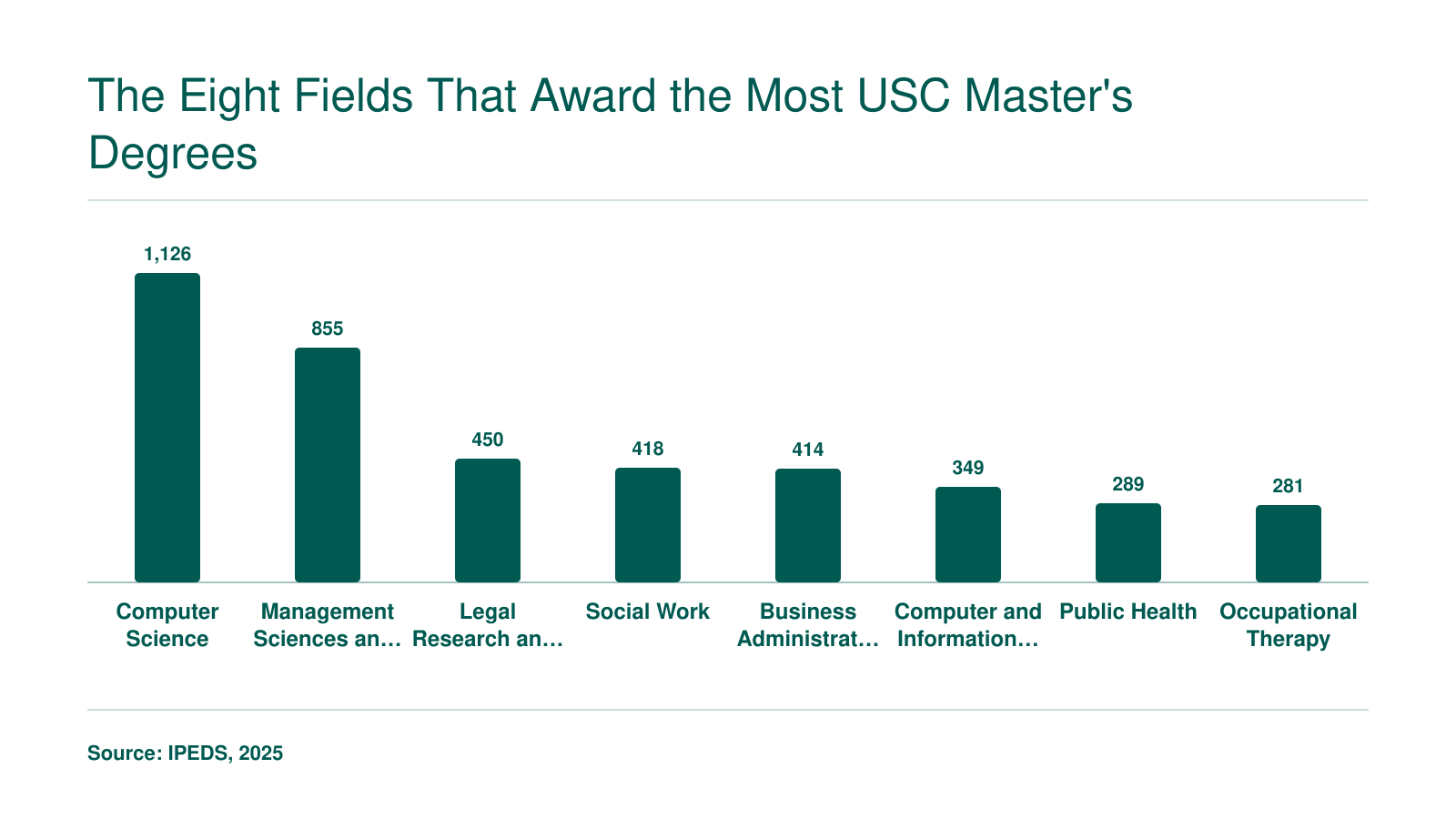
The Eight Fields That Award the Most USC Master's Degrees
USC awarded 9,331 master's degrees in 2025, and the eight largest fields accounted for about 4,182 of them, roughly 45% of the total. Computer science alone produced 1,126, more than double the next field. The portfolio stays deep well past the top eight: electrical and electronics engineering added 276, radio, television and digital communication 242, and communication and media studies 188.
Online, Hybrid, or On-Campus, and 12 Months or 4 Years?
At USC, 6,615 graduate students (23%) were enrolled exclusively online in 2024, while 12,415 (43%) took some online courses and 9,852 (34%) took none, according to IPEDS / U.S. Department of Education College Scorecard data. Format is not a side detail. It determines your weekly schedule, your access to labs, and which recruiting events you can attend.
Three formats, three different student lives
On-campus remains the default across the programs we list. Degrees such as the MS in Finance and MS in Cyber Security Engineering put you in Los Angeles classrooms and labs, with the in-person cohort and campus recruiting that full-time students lean on. Online options include the MS in Human Resource Management, the Master's in Project Management in California, Master of Management in Library and Information Science, and MS in Applied Psychology. Hybrid programs sit in between: the Executive MBA, the Integrative Social Work MSW in California, and the MS in Analytics (Data Analysis) blend remote coursework with scheduled residencies or intensives.
How long it actually takes
USC does not publish a single university-wide unit requirement or completion clock for every master's program, so program pages set their own terms. In practice, some accelerated professional master's programs are built as 12-month cohorts, many campus programs run about 16 to 18 months, and part-time or online tracks can extend well beyond two years. The practical range is therefore a 12-month sprint at one end and a multi-year part-time path at the other.
The Progressive Degree shortcut
For USC undergraduates, the Progressive Degree Program can compress the timeline. Eligible students apply in junior or senior year after completing at least 64 undergraduate units.1 The university minimum is a 3.0 GPA, though schools can set a higher bar; Viterbi states 3.2.2 The general rule requires no GRE or GMAT, but program exceptions exist.1 Master's units can be reduced by up to one-third, at least two-thirds must be at the 500 level,3 and the combined path is capped at 12 semesters or six years.1 Most students finish in about five.4
What online and hybrid trade away
Online and hybrid formats buy schedule flexibility, which is why working professionals gravitate to them. They also give up some of what full-time campus students rely on: on-campus recruiting, lab access, and the casual cohort relationships that turn into referrals. If your goal is a research lab or an internship-heavy career pivot, campus usually wins. If you are keeping a job and need a credential, online or hybrid can be the more rational purchase. The right answer is the one that fits the next 18 months of your life.
What a USC Master's Degree Costs: Tuition by School, Fees, and Total Attendance
Per-unit versus per-term rates
Across Master's Programs in California, USC does not charge one master's rate. The university-wide regular-session rate for Fall 2026 is $37,692 per term for 15 to 18 units1, which is a per-term band, not a per-unit price. School rates sit on top of or beside it. Viterbi charges $2,742 per unit for 2026-27, or $8,226 for a three-unit course and $10,968 for four units2. Annenberg's Master's in Communication in California charges $2,539 per unit. Gould's LLM is flat-rated: $86,472 for the academic year, or $43,236 per term, for 8 to 15 units each semester4. For Marshall, Rossier, Price, Dornsife, Keck, and the Suzanne Dworak-Peck School of Social Work--including Marshall's MBA in Management in California options--the current master's rate is set by the school; confirm it directly before you budget.
Fees that stack on tuition
Per-term charges are the ones that repeat. Viterbi estimates $922 per semester in mandatory fees for its 32- and 33-unit master's programs3, including $720 for the Student Health Center, $151 for transportation, $40 for graduate student programming, and $11 for the Norman Topping student aid fee2. Gould lists $2,139 in annual mandatory fees4. USC's university-wide graduate student fee is $40 per semester at UPC and nearby campuses and $20 per semester at other locations and online1. One-time charges are separate: $90 for the graduate application and $155 for Marshall's graduate application1.
A realistic 12-month total
Take a 32-unit Viterbi master's finished in 12 months at full-time load: $87,744 in tuition plus $1,844 in mandatory fees comes to $89,588. Add a Los Angeles living budget of $30,000 to $36,000 for rent, food, transport, books, and health insurance, and the all-in estimate lands at roughly $119,600 to $125,600. That living figure is an assumption, not a USC rate, and program length is the biggest variable. A two-year pace adds a second year of living costs.
The benchmark, and the cheapest documented path
IPEDS / U.S. Department of Education College Scorecard puts average full-time graduate tuition and fees at USC at $71,515. Every rate above clears it. The lowest documented full-time total is the university-wide regular-session rate, about $75,384 for two terms, roughly $3,900 above the average. Annenberg's per-unit rate would produce about $81,248 for a 32-unit program; Viterbi's 32-unit total is $87,744; Gould's LLM is $86,4724. On published rates, the least expensive path is a program billed at the university-wide rate; every school-specific rate sits well above the benchmark.
Paying for It: Scholarships, Fellowships, and Assistantships for Master's Students
Master's funding at USC now sits mostly at the school level, and those awards close earlier than admission does, so the funding application sets the pace. There is no single university-wide master's scholarship list at USC; each school and program coordinates its own awards, so a general admission application does not put you in the running for all of them.
What Aid Actually Looks Like by School
The forms differ by school. General graduate assistantships are department-awarded on academic promise, run at most one year at a time, require six graduate units of enrollment, and involve up to 20 hours of work per week, with tuition credit and a stipend depending on the appointment.1 Price School guarantees partial tuition to eligible applicants who apply by December 15, 2026 and are admitted to qualifying in-person programs, and its Dean's Merit award is tuition-only for fall on-campus MPA, MPP, MHA, and MUP students, open to domestic, undocumented, and international applicants. Price's Town and Gown Scholarship provides $15,000 in graduate tuition support within more than 200 awards worth $2.3 million annually, requiring U.S. citizenship, a 3.4 GPA, Southern California residency, and a November 15, 2026 deadline. Viterbi's Fall 2026 civil and environmental engineering cohort includes five 50%-tuition merit awards for new full-time residential students with a 3.3 undergraduate GPA or better, and the Chevron Fellowship pays $25,000 across multiple years.2 Annenberg considers departmental scholarships alongside admission but says awards are limited and many qualified admits receive none; its assistantships are rarely offered and tied to merit-scholarship recipients.
The Honest Arithmetic
Most master's aid is partial, and assistantship slots cluster in PhD-heavy departments rather than spreading evenly across professional master's programs. Plan on federal Direct Unsubsidized Loans and Grad PLUS, employer tuition benefits, and field-specific external scholarships as the backbone.
Where to Look, and When
Check the department's own funding page first, then the central financial aid office for loan and work-study mechanics. Aid deadlines generally precede admission deadlines, so file funding materials before anything else.
Admissions, Test Policy, and Selectivity: What USC Schools Actually Expect
There is no single USC master's admission standard. Requirements are set school by school, and two applicants to different parts of the university can face completely different test policies, GPA expectations, and document lists. The Graduate School tells applicants to confirm each department's GRE policy rather than assume a campus-wide rule.1
Test policy: three different answers inside one university
- Viterbi: The engineering school does not require the GRE for Spring or Fall 2026 master's applicants, and submitted scores are not reviewed.2 It publishes no minimum GPA and says it applies no formula.3
- Dornsife Mathematics: The general GRE is not required, though the math subject test may be submitted and is factored into review. Three letters of recommendation are required.4
- Price: The GRE and GMAT are discontinued for on-campus master's programs, aligning with the broader shift toward MBA/MSW With No GMAT or GRE Required programs, with one exception: MPPDS applicants must submit one of the two exams. Price sets no minimum GPA but reports that successful applicants typically sit at 3.0 or above.
- Spatial Sciences: The M.S. in Spatial Economics and Data Analysis still requires a GRE submission, with no minimum score published.5
Letters and essays are equally uneven. Beyond the three letters Mathematics asks for, there is no university-wide recommendation requirement, so the department page is the only reliable source.4
GPA and English proficiency
The general baseline is a bachelor's degree and preparation adequate for graduate work; it does not establish a universal admission GPA.1 Mathematics publishes 3.0.4 Price expects 3.0 or better in practice.
The general English floor is a TOEFL iBT of 90 with at least 20 in each section, or IELTS Academic 6.5 with no band below 6.0, and TOEFL scores must fall within 24 months of application. Mathematics holds international applicants to a higher bar: TOEFL 100, IELTS 7.0, or PTE 68.4 Price accepts TOEFL or IELTS but not Duolingo, and neither Price nor Spatial Sciences waives proficiency for work experience or prior ESL study.
Extra hurdles worth planning around
- Portfolios or auditions for fine arts and cinematic arts applicants.
- Licensure-linked prerequisites in Family Nurse Practitioner programs in California and MSW tracks.
- Quantitative prerequisites for the MS in Finance, MS in Analytics, and computer science conversion paths.
Selectivity: verify before you apply
USC discloses master's acceptance rates for few programs, and cohort sizes are not routinely published either. Where a school has not released a figure, treat any number you encounter as unverifiable. Applications are reviewed holistically, so a missing test score or a GPA below a program's stated expectation is a reason to ask the department directly, not a reason to skip the application.
USC Master's Application Deadlines by School
USC does not publish one graduate application deadline. Each school sets its own calendar, and several programs layer rounds or scholarship priority dates on top of the final cutoff. The dates below are the ones the schools published in 2026; because departmental calendars can shift, confirm the current date with your program before you apply.
| School / College | Example Master's Program | Application Deadline(s) | Decision Timeline |
|---|---|---|---|
| Viterbi School of Engineering | MS in Electrical and Computer Engineering (Machine Learning and Data Science) | Fall entry: December 15, 2026 for scholarship consideration; January 15, 2027 final. Spring entry: September 15, 2026 in the FAQ; the same page's table lists October 15. | Fall decisions January to June; spring decisions September to December. |
| Annenberg School for Communication and Journalism | Communication Data Science (MS) | December 15, 2026 | Varies by degree program; official decisions released by USC Graduate Admission. |
| Annenberg School for Communication and Journalism | Digital Social Media (MS) | December 7, 2026 | Varies by degree program; official decisions released by USC Graduate Admission. |
| Annenberg School for Communication and Journalism | Journalism (MS) | January 8, 2027 | Varies by degree program; official decisions released by USC Graduate Admission. |
| Annenberg School for Communication and Journalism | Public Diplomacy (MPD) | January 15, 2027 | Varies by degree program; official decisions released by USC Graduate Admission. |
| Annenberg School for Communication and Journalism | Global Media and Communication (MA) / Global Media (MSc) | Rolling | Varies by degree program; official decisions released by USC Graduate Admission. |
| Marshall School of Business | MS Business Analytics | Round 1: February 15; Round 2: April 30; Round 3: May 30 (2026 commitment dates by round) | Most fall applicants by June; most spring applicants by December. |
| Sol Price School of Public Policy | Master of Public Administration | December 15, 2026 for scholarship consideration (eligible fall graduate programs) | Most fall applicants by June; timing varies by program. |
F-1 students who complete a STEM-designated degree can apply for a 24-month OPT extension on top of the standard 12 months of post-completion OPT, giving three years of work authorization in total. Under USCIS and SEVP guidance, the employer must be enrolled in E-Verify for the extension to apply.
STEM Designation at USC: Which Master's Programs Qualify and What It Unlocks
A STEM designation is a classification the U.S. Department of Homeland Security attaches to a specific academic program's CIP code, not to a school or a degree title. At USC it matters almost entirely for one thing: how long an F-1 graduate can work in the United States after finishing the degree.
Which programs carry it
Confirmed: Viterbi's MS in Computer Science1 and its Artificial Intelligence2, Data Science3, and Scientists and Engineers4 tracks are eligible for the OPT STEM extension. Marshall's full-time MS in Business Analytics5, one of several California business analytics programs, is STEM-designated, as are Dornsife's MS in Applied Economics and Econometrics6, MS in Economics and Data Science7, MS in Innovation Economics, Law and Regulation8, and Master of International Trade Law and Economics8. Verify program by program: USC's pages confirm status where it exists but do not publish CIP codes, and a quantitative title (analytics, data science, computational) is not proof across California machine learning master's programs. Dornsife lists Quantitative and Computational Biology, Quantum Information Science, and Physical Biology without stating status.
How the mechanics work
Standard post-completion OPT gives 12 months of work authorization. A STEM-designated degree lets an F-1 graduate apply for a further 24-month extension, 36 months in total, subject to DHS, USCIS, employer (E-Verify) and reporting requirements. That extension is an opportunity, not an automatic right, and students apply for OPT and the extension separately. CPT is a different mechanism: it happens during the program, must be integral to the curriculum, and needs authorization before the work begins. Dornsife's Applied Economics and Econometrics program, for example, ties CPT to registration in a designated course.6
What it does not change
STEM status affects work authorization only. It does not improve your admission odds, lower tuition, or alter the $71,515 average graduate tuition and fees that IPEDS reports for full-time study in 2024. Designations can also change between catalog years, so confirm with the department before you enroll.
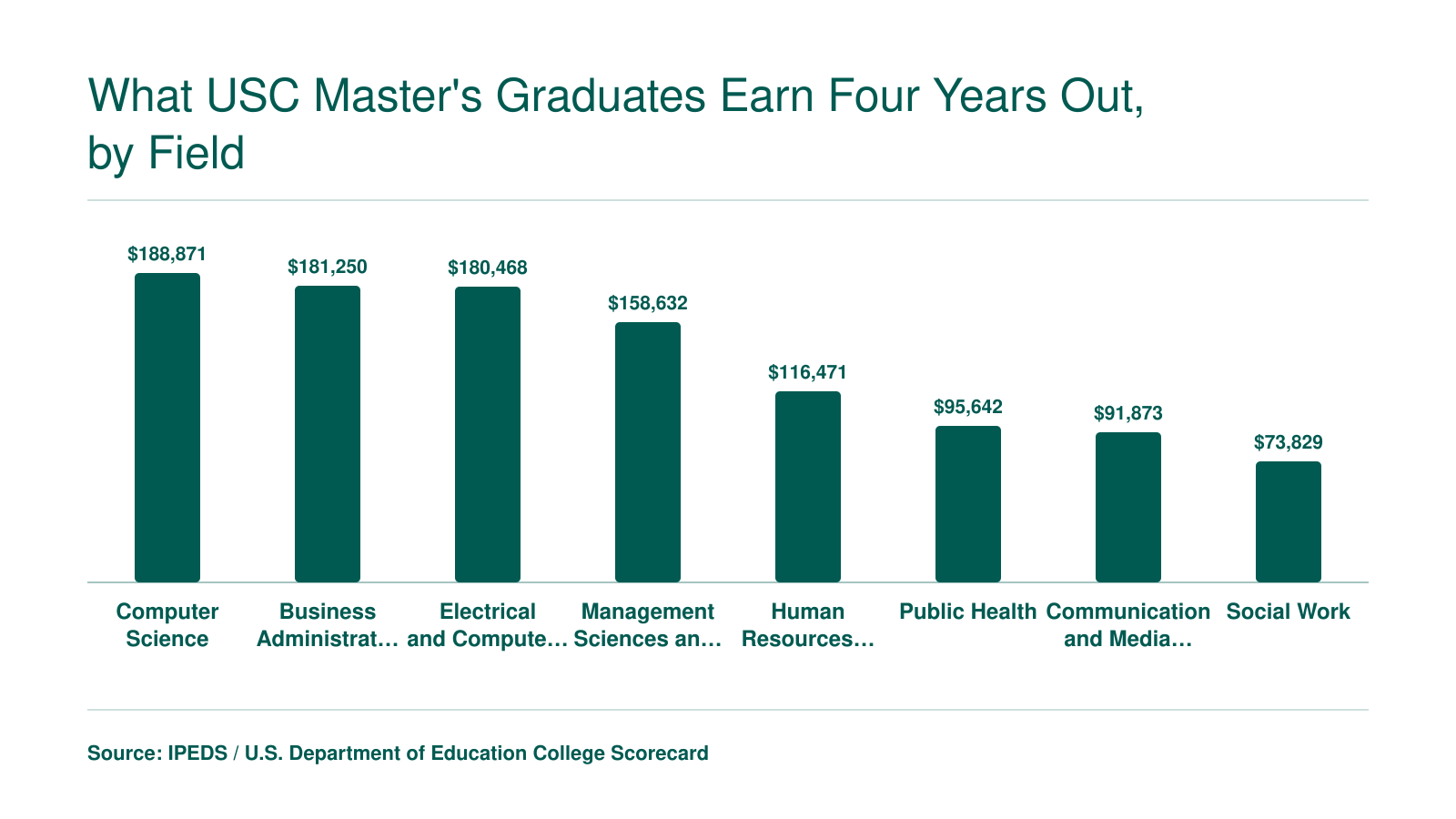
What USC Master's Graduates Earn Four Years Out, by Field
Field of study moves earnings more than anything else in this data. Four years after finishing a USC master's, computer science graduates report a median of $188,871, while social work graduates report $73,829, a spread of roughly 2.5 times. These are field-level medians from federal data, so read them as a signal about the market rather than a guarantee for any single program.
Outcomes, Accreditation, and Who Actually Thrives in a USC Master's Program
A master's degree is increasingly judged by its financial return rather than by the credential itself, and the U.S. Department of Education's outcome data show how widely that return varies. In the College Scorecard figures used here for 2026, median earnings four years after completion range from $69,534 in teacher education to $188,871 in computer science, while median federal debt runs from $51,250 to $125,849.
Earnings Against Debt, Field by Field
The ratio tells the story faster than either number alone. Computer Science graduates record $188,871 in median earnings against $51,250 in median federal debt, roughly $3.70 per dollar of debt. Master's in Human Resource Management in California pairs $116,471 with $53,261, about $2.20 per dollar. Both compare well with the heaviest loads. Social Work sits at $73,829 against $125,849, or about $0.59 per dollar, and Public Health at $95,642 against $83,937, about $1.14. The point is not that one field is worth more than another. It is that debt loads differ enough that a low-debt path matters more in some programs than others.
Accreditation: Institutional Versus Program-Level
USC is accredited by the Western Association of Schools and Colleges Senior Colleges and University Commission (WSCUC). That institutional stamp covers the university, not the individual master's program. For licensed fields, program-level accreditation carries more weight with boards and employers: CSWE for social work, CEPH for public health, AACSB for business. Before applying, confirm the specific program holds the accreditation your license or employer requires, because a regional stamp alone will not satisfy a state board.
Who Thrives Here, and Who Should Look Elsewhere
The format matters as much as the field. Working professionals in HR, project management, and library science can use USC's online and hybrid tracks without leaving a job, as can students pursuing a Master's in Business Communication in California. Full-time campus students gravitate to Viterbi, Annenberg, and Gould, and to Marshall's General MBA in California, where lab, cohort, and recruiting access are part of the value. International students who need the OPT extension should confirm a program's STEM designation before enrolling.
The mismatches are just as clear. Candidates who need fully funded study or a research-track master's will find thin master's funding at USC, where assistantships and fellowships are limited relative to doctoral support. Anyone targeting clinical licensure should check program accreditation before comparing tuition or prestige. The right question is not whether USC is a good school. It is whether a specific program matches your format, your budget, and the license or career you are actually pursuing.
Common Questions About USC Master's Programs
The answers below pull together what the sections above cover: test policy, real cost of attendance, part-time and online options, program length, and how credit moves between schools and into USC's own bachelor's-to-master's pathway.
Does USC require the GRE or GMAT for master's programs?
What is the total cost of a USC master's degree, including fees and living expenses?
Can I earn a USC master's degree while working full time?
How long does a USC master's program take to complete?
Do USC master's programs accept transfer credit, or is there a path from a USC bachelor's degree into a master's?
Compare University of Southern California against every school in its field
Every ranking scores programs on graduate earnings, graduate tuition, debt and completion data from IPEDS and the College Scorecard.
Master's programs in California Browse all fields