Best MBA/MSW Programs
Compare 30+ accredited MBA/MSW programs, with graduate earnings, cost, debt, and completion data from IPEDS and the U.S. College Scorecard.

A University of Michigan MBA/MSW student completes 89 credits, compared with 117 if the two degrees were earned separately. That compression draws professionals who want to lead mission-driven organizations, adding finance and operations training to a social work foundation without doubling time.
mastersprograms.com ranks these dual-degree programs on published outcomes, not prestige: net price, debt, and graduate earnings. Admissions, licensure, and online options all shift the decision.
Cost is the sharpest variable among affordable MSW programs, from a net price near $11,300 at Florida State to about $41,700 at Boston College. Program-level MBA/MSW earnings are not published for every program, so the compressed timeline and second credential must beat each institution's overall cost and earnings record.
Key Points
- Net price ranges from about $11,300 at Florida State to $41,700 at Boston College.
- Michigan's dual program needs a minimum of 89 credits, versus 117 for both degrees separately.
- Program-level earnings for MBA/MSW graduates aren't published yet, so confirm each school's own outcomes.
Best MBA/MSW Programs Ranked for 2027
The programs at the top of this list pair selective business schools with CSWE-accredited social work training, and most are residential, full-time pathways with integrated credit overlap. The strongest values in the group lean public, where in-state tuition and net price are lower even as graduate earnings remain competitive.
Columbia University in the City of New York
#1New York, NY · ~$58,000/yr (est.) · ASWB pass rate 86.7% (3-yr weighted avg)
Best for: Nonprofit leaders seeking Ivy League network
Columbia pairs a full-time MBA with a Master of Science in Social Work, sharing credits to cut about one year from the separate degree path. Students register in one school per term and pay that school's tuition, with separate admission decisions from each school. The pathway is built for nonprofit management, healthcare administration, government, and social entrepreneurship roles.
- Combines the full-time MBA with a Master of Science in Social Work
- Shared credits cut about one year from the separate degree path
- Requires separate applications to each school
- Register in one school per term and pay that school's tuition
- Financial aid available, but scholarships are not transferable
- CSWE-accredited social work component
University of Pennsylvania
#2Philadelphia, PA · ~$48,000/yr (est.) · ASWB pass rate 90.3% (3-yr weighted avg)
Best for: Experienced professionals wanting Wharton integration
Penn combines Wharton's MBA with the School of Social Policy & Practice MSW in a full-time, two-year program. Students choose a clinical or macro concentration and complete practicum internships that integrate business and social work. Admission is separate to each school, and the program is designed for students with supervisory experience.
- Blends Wharton's MBA with the School of Social Policy & Practice MSW
- Full-time, two-year program
- Choose a clinical or macro concentration
- Practicum internships integrate management and policy perspectives
- Designed for students with supervisory experience
- Two separate diplomas awarded
- CSWE-accredited social work component
University of Michigan
#3Ann Arbor, MI · $29,000 – $58,000/yr (est.) · ASWB pass rate 87.2% (3-yr weighted avg)
Best for: Public-university applicants seeking lower net price
Michigan links the Ross School of Business and School of Social Work in an 89-credit, two-and-a-half-year dual degree. The structure sequences year one at one school, year two at the other, and a final year finishing remaining requirements. Field instruction is built in, and the program prepares graduates for nonprofit, healthcare, policy, and community development leadership.
- Jointly offered by Ross School of Business and School of Social Work
- 89 total credit hours
- First year at one school, second at the other, third year finishes requirements
- Field instruction included
- Separate applications required to each school
- CSWE-accredited social work component
University of Southern California
#4Los Angeles, CA · ~$72,000/yr (est.) · ASWB pass rate 70.6% (3-yr weighted avg)
USC brings together the Suzanne Dworak-Peck School of Social Work and Marshall School of Business in a 93-unit, three-year path. Students complete a field practicum and can focus on social change and innovation or the world of work. The Los Angeles setting supports careers in corporate social responsibility, HR leadership, and nonprofit management.
- 93 total credit hours over three years
- Combines Dworak-Peck School of Social Work and Marshall School of Business
- Concentrations in Social Change and Innovation and World of Work
- Field practicum required
- CSWE-accredited social work component
University of Maryland-College Park
#5College Park, MD · ~$18,000/yr (est.)
Maryland's College Park dual degree blends financial management, strategic planning, and organizational leadership with clinical and community social work. GMAT and GRE are optional, and applicants apply separately to both programs. The Baltimore-Washington corridor location supports careers in government, healthcare, and philanthropy.
- GMAT and GRE are optional; separate applications to both schools
- Combines business strategy with clinical and community social work
- Dedicated career services office with on- and off-campus recruitment
- Essay required for admission
- International applicants submit TOEFL, IELTS, or PTE
Boston College
#6Chestnut Hill, MA · ~$38,000/yr (est.) · ASWB pass rate 92.4% (3-yr weighted avg)
Boston College pairs the School of Social Work with the Carroll School of Management in a full-time MSW/MBA. The curriculum integrates management principles with social work intervention skills, and students are admitted independently to both schools. Its Jesuit commitment to justice informs the program's focus on social entrepreneurship and nonprofit leadership.
- Full-time curriculum from School of Social Work and Carroll School of Management
- Independent admission to both schools required
- Combines management principles with social work intervention skills
- Jesuit commitment to justice frames the program
- CSWE-accredited social work component
- Prepares for executive director, social entrepreneur, and policy advocate roles
Florida State University
#7Tallahassee, FL · ~$11,000/yr (est.) · ASWB pass rate 76.9% (3-yr weighted avg)
Florida State's joint MSW/MBA is a campus-based partnership with the FSU College of Business centered on a Social Leadership concentration. Students can take a 91-credit traditional path or a 66-credit Advanced Standing route for BSW graduates. The program starts in fall, with financial aid and scholarships available through the College of Social Work.
- Joint program with FSU College of Business
- Social Leadership concentration
- Traditional path is 91 credits; Advanced Standing path is 66 credits
- Advanced Standing available for CSWE-accredited BSW graduates
- Fall start with May 1 application deadline
- Financial aid and scholarships available through College of Social Work
- CSWE-accredited social work component
University of Maryland, Baltimore
#8Baltimore, MD · ~$18,000/yr (est.) · ASWB pass rate 81% (3-yr weighted avg)
Maryland, Baltimore partners with the Robert H. Smith School of Business on a 90-credit MSW/MBA spread over four years. The sequence moves from social work to business and back to social work, with a summer course option. Students earn 51 credits in social work and 39 in business, preparing for nonprofit, healthcare, and corporate social responsibility leadership.
- Partnership with Robert H. Smith School of Business
- 90 total credit hours over four years
- 51 credits from School of Social Work and 39 from Smith School
- First year in social work, next two in business, final year in social work
- Summer course option available
- CSWE-accredited social work component
University at Buffalo
#9Buffalo, NY · $10,000 – $15,000/yr (est.) · ASWB pass rate 88.4% (3-yr weighted avg)
Buffalo merges the MBA and MSW in a full-time, campus-based program with Traditional and Advanced Standing paths. The 120-credit curriculum includes a 900-hour practicum, an MBA internship, and a trauma-informed, human rights focus. Students start in either school, and billing follows the school where the majority of credits are taken.
- 120 total credit hours over three years
- 900-hour practicum and MBA internship included
- Traditional and Advanced Standing paths available
- Start in either school
- Full-time, campus-based enrollment
- Trauma-informed and human rights focus
- CSWE-accredited social work component
- MBA-only semesters bill MBA rate; mixed terms bill by majority registration
University of Pittsburgh-Pittsburgh
#10Pittsburgh, PA · ~$28,000/yr (est.) · ASWB pass rate 86.9% (3-yr weighted avg)
Pitt's MSW/MBA is reserved for Community Organization and Social Action students and offered jointly with Katz Graduate School of Business. The program requires 64.5 to 85.5 credits, with GMAT or GRE scores required for Katz and double-counted credits reducing overall requirements. Advanced standing is available for CSWE-accredited BSW graduates, and a field practicum plus a social entrepreneurship course round out the training.
- Restricted to Community Organization and Social Action (COSA) students
- Requires 64.5 to 85.5 credits depending on standing
- GMAT or GRE required for Katz Graduate School of Business
- 3.0 minimum undergraduate GPA and $50 application fee
- Double-counted credits reduce total requirements
- Advanced standing available for CSWE-accredited BSW graduates
- Field practicum in community organization management
- Required social entrepreneurship course
Cost & outcomes by school
Federal data for the highest-earning MBA/MSW programs, independent of the ranking above. Earnings are this field's master's graduates four years after completing, where the Scorecard reports them.
| School | Earnings | Tuition / yr | Debt | Grads/yr | Format |
|---|---|---|---|---|---|
| University of Denver CO | $133,993 | $42,173 | $66,687 | 186 | Campus |
| Florida State University FL | $107,889 | $10,553 | $30,750 | 258 | Campus |
| Kennesaw State University GA | — | $6,702 | — | — | Campus |
| New Mexico Highlands University NM | — | $8,016 | — | — | Campus |
| University of Houston TX | — | $10,051 | — | — | Campus |
| University of Georgia GA | — | $11,002 | — | — | Campus |
| Pennsylvania Western University PA | — | $11,261 | — | — | Online |
| The University of Texas at Austin TX | — | $12,006 | — | — | Campus |
| University of Iowa IA | — | $13,425 | — | — | Campus |
| Augsburg University MN | — | $13,766 | — | — | Campus |
| Southern Adventist University TN | — | $13,760 | — | — | Hybrid |
| University at Buffalo NY | — | $14,530 | — | — | Campus |
Sources: U.S. Department of Education. Tuition and graduates: IPEDS. Earnings and debt: College Scorecard, this field's master's graduates; a dash means no figure is reported.
Cost, debt & payoff
Median earnings of this field's master's graduates (4 yrs after completing) vs. their median federal loan debt · U.S. College Scorecard
Across these programs the median graduate earns about $133,993 and finishes with roughly $66,687 in debt — a ratio that clears a common rule of thumb (keep debt below first-year salary). Tuition and debt vary widely school to school, so check the per-school figures in the table above before you shortlist.
How We Rank MBA/MSW Programs
A famous name and a strong return on investment are not always the same thing, and a dual degree that takes three years makes that gap expensive. So the rankings here lean on verifiable outcomes instead of reputation.
What We Weigh
The rankings draw on federal data from IPEDS and the College Scorecard. Four measures carry the weight:
- Graduate tuition: The published price of the degree, which sets the baseline cost.
- Average net price: What students pay on average after grants and scholarships.
- Earnings after completion: Program-level pay for graduates, where the government reports it.
- Median federal debt: What graduates typically owe when they finish.
Read Net Price as a Benchmark
Net price is a school-wide average after aid. It is not a quote for an MBA/MSW student. Your own cost will depend on your funding package, your credit load, and whether the best MBA schools and MSW schools both award aid. Use the figure to compare schools, then request a personal estimate from each admissions office.
Why Some Schools Show Fewer Figures
Program-level earnings and debt are published only when enough graduates report. Smaller or newer programs may therefore show fewer numbers, or none. A gap in the data says nothing about quality. We say so plainly rather than estimating what is missing.
What We Leave Out
We do not weight reputation surveys or selectivity on their own. Admission rates measure how many people apply, not what graduates earn or owe. For career-changers moving into nonprofit leadership, healthcare administration, or social enterprise, outcome data answers the practical question: what will this degree cost, and what does it return?
MBA/MSW Dual Degree Cost: Tuition, Net Price, and Funding
The lowest-cost ranked programs are Florida State University, Dominican University, and the University of Michigan. At these schools, in-state graduate tuition runs from $10,553 to $28,886, while out-of-state tuition reaches $57,776 at Michigan. Published rates elsewhere show how quickly MBA billing can raise costs: Washington University in St. Louis lists $72,700 for its MBA, Boston College charges $35,195 per MBA semester, and UC Berkeley's MSW tuition is $6,861 for 2026. Because dual-degree students often spend some semesters in the business school, they may be billed at the MBA rate for those terms rather than the social work rate. Funding can come from graduate assistantships, Title IV-E child welfare stipends, and Public Service Loan Forgiveness for nonprofit or public careers. Ask each school which college's tuition rate applies in each term before you commit.
| School | Graduate tuition (in-state) | Graduate tuition (out-of-state) | Net price (effective) | Median earnings 4 years after graduation | Median graduate debt |
|---|---|---|---|---|---|
| Florida State University | $10,553 | $26,707 | $11,297 | $60,003 | $18,000 |
| Dominican University | $18,500 | $18,500 | $11,745 | $63,207 | $24,411 |
| University of Michigan | $28,886 | $57,776 | $13,138 | $64,788 | $19,500 |
MBA/MSW Credits, Curriculum Overlap, and Program Length
Earning the two degrees separately and earning them as a dual degree are very different time commitments. Michigan's separate-degree totals add up to 117 credits (57 MBA plus 60 MSW), while its dual program requires a minimum of 89.5 Tennessee puts the same difference at roughly four years separately versus three together.4
Typical Credit Totals
Combined requirements across the programs here run from about 75 credits to 106. Houston and Union sit at 75,1 Michigan at 89,5 Buffalo at 95,3 Tennessee at 96,4 and Denver at 106.6 The savings come from cross-counting, but the details differ. Houston applies 12 MBA hours to the MSW and 12 MSW hours to the MBA.1 Union counts 12 MSW core hours toward MBA electives and 9 MBA hours toward MSW electives. Iowa's figures are 9 and 12.7 WashU credits 15 MSW credits toward its MBA side.8 These are not uniform "shared credit" totals, so compare each school's own rules.
Simultaneous vs. Sequential Pathways
Most dual programs expect you to move between the two schools rather than finish one degree first. Michigan is explicitly concurrent, with a Spring/Summer term placed after the first year in Social Work.5 Iowa requires at least one overlapping semester to qualify for dual-degree treatment.7 Houston requires all MSW Foundation coursework before advanced social work courses.1 Michigan also bars pre-admission coursework from counting toward MBA requirements.5 Many schools do not publish whether fully sequential study is allowed, so ask before you apply.
Field Practicum
CSWE requires at least 900 field hours for the MSW, and the practicum is the part of the schedule you cannot compress. Buffalo lists 480 clinical hours for its program, so ask how hours are counted toward the full requirement.3 Confirm how placements are sequenced around MBA terms before you commit.
How Long Does an MBA/MSW Take?
Full-time students usually finish in 2 to 3 years. Michigan runs 2.5 years,5 Tennessee 3,4 and Houston 3 to 4 for the traditional path.1 Part-time study stretches the timeline, and Denver allows up to 5 years from matriculation.6
Advanced Standing
BSW holders can shorten the path with Advanced Standing MSW programs. Houston's advanced-standing route takes 2 to 3 years and 64 credits,1 and Union's MSW portion drops to 51 hours. Buffalo's two-year, on-campus program is limited to BSW graduates of CSWE-accredited programs who meet additional requirements.3
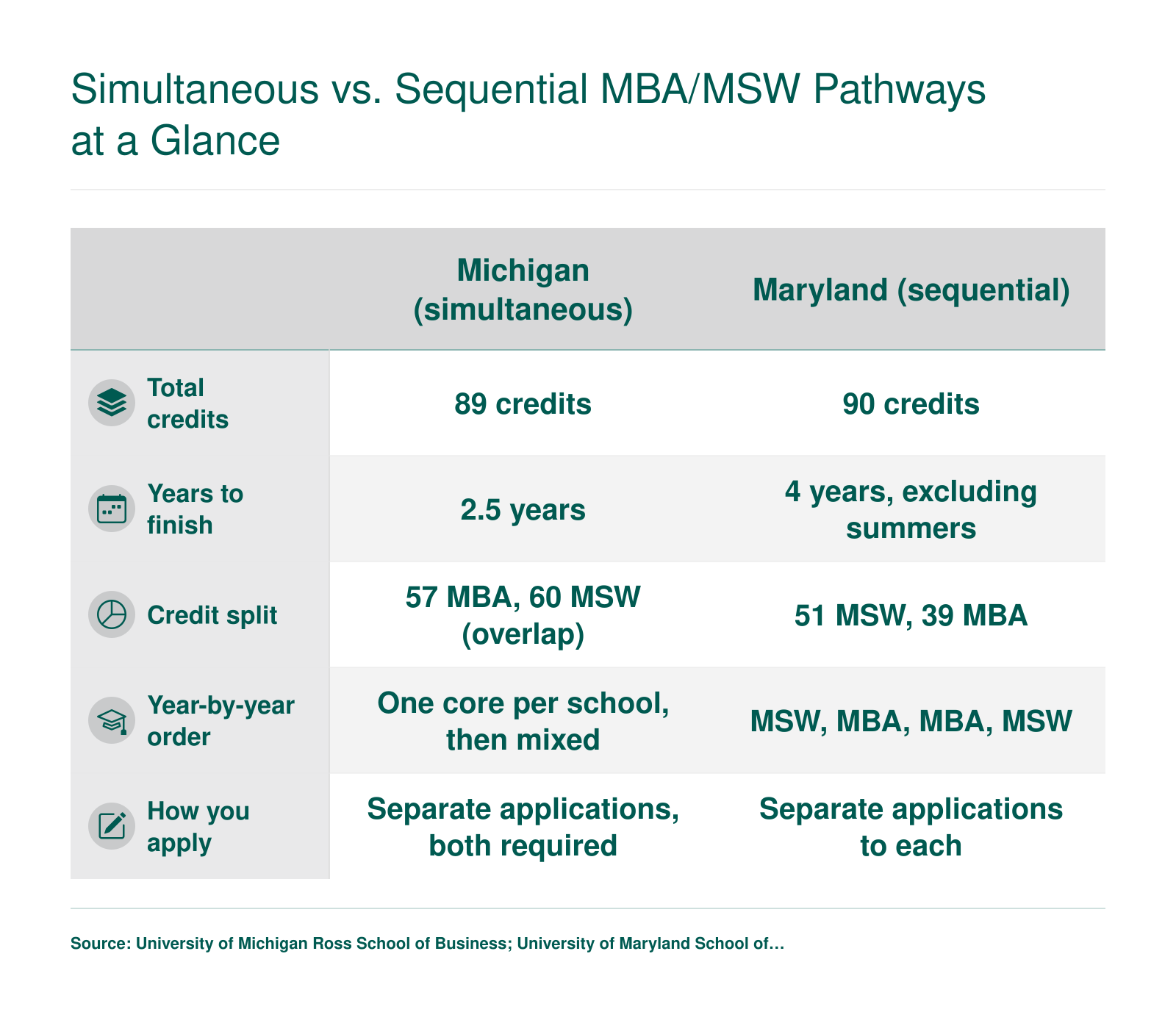
Simultaneous vs. Sequential MBA/MSW Pathways at a Glance
The University of Michigan runs its MBA/MSW as a simultaneous program, while the University of Maryland offers a sequential MSW/MBA. A career-changer who wants both credentials in the shortest time will likely find the simultaneous model a better fit. Someone already working in social services who wants to stage the degrees over several years may prefer the sequential model. Neither program's published material specifies when field placements fall, so confirm that with each school.
Related Articles
Social and Community Service Manager Pay
Many MBA/MSW graduates move into management roles at nonprofits, health systems, and public agencies. Social and community service manager is one common destination.
MBA/MSW Admissions, Accreditation, and Licensure Requirements
Requirements differ by school, and the research behind this section does not establish universal 2026 rules for MBA/MSW applicants. Treat what follows as a framework, and confirm every detail with each program before you apply.
- Separate vs. joint applicationsMost dual-degree programs do not offer automatic joint admission. Penn, Case Western Reserve, and the University of Pittsburgh all require separate applications to the business school and the social work school. Case Western Reserve uses a joint committee to review files, but each school still decides on its own and no admission is guaranteed. Plan on being admitted to both.
- GMAT/GRE policyTest rules are not uniform. Pitt does not require the GMAT or GRE for its regular MSW, but joint MSW/MBA applicants must submit official scores to the business school by its deadline. An MBA-only waiver may not carry over to a dual-degree application, and the business school's policy generally controls unless the program says otherwise. Ask the admissions office directly whether waivers apply to dual-degree applicants and what criteria they use.
- Typical materials and deadlinesExpect a bachelor's degree, transcripts, a résumé showing work or volunteer experience, essays, and recommendations. Pitt, for example, lists a 3-5 page personal statement and three recommendations. Business schools often run multiple rounds, while MSW programs may use a single deadline. With separate applications you generally must meet both schedules, including the earlier test-score receipt date. Verify 2026 and 2027 deadlines with each school.
- Accreditation checkCSWE accreditation is program-specific, so confirm the MSW itself is accredited (or in candidacy, where state rules allow). Most states require licensure applicants to graduate from a CSWE-accredited program. For the business side, look for AACSB accreditation, which is a separate body and no substitute for CSWE. Do not assume both components hold it; check each.
- LicensureState boards, not CSWE, control licensure. A CSWE-accredited MSW generally supports LMSW eligibility, while the LCSW typically requires post-graduate supervised clinical experience and an exam, with details varying by state. New York, for example, may require an education review showing at least 12 semester hours of clinical content. The MBA does not affect licensure, but your clinical coursework and field hours do, so check your state board's rules.
CSWE's Annual Statistics on Social Work Education reports 55,935 students enrolled in MSW programs in 2023-2024, across the 225 programs that responded to the survey. That's a large pipeline of future social workers, and a reminder that the field is bigger than most applicants assume.
MBA/MSW programs by state
MBA/MSW Dual Degree FAQs
These answers cover the questions prospective students ask most often about timing, format, enrollment sequencing, and licensure. Policies differ by school and state, so confirm specifics with each program and your state licensing board.
How long does it take to earn an MBA/MSW dual degree?
Can I earn an MBA/MSW dual degree online?
Can I add the MBA after I've already started an MSW program?
Can I become a licensed clinical social worker (LCSW) with an MBA/MSW?
Compare MBA/MSW programs on the data that matters
Explore more MBA specializations or browse every graduate field.
All MBA programs