Best General MBA Programs
Compare 710+ accredited General MBA programs at 680+ schools, with graduate earnings, cost, debt, and completion data from IPEDS and the U.S. College Scorecard.

A general MBA trains managers to move across functions rather than specialize in one, such as an MBA in Accounting or an MBA in Business Analytics, covering finance, marketing, operations, and strategy so graduates can run a team, a division, or eventually a company. That breadth is the point: cross-functional fluency is what recruiters in consulting, tech, and corporate leadership still pay for.
The cost gap, though, is wide. Among the schools ranked here, the net price a student actually pays runs from roughly $13,500 at UC Berkeley's Haas program to about $25,000 at Virginia Tech, with full sticker tuition at private campuses like Chicago Booth and Boston University climbing well past that before aid.
Berkeley reports median earnings of $125,000 and a 95% job placement rate, a reminder that broad training, not a single concentration, still carries the strongest recruiter pull.
Key Points
- Rankings weigh graduate earnings, net price, and debt from federal data, not reputation surveys.
- Sticker tuition rarely matches net price, and residency can swing cost more than school choice.
- AACSB reported 1,085 accredited institutions across 71 countries as of July 2026.
10 General MBA Programs Worth Your Tuition
These ten general MBA programs earned their places on graduate earnings and what students actually owe, not on reputation surveys. The list spans full-time residential MBAs, flexible hybrid formats, and fully online options, so the right fit depends on your budget, schedule, and career target.
University of California-Berkeley
#1Berkeley, CA · ~$16,000/yr (est.)
Best for: Career changers targeting Bay Area tech
The full-time Haas MBA in Berkeley, California is campus-based and emphasizes general management across finance, marketing, strategy, and operations. Its Silicon Valley location feeds consulting, finance, and technology recruiting, and the AACSB-accredited program reports a typical net price around $13,481. Five years after finishing, program-level median earnings reach $266,651.
- AACSB accredited
- Requires GMAT; work experience required
- $75,000 total program tuition
- 2-year, full-time, cohort-based format
- 95% job placement rate
- Capstone required
- Located in Silicon Valley
- Cross-functional business fundamentals
Harvard University
#2Cambridge, MA · $55,000 – $60,000/yr (est.)
Best for: Aspiring global executives needing leadership network
Harvard Business School's full-time MBA in Cambridge, Massachusetts offers a STEM-designated general management curriculum with lifelong career support and joint degree options. The campus-based program carries a typical net price near $19,066, and four years after finishing, program-level median earnings are $113,503. Graduates enter leadership roles across industries through HBS's global network.
- STEM-designated MBA program
- 2-year, full-time, campus-based format
- General management curriculum
- Lifelong learning and career support
- Joint degree programs available
University of Chicago
#3Chicago, IL · ~$69,000/yr (est.)
Best for: Analytical learners wanting flexible campuses
Booth's MBA in Chicago, Illinois combines rigorous economics and decision-making with the flexibility to shape your own course path, including part-time evening and weekend formats. Students study on permanent campuses in Chicago, London, and Hong Kong. The typical net price is about $14,860, and four years after finishing, program-level median earnings reach $243,256.
- Full-time, part-time, evening, and weekend options
- Permanent campuses in Chicago, London, and Hong Kong
- LEAD leadership program since 1989
- Experiential courses with real business challenges
- Electives in finance, marketing, and strategy
Grove City College
#4Grove City, PA · ~$9,000/yr (est.)
Grove City College's online MBA in Grove City, Pennsylvania blends a Christ-centered general business curriculum with a 39-credit cohort model and weekend residencies. Full-time, part-time, and +1 fast-track options make it accessible for working professionals and recent graduates. The program is ACBSP accredited and emphasizes ethical leadership across healthcare, technology, and finance sectors.
- ACBSP accredited
- 39 total credit hours
- Full-time and part-time options
- Cohort-based with weekend residencies
- Over 80% of faculty hold terminal degrees
- Christ-centered business education
- +1 MBA fast-track for undergraduates
University of Wisconsin-Madison
#5Madison, WI · ~$12,000/yr (est.)
The University of Wisconsin-Madison's part-time Professional MBA in General Management is a hybrid program based in Madison, Wisconsin, with 50% on-campus and 50% online learning. It requires 44 credits and can be completed in 2 to 5 years. The AACSB-accredited program emphasizes strategic problem-solving and cultural competence, with a typical net price near $17,354.
- Part-time hybrid program
- Flexible 2-5 years
- 50% on-campus, 50% online
- 44 credit requirement
- 3.00 GPA required
- AACSB accredited
- General Management specialization
- Strategic problem-solving focus
Lincoln University
#6Oakland, CA · ~$11,000/yr (est.)
Lincoln University's MBA in General Business in Oakland, California is a hybrid program built for future business owners and general managers. It starts with seven core courses and allows electives in entrepreneurship, project management, and supply chain, with a strong international focus. The 36-credit degree includes a capstone, internship report, case study, or comprehensive exam.
- 7 concentration options
- $41,600 total program tuition
- 36 total credit hours
- Full-time and part-time options
- Transfer up to 9 graduate credits
- Thesis, capstone, or comprehensive exam option
- Strong international focus
Virginia Polytechnic Institute and State University
#7Blacksburg, VA · ~$19,000/yr (est.)
Virginia Tech's online MBA in Blacksburg, Virginia offers a 24-month, cohort-based general business concentration for working professionals. The fully online program combines self-paced coursework with live weekend sessions and electives in cybersecurity, healthcare, or entrepreneurship. The typical net price is about $24,953, and four years after finishing, program-level median earnings are $154,688.
- 4 concentration options
- 24-month, part-time online format
- Synchronous and asynchronous options
- Cohort-based structure
- Periodic weekend live sessions
- Starts summer
- Join 100,000+ Mid-Atlantic alumni
URBE University
#8Sweetwater, FL · $10,000 – $15,000/yr (est.)
URBE University's online MBA with a Management concentration in Sweetwater, Florida uses a 45-credit curriculum that blends core business foundations with courses in human capital, organizational change, and critical thinking. The e-learning format includes videos, infographics, and discussion forums for schedule flexibility. Graduates typically pursue general manager, operations director, or administrative director roles.
- Management concentration
- 45 total credit hours
- Capstone required
- Interactive media and e-learning activities
- Collaborative discussion forums
- Personal career coaching and job search
- Faculty are professionals in their field
Polytechnic University of Puerto Rico-Miami
#9Miami, FL · ~$8,000/yr (est.)
At Polytechnic University of Puerto Rico's Miami campus, the online MBA in General Business requires 39 credit hours and no thesis or comprehensive exams. Students design their own path by choosing nine credits from other MBA tracks and can transfer up to 18 graduate credits. The program emphasizes real-world decision-making, data analysis, and leadership.
- General Business concentration
- 39 total credit hours
- 3.0 GPA minimum
- No thesis or capstone required
- Design your own program with nine credits from other tracks
- Transfer up to 18 graduate credits
- Military benefits accepted
- Minimum full-time load six credits
Boston University
#10Boston, MA · $65,000 – $70,000/yr (est.)
Boston University's Questrom MBA in Boston, Massachusetts offers a General Management concentration through a cohorted full-time format, with part-time and online paths available. The 64-unit program includes action learning electives, a required career management internship, and a strong alumni network. Four years after finishing, program-level median earnings are $147,178, with a typical net price near $24,402.
- General Management concentration
- 5 concentration options
- 64 total credit hours
- Full-time and part-time options
- Cohort-based structure
- Action learning elective required
- Career management internship required
- Dual degree with MS Digital Technology
Cost & outcomes by school
Federal data for the highest-earning General Business programs, independent of the ranking above. Earnings are this field's master's graduates four years after completing, where the Scorecard reports them.
| School | Earnings | Tuition / yr | Debt | Grads/yr | Format |
|---|---|---|---|---|---|
| University of Pennsylvania PA | $272,321 | $47,844 | $41,420 | 486 | Campus |
| University of Washington-Seattle Campus WA | $194,296 | $18,792 | $58,052 | 294 | Hybrid |
| University of Phoenix-Arizona AZ | $80,622 | $15,208 | $30,432 | 2,401 | Online |
| Louisiana State University-Shreveport LA | — | $7,349 | $21,230 | 2,147 | Campus |
| Albright College PA | — | $1,540 | — | — | Online |
| The University of Texas Permian Basin TX | — | $9,276 | $19,250 | 168 | Online |
| Missouri Valley College MO | — | $3,870 | — | — | Online or campus |
| Cameron University OK | — | $5,022 | — | — | Online or campus |
| Northwestern Oklahoma State University OK | — | $5,320 | — | — | Online |
| Hartwick College NY | — | $5,400 | — | — | Hybrid |
| University of North Georgia GA | — | $5,416 | — | — | Online |
| Culver-Stockton College MO | — | $6,200 | — | — | Online |
Sources: U.S. Department of Education. Tuition and graduates: IPEDS. Earnings and debt: College Scorecard, this field's master's graduates; a dash means no figure is reported.
Cost, debt & payoff
Median earnings of this field's master's graduates (4 yrs after completing) vs. their median federal loan debt · U.S. College Scorecard
Across these programs the median graduate earns about $93,391 and finishes with roughly $32,783 in debt — a ratio that clears a common rule of thumb (keep debt below first-year salary). Tuition and debt vary widely school to school, so check the per-school figures in the table above before you shortlist.
Inside Our Scoring: Earnings, Net Price, and Debt
A reputation survey asks deans and recruiters what they think of a school. Federal outcome data asks what actually happened to the people who graduated. This ranking of best MBA programs is built on the second question.
What Goes Into the Score
The core inputs come from program-level reporting the U.S. Department of Education publishes through the College Scorecard for MBA graduates specifically:
- Earnings over time: Median pay one, two, four, and five years after completion, so you can see whether a salary bump holds or fades.
- Debt at completion: The median federal loan balance MBA graduates leave with.
- Monthly payment: The estimated payment on a standard 10-year repayment schedule, which makes debt legible next to a first-year salary rather than abstract.
How to Read Net Price
Net price is the average annual cost after grants and scholarships are subtracted, and it is reported for the institution as a whole rather than for the business school alone. Treat it as a directional guide to how aggressively a school discounts, not as a quote for the affordable MBA programs on your comparison list. Graduate assistantships, employer tuition benefits, and merit awards all move the real number.
Where the Data Stops
Graduation rates and 10-year earnings are institution-wide figures covering the full student body, not the MBA cohort. Some programs also have no published earnings yet, usually because the cohort is too small to report, so a card may simply show fewer stats. We leave the gap visible instead of filling it with an estimate.
Prestige surveys measure what people believe about a school. Earnings, debt, and net price measure what a degree did for the last class that paid for it, which is the comparison that affects your finances.
General MBA Cost and Tuition: Sticker Price vs. What Students Pay
General MBA cost is what a student actually pays to finish the degree, and it rarely matches the figure on a tuition page. The sticker price is the published rate. The net price is what remains after grants, and the federal version also folds in books and living costs.
Sticker vs. Net Price at the Cheapest Schools
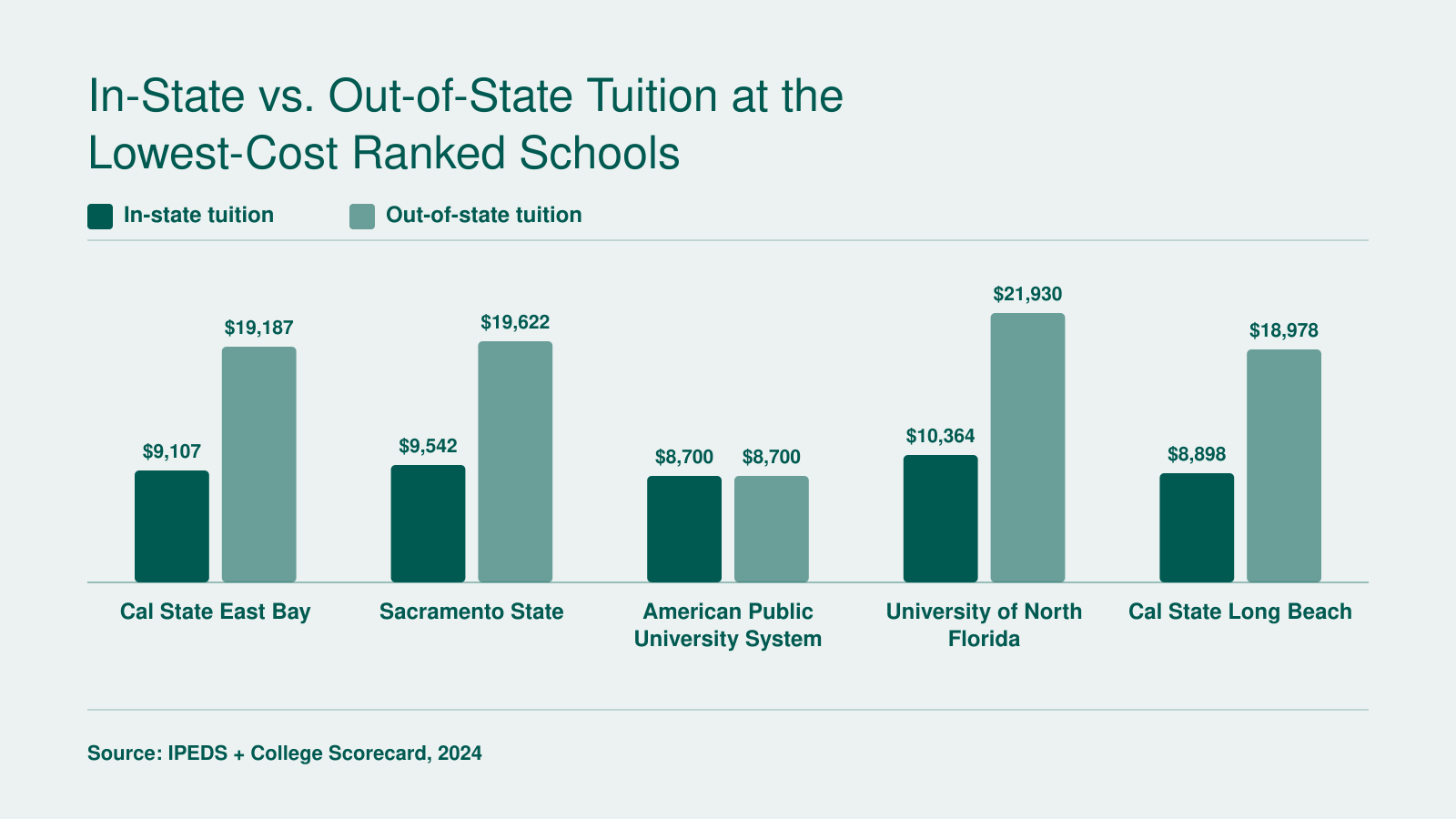
At the lowest-cost schools here, published program tuition runs from about $7,300 (California Miramar University, online) to about $10,400 (University of North Florida, in-state). Federal net prices at those institutions sit in a similar band, roughly $9,300 to $12,500. At Cal State Long Beach, net price ($10,440) even exceeds in-state tuition ($8,898) because living expenses are included. The bigger gap appears out of state, where Long Beach charges nonresidents $18,978.
Public vs. Private Pricing
Public schools usually split rates by residency. UC Berkeley Haas runs about $149,948 in-state versus $174,439 for nonresidents over two years. Private schools charge one rate to everyone, such as Tulsa's online MBA at $850 per credit hour.
Published Tuition at Well-Known Programs
Two-year tuition estimates for 2025-2026 (not guaranteed charges):
- Harvard Business School: $157,400
- Northwestern Kellogg: $169,980
- Chicago Booth: $171,552
- Wharton: $172,800
- MIT Sloan: $175,550
Online pricing is far lower. Purdue charges $728 per credit across 48 credits (about $34,944). George Mason's effective rate is $1,229 per credit with its distance-learning fee, also over 48 credits. SNHU's $659 per credit over 30 credits implies $19,770. WGU bills $4,805 per six-month term.
Budget Beyond Tuition
Fees, books, and housing add up, and full-time students also give up two years of salary. MIT Sloan's total cost of attendance is listed at $288,650, and GMAC says leading U.S. programs, including executive MBA programs, can exceed $250,000 all-in.
In-State vs. Out-of-State Tuition at the Lowest-Cost Ranked Schools
Residency can change the price of a general MBA more than the choice of school. The bars below compare in-state and out-of-state tuition at the lowest-cost schools ranked here.
Related Articles
General MBA Career Outcomes: Earnings, Debt, and Recruiter Pull
Federal earnings data and school employment reports answer different questions, and for general MBAs only the second is reliably filled in right now.
What the Earnings and Debt Data Show
No program-level median earnings have been published for the general MBA programs here at any window after completion. The same goes for program-level debt and the debt-to-earnings comparison readers would use to judge payoff. We will not substitute institution-wide figures, since they blend every degree a school awards. Berkeley Haas advertises $125,000 median earnings and a 95% placement rate, but without a stated timeframe, so treat that as marketing until verified.
Where Graduates Land
Chicago Booth's Class of 2025 report is the most current school-specific evidence available, and it is one school, not a national average. Six industries took 78.7% of accepted jobs: consulting (36.7%), technology (14.1%), diversified financial services (9.0%), investment banking (8.3%), investment management (5.3%), and private equity (5.3%). Median salaries that year ran $190,000 in consulting, $175,000 in financial services (the target of many MBA in Finance candidates), and $151,000 in technology. Top employers were BCG (52 hires), McKinsey (35), Bain (30), Amazon (20), and Goldman Sachs and JP Morgan (11 each).
Recruiter demand is broader. GMAC's 2026 survey of 621 recruiters in 39 countries found hiring interest strongest in manufacturing (58%) and products and services (56%), ahead of finance and accounting (42%), health care and pharma (40%), where an MBA in Healthcare Administration is a common alternative, and consulting (38%).
Roles and Network Reach
A generalist degree typically leads to management consulting, product management, corporate finance, corporate strategy, and operations leadership.
Network size is harder to compare. Booth's report does not quantify its alumni reach. West Coast University cites 65,000 alumni worldwide, and Virginia Tech cites 100,000+ in the Mid-Atlantic. Both are school claims, so check how many alumni work in the industry and city you are targeting. Regional density often matters more than total headcount.
AACSB Accreditation and Campus, Online, or Hybrid Formats
Accreditation is a quality review of the business school itself, and the name attached to it changes how your degree travels. AACSB reported 1,085 accredited institutions across 71 countries and territories in its July 2026 announcement and reviews a school's strategy, faculty credentials, research output, curriculum, and how it measures student learning. Those standards apply the same way whether classes meet in a lecture hall or run asynchronously online.2 That school-level stamp is what employers recognize, what many corporate tuition reimbursement policies require, and what makes credits more likely to transfer if you change institutions mid-degree.
AACSB vs. ACBSP and IACBE
ACBSP (founded 1988) and IACBE are the other two widely recognized business accreditors, and both operate at the program level rather than the school level, accrediting degrees from associate through doctoral, as detailed in this ACBSP vs AACSB vs IACBE accreditation comparison. Their emphasis leans toward teaching quality, learning outcomes, and continuous improvement rather than research intensity. They are legitimate, but do not assume they are interchangeable with AACSB. Scope and standards differ, and no source establishes that every employer, lender, or reimbursement policy treats all three identically. If your employer funds tuition, check the policy language before you apply.
Formats and completion times
The programs here split across campus, fully online, and hybrid delivery. Berkeley, Harvard, and Chicago Booth run campus-based general MBAs, with Booth also offering a part-time evening track that finishes in about 2.5 years. Wisconsin-Madison's professional MBA is roughly half on-campus and half online with monthly campus meetings and a flexible two-to-five-year window. Boston University and Lincoln University offer both full-time and part-time paths, and Virginia Tech's online MBA is a 24-month cohort with periodic weekend sessions. Grove City College lists ACBSP accreditation rather than AACSB.
As a general rule: full-time programs run about two years, accelerated formats compress to roughly one, and part-time or evening tracks typically stretch 2.5 to 4 years. Verify any school's current accreditation and format directly in the AACSB directory1, since delivery options change more often than accreditation does.
GMAC's Prospective Students Survey is the best starting point for MBA preference data, but percentages shift by year, region, and candidate segment. Search "GMAC Prospective Students Survey 2027", check sample size and definitions, then compare each school's format page, BLS career data, and AACSB resources against your schedule, budget, and networking goals.
General Business programs by state
General MBA Questions Applicants Ask Most
These answers draw on federal data, school-published policies for the 2026-2027 cycle, and general knowledge of MBA admissions. Policies and aid amounts change by school and year, so confirm details with each admissions office before you apply.
What are the best general MBA programs in the USA?
How much does a general MBA cost from start to finish?
What can you do with a general MBA?
Are all general MBA programs AACSB accredited?
Do general MBA programs require the GMAT or GRE?
What scholarships and employer tuition benefits can general MBA students use?
How long does a full-time vs. part-time general MBA take?
Compare General Business programs on the data that matters
Explore more MBA specializations or browse every graduate field.
All MBA programs