Best General MBA Programs in Connecticut
Compare 9 accredited General MBA programs in Connecticut, with graduate earnings, cost, debt, and completion data from IPEDS and the U.S. College Scorecard.

Connecticut's MBA market splits along an unusually wide price line: graduate business tuition runs from $7,955 at Post University to as much as $53,970 at Fairfield University, for degrees aimed at the same insurance, finance, and healthcare administration employers across Hartford, New Haven, and Fairfield County.
Campus and online general MBA programs are ranked together here, judged on cost, reported graduate earnings, and completion data rather than name recognition.
Outcomes spread just as widely as price. Median pay five years out reaches $152,409 for UConn graduates, while some programs report figures closer to $60,000, so tuition alone is a weak proxy for what a Connecticut MBA returns.
Key Points
- Post University's graduate tuition is $7,955, the lowest among ranked programs.
- Median MBA earnings here range from $60,769 to $152,409.
- UConn's Online MBA is fully online with GMAT/GRE waivers in 2027.
Best General MBA Programs in Connecticut, Ranked
These Connecticut MBA programs are ranked by measurable outcomes and value, with flexibility and employer fit in mind. Each entry below pairs campus and online options in the state, from research universities to private and public colleges. Use the cards to compare tuition, net price, delivery format, and what makes each program stand out.
University of Connecticut
#1Storrs, CT · ~$23,000/yr (est.)
Best for: Working professionals wanting flexible online and campus paths
UConn's MBA stands out for its Flex format, which blends online and in-person classes at Hartford and Stamford, plus a fully online option with limited live sessions. The 42-credit program offers eight concentrations, including Business Applications of AI, and a new one-year accelerated track launching in 2026. The university reports an 83% institution-wide graduation rate, and the business school holds AACSB accreditation.
- 42 total credit hours
- 8 concentration options
- Fully online option available
- Flex MBA mixes online and in-person
- Live online sessions under three hours weekly
- In-person classes in Hartford and Stamford
- Advanced standing pathway is 33 credits
- One-Year MBA launching in 2026
Fairfield University
#2Fairfield, CT · ~$21,000/yr (est.)
Best for: Ethics-driven professionals seeking strategic breadth
Fairfield's Dolan MBA emphasizes ethical judgment, strategic thinking, and the ability to synthesize information across business functions. Students can customize the curriculum with concentrations such as Cybersecurity or Business Technology and complete courses on campus, online, or in hybrid format. The school reports an 84% institution-wide graduation rate, and Dolan has held AACSB accreditation since 1997.
- Broad strategic business perspective
- Customize curriculum to career aspirations
- Online, in-person, and hybrid courses
- Cybersecurity or Business Technology concentrations
- Career development center available
- Dual degree programs offered
- AACSB accreditation since 1997
Sacred Heart University
#3Fairfield, CT · ~$34,000/yr (est.)
Best for: Career changers needing internship and consulting experience
The Welch MBA at Sacred Heart uses a 33-to-45-credit structure that adjusts based on your business background and work experience. It includes an international consulting project or capstone, and students with less than two years of experience complete an internship.
- 33 to 45 total credits, based on background
- 3.0 GPA minimum
- Prerequisite courses required
- Capstone requires international consulting project or WGB 691
- 9 concentration options
- Internship required for students with less than two years experience
- 20% tuition discount for Hartford HealthCare employees
- Rolling admissions and no GRE/GMAT requirement
Southern Connecticut State University
#4New Haven, CT · ~$15,000/yr (est.)
Southern Connecticut State University's General MBA concentration is a public option with a clear 33-credit structure: 18 core credits, 9 concentration credits, and a 6-credit capstone. The program lets students choose courses from any MBA concentration to build a broad managerial skill set. The school reports a 50% institution-wide graduation rate, and the business school is AACSB-accredited.
- 33 total credits required
- 18 core credits
- 9 general concentration credits
- 6 capstone credits
- Core covers managerial economics, financial management, organizational behavior
- General concentration uses any MBA courses
- Traditional, accelerated, and online MBA options available
- AACSB accredited
University of Hartford
#5West Hartford, CT · ~$16,000/yr (est.)
University of Hartford's MBA in General Business is a 36-credit, 12-course program with seven-week terms, offered online or on campus to accommodate working students. It pairs core business functions with flexible electives, and students can focus on areas like digital marketing, healthcare management, or project management. The school reports a 54% institution-wide graduation rate, and the business school holds AACSB accreditation.
- 36 total credit hours, 12 courses
- Seven-week course terms
- Online or onsite course options
- 13 concentration options
- Rolling admissions
- 3.0 GPA minimum
- Capstone required
- AACSB accredited
University of Bridgeport
#6Bridgeport, CT · ~$22,000/yr (est.)
University of Bridgeport's MBA is available on the Main Campus and fully online, using a 36-credit structure with six core courses, three concentration courses, and capstone work. Students can choose from eight concentrations, including AI, analytics intelligence, and healthcare management, and no previous work experience is required.
- 36 total credit hours
- 8 concentration options
- Fully online option available
- 3.0 GPA minimum
- Six core courses required
- Three capstone courses
- Transfer up to two graduate courses
- No previous work experience required
Post University
#7Waterbury, CT · ~$8,000/yr (est.)
Post University's MBA with a Multidisciplinary concentration lets students draw on courses from all 13 MBA concentrations to design their own curriculum. The program emphasizes project-based learning, has no GMAT requirement, and offers online or on-campus study with multiple start dates.
- 39 total credit hours
- 13 concentration options
- No entrance exam required
- $0 application fee
- Project-based learning with real-world projects
- On-campus or online delivery
- Two STEM-designated concentrations available
- 24/7 tutoring support
Cost & outcomes by school
Federal data for the highest-earning General Business programs, independent of the ranking above. Earnings are this field's master's graduates four years after completing, where the Scorecard reports them.
| School | Earnings | Tuition / yr | Debt | Grads/yr | Format |
|---|---|---|---|---|---|
| University of Connecticut CT | $150,756 | $22,872 | $48,368 | 285 | Hybrid |
| University of Hartford CT | $126,408 | $16,129 | $26,383 | 265 | Hybrid |
| Fairfield University CT | $112,565 | $21,448 | — | 138 | Campus |
| Central Connecticut State University CT | $105,899 | $14,562 | — | — | Online or campus |
| Sacred Heart University CT | $100,796 | $34,394 | $31,434 | — | Campus |
| Southern Connecticut State University CT | $96,254 | $14,930 | $29,500 | 41 | Campus |
| Western Connecticut State University CT | $88,576 | $15,039 | — | — | Hybrid |
| University of Bridgeport CT | $88,084 | $21,786 | $41,000 | 65 | Hybrid |
| Post University CT | — | $7,955 | — | 30 | Hybrid |
Sources: U.S. Department of Education. Tuition and graduates: IPEDS. Earnings and debt: College Scorecard, this field's master's graduates; a dash means no figure is reported.
Cost, debt & payoff
Median earnings of this field's master's graduates (4 yrs after completing) vs. their median federal loan debt · U.S. College Scorecard
Across these programs the median graduate earns about $103,348 and finishes with roughly $31,434 in debt — a ratio that clears a common rule of thumb (keep debt below first-year salary). Tuition and debt vary widely school to school, so check the per-school figures in the table above before you shortlist.
Online and Hybrid MBA Options in Connecticut
The line between an online MBA and a campus MBA has narrowed sharply, and Connecticut schools now build most part-time and hybrid options around working schedules, a pattern visible across online master's programs in Connecticut.
Fully online and hybrid delivery
The UConn Online MBA is 100% online, requiring 42 credits across 14 courses. Its cohort track runs five consecutive semesters, including summer, with two core courses per semester and one Monday 7:00-8:30 p.m. Eastern live session; live coursework is capped at three hours weekly. The independent learning track averages 2-2.5 years. UConn's Flex MBA blends online and in-person classes in Hartford and Stamford, also 42 credits, with a 24-month path or a flexible pace.
CCSU's MBA combines online and on-campus formats for working students, and Southern Connecticut State's MBA also offers an online option alongside its traditional format. The Fairfield University MBA offers online and hybrid options at 36-42 credits and 12-24 months. The University of Hartford's hybrid MBA is 36 credits and can be completed in two years part-time or less, with online or onsite course options. University of Bridgeport and Post University also offer fully online paths; Post lists 39 credits and a typical 24-month completion.
Do employers treat online MBAs differently?
In practice, accreditation and outcomes matter more than delivery. When the online version carries the same AACSB or ACBSP status as the campus program, graduates receive the same MBA credential, and employers evaluate the degree, not the classroom format, the same standard applied to best general mba programs.
Connecticut MBA Programs That Waive the GMAT or GRE
Test requirements vary across Connecticut MBA programs, and work experience is the most common way around them.
- University of Connecticut: Waiver available.1 Criteria include 5+ years of relevant work experience, a graduate degree from an AACSB-accredited university, or a 3.4+ GPA in specified cases.2
- Fairfield University: Generally required, waiver available. Options include 2+ years of experience with a 3.50 GPA, a master's degree, or 5+ years with a 3.25 GPA.3
- University of Hartford: Optional. Scores are encouraged only if you lack a 3.0 GPA, three years of work experience, or a prior master's.
- Sacred Heart University: No GMAT/GRE requirement.
- Southern Connecticut State University: No published policy.
- University of Bridgeport: No published policy.
- Post University: No published policy.
"No published policy" means we found no test statement, not that tests are or aren't required. As with many MBA programs with no GMAT or GRE required, waiver rules change and often depend on your specific background, so confirm the current policy with admissions before you apply. Ask whether a waiver request needs its own form or deadline.
Related Articles
What an MBA Costs in Connecticut and Where Employers Are Hiring
The cheapest and priciest options
Post University's graduate tuition runs $7,955 whether you live in Connecticut or not, making it the lowest-cost program ranked here and a standout among the Most Affordable General MBA Programs. At the other end, the University of Connecticut charges $22,872 for in-state graduate students and $44,784 out of state, the widest resident/non-resident gap on this list. Southern Connecticut State sits between the two at $14,930 in state and $21,727 out of state, and Sacred Heart posts a flat $34,394.
Per-credit pricing tells the story differently. The UConn Flex MBA, which blends online and in-person study across Hartford and Stamford, is priced at $1,250 per credit for 2026-27; over 42 credits that comes to roughly $52,500 in tuition, before textbooks, fees, and living costs. Fairfield University charges $1,285 per credit, putting a 36 to 42 credit program somewhere around $46,260 to $53,970, again excluding fees.
One caution on net price figures: they are institution-wide averages after aid, driven largely by undergraduate aid packages. Treat them as context, not an MBA quote.
Who hires MBA graduates here
Hartford-area insurance and health services anchor demand, with Travelers, The Hartford, Aetna/CVS Health, and Cigna recruiting into operations, data analysis, product management, and strategy roles that align with the Master's in Business Analytics in Connecticut. Aerospace and defense add Pratt & Whitney, RTX, Sikorsky, and General Dynamics Electric Boat. GE sits in Stamford's corporate finance cluster. Several of these employers offer $5,000 to $10,000 a year in tuition reimbursement.
Connecticut Manager Pay at a Glance
Financial managers in Connecticut earned a median annual wage of $174,830 in May 2025, according to the Bureau of Labor Statistics.
How We Rank Connecticut MBA Programs
Rankings of best MBA programs have drifted away from test scores and selectivity toward what graduates actually earn and owe, and that is the standard applied here. Each program is scored on published graduate tuition, average net price, federal earnings and debt figures reported for business graduate students, and institution-wide graduation rates. Campus, hybrid and online MBAs are measured against the same criteria, so a fully online option is not penalized for its format or given a pass on cost.
Two limits matter. Net price and graduation rates are reported for the institution as a whole, not for the MBA alone, so they describe the school's broader track record rather than your cohort. And some of the best MBA programs in Connecticut are too small or too new for federal earnings figures to be published at all.
Treat the order below as a shortlist. Confirm AACSB accreditation status, start dates and admissions requirements directly with each school before you apply.
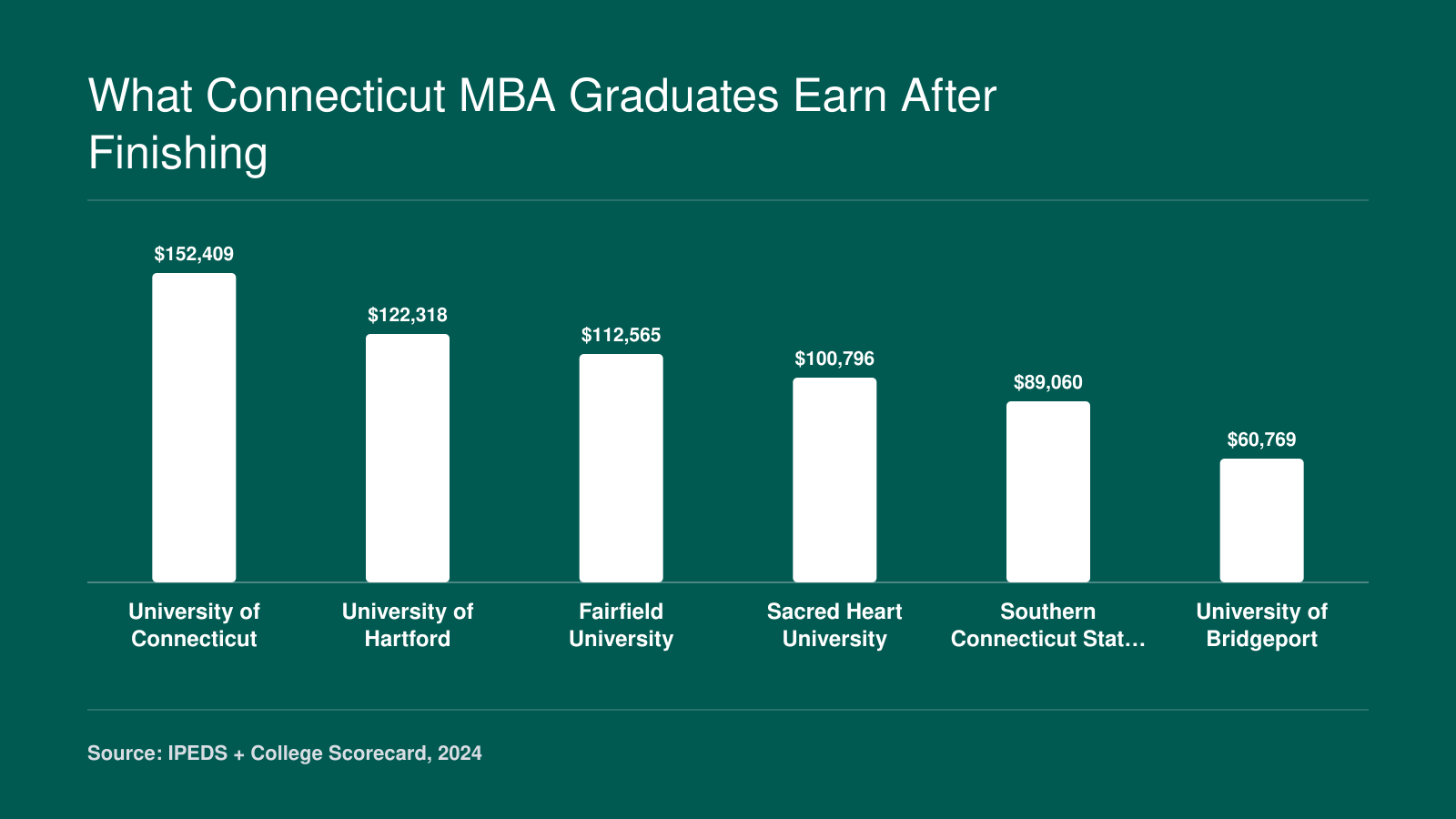
What Connecticut MBA Graduates Earn After Finishing
Median MBA earnings among the programs here with published figures range from $60,769 to $152,409. UConn and Hartford report $152,409 and $122,318 five years after finishing, Fairfield and Sacred Heart report $112,565 and $100,796 four years after finishing, and Southern Connecticut State and Bridgeport report $89,060 and $60,769 five years after finishing. The gap matters for return on investment: compare these earnings against each school's tuition and net price above to see where higher cost translates into meaningfully higher pay.
Frequently Asked Questions About Connecticut MBA Programs
These are the questions prospective students ask most about Connecticut MBA programs, from deadlines to accreditation and test waivers. Answers are concise and grounded in current admissions information.
What is the best general MBA program in Connecticut?
Which Connecticut MBA programs are AACSB accredited?
When are application deadlines for Connecticut MBA programs?
What do I need to apply to an MBA in Connecticut?
Compare General Business programs on the data that matters
Explore more MBA specializations or browse every graduate field.
All MBA programs