Best MBA in Finance Programs
Compare 510+ accredited MBA in Finance programs at 410+ schools, with graduate earnings, cost, debt, and completion data from IPEDS and the U.S. College Scorecard.

A finance MBA can cost more than most graduates will borrow for anything but a house. Annual tuition at Penn and Northwestern tops $68,000, while Florida lists $26,473 for its entire program. Prestige-only lists skip that gap, and they say little about what graduates earn or owe afterward.
This list weighs earnings, debt, and net price from federal College Scorecard data instead of brand reputation.
Name recognition still carries weight in bank recruiting, but it is priced into the tuition. The premium only pays off when the debt stays manageable against a realistic first-year offer.
Key Points
- The ROI ratio divides median earnings 10 years after enrollment by median graduate debt.
- Program-level finance MBA earnings and debt are not yet published in federal data.
- STEM-designated MBAs can give international students up to 36 months of U.S. work authorization.
Best MBA in Finance Programs Ranked for Value
Each school below earned its spot on what graduates take home and what they owe, not on brand recognition. The list favors programs where published early-career earnings, affordability, and career-relevant finance training line up. Use the cards to compare delivery format, cost, and published outcomes side by side.
University of Florida
#1Gainesville, FL · ~$13,000/yr (est.)
Best for: Budget-conscious finance students
The University of Florida pairs a Full-Time MBA Finance concentration with hands-on data and AI training, and its published early-career median earnings are $116,367 one year after completion. In-state students can enter at a much lower net price than most nationally ranked MBAs, which makes the program a standout value pick. Multiple completion tracks from 10 to 22 months let students align timing with career moves.
- Finance concentration within Warrington College of Business
- 10, 12, and 22 month completion tracks available
- 48 total credit hours; full-time enrollment
- Admission requires two years of work experience and GMAT or GRE
- 87% job placement rate after graduation
- $124,783 average base salary for full-time MBA graduates
- Hands-on data and AI training; global immersion experience
Northwestern University
#2Evanston, IL · ~$55,000/yr (est.)
Best for: Career switchers seeking elite network
Northwestern's Kellogg School offers a two-year campus MBA with a Finance concentration built around corporate finance, capital markets, and experiential coursework. Students complete at least four finance course credits and can pursue course waivers for accelerated study. The program's three annual application deadlines and financial aid options give applicants structured entry points.
- Two-year, full-time campus program
- Complete at least four finance course credits
- Courses draw from corporate finance and capital markets
- Experiential learning beyond the classroom
- Three annual application deadlines
- Financial aid available through Kellogg
- Course waivers for accelerated study
University of Pennsylvania
#3Philadelphia, PA · ~$48,000/yr (est.)
Best for: Quantitative finance candidates targeting CFO roles
The University of Pennsylvania's Wharton School offers a STEM-certified MBA with Finance and Quantitative Finance majors. Published median earnings one year after completion are $216,287, and four-year earnings climb to $316,195, making the early-career payoff a central value argument. Core courses in corporate finance and macroeconomics anchor a curriculum aimed at investment banking, asset management, consulting, and CFO roles.
- Choose Finance or Quantitative Finance major
- STEM-certified MBA program
- No thesis or capstone requirement
- Core courses include corporate finance and macroeconomics
- Prepares for investment banking, asset management, consulting, and CFO roles
- Extensive elective course variety
The University of Texas at Austin
#4Austin, TX · ~$12,000/yr (est.)
The University of Texas at Austin's McCombs School runs a two-year campus Full-Time MBA with a Finance concentration and optional STEM designation. Finance roles account for about 40% of job offers, and published median earnings four years after completion are $128,956. Live-learning assets like the MBA Investment Fund and Venture Fellows program give students hands-on exposure to private equity, energy finance, and real estate.
- Two-year, full-time campus program
- STEM designation available
- AACSB-accredited business school
- Finance roles represent about 40% of job offers
- MBA Investment Fund and Venture Fellows participation
- Career paths in investment banking, private equity, energy finance, real estate
- GMAT required for admission
Bentley University
#5Waltham, MA · ~$47,000/yr (est.)
Bentley University offers an MBA with a Finance concentration in a hybrid format that suits full-time and part-time students. Published median earnings one year after completion are $76,511 and rise to $131,993 four years after completion, with median program debt of $20,500 in the available data. The curriculum emphasizes corporate finance, financial markets, and risk-return trade-offs in a global economy.
- Hybrid format with full-time and part-time options
- Finance concentration is one of five available
- Required courses in Corporate Finance and Investments
- Focus on corporate finance, financial markets, and risk-return trade-offs
- Median program debt of $20,500
University of Wisconsin-Madison
#6Madison, WI · ~$12,000/yr (est.)
The University of Wisconsin-Madison offers an MBA in Corporate Finance & Investment Banking with three career paths: Strategic Corporate Finance, Investment Banking, and Entrepreneurial Finance. Published median earnings one year after completion are $122,802, and the school reports 84% of graduates receive job offers within three months. Consulting projects, a Bloomberg Terminal lab, and a high staff-to-student ratio support the school's applied finance focus.
- Concentration track: Strategic Corporate Finance
- Three career pathways in Corporate Finance and Investment Banking
- 84% of graduates receive offers within three months
- Applied consulting projects with real companies
- Bloomberg Terminal, Capital IQ, and FactSet access
- Mentorship from finance experts and advisory board
- Concentration track: Investment Banking
- M&A, business valuation, and corporate finance theory courses
- Investment banking course plus fixed income or derivatives electives
- Project management, corporate governance, negotiations, real estate finance electives
- Finance and Analytics Lab access
- Career support and applied consulting projects
- Concentration track: New Venture Finance
- Entrepreneurial finance pathway
- Business valuation and corporate finance theory
- Venture-focused electives and experiential projects
- Mentorship from finance experts
- Access to Bloomberg Terminal, Capital IQ, and FactSet
Washington University in St Louis
#7St. Louis, MO · ~$65,000/yr (est.)
Washington University in St. Louis offers a two-year Full-Time MBA with a Finance concentration and a STEM degree option. Published median earnings four years after completion are $165,087, and Olin's small cohort supports individualized career coaching. The program ranks highly for entrepreneurship and Fortune 1000 C-suite outcomes, adding a leadership lens to the finance curriculum.
- Two-year, full-time campus program with fall start
- Finance is one of 12 MBA specializations
- STEM degree option available
- Average compensation of $151,965 salary plus bonus
- #1 MBA for entrepreneurship and #10 for Fortune 1000 C-suite executives
- Dual degree programs with other WashU graduate programs
- 53% women and 34% underrepresented students of color in incoming class
Brigham Young University
#8Provo, UT · $5,000 – $10,000/yr (est.)
Brigham Young University's Marriott School offers a campus MBA Finance track with a focus on corporate finance, financial institutions, and real estate finance. The low tuition and net price make it an affordability standout, with a finance track focused on corporate finance, financial institutions, and real estate finance. Students can tailor electives toward financial analyst, investment banker, or portfolio manager roles.
- Finance track with five concentration options
- Emphasis on corporate finance and real estate finance
- Prepares for financial analyst, investment banker, and portfolio manager roles
- Finance electives aligned to career goals
- Joint degrees and experiential learning available
- GMAT test waiver available
Lehigh University
#9Bethlehem, PA · ~$29,000/yr (est.)
Lehigh University offers two finance-focused MBA routes: a 13-month 1-MBA with a Financial Management concentration and a part-time FLEX MBA with a Finance concentration, both in hybrid formats. The 1-MBA emphasizes corporate finance and entrepreneurial insights, while the FLEX MBA allows on-campus or online coursework with required investments and financial management courses. The accelerated timeline is the main draw for professionals wanting to return to the workforce quickly.
- 13-month full-time MBA program
- 12 total concentration credits
- Summer internship option available
- Covers corporate finance and entrepreneurial perspectives
- Synchronous online summer courses
- Part-time FLEX MBA with Finance concentration
- 12 credits required for concentration
- On-campus and online course options
- Required Financial Management and Investments courses
- Electives include Advanced Topics, Financial Markets, International Finance
University of South Florida
#10Tampa, FL · ~$10,000/yr (est.)
The University of South Florida offers an online MBA with a Finance concentration in an asynchronous format that fits working professionals. Full-time students can finish in 12 to 24 months, and foundation and core courses are priced per credit with a total program tuition range published by the school. The finance concentration pairs analytics and ethics with elective flexibility for students targeting leadership roles.
- Asynchronous online MBA with Finance concentration
- Full-time completion in 12 to 24 months
- Part-time option available
- Two start dates per year, fall and spring
- Nine concentration options including finance
- Foundation courses $497 per credit; core and capstone $750
- Total tuition $24,750 to $32,702
Cost & outcomes by school
Federal data for the highest-earning Finance programs, independent of the ranking above. Earnings are this field's master's graduates four years after completing, where the Scorecard reports them.
| School | Earnings | Tuition / yr | Debt | Grads/yr | Format |
|---|---|---|---|---|---|
| University of Pennsylvania PA | $316,195 | $47,844 | $41,000 | 2 | Campus |
| Albright College PA | — | $1,540 | — | — | Online |
| Columbia Southern University AL | — | $3,936 | — | — | Online |
| Fort Hays State University KS | — | $4,949 | — | — | Online or campus |
| Park University MO | — | $4,783 | — | — | Hybrid |
| Southeastern Oklahoma State University OK | — | $5,220 | — | — | Online |
| Hartwick College NY | — | $5,400 | — | — | Hybrid |
| Adams State University CO | — | $5,898 | — | — | Online |
| University of the Potomac-Washington DC Campus DC | — | $5,850 | — | — | Hybrid |
| University of the Potomac-VA Campus VA | — | $5,850 | — | — | Hybrid |
| Fitchburg State University MA | — | $6,246 | — | — | Online |
| Texas A&M University-Texarkana TX | — | $6,036 | — | — | Hybrid |
Sources: U.S. Department of Education. Tuition and graduates: IPEDS. Earnings and debt: College Scorecard, this field's master's graduates; a dash means no figure is reported.
Cost, debt & payoff
Median earnings of this field's master's graduates (4 yrs after completing) vs. their median federal loan debt · U.S. College Scorecard
Across these programs the median graduate earns about $116,094 and finishes with roughly $39,000 in debt — a ratio that clears a common rule of thumb (keep debt below first-year salary). Tuition and debt vary widely school to school, so check the per-school figures in the table above before you shortlist.
How We Rank Finance MBA Schools: Earnings, Debt, and ROI
A value ranking asks a narrow, measurable question: what do graduates of this specific program actually earn, and how much did they borrow to get there? Every program on this list is scored on federal data tied to the degree itself, not to the university's overall brand.
The inputs
- Graduate earnings: Median pay reported for program completers in the years immediately after they finish, typically one to five years out.
- Debt at completion: The median federal loan balance carried by borrowers who finished the program.
- Net price: What students actually pay after grants and scholarships, rather than the sticker tuition number that often headlines affordable MBA programs lists.
- Earnings against debt: A simple ratio comparing what graduates make to what they owe, which is the clearest proxy for whether the degree pays for itself.
Why this differs from prestige lists
Most national Best MBA Programs rankings lean on peer reputation surveys, GMAT averages, and selectivity. Those measure who gets in, not what happens after. An outcomes lens tends to elevate public universities with strong regional placement and modest debt loads, schools that rarely crack reputation-driven top tens.
What the data cannot tell you
Federal reporting gives medians only, and it covers students who borrowed federal loans, so high earners funded by employers or savings can be underrepresented. It also does not separate investment banking from corporate finance placement, which is why the career discussion here draws on school employment reports. Graduation rates and net price cover the whole institution, not an individual MBA student.
Finance MBA ROI Leaders: Earnings Against Debt
These three schools lead on an institution-wide ROI ratio, which divides 10-year median earnings by median graduate debt across all graduates. Treat that ratio as a school-level signal, not a finance MBA payback figure. Program-level columns use the 1-year earnings window and debt at evaluation where reported, and a payment near $466 shows how a low monthly loan bill can shift the math for career switchers.
| School | Institution-wide 10-yr median earnings | Institution-wide median graduate debt | ROI ratio (10-yr earnings / debt) | Program 1-yr median earnings | Program median debt at evaluation | Program 10-yr monthly payment |
|---|---|---|---|---|---|---|
| University of Pennsylvania | $111,371 | $15,715 | 7.09 | $216,287 | $41,000 | $466 |
| Brigham Young University | $75,790 | $11,069 | 6.85 | N/A | N/A | N/A |
| Northwestern University | $89,363 | $15,000 | 5.96 | N/A | N/A | N/A |
Related Articles
Finance MBA Career Outcomes: Investment Banking, Asset Management, and Corporate Finance
Investment banking and corporate finance are both "finance jobs," but they recruit on completely different timelines, from different schools, and at very different pay levels. Knowing which one you're aiming at should shape where you apply.
What the employment reports actually show
The clearest recent picture comes from Wharton's Class of 2025, where 14.2% of graduates took investment banking or brokerage roles at a median base salary of $175,000, and 13.4% went into private equity, buyouts, and related roles at a median base of $200,000. Investment management drew a much smaller slice, 5.3%, also at a $175,000 median base, and that share has bounced between roughly 4% and 6% over the prior several classes, so buy-side seats stay scarce year to year.
Chicago Booth's Class of 2025 reported a $175,000 median base in investment banking paired with a $50,000 median signing bonus, $185,000 in private equity, and $172,500 plus a $35,000 bonus in investment management. Columbia Business School and NYU Stern both posted a $175,000 overall median base for the Class of 2025; Stern's reported average total compensation reached $202,705 once bonuses are counted. Columbia's 2024 industry-level breakdown shows private equity at 5.2% (median base $165,000) and investment management at 6.0% ($160,000).
Banking recruiting starts almost immediately
Full-time associate offers at banks overwhelmingly come from the summer associate internship, and that internship is recruited in the first year. In practice, networking, coffee chats, and technical prep begin within weeks of your first semester. If you arrive without a clear banking plan, you are already behind the students who did.
Geography, networks, and the corporate finance alternative
Proximity matters. Programs in or near New York, Chicago, Boston, and Charlotte make it far easier to attend bank events, interview on short notice, and tap alumni who sit on the desks doing the hiring. Buy-side roles lean even harder on those networks.
Corporate finance works differently. FP&A, treasury, and corporate development teams recruit from a much broader set of schools, including strong public programs with modest tuition. Pay starts lower than banking, but so does the debt, and the ROI math often lands in favor of the cheaper degree.
What Banks Pay New MBA Associates
Investment banking remains one of the highest-paying destinations for finance MBAs.
Online vs. Campus Finance MBA Programs: Which Format Fits Your Goals?
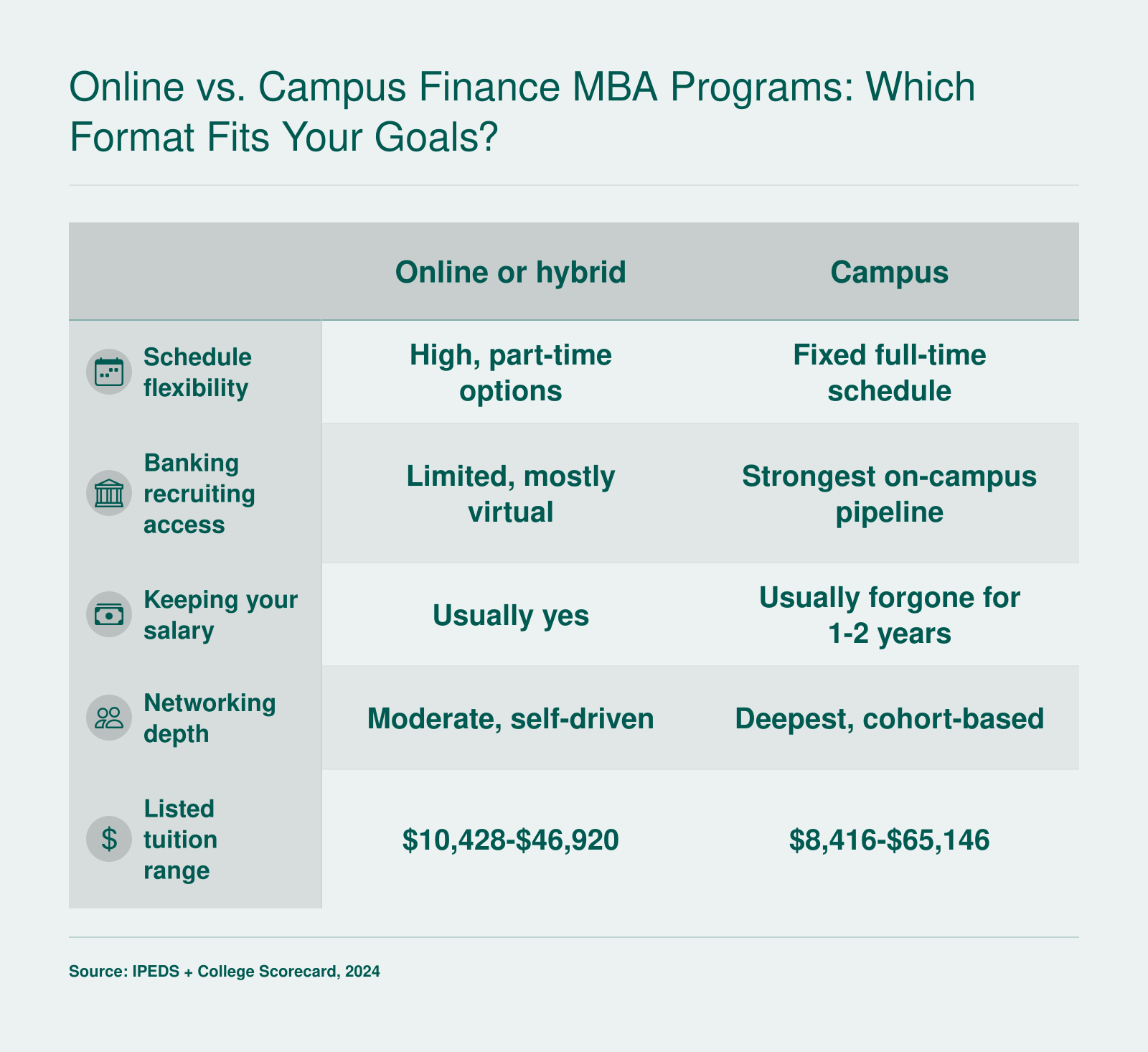
Most of the programs ranked here are campus-based, and a few offer hybrid or flexible formats, so none of them is a pure online-only option. Online and hybrid formats suit working professionals targeting corporate finance or a promotion. Campus programs suit career switchers aiming for investment banking.
Net Price, Debt, and Scholarships: Paying for a Finance MBA
The gap between a business school's sticker price and what a finance MBA student actually pays has become one of the most important numbers in the decision. Program-level median federal debt at completion is not yet reported for the finance MBA programs ranked here, so published tuition and aid are the most reliable guides for now.
Tuition Versus Net Price
Published graduate tuition is the rate the business school charges. Among the schools here, it runs from $6,693 in-state at Florida Atlantic University to $65,146 at Washington University in St. Louis. Public schools split the rate by residency: the University of Florida lists $12,737 in-state and $30,130 out-of-state. The institution-wide net price is something else: an average across the whole university, after grants, and it does not describe what an MBA student will pay. Northwestern's institution-wide average net price is $29,167, against Kellogg's $54,655 tuition. Budget from the program's own tuition, then subtract the aid you actually win.
Where the Scholarship Money Is
- Merit awards: These are based on GMAT or GRE scores, GPA, leadership, and professional achievement. Boston College's Carroll School awards $7,500 up to full tuition.
- Need-based aid: About half of Harvard Business School students receive need-based scholarships of $2,000 to $87,000 per year. These are gifts that are not repaid.
- Finance-specific fellowships: Berkeley Haas offers the C & J White Fellowship for students pursuing investment banking or finance. NYU Stern's Dean's Scholarship goes to a limited number of top admits. The Government Finance Officers Association offers awards of roughly $5,000 to $30,000.
- Diversity fellowships: The Consortium grants 30 merit-based fellowships each year, worth up to $90,000. Forté Foundation fellowships support women and run up to $15,000 per academic year.
- Employer sponsorship: If you plan to return to your current firm, ask whether it will cover part of tuition before you apply.
Negotiate Your Offer
Merit aid is often negotiable. If a peer school offers you more, share that letter with your first-choice program and ask politely whether it can revisit your award. The worst answer is no.
International students on F-1 visas who graduate from a STEM-designated degree can apply for a 24-month STEM OPT extension on top of the initial 12 months, allowing up to 36 months of U.S. work authorization. Many business schools have reclassified MBA or finance tracks as STEM, but eligibility depends on the official program code listed on your I-20 appearing on the DHS STEM Designated Degree Program List, not on the concentration's name. Verify with USCIS or the DHS Study in the States site before enrolling.
Finance programs by state
Finance MBA Questions Worth Settling Early
Three questions come up most often when applicants weigh a finance MBA against other options. The answers below reflect how programs generally work, though admissions rules and employer attitudes vary by school and industry.
Do I need a finance background to get an MBA in finance?
What is the difference between an MBA in finance and a master's in finance?
Do employers value an online finance MBA as much as a full-time one?
Compare Finance programs on the data that matters
Explore more MBA specializations or browse every graduate field.
All MBA programs