Best MBA in Finance Programs in Arkansas
Compare 4 accredited MBA in Finance programs in Arkansas, with graduate earnings, cost, debt, and completion data from IPEDS and the U.S. College Scorecard.

Arkansas State University prices its online finance-focused MBA at $17,292 for the full 33 credits, while Strayer University charges $3,045 per course across 12 courses. That gap matters in a state where retail, logistics, and banking employers anchor demand for finance talent.
Campus, hybrid, and online masters programs in arkansas are ranked together here, and because the field is small, each one gets a close look.
With so few options, differences in format, accreditation, and cost among Most Affordable MBA in Finance Programs show up fast.
Key Points
- University of Arkansas waives GMAT/GRE for work experience or strong grades.
- Online and hybrid finance MBA options are available across these schools.
- Federal earnings, net price, completion, and debt data order this ranking.
Arkansas MBA in Finance Programs Ranked
This list brings together campus, hybrid, and online finance-focused MBA options in Arkansas and highlights the practical strengths of each program. It is meant to help you compare career focus and value without getting distracted by name recognition.
University of Arkansas
#1Fayetteville, AR · ~$12,000/yr (est.)
Best for: Retail and supply chain professionals
The Walton MBA at the University of Arkansas offers a Financial Management Career Track through the Department of Finance. It centers on retail, supply chain, and consumer products industries while grounding students in financial theory and management. The AACSB-accredited Walton College emphasizes strategies that create value for consumers and shareholders.
- Financial Management Career Track within the Walton MBA
- Emphasizes retail, supply chain, and consumer products industries
- Covers fundamental financial theory and management
- Develops strategies for consumer and shareholder value
Arkansas State University
#2Jonesboro, AR · $7,000 – $13,000/yr (est.)
Best for: Working professionals balancing full-time employment
Arkansas State University's fully online MBA includes a Financial Planning and Analysis concentration. The AACSB-accredited program uses 7-week courses and can be completed in as few as 12 months, with five start dates per year. It is designed for working professionals and emphasizes budgeting, forecasting, and financial decision-making through a capstone.
- 100% online format with asynchronous classes
- 33 credit hours, 11 total courses
- Can complete in as few as 12 months
- 7-week course terms with five start dates per year
- No GRE required for admission
- Same tuition for all U.S. residents
- Prepares for financial manager, analyst, and CFO roles
- AACSB-accredited business school
University of Central Arkansas
#3Conway, AR · $5,000 – $10,000/yr (est.)
Best for: Aspiring financial analysts and CFOs
The University of Central Arkansas offers a Finance MBA that combines a 21-hour MBA core with three finance electives. Students study bank management, investments, international finance, derivatives, and entrepreneurial finance. The AACSB-accredited program also offers a Data Analytics graduate certificate alongside the degree.
- 30 total credit hours
- 21-hour MBA core plus three finance electives
- Courses in bank management and investments
- International finance and derivatives coursework
- Optional graduate certificate in Data Analytics
- Prepares for CFO, financial analyst, and controller roles
Strayer University-Arkansas
#4Little Rock, AR · $15,000 – $20,000/yr (est.)
Strayer University-Arkansas offers an online MBA in Finance that emphasizes international finance, advanced corporate finance, and corporate investment analysis. The 12-course program is built for working adults and includes asset pricing, portfolio management, and risk evaluation. Students can transfer up to four classes and receive one-on-one academic coaching.
- 12 total courses, fully online option
- Covers international finance and corporate finance
- Corporate investment analysis and risk evaluation
- Asset pricing and portfolio management coursework
- Transfer up to four eligible classes
- One-on-one academic coaches and career planning services
- Middle States accredited institution
Cost & outcomes by school
Federal data for the highest-earning Finance programs, independent of the ranking above. Earnings are this field's master's graduates four years after completing, where the Scorecard reports them.
| School | Earnings | Tuition / yr | Debt | Grads/yr | Format |
|---|---|---|---|---|---|
| Arkansas State University AR | — | $7,322 | — | — | Online |
| University of Central Arkansas AR | — | $7,446 | — | — | Hybrid |
| Strayer University-Arkansas AR | — | $15,135 | — | — | Online |
| University of Arkansas AR | — | $12,470 | — | 21 | Campus |
Sources: U.S. Department of Education. Tuition and graduates: IPEDS. Earnings and debt: College Scorecard, this field's master's graduates; a dash means no figure is reported.
How We Rank These MBA in Finance Programs
Which Arkansas MBA in finance actually pays off for graduates? We order the MBA programs below using federal data from the College Scorecard and IPEDS: net price, completion, and, where the government publishes them, program-level earnings and debt for graduates. Reputation surveys and advertising play no part.
Two caveats shape how to read the results. Graduation rates and net price are reported for the whole institution, so they describe the school rather than its MBA cohort. Program-level earnings come from federal releases, and not every program has published figures. When a program's earnings are not reported, that gap does not count against it. The school is judged on the cost and completion data that does exist.
Arkansas MBA in Finance Programs at a Glance
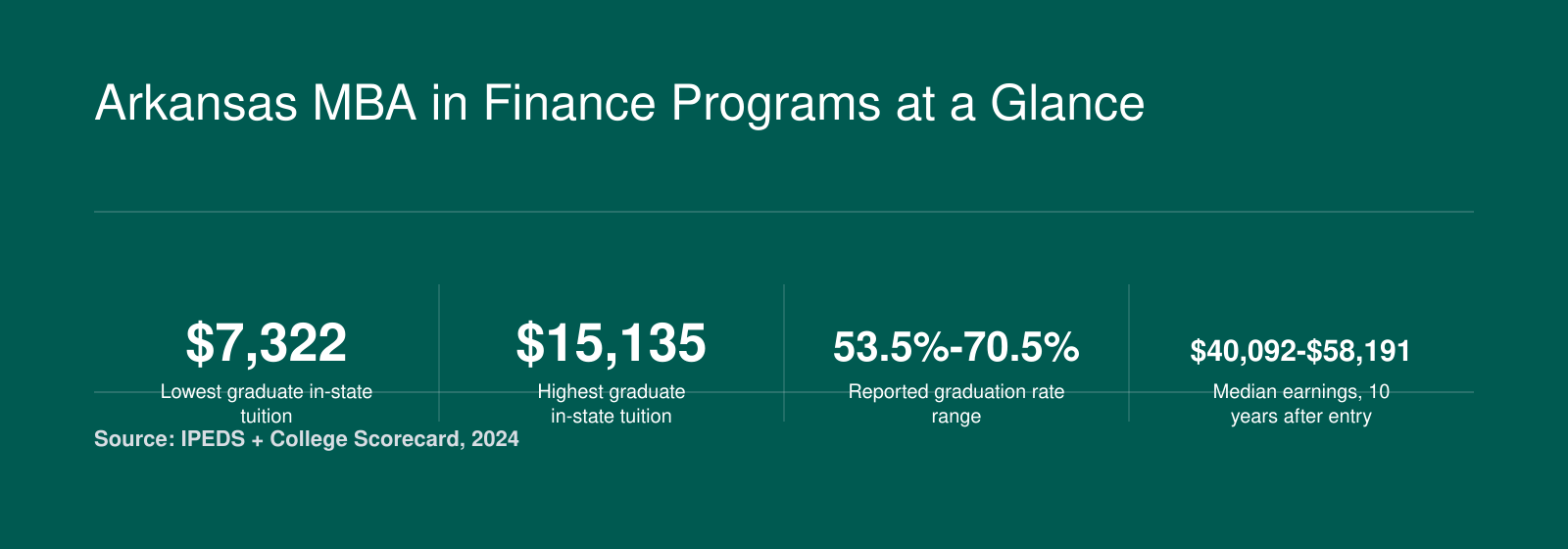
Tuition varies widely across the ranked Arkansas MBA in Finance programs, and most distance-friendly formats are available. The figures below show the price spread, completion risk, and later earnings range, so you can weigh cost against likely payoff.
Online and Hybrid MBA in Finance Options in Arkansas
Online and hybrid MBA formats let you earn a finance credential without moving to a campus full-time, and the MBA programs in Arkansas span several of those formats. The University of Arkansas runs its Finance concentration as a full-time, on-campus MBA: 38 credits over one year, August to June. Its Executive MBA Finance track is also 38 credits but runs two years, part-time, with mostly online coursework and an in-person Saturday about once a month.
Arkansas State University is the fully online MBA in finance route. Its Financial Planning & Analysis concentration is 33 credits taught in 7-week asynchronous courses, finishable in as few as 12 months. Its published tuition is the same for all U.S. residents, so out-of-state applicants pay no premium. The University of Central Arkansas requires a 21-credit core plus three finance electives and offers online, daytime and evening classes. Completion typically takes 12 to 18 months, and nine credits counts as full-time. Strayer University-Arkansas offers a fully online finance MBA of 12 courses at $3,045 per course.
Full-time career switchers fit Fayetteville's one-year format best. Working Arkansas finance professionals will likely prefer the University of Arkansas Executive MBA track, evening classes at Central Arkansas, or the online pace at Arkansas State.
Related Articles
Which Arkansas MBA Programs Waive the GMAT and GRE
Among the schools ranked here, University of Arkansas and University of Central Arkansas publish the most flexible test policies for working professionals. University of Arkansas waives the GMAT or GRE for applicants with documented post-bachelor's work experience or strong grades, and its Executive MBA does not require a test. University of Central Arkansas offers several exemptions, including advanced degrees, qualifying GPA, and CPA completion.
| School | GMAT/GRE Policy | Waiver Criteria | Other Key Requirements |
|---|---|---|---|
| University of Arkansas | Required for full-time MBA, but may be waived; not required for Executive MBA | Full-time MBA: 2+ years of post-bachelor's professional work experience or 3.2 cumulative or last-60-credit-hour GPA from a regionally accredited U.S. institution. Executive MBA: no test requirement. | Prior full-time professional experience receives priority consideration. |
| University of Central Arkansas | Generally required, but may be exempt under listed criteria | Terminal degree such as PhD, MD, JD, DDS, or EdD; master's degree; bachelor's degree in business with 3.2+ GPA in last 60 hours; bachelor's degree with 3.2+ GPA plus completion of four prerequisite courses; or passed all parts of the CPA exam. | Bachelor's degree from an accredited institution, written statement of intent, current resume, and two letters of recommendation. |
Arkansas MBA in Finance FAQs
What is the best MBA in Finance program in Arkansas?
Which Arkansas MBA programs are AACSB accredited?
Can I pursue the CFA designation while earning an MBA in Finance?
Is a finance concentration different from a standalone MS in Finance?
Compare Finance programs on the data that matters
Explore more MBA specializations or browse every graduate field.
All MBA programs