Best School Counseling Master's Programs in California
Compare 41 accredited School Counseling programs in California at 33 schools, with graduate earnings, cost, debt, and completion data from IPEDS and the U.S. College Scorecard.

In-state graduate tuition for the California school counseling master's programs ranked here runs from about $7,100 at CSU campuses to $49,500 at private universities, yet all lead to the same credential. Public K-12 counselor jobs require a master's plus the Pupil Personnel Services (PPS) credential.
Campus, hybrid, and online programs are ranked together because the PPS credential is the same whichever format earns it.
What no format removes is supervised fieldwork inside a K-12 school, so online students still spend school-day hours on site.
Key Points
- The PPS credential needs 48 semester units, not CACREP accreditation.
- CSU tuition runs roughly $7,100 to $8,700 a year, below private rates.
- USC Rossier neither requires nor accepts GRE scores for school counseling applicants.
California's 10 Best Master's Programs for Future School Counselors
Each program below earned its spot by balancing what you'll pay, how often students finish, and how flexibly you can study. Net price is an institution-wide average after aid, and graduation rates are the school's overall rate, not a program completion rate. Program-level earnings come from federal data and are labeled with their time window; where a figure is not reported, we leave it out.
University of Southern California
#1Los Angeles, CA · ~$72,000/yr (est.)
Best for: Online learners seeking a California credential
USC offers its Master of Education in School Counseling fully online, with full-time (20 to 21 months) and part-time tracks and January or August starts. The school's overall graduation rate is about 92%, and graduates of the program earned a median of $52,999 one year after finishing. Listed graduate tuition is $69,904, and the institution-wide average net price after aid is $32,740, so scholarships of $15,000 to $30,000 matter here. Fieldwork pairs a 100-hour practicum with a 700-hour internship, and placement specialists help students find California sites.
- Delivered online, 49 credit hours
- Full-time in 20 to 21 months, or part-time in about 33
- 100-hour practicum plus 700-hour internship
- Starts in January and August
- Scholarships from $15,000 to $30,000, considered automatically
- Curriculum covers trauma, restorative justice, and college readiness
- Placement specialists help locate practicum and internship sites
San Jose State University
#2San Jose, CA · ~$10,000/yr (est.)
Best for: Part-time campus learners balancing work
San Jose State's campus-based MA in K-12 School Counseling is built around California's PPS-SC credential and runs five semesters at 60 units, with plans of study adaptable for part-time students. In-state graduate tuition is about $7,608 plus fees, the institution-wide average net price after aid is $13,760, and the school's overall graduation rate is about 69%. Program-level earnings are not yet reported.
- Campus format, 60 total credit hours
- Five semesters at four classes per semester
- Full-time and part-time options
- Practicum plus three supervised fieldwork courses
- MA paper (Plan A or B) required
- Credential programs are CTC-accredited
- Optional preparation for Child Welfare and Attendance Authorization
San Diego State University
#3San Diego, CA · ~$10,000/yr (est.)
Best for: Full-time students ready for immersive fieldwork
San Diego State's Master of Science in School Counseling is a full-time, two-year campus program with a strong equity and social justice focus. In-state graduate tuition is about $7,608 plus fees, the institution-wide average net price after aid is $15,364, and the school's overall graduation rate is about 76%. Graduates earned a median of $52,062 one year after finishing.
- Campus format, 60-unit full-time program
- Two years, including the PPS credential
- Onsite school fieldwork 1 to 2 days per week
- Emphasis on leadership, advocacy, and systemic change
- Equity and social justice focus
California State University-Long Beach
#4Long Beach, CA · $9,000 – $19,000/yr (est.)
Cal State Long Beach teaches its M.S. in School Counseling in weeknight classes, which suits working professionals, with practicum and fieldwork during the school day. In-state graduate tuition is about $7,608 plus fees, the institution-wide average net price after aid is $10,440, and the school's overall graduation rate is about 69%. Graduates earned a median of $58,659 one year after finishing.
- Campus format with fall and spring starts
- Courses weeknights, 4 to 9:45 PM
- Practicum and fieldwork during the K-12 school day
- Thesis or comprehensive exam option
- Meets CCTC standards for the PPS credential
- Faculty advisor assigned at admission
California State University-Fresno
#5Fresno, CA · ~$9,000/yr (est.)
Fresno State's 48-unit counseling master's with a School Counseling option is one of the lower-cost routes to the PPS credential. In-state graduate tuition is about $7,608 plus fees, the institution-wide average net price after aid is $7,000, and the school's overall graduation rate is about 57%. Graduates earned a median of $46,137 one year after finishing, so weigh affordability against a lower early-career figure.
- Campus format, 48 total credit hours
- 3.0 GPA minimum and three recommendation letters
- Prerequisite courses and faculty interview required
- Certificate of Clearance required
- Practicum requires a grade of B or better
- Thesis, project, or comprehensive exam options
- Aligned with the PPS credential
Loyola Marymount University
#6Los Angeles, CA · ~$23,000/yr (est.)
Loyola Marymount offers a hybrid MA in School Counseling with weekday evening classes, three start terms a year, and no cohort requirement. Cost is the tradeoff: tuition is $1,822 per credit, and the institution-wide average net price after aid is $48,381. The school's overall graduation rate is about 79%, and graduates earned a median of $56,575 one year after finishing. It adds the Child Welfare and Attendance Authorization to PPS preparation.
- Hybrid format with some online coursework
- 51 credit hours, finished in two to three years
- 800 hours of supervised fieldwork
- Prepares for PPS credential and CWA authorization
- Starts fall, spring, and summer
- 3.0 GPA minimum and two recommendation letters
- Paying residency option for selected students
California State University-Stanislaus
#7Turlock, CA · ~$10,000/yr (est.)
Stanislaus State pairs the PPS school counseling credential with preparation for Professional Clinical Counselor licensure in a single 76-unit cohort program. In-state graduate tuition is about $7,608 plus fees, the institution-wide average net price after aid is $6,067, and the school's overall graduation rate is about 53%. Program-level earnings are not yet reported.
- Campus format, 76 total credit hours
- Dual concentration: PPS and Professional Clinical Counselor
- Cohort model, completed within three years
- Late afternoon and evening classes
- 3.0 GPA minimum and two recommendation letters
- Certificate of Clearance required
- Comprehensive exam or thesis option
California State University-Sacramento
#8Sacramento, CA · $10,000 – $20,000/yr (est.)
Sacramento State's MS in Counseling with a School Counseling concentration is the only program in this list with CACREP accreditation verified. The three-year, full-time cohort embeds the PPS credential and fieldwork in local schools. In-state graduate tuition is about $7,608 plus fees, the institution-wide average net price after aid is $9,338, and the school's overall graduation rate is about 56%. Graduates earned a median of $59,543 one year after finishing.
- Campus format, 60 credit hours over three years
- CACREP and CCTC accredited
- Embedded PPS credential preparation
- 100-hour practicum plus 800 hours of field experience
- Fall start only, cohort-based
- Work experience and 3.0 GPA required
- Meets LPCC educational requirements with one added course
California State University-San Bernardino
#9San Bernardino, CA · ~$10,000/yr (est.)
Cal State San Bernardino offers a three-year MS in Counseling with a School Counseling concentration aligned to the PPS-SC credential, with a dual option toward clinical licensure. In-state graduate tuition is about $7,608 plus fees, the institution-wide average net price after aid is $4,564, and the school's overall graduation rate is about 55%. Program-level earnings are not yet reported.
- Campus format, three-year sequence
- Three concentration options
- Prepares for the PPS School Counseling Credential
- Field training with local districts and agencies
- Emphasis on cultural responsiveness
- Paths into school, college, or clinical counseling
California State University-Los Angeles
#10Los Angeles, CA · ~$9,000/yr (est.)
Cal State LA's MS in Counseling with an option in School-Based Family Counseling is a 73-unit program that combines the Advanced Authorization in School Counseling, PPS with Child Welfare and Attendance Services, and coursework meeting MFT licensure requirements. In-state graduate tuition is about $7,608 plus fees, the institution-wide average net price after aid is $3,967, and the school's overall graduation rate is about 53%. Graduates earned a median of $67,075 one year after finishing.
- Campus format, 73 total credit hours
- Includes Advanced Authorization in School Counseling
- PPS credential with Child Welfare and Attendance Services
- Meets state MFT licensure requirements
- Family-systems orientation
- Rehabilitation Counseling option also offered in the department
Cost & outcomes by school
Federal data for the highest-earning School Counseling programs, independent of the ranking above. Earnings are this field's master's graduates four years after completing, where the Scorecard reports them.
| School | Earnings | Tuition / yr | Debt | Grads/yr | Format |
|---|---|---|---|---|---|
| Fresno Pacific University CA | $94,232 | $13,780 | — | 78 | Hybrid |
| San Francisco State University CA | $91,778 | $9,370 | $40,113 | 50 | Campus |
| Concordia University-Irvine CA | $91,553 | $8,895 | $42,448 | 128 | Online |
| California State University-Los Angeles CA | $88,659 | $8,688 | $40,301 | 85 | Campus |
| California State University-East Bay CA | $85,452 | $9,107 | $39,757 | 73 | Hybrid |
| Alliant International University-San Diego CA | $84,805 | $19,690 | $41,000 | 71 | Online |
| California State University-Dominguez Hills CA | $84,789 | $8,978 | — | 24 | Campus |
| California State University-Bakersfield CA | $82,248 | $9,611 | — | 14 | Campus |
| California Lutheran University CA | $82,204 | $22,046 | $51,250 | 60 | Campus |
| University of Redlands CA | $82,138 | $25,172 | $41,000 | 29 | Campus |
| Chapman University CA | $81,239 | $39,868 | — | 21 | Campus |
| University of Massachusetts Global CA | $81,233 | $13,680 | — | 100 | Online |
Sources: U.S. Department of Education. Tuition and graduates: IPEDS. Earnings and debt: College Scorecard, this field's master's graduates; a dash means no figure is reported.
Cost, debt & payoff
Median earnings of this field's master's graduates (4 yrs after completing) vs. their median federal loan debt · U.S. College Scorecard
Across these programs the median graduate earns about $81,200 and finishes with roughly $41,000 in debt — a ratio that clears a common rule of thumb (keep debt below first-year salary). Tuition and debt vary widely school to school, so check the per-school figures in the table above before you shortlist.
Online, Hybrid, and Campus Master's Formats Among the Ranked Schools
Campus programs offer cohort contact and set evening schedules, while online master's programs in California save the commute.
San Jose State, San Diego State, Fresno, Stanislaus, San Bernardino, and Cal State LA are campus-based. The CSULB master's in school counseling is on campus, with weeknight classes from 4 to 9:45 p.m. and fall or spring starts. Its practicum and fieldwork take place during the K-12 school day. Cal Lutheran is also in-person only, meeting one evening a week in Thousand Oaks.
LMU is hybrid, with late afternoon and evening classes. USC Rossier is online. Concordia University-Irvine runs online synchronous classes, Point Loma Nazarene is asynchronous, UMass Global is instructor-led online, and Azusa Pacific is hybrid online. Published details on required campus residencies are thin for most of these, so ask admissions directly.
No California PPS program is fully online, and every approved program requires at least 600 supervised clock hours. USC places distance students in local K-12 schools (100 practicum hours plus 700 fieldwork hours). Other programs may expect you to find a site and secure principal and district approval, so ask how placements work before you enroll.
Related Articles
Which Ranked California Schools Waive the GRE for School Counseling Master's Applicants
A GRE score can gatekeep graduate admission, but several California school counseling programs have shifted to holistic review that omits the exam.
USC Rossier's M.Ed. in School Counseling neither requires nor accepts GRE scores, and it publishes no minimum GPA to apply.1 Competitive applicants typically present a 3.0 undergraduate GPA. CSU East Bay's school counseling concentration also does not require the GRE and lists a 3.0 cumulative undergraduate GPA minimum. Its general counseling FAQ still shows a conflicting GRE requirement for the broader program, so confirm the school counseling policy with the department.
CSU San Bernardino asks for a 3.0 GPA across all previous undergraduate and graduate work but does not publish a GRE policy. Point Loma Nazarene requires a 3.0 cumulative GPA, with exceptions for lower GPAs, and does not publish a GRE policy. California Lutheran also does not publish a clear GRE policy. In place of test scores, these programs lean on GPA, interviews, recommendations, and K-12 or youth-work experience.
Master's Tuition, Net Price, and PPS Credential Costs in California
If cost is the deciding factor, California public CSU programs and private universities sit in very different price bands. Annual tuition at CSU campuses here generally runs about $7,100 to $8,700; private programs range from roughly $13,300 to $49,500 per year. Program listings show Cal State Long Beach's in-state graduate tuition around $8,900, while Cal State LA's is closer to $8,700.
Per-unit rates tell the sharper story. USC Rossier lists $2,467 per credit for a 49-credit M.Ed. and PPS program, about $120,883 base. Azusa Pacific and Fresno Pacific list roughly $815 and $800 per credit for 50-unit programs, or about $40,750 and $40,000. National University's rate is about $696 per credit, and Point Loma Nazarene's $680 per credit produces an estimated $26,520 to $34,000.
Net price after aid is approximate and institution-wide: at Cal State LA, the average is near $3,970, while Long Beach and San Francisco State report roughly $10,440 and $12,278. Where program-level debt is reported, median debt ranges from about $25,000 at Fresno State to about $40,300 at Cal State LA, with monthly 10-year payments of about $285 to $458.
PPS Credential Costs to Budget
On top of tuition, budget for the California Commission on Teacher Credentialing: the PPS School Counseling application fee is $100. Live Scan fingerprinting fees are collected by the operator, so no statewide total exists; out-of-state applicants pay a $49 fingerprint processing fee. No separate exam fee is currently established. Your university must recommend you for the credential after you finish the required 48 semester units and practicum.
California's Pupil Personnel Services Credential at a Glance
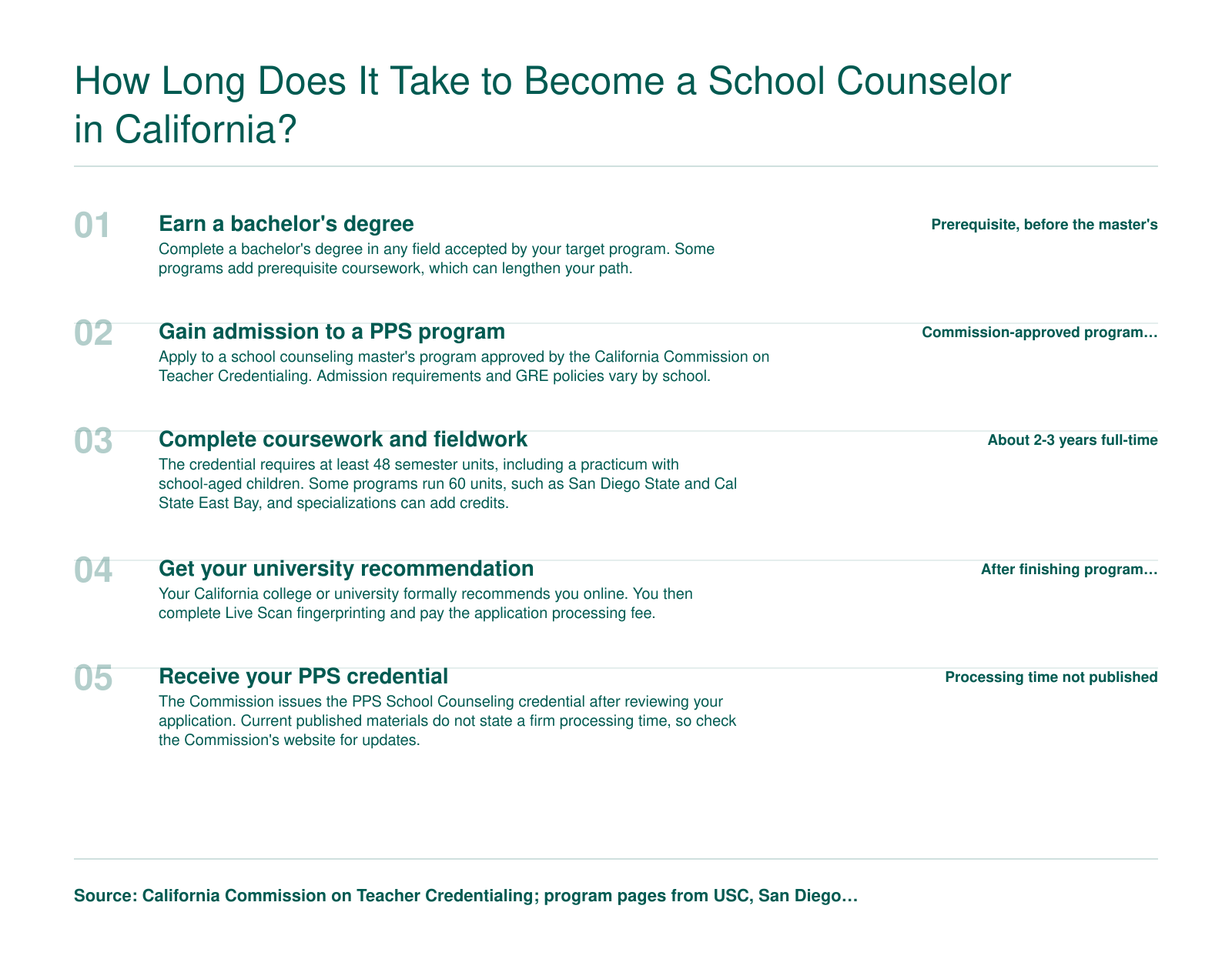
How Long Does It Take to Become a School Counselor in California?
Most California school counselors finish a PPS master's program in about 2-3 years, then wait on a credential application. Timelines shift with course load, summer enrollment, fieldwork, and any added specialization. Typical total from starting the master's to holding the PPS credential: roughly 2-3 years of study, plus the credential processing period. Part-time study usually stretches this (USC lists 2.5-3 years part-time), and the California Commission on Teacher Credentialing has not published a current processing time for initial applications.
Why CACREP Accreditation Matters When Choosing a California School Counseling Master's
CACREP accreditation is a national quality signal, but it is not a California requirement for the Pupil Personnel Services (PPS) credential. CACREP currently lists school counseling programs at California State University-Fresno, California State University-Sacramento, California State University-San Bernardino, Concordia University-Irvine, San Francisco State University, and Sonoma State University. The remaining ranked programs are not listed in the CACREP directory.
The California Commission on Teacher Credentialing (CTC) approves programs for the PPS credential, which you need to work as a school counselor in California. CACREP is optional national accreditation, valued for portability across states and for the LPCC route.
Before deciding, check three practical fit points: - Fieldwork placement support: how does the program help you secure school placements and supervision? - Cohort start terms: does the program admit once or multiple times per year? - Format match: does online, hybrid, or campus delivery align with your schedule and clinical hours?
Quick Answers Before You Compare California School Counseling Master's Programs
These short answers cover the questions applicants ask most often. Each one points to a deeper section below, where the details and caveats are laid out school by school.
How long does it take to become a school counselor in California?
How is a school counseling master's different from the PPS credential in California?
Which ranked California school counseling master's programs can be completed fully online?
Do California school counseling master's programs require the GRE?
How much does a school counseling master's cost in California?
When do ranked programs accept applications, and what prerequisites do they expect?
Compare School Counseling programs on the data that matters
Explore more Counseling specializations or browse every graduate field.
All Counseling programs