Best MBA/MD Programs
Compare 90+ accredited MBA/MD programs, with graduate earnings, cost, debt, and completion data from IPEDS and the U.S. College Scorecard.

Hospital systems now hire physicians into chief medical officer and service-line roles that assume fluency in budgets, payer contracts, and operations, none of which a standard MD curriculum teaches. The same gap shows up for doctors launching health startups or moving into policy, where an MBA in Healthcare Management helps. An MD/MBA is the formal fix, and it costs real time and tuition.
The ranked list comes first, followed by cost, admissions, and timelines. Most tracks add about one year to medical school, though the exact structure varies by program.
One caution from the start: a famous name on the diploma does not guarantee a better return on the extra year.
Key Points
- Most MD/MBA tracks run five years, with the business year placed differently by school.
- Published net price understates what MD/MBA students pay, so request both schools' cost sheets.
- Compare programs on graduate earnings and debt, not prestige, and confirm 2027 test requirements.
10 MD/MBA Dual Degree Schools for 2027
An MD/MBA is one of the most expensive paths in higher education, so the value question is not just whether a school places students into leadership roles, but whether the price lines up with later earnings. The ten programs below combine clinical training with a business curriculum, and each card pairs the program's defining strengths with the published cost and graduation context a prospective applicant would actually weigh. All ten entries are campus-based, as expected for clinical training.
Stanford University
#1Stanford, CA · $60,000 – $65,000/yr (est.)
Best for: Healthcare founders seeking venture capital fluency
Stanford interleaves five years of medical and business training across its School of Medicine and Graduate School of Business, with a heavy emphasis on health policy, finance, and strategy. The setting near Silicon Valley translates into unusually strong pathways into biotech, venture capital, and healthcare consulting for physician-executives.
- Five-year integrated curriculum across medicine and business
- Combines School of Medicine and Graduate School of Business
- Emphasizes health policy, finance, and strategy
- Strong Silicon Valley and biotech career pathways
Harvard University
#2Cambridge, MA · $55,000 – $60,000/yr (est.)
Best for: Physician-scientists pursuing policy and management
Harvard's five-year joint degree gives students three years of clinical foundations at HMS, a concentrated year of the HBS core, and a final integrated year that can include a capstone or thesis. The dual pathway is built around a required Medicine and Management course and is aimed at clinicians who plan to lead health systems, life sciences firms, or policy work.
- Entrance exams: GMAT or GRE accepted
- Five-year integrated MD-MBA curriculum
- Required Medicine and Management course
- Two admission pathways plus HBS CORe prerequisite
- Capstone thesis or scholarly project option
Georgia Institute of Technology
#3Atlanta, GA · ~$16,000/yr (est.)
Best for: Atlanta medical students needing pragmatic business skills
Georgia Tech's Scheller College offers a one-year MBA for Morehouse School of Medicine students, with 15 credits transferred from the MD curriculum to satisfy the 54-credit requirement. The program is firmly embedded in Atlanta's Tech Square, pairing applied business training with the city's healthcare and technology networks.
- MCAT accepted in place of GMAT or GRE
- 54 total credit hours; 15 credits transfer from MD coursework
- Partnership with Morehouse School of Medicine
- Located in Atlanta's Tech Square innovation district
- Complete both degrees in five years
- Leadership development course included
Yale University
#4New Haven, CT · ~$50,000/yr (est.)
Yale's five-year MBA/MD sequence places the full-time SOM year between the early clinical years and a final year of electives at both schools. An optional Healthcare Management Colloquium and a required primary care clerkship help the program develop physician managers who can bridge clinical care and organizational change.
- Optional Healthcare Management Colloquium with industry leaders
- Apply during third year of medical school
- Primary care clerkship required
- Fifth-year electives at both schools
- Five-year physician manager pathway
University of Pennsylvania
#5Philadelphia, PA · ~$48,000/yr (est.)
Penn's MD/MBA lets Perelman medical students complete a Health Care Management major at Wharton across five years, with 15 Wharton credit units plus four credits transferred from the medical school. The integrated structure includes a Wharton internship and access to PennHealthX, supporting paths into academic medicine, hospital leadership, and consulting.
- Entrance exams: GMAT or GRE
- Health Care Management major at Wharton
- Wharton fellowships and financial aid available
- Five-year integrated curriculum with internship
- Access to PennHealthX and healthcare business activities
University of Chicago
#6Chicago, IL · ~$69,000/yr (est.)
UChicago's five-year path sends Pritzker students on a year-long leave for the full-time Booth MBA between clinical years, with an optional Certificate in Health Administration and Policy through GPHAP. The Booth Healthcare Analytics Laboratory and limited Steven Weiner Fellowship support add research and tuition benefits.
- Year-long leave for full-time Booth MBA
- Optional Certificate in Health Administration and Policy
- Booth Healthcare Analytics Laboratory access
- Steven Weiner Fellowship tuition support
- Five-year completion path
Rice University
#7Houston, TX · ~$57,000/yr (est.)
Rice partners with Baylor College of Medicine for a five-year MBA/MD that concentrates on healthcare economics, organizational management, and strategic decision-making. The dual access to Rice Business and Baylor gives students a rare blend of clinical and business resources in Houston.
- Five-year program with Baylor College of Medicine
- Healthcare concentration focuses on economics and management
- Prepares for hospital and managed care leadership
Cornell University
#8Ithaca, NY · ~$30,000/yr (est.)
At Weill Cornell, medical students complete the Johnson School MBA in just 12 months during a one-year leave between the third and fourth years, with no GMAT required. The fast-paced business year emphasizes healthcare management, finance, and strategy for careers in hospitals, pharma, and biotech.
- MBA completed in just 12 months
- No GMAT required for Weill Cornell medical students
- Partnership with Johnson School of Management
- One-year leave between third and fourth years
- Emphasizes healthcare management, finance, and strategy
University of California-Los Angeles
#9Los Angeles, CA · ~$14,000/yr (est.)
UCLA's five-year MD/MBA, offered through PRIME-LA, runs the MBA year concurrently with the final medical year and keeps the cohort at about 18 students. The small-group format includes clinical shadowing during the business year and financial aid that can cover all five years, with a focus on California healthcare leadership.
- MCAT or GRE accepted
- Small cohort of about 18 students
- MBA year concurrent with final medical year
- Financial aid available across all five years
- Clinical shadowing offered during MBA year
Vanderbilt University
#10Nashville, TN · ~$58,000/yr (est.)
Vanderbilt's five-year MBA/MD pathway moves students from three years at the School of Medicine into a year at Owen, then a final year of courses at both schools. The cross-listed arrangement accepts 12 medical school credits toward the MBA and applies Owen coursework toward the MD, supporting roles in hospital management, biotech, and medical entrepreneurship.
- 50 total MBA credit hours
- First three years at School of Medicine
- 12 credits transfer from medical school to Owen
- Owen coursework counts toward MD
- Apply to Owen during third year
Cost & outcomes by school
Federal data for the highest-earning MBA/MD programs, independent of the ranking above. Earnings are this field's master's graduates four years after completing, where the Scorecard reports them.
| School | Earnings | Tuition / yr | Debt | Grads/yr | Format |
|---|---|---|---|---|---|
| The University of Texas Health Science Center at San Antonio TX | — | $4,648 | — | — | Campus |
| Florida Atlantic University FL | — | $6,693 | — | — | Campus |
| University of Nevada-Reno NV | — | $7,032 | — | — | Campus |
| Augusta University GA | — | $6,992 | — | — | Hybrid |
| University of Nevada-Las Vegas NV | — | $7,413 | — | — | Campus |
| University of South Dakota SD | — | $7,118 | — | — | Hybrid |
| Texas Tech University Health Sciences Center TX | — | $7,153 | — | — | Hybrid |
| East Carolina University NC | — | $7,658 | — | — | Hybrid |
| University of Texas Southwestern Medical Center TX | — | $8,255 | — | — | Campus |
| University of Alabama at Birmingham AL | — | $8,640 | — | — | Campus |
| University of Central Florida FL | — | $8,872 | — | — | Campus |
| University of Utah UT | — | $8,724 | — | — | Campus |
Sources: U.S. Department of Education. Tuition and graduates: IPEDS. Earnings and debt: College Scorecard, this field's master's graduates; a dash means no figure is reported.
What Drives Our MD/MBA Rankings: Federal Data Plus Accreditation Checks
Most MD/MBA lists on the web are alphabetical directories with no outcome data. An independent ranking works differently: it puts cost and results next to each other so you can see what a program asks of you and what it returns, the same comparison we make in our best MBA programs.
The Federal Inputs
The comparisons here draw on federal IPEDS and College Scorecard figures: graduate tuition, net price, and median debt, the same cost and debt measures we use when comparing affordable MBA programs. They also draw on program-level earnings where the government has published them. Program-level earnings have not been published for these MD/MBA programs, so we do not claim them. Instead, cost and debt carry more weight, and you should treat any earnings promise from a school's marketing page with caution.
AACSB Accreditation as a Quality Signal
The business-school partner matters because half your degree comes from it. AACSB accreditation is the most widely recognized quality marker for business programs, and its directory describes accredited institutions as having met rigorous standards and being committed to advancing the quality of business education. We checked the directory for the schools ranked here. Stanford2, Harvard1, Yale4, and UCLA5 are listed as AACSB accredited, with records updated in October 2026, and Penn has a directory entry as well. Duke's Fuqua School of Business is also listed as AACSB accredited, with a record updated in October 2026.3 Treat that as a gap in our evidence, not as a finding that those programs lack accreditation. Confirm it with the school before you apply.
What the Numbers Cannot Tell You
Some figures describe the whole university rather than MD/MBA students. Graduation rate and 10-year earnings are two examples. They reflect every student at the institution, including undergraduates and those in unrelated fields. Use them as context for the school's overall strength, not as a forecast of what a dual-degree physician will earn or owe.
MD/MBA Costs: Graduate Tuition, Net Price, and Median Debt
Like JD/MBA dual degree programs, an MD/MBA bill is really two bills stacked on top of each other: four years charged at medical school rates, plus a business school year that is usually priced like any other full-time MBA year. That second price tag is where applicants get surprised.
In-State Public Rates Are the Biggest Lever
Graduate tuition at the public universities here starts low. The University of Texas at Austin lists roughly $12,006 in-state against $22,954 out-of-state, and UNC Chapel Hill comes in around $12,751 in-state versus $31,408 out-of-state. UCLA ($14,476 in-state), UC Irvine ($14,827), and UC Davis ($15,141) follow a similar pattern. On the private side, the figures run far higher: the University of Chicago sits near $68,652, Johns Hopkins around $64,730, Stanford near $61,878, and Harvard roughly $57,248, with no in-state discount available anywhere. Residency status at a public school can swing the sticker price by $15,000 to $20,000 per year.
What the MBA Year Actually Adds
Published program figures make the gap concrete. Wharton's 2026-27 MBA tuition and fees run $93,008, within a standard one-year MBA budget of $135,4411; Penn places most Wharton coursework in Year 4 and the final spring of Year 5.2 Duke estimates its 2026-27 MD/MBA year at $83,700 in blended tuition plus $9,014 in fees, $850 in course materials, and $25,290 in living costs, for $118,854 over a nine-month academic year.3 Northwestern budgets $128,202 in direct costs and $168,822 including indirect expenses4, with Kellogg charging $29,708 per quarter5. Harvard bills eight semesters at medical school rates and two at business school rates, though a Year V reimbursement makes the effective split seven and three.6
Debt Figures
Federal median debt at completion is not reported at the MD/MBA program level for these schools, so institution-wide medians are the only available reference point. Treat any published total as one academic year unless the school says otherwise. No school on this list publishes a single verified five-year combined cost of attendance.
MD/MBA Admission Requirements: MCAT, GMAT or GRE, and Application Timing
Requirements differ by school, so confirm each program's current policy before you plan. The details below come from published program pages; where a school's policy could not be verified, we say so rather than guess.
- MCAT scoreMedical school admission still runs through the MCAT. Published sources do not give a reliable MD/MBA-specific MCAT range for the schools here, so use each medical school's own class profile as your benchmark. Some business schools also use the MCAT in place of a separate business exam (see below).
- GMAT or GREPolicies split. Penn's Perelman School of Medicine requires the GMAT or GRE for Wharton, and being a medical student does not waive it. Wharton sets no minimum score; its Class of 2026 MBA average was 732 on the GMAT, a general MBA figure and not an MD/MBA requirement. Minnesota Carlson waives the exam for MD/MBA students who submit the MCAT. UNC lets medical students submit scores or request a waiver based on the MCAT plus additional materials. We could not confirm 2026 policies at Harvard, Duke, Northwestern, or Stanford, so check directly.
- Application sequencingTiming is program-specific. Penn MD/MBA applicants apply in Round 1 of the third year of medical school, and no other times are accepted. For other schools, verify whether you can apply to both degrees at once through AMCAS or must apply after matriculating. Do not assume Penn's process applies elsewhere.
- GPA, letters, and statementExpect to submit transcripts, recommendations, and an essay explaining why you need both degrees. Wharton's Class of 2026 MBA average undergraduate GPA was 3.68, and a nonofficial guide puts top MBA averages around 3.5 to 3.8. These are general MBA benchmarks, not published MD/MBA cutoffs.
- InterviewsSome programs may require separate medical school and business school interviews. We did not find this confirmed for each school, so ask each admissions office what to expect.
Related Articles
Four-Year vs Five-Year MD/MBA Tracks: How the Curriculum Fits Together
A five-year MD/MBA gives the business degree its own block of time. A four-year version fits it inside the medical calendar. Most programs run five years, and only a few offer an accelerated MBA route. Among the schools here, UTHealth Houston's McGovern Medical School is the clearest example, letting students finish in either four or five years.1
How the Five-Year Model Works
The usual pattern is preclinical coursework, core clerkships, a concentrated stretch of business school, then a return for advanced clinical work. Placement of the MBA varies by school.
- Penn (Perelman/Wharton): Students complete three full-time medical years, then a full-time Wharton year in Year 4. Year 5 splits between the two schools, and most take business courses in spring so they can interview for residency.2
- Harvard: The MBA sits in Year 5, with one semester at Harvard Medical School and one at Harvard Business School. Tuition works out to seven medical semesters and three business semesters.3
- UTHealth Houston: The five-year option uses one contiguous 12-month MBA block, which leaves the traditional medical summers free for research or special projects.1
How Four-Year Programs Compress the MBA
UTHealth Houston's four-year option spreads MBA work across summers and elective time. Medical-school credits are accepted toward the MBA, so some coursework counts twice. Exact credit totals are not published there.1 Penn is the one school here that states its figure: 19 credit units, with 15 from Wharton and 4 transferred from the medical school.2
The trade-off is intensity and opportunity. Students give up summers that would otherwise go to research, internships, or rest, and they get less uninterrupted time with business classmates. A contiguous year gives you more room for networking and internships, which is why Penn builds a summer business internship into its five-year path.2
What Stays on Campus
The medical side remains campus-based and in person everywhere, because clerkships and clinical rotations require it. Business delivery can be more flexible. The new Texas McCombs MD/MBA in Houston, starting Fall 2026, is a five-year program with classes every other weekend, so students can keep up their medical training while earning the MBA.4
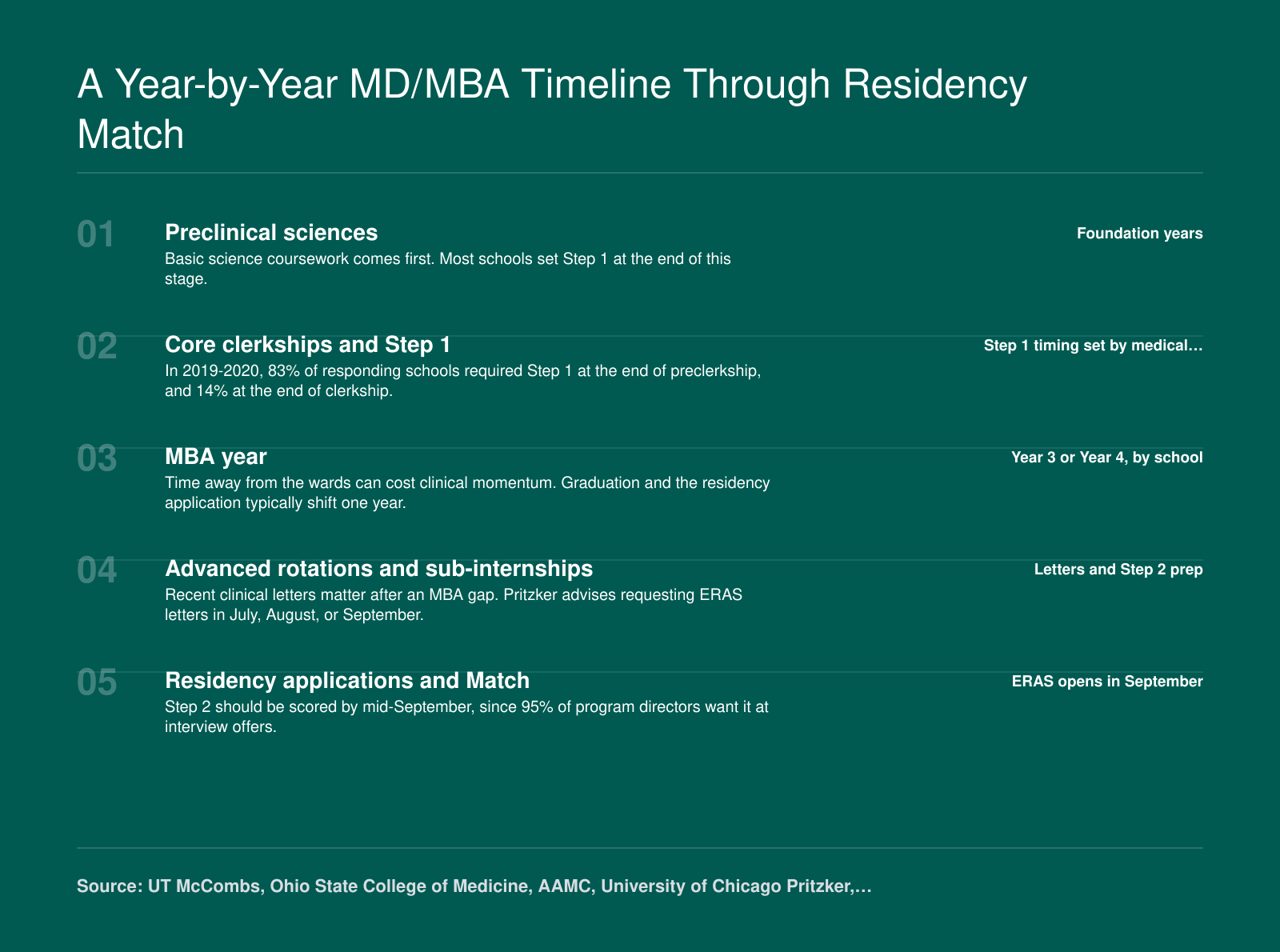
A Year-by-Year MD/MBA Timeline Through Residency Match
Most five-year MD/MBA paths follow this sequence, but program order varies by school. UT McCombs places the MBA in Year 4, while Ohio State places it in Year 3.
What Physician Executives Earn
Leadership roles pay well, though the figure below covers physician executives broadly rather than MD/MBA graduates specifically.
MBA/MD programs by state
MD/MBA Questions Applicants Ask Most
Policies vary by school, so treat these answers as patterns to verify rather than universal rules. Always confirm current deadlines and exam requirements with each program's admissions office before you apply.
Can I apply to the MD and MBA programs at the same time?
Do MD/MBA programs require the GMAT or GRE?
Which schools offer 4-year MD/MBA programs?
Can I add the MBA after I've already started medical school?
Does the extra MBA year hurt my residency application?
Compare MBA/MD programs on the data that matters
Explore more MBA specializations or browse every graduate field.
All MBA programs