Best MBA/MD Programs in North Carolina
Compare 3 accredited MBA/MD programs in North Carolina, with graduate earnings, cost, debt, and completion data from IPEDS and the U.S. College Scorecard.
Physicians who want to run hospitals, launch health ventures, or move into consulting hit the same gap: medical school teaches little finance or strategy. A joint MD/MBA fills it, usually by adding a fifth year, and only a handful of North Carolina schools offer one, on campus or in hybrid form.
The tension is time and money. The extra year delays residency, and tuition varies widely between public and private schools.
Physician-leadership hiring still weighs clinical credibility first, so the MBA works best as an added credential.
Key Points
- Duke and UNC Chapel Hill both publish a five-year MD/MBA length.
- In-state graduate tuition is about $7,658 at East Carolina University versus $12,751 at UNC Chapel Hill.
- No MD/MBA is fully online, since clinical training stays in person.
Ranked: Best MBA/MD Schools in North Carolina
North Carolina has three MD/MBA programs, and they differ sharply in cost, structure, and who they suit. All three are listed below in rank order, with institution-wide figures from federal data. The graduation rate and net price shown are for each school as a whole, not for dual-degree students.
Duke University
#1Durham, NC · ~$67,000/yr (est.)
Best for: Future biotech and health system leaders
Duke in Durham runs a five-year MD/MBA that starts with two years at the School of Medicine before moving to Fuqua School of Business. Its Management and Leadership Pathway, a rotational residency, is a distinctive feature, and the Durham location gives access to Duke Medical Center and Research Triangle Park. The school's graduation rate is 96.8%, and listed graduate tuition is about $66,325 for in-state and out-of-state students alike. Net price is an approximate institution-wide average of about $29,612, not a quote for dual-degree students.
- 5-year program earning both the MD and the MBA
- Begins with two years at the School of Medicine
- Requires a minimum of 65 graduate credits at Fuqua
- Health Sector Management concentration
- Apply to both schools independently
- Includes the Management and Leadership Pathway rotational residency
University of North Carolina at Chapel Hill
#2Chapel Hill, NC · ~$13,000/yr (est.)
Best for: North Carolina residents watching tuition
UNC-Chapel Hill offers a five-year MD/MBA with three years of medicine, a fourth year of MBA coursework at Kenan-Flagler, and a final year that blends both. As a public school, it charges in-state students about $8,994 and out-of-state students about $41,203 in listed graduate tuition. The school's graduation rate is 91.2%, and net price averages roughly $11,655 institution-wide, which is not a quote for dual-degree students. GMAT or GRE scores are required, but MCAT scores can support a waiver.
- Five-year combined MD and MBA with Kenan-Flagler
- First three years in the MD program, year four in MBA courses
- Final year blends coursework from both schools
- Apply during the second or third year of medical school
- GMAT or GRE required, with MCAT-based waiver available
East Carolina University
#3Greenville, NC · ~$8,000/yr (est.)
Best for: Residents and physicians needing flexibility
East Carolina University in Greenville offers an MD/MBA open to medical students, residents, and practicing physicians. It uses a streamlined 14-course load instead of the usual 18, focused on financial management, organizational behavior, and healthcare policy. Listed graduate tuition is about $7,361 in-state and $23,638 out-of-state, the lowest of the three. The school's graduation rate is 62.6%, and net price averages about $15,739 institution-wide, not a quote for dual-degree students.
- Hybrid delivery format
- 14 total courses instead of 18
- Open to medical students, residents, and practicing physicians
- No entrance exam required per the program listing
- GMAT waiver typically available
- Focus on financial and management practices
Cost & outcomes by school
Federal data for the highest-earning MBA/MD programs, independent of the ranking above. Earnings are this field's master's graduates four years after completing, where the Scorecard reports them.
| School | Earnings | Tuition / yr | Debt | Grads/yr | Format |
|---|---|---|---|---|---|
| East Carolina University NC | — | $7,658 | — | — | Hybrid |
| University of North Carolina at Chapel Hill NC | — | $12,751 | — | — | Campus |
| Duke University NC | — | $66,523 | — | — | Campus |
Sources: U.S. Department of Education. Tuition and graduates: IPEDS. Earnings and debt: College Scorecard, this field's master's graduates; a dash means no figure is reported.
How Long Does an MD/MBA Program Take in North Carolina?
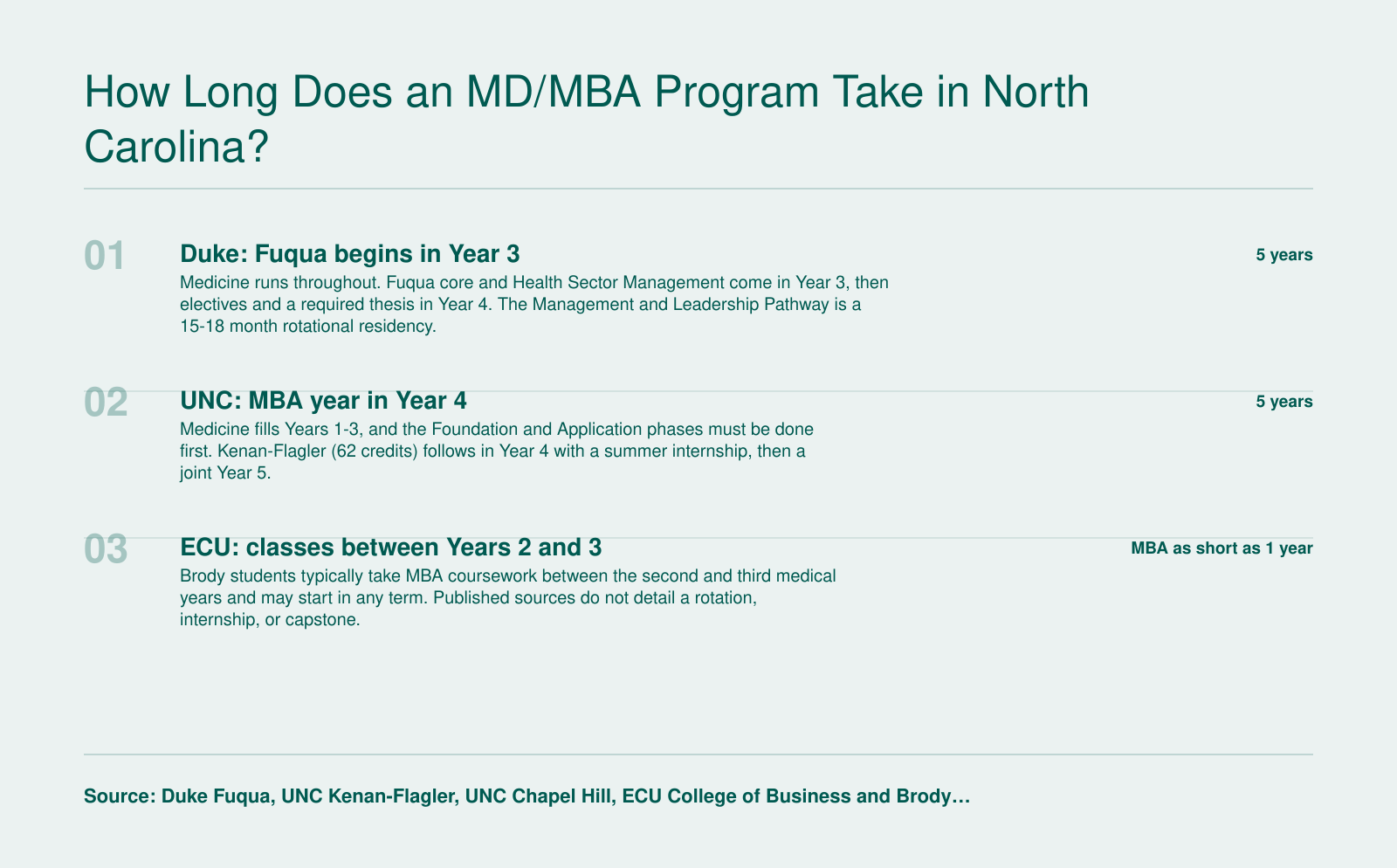
Most NC MD/MBA tracks take about five years: preclinical medicine, clinical rotations, a dedicated MBA year, then a return to finish the MD. Duke and UNC Chapel Hill both publish a five-year length, while ECU is more flexible and does not publish a single total.
Online and Hybrid MBA/MD Options in North Carolina
An online MBA/MD dual degree does not exist in any complete sense: the MD portion requires in-person clinical training at every school in North Carolina, so only the business coursework can ever move off campus.
ECU: The Clearest Flexibility
ECU's program is listed as hybrid. Its MBA materials say students can take courses on campus, online, or a mix, and can change modes each semester, with no campus visit required.1 Medical students typically complete the MBA in as little as one year between the second and third years of medical school.2 The MD/MBA page itself does not spell out whether every dual-degree student may choose any mode, so confirm that with the admissions office.
UNC and Duke: Campus-Based
UNC's MD/MBA is a five-year campus program, with MBA coursework in year four and both degrees' courses in year five. UNC also runs a separate Kenan-Flagler Online MBA, which is mostly online with two required in-person components.3 It accepts no transfer credits, and published sources do not say medical students can substitute it for the dual degree.
Duke's program is built on Fuqua's Daytime MBA, and Duke does not publish an online or hybrid option for MD/MBA students.
GMAT and GRE Waivers at North Carolina MBA/MD Schools
Do MD/MBA applicants in North Carolina need a GMAT or GRE score, or can the MCAT stand in? Unlike broad lists of No-GRE master's programs, the published policies here are thinner than you might expect, so treat the details below as a starting point and confirm with each admissions office.
Duke
Duke's Fuqua School of Business accepts the GMAT, GMAT Focus, GRE, or Executive Assessment, with no minimum score. Scores stay valid for five years and can be self-reported until admission. The MD/MBA page does not state an MCAT substitution or a test waiver. Students typically apply during the second year of medical school, and Fuqua and the medical school admit separately. Fuqua lists 2026-2027 Daytime MBA deadlines of September 2 (early action), September 30, January 5, and March 25, but does not say which round suits a second-year medical student.
UNC Chapel Hill
Kenan-Flagler's dual-degree page says the MBA requires the GRE or GMAT. Its MBA pages list GMAT/GRE waiver request dates (September 9, December 9, February 10, and April 7) but do not publish eligibility criteria or say whether the MCAT counts. MBA round deadlines for 2026-2027 are September 30, January 6, March 3, and April 21. No separate MD/MBA deadline is published.
East Carolina University
I could not find an official Brody MD/MBA page stating a testing requirement, MCAT substitution, waiver, or deadline. Ask the program directly before planning around any assumption.
Related Articles
MBA/MD Program Costs and North Carolina Employer Demand
For North Carolina residents, public or private status shapes the MD/MBA bill more than any other factor at the best business schools in North Carolina. Published graduate tuition runs about $7,658 a year in-state at East Carolina University and $52,186 at UNC Chapel Hill. Duke charges $66,523 to every student regardless of residency. Out-of-state, the public figures rise to $20,807 at ECU and $70,908 at UNC.1 That narrows the gap for ECU, but UNC's out-of-state rate now passes Duke.
Who Bills the Business Year
Duke spells out its sequence. Years one and two are charged at School of Medicine tuition, year three at Fuqua's rate, and years four and five at a blended rate drawn from both schools. Fuqua scholarships do apply during the dual-degree years, but only to the Fuqua share of the bill. Duke also resets medical tuition annually and requires eight semesters of full tuition for the MD, so plan for increases rather than a fixed price.2
UNC Chapel Hill lists 2026-27 full-time MBA tuition and fees of $113,472 for residents and $150,916 for nonresidents. Its 2025-26 MD tuition was $16,479 per semester in-state and $30,641.50 out-of-state, before fees.3 UNC does not publish which joint-degree years are billed to Medicine and which to Kenan-Flagler, or whether the full MBA total applies to dual-degree students. Ask the dual-degree office for a year-by-year estimate before you commit. ECU does not publish a joint-degree billing policy we could confirm.
Employer Demand and Earnings
North Carolina's large academic health systems and the Research Triangle's life-science and health-tech companies are logical employers for physicians moving into management and healthcare administration in North Carolina. Still, no published North Carolina data measures hiring demand or a salary premium for physicians who hold an MBA, so treat recruiter claims with caution. Program-level earnings for MD/MBA graduates are not yet available, and university-wide earnings figures describe all graduates, not this dual degree.
Duke vs UNC vs ECU: Which MD/MBA Program Fits Your Career Goals?
Use this section as a verification checklist, not a verdict. We could not confirm published MD/MBA cohort size, annual enrollment, or acceptance rates for any of these three schools, so get them from the source. Visit each official MD/MBA page (Duke Fuqua and School of Medicine, UNC Kenan-Flagler and School of Medicine, ECU Brody and College of Business), download class profiles or brochures, and ask admissions to confirm in writing. School sites and admissions offices are the authority on program-specific facts. AAMC's MD-MBA and medical education data show national patterns, not individual cohorts. BLS.gov covers healthcare management pay and outlook, not program quality. ACHE and GMAC add field and business-school context, not school-level outcomes. Then request cohort and selectivity data, attend info sessions, talk to current MD/MBA students, and build a comparison table of verified facts alongside your career goals.
| School | What we can confirm | Still unverified | Questions to ask |
|---|---|---|---|
| Duke | Duke's School of Medicine offers a four-year Primary Care Leadership Track for future primary-care leaders. | MD/MBA cohort size, annual enrollment, and selectivity. | How does the program support health system leadership or entrepreneurship? What do alumni do after graduating? |
| UNC | About 2% of its 2026 graduates went into rural primary care, per the state workforce report. | MD/MBA cohort size, applicant pool, acceptance rate, and a stated career focus. | Which internships and employer networks does the MD/MBA offer? Where do graduates work? |
| ECU Brody | Class of 2024: 86 students from 1,021 applicants (8.4%), all North Carolina residents. Distinction tracks include Health System Leadership and Transformation. Brody's mission centers on primary care and rural health. | Those figures describe the MD class, not an MD/MBA cohort. | How does the College of Business pairing work? How is rural health or leadership built into the curriculum? |
Compare MBA/MD programs on the data that matters
Explore more MBA specializations or browse every graduate field.
All MBA programs