Best MBA/MD Programs in Illinois
Compare 3 accredited MBA/MD programs in Illinois, with graduate earnings, cost, debt, and completion data from IPEDS and the U.S. College Scorecard.

Chicago's academic medical centers sit next to MBA programs in Chicago, so Illinois MD/MBA tracks are leadership credentials as much as clinical training, a focus shared by a master's in healthcare administration in Illinois.
At Northwestern, MD/MBA graduates report a median of $240,637 four years after finishing, but they absorb about $118,832 in MBA tuition and an extra year before that payoff. University of Chicago and Loyola University Chicago structure the same tradeoff differently in cost and calendar. Most students finish in roughly five years, which makes admissions timing and financing as decisive as the curriculum itself.
Key Points
- An MD/MBA runs about five years, one more than the MD alone.
- Northwestern's MD/MBA is open only to Feinberg students, who apply to Kellogg in year 3.
- Northwestern MD/MBA graduates show a median of $240,637 four years out, against $76,735 in program debt.
Ranked: Best MBA/MD Schools in Illinois
Illinois has three campus-based MD/MBA options, and they differ in structure more than in name. The graduation rates below describe each university as a whole, not MD/MBA completion, and none of the three publishes a dual-degree cohort size we could verify.
University of Chicago
#1Chicago, IL · ~$69,000/yr (est.)
Best for: Analytics-minded future health system executives
The University of Chicago pairs Pritzker School of Medicine with Chicago Booth. The program is built around training leaders of healthcare organizations, with economics, statistics, and behavioral science as its foundation. The university graduates about 96% of its students overall. No MD/MBA cohort size or acceptance figure is published.
- Typical five-year path: three medical years, a full-time Booth year, then a final clinical year
- Requires 1400 Booth-only course units plus the LEAD course
- Booth's Healthcare concentration has four courses, including a core, an elective, and a lab
- Booth Healthcare Analytics Lab offers interdisciplinary research opportunities
- Optional Graduate Program in Health Administration and Policy certificate via the Harris School
- Limited business-school tuition support through the Steven Weiner Fellowship
- Separate admissions and financial aid applications at Pritzker and Booth
Northwestern University
#2Evanston, IL · ~$55,000/yr (est.)
Best for: Medical students wanting a compressed MBA year
Northwestern's MD-MBA joins Feinberg School of Medicine with the Kellogg School of Management. Feinberg students apply through Kellogg's full-time MBA application during their third year of medical school. The university graduates about 95% of its students overall. No MD/MBA-specific cohort size or acceptance rate is published.
- About one year on the Evanston campus, starting in summer after the third medical year
- Core courses taken alongside full-time MBA students, with access to the full Kellogg catalog
- Healthcare at Kellogg (HCAK) is an integrated, cross-functional healthcare management sequence
- Example HCAK courses: Healthcare Strategy and Pharmaceutical Strategy
- HCAK coverage includes life sciences and payer/provider sectors
- 2026-27 deadlines listed as September 9, 2026 and January 6, 2027
Loyola University Chicago
#3Chicago, IL · ~$22,000/yr (est.)
Best for: Aspiring physician-leaders preferring concurrent study
Loyola University Chicago offers an MD/MBA through Stritch School of Medicine and the Quinlan School of Business. The program centers on physician-leaders who understand the business and operations of medicine. Loyola graduates about 73% of its students overall, below the other two Illinois schools. Published detail on healthcare course emphasis and cohort size is thin.
- MBA is earned while completing the MD at Stritch
- Offered with the Quinlan School of Business
- Focus on healthcare management, financial decision-making, and organizational leadership
- Campus-based format with medical and business students collaborating
- No published cohort size or admissions statistics found
Cost & outcomes by school
Federal data for the highest-earning MBA/MD programs, independent of the ranking above. Earnings are this field's master's graduates four years after completing, where the Scorecard reports them.
| School | Earnings | Tuition / yr | Debt | Grads/yr | Format |
|---|---|---|---|---|---|
| Loyola University Chicago IL | — | $21,912 | — | — | Campus |
| Northwestern University IL | — | $54,655 | — | — | Campus |
| University of Chicago IL | — | $68,652 | — | — | Campus |
Sources: U.S. Department of Education. Tuition and graduates: IPEDS. Earnings and debt: College Scorecard, this field's master's graduates; a dash means no figure is reported.
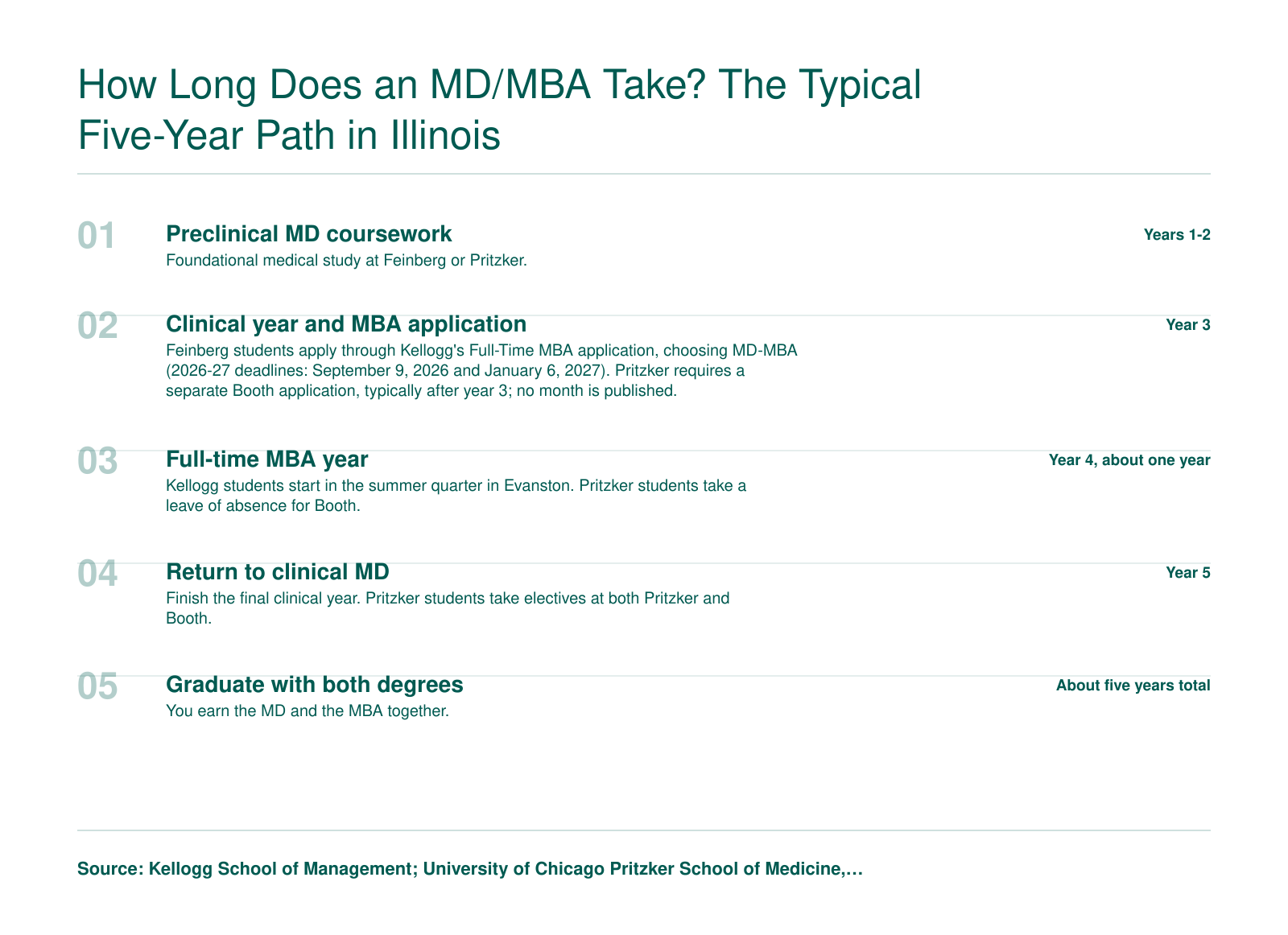
How Long Does an MD/MBA Take? The Typical Five-Year Path in Illinois
An MD/MBA takes about five years, one more than the MD alone. Northwestern and UChicago both place the full-time MBA year after year 3 of medical school.
Do You Need to Be in Med School First? MD/MBA Admissions in Illinois
At Northwestern, yes. You must already be a Feinberg medical student, and you apply to Kellogg during your third year. Prospective applicants and students at other medical schools are not eligible.
- MD enrollmentNorthwestern: current Feinberg School of Medicine students only.
- Separate MBA applicationNorthwestern: you apply to Kellogg through its own MD-MBA application, apart from your medical school file.
- Test requirementGMAT and GRE policies vary by school. See the next section.
- Essays and interviewCheck Kellogg's MD-MBA page for current essay and interview requirements before you start.
- Application windowNorthwestern: Round 1 closes September 9, 2026, and Round 2 closes January 6, 2027. Kellogg's MD-MBA page lists only these two rounds.
- Simultaneous or after matriculatingNorthwestern ties eligibility to current third-year status, so plan to apply after you matriculate, not alongside your medical applications.
- University of Chicago and Loyola University ChicagoContact each admissions office directly. We have not confirmed their current eligibility rules or deadlines.
Which Illinois MD/MBA Programs Waive the GMAT or GRE?
For MBA/MD dual degree applicants, testing rules are often written for MBA applicants in general, so the MD/MBA-specific language is what counts.
- Northwestern (Kellogg): The Feinberg MD/MBA is open only to Feinberg M3 students, and the GMAT or GRE is optional, placing it among master's programs with no GRE required. You may upload an unofficial MCAT score in the additional-essay section, but the instructions do not say it replaces the GMAT or GRE, so treat it as supporting evidence only.
- University of Chicago (Booth): Applicants use a special joint-degree application and need the GMAT or GRE. Waivers go only to current UChicago students and graduates. Superscores are not accepted, scores expire after five years, and nothing establishes that the MCAT can stand in.
- Loyola University Chicago: We found no published MD/MBA-specific testing policy, so don't infer one from its general MBA rules or from master's programs without gre in illinois.
The takeaway: a waiver spares you test prep during a demanding stretch of medical school. Still, where a school asks for a score, a strong one can help in a competitive round.
Tip: confirm current policy with each business school's admissions office before you apply.
Related Articles
Online and Hybrid MBA/MD Options in Illinois
Northwestern's MD-MBA sends Feinberg students to the Evanston campus for about a year of Kellogg coursework, then continues with evening Kellogg classes during the fourth year of medical school.1 That evening component is the closest thing to a flexible format among the joint degrees here, and it is not an online MBA.
The University of Chicago's five-year MD/MBA is also campus-based. Students spend year four at Booth (1,200 units), then finish the remaining 200 units while back in medical school. Loyola University Chicago's MD/MBA is likewise listed as campus delivery, and its published details do not describe an online or part-time route.
Booth's standalone Evening and Weekend MBA programs allow up to 25 percent remote coursework, and Kellogg's part-time MBA is hybrid. Neither is established as a way to complete the joint degree with the MD.
If you need a fully online or part-time format, the realistic alternative is an online MBA or an Executive MBA in Illinois after residency, once your schedule is more predictable.
Cost, Financial Aid, and Illinois Employer Demand for MBA Graduates
Tuition and Net Price
Listed program tuition runs about $68,652 at University of Chicago, $54,655 at Northwestern University, and $21,912 at Loyola University Chicago, for in-state and out-of-state students alike. These are not like-for-like dual-degree quotes. Net price after aid, an institution-wide average rather than an MD/MBA figure, is $14,860 at University of Chicago, $29,167 at Northwestern, and $36,079 at Loyola.
Estimating Five Years
Northwestern publishes the clearest MBA-year numbers for 2026-27: $29,708 per quarter across four quarters ($118,832), $128,202 in direct costs, and $168,822 total with Chicago living estimates.1 Feinberg's MD tuition is $76,512 a year.2 As a rough check, four MD years plus the MBA year puts direct costs near $470,000 before housing. University of Chicago's published MD budgets cover only the early years ($65,576 tuition in years one and two, $87,436 in year three), so a full total is not possible. Add the opportunity cost of the extra year before resident pay begins.
Aid and Employer Demand
University of Chicago lists scholarships and a year-long leave for the Booth MBA, but no dual-degree award amounts were confirmed. The same goes for Northwestern and Loyola, so ask each financial aid office how the MBA year is billed.
Demand is plausible rather than quantified here. Chicago-area health systems such as Northwestern Medicine, UChicago Medicine, and Advocate, along with pharma employers like AbbVie, Abbott, and Baxter, and healthcare consultancies, commonly recruit physician-leaders. Check current postings before counting on any role.
MD/MBA Earnings Snapshot
Median total compensation for physician executives nationally
MD/MBA Salary and Career Outcomes in Illinois
Northwestern's MD/MBA graduates show a median of $240,637 four years after finishing, against median program debt of $76,735. That early gap is favorable, but it understates the payoff: the value of top MBA programs tends to surface in mid-career leadership roles rather than in a first post-residency paycheck.
For dual-degree physicians, career paths commonly span clinical practice, hospital administration, consulting, biotech and pharma, health-tech startups, and academic medicine. National salary benchmarks show why those mid-career roles matter: medical directors range from $275,928 to $330,945, chief medical officers from $378,207 to $502,377, and pharmaceutical or biotech managing consultants around $192,247. These are broad role benchmarks, not MD/MBA alumni-survey medians. A 2025 scoping review found just six studies on MD/MBA career outcomes and only one reporting salary, so treat any single program's earnings as directional rather than a guaranteed premium.
A 2026 leadership study of 22 MD/MBA graduates found they were not more likely than MD-only peers to hold systems-facing roles; most held education leadership (45.5%) or clinical affairs (18.2%) positions. Still, the combination of clinical credibility and management training is the reason many dual-degree physicians move into those roles. The practical takeaway: weigh the MBA's cost against a mid-career leadership trajectory, not an immediate salary bump after residency.
Compare MBA/MD programs on the data that matters
Explore more MBA specializations or browse every graduate field.
All MBA programs