Most Affordable MBA/MD Programs
Compare 90+ accredited most affordable MBA/MD programs, with graduate earnings, cost, debt, and completion data from IPEDS and the U.S. College Scorecard.

Two professional degrees can easily mean six figures of debt, and the MBA year lands on top of an already heavy medical school bill. Indebted 2025 medical graduates owed a median $215,000, according to the AAMC.
Where you enroll changes that math. Among the schools here, annual graduate in-state tuition runs from $4,648 at UT Health San Antonio to $15,141 at UC Davis. Out-of-state rates span $14,306 to $31,408.
Residency status, more than brand, often decides whether the business degree adds a modest sum or tens of thousands.
Key Points
- Medical graduates in 2025 owed a median $215,000 in education debt.
- For 2027, public in-state tuition keeps MD/MBA costs more affordable.
- Medical school grants and MBA scholarships operate as separate aid systems.
10 Most Affordable MBA/MD Dual Degree Programs for 2027
These ten schools pair an MD with business training while keeping cost realistic. We rank them by tuition adjusted for local living costs, institution-wide net price after aid, and graduation rate. Each card lists campus location, graduate in-state and out-of-state tuition, net price, graduation rate, and format.
Florida International University
#1Miami, FL · ~$11,000/yr (est.)
Best for: Florida residents leveraging in-state tuition value
Florida International University pairs the MD with a 9-month Healthcare MBA between the third and fourth years of medical school. In-state graduate tuition is about $6,565, and the institution-wide net price after aid sits near $9,288, making this a strong value for Florida residents. The joint program is offered with the Herbert Wertheim College of Medicine and the FIU College of Business, focusing on healthcare operations and management.
- 9-month program between third and fourth years of medical school
- Focus on U.S. and international healthcare systems and operations
- Requires two letters of recommendation and medical school committee approval
- Jointly offered by Herbert Wertheim College of Medicine and FIU College of Business
- Career paths include pharmaceuticals, hospital administration, practice management
University of Central Florida
#2Orlando, FL · ~$9,000/yr (est.)
Best for: Future physician-executives seeking predictable program pricing
The University of Central Florida combines the MD with an AACSB-accredited MBA in a five-year cohort model, with the third year dedicated to MBA coursework at UCF Downtown. The program's all-inclusive tuition of $30,000 covers software, a laptop, Bloomberg lab access, parking, and networking events, which is an unusually transparent price point. Institution-wide net price is around $10,411, and in-state graduate tuition is about $6,368.
- Five-year cohort-based joint program with UCF College of Medicine and College of Business
- All-inclusive $30,000 total tuition covers laptop, software, Bloomberg lab, parking
- Third year dedicated to MBA coursework at UCF Downtown Campus
- 30 credit hours across 10 courses including managerial accounting, strategic finance, supply chain
- AACSB-accredited business curriculum
- Personal Zoom interview required for applicants
University of California-Los Angeles
#3Los Angeles, CA · ~$14,000/yr (est.)
Best for: California students preferring intimate cohort learning
UCLA delivers its MD/MBA through the PRIME-LA program, with the MBA year running alongside the final year of medical school in a five-year sequence. A small cohort of about 18 students and clinical shadowing during the MBA year distinguish the experience. Financial aid and scholarships are available for all five years, and the institution-wide net price is about $12,548.
- Five-year concurrent degree through PRIME-LA
- MBA year runs alongside final year of medical school
- Small cohort of about 18 students fosters close collaboration
- Students can shadow clinicians during the MBA year
- PRIME students may complete MBA at other accredited institutions
- Financial aid and scholarships available all five years
University of California-Irvine
#4Irvine, CA · ~$15,000/yr (est.)
UC Irvine offers a five-year integrated MD/MBA through its School of Medicine and Paul Merage School of Business, with a curriculum covering healthcare management, finance, and strategy. The program is open only to current UCI medical students, and the GMAT may be waived for applicants who have completed the MCAT and USMLE Step 1. Institution-wide net price is about $14,251, with in-state graduate tuition around $15,722.
- Five-year integrated MD/MBA from School of Medicine and Paul Merage School of Business
- Covers healthcare management, finance, strategy, organizational leadership
- GMAT may be waived with MCAT and USMLE Step 1
- Open only to current UCI medical students
- Prepares for hospital executive, health system administrator, medical director roles
University of California-Davis
#5Davis, CA · $15,000 – $20,000/yr (est.)
UC Davis requires students to first gain acceptance to the medical school and then apply separately to the MBA, creating a selective path for physician-executives. The dual degree blends clinical training with strategic decision-making and organizational leadership, preparing graduates for hospital management and medical entrepreneurship. Institution-wide net price is about $14,741, and in-state graduate tuition is around $16,774.
- Must first gain acceptance to the medical school, then apply separately to the MBA
- Focuses on healthcare administration, hospital management, medical entrepreneurship
- Blends health sciences and management strengths at UC Davis
- Designed for future physician-executives driving innovation in care delivery
The University of Texas Health Science Center at San Antonio
#6San Antonio, TX · ~$5,000/yr (est.)
UT Health San Antonio integrates the MD with an MBA from UTSA in a five-year track with small cohorts of one to two students. The medical school notes that eligible out-of-state students may qualify for competitive scholarships that move them to in-state tuition, potentially reducing costs by nearly $75,000. This makes the program notably affordable for nonresidents who secure that support.
- Five-year curriculum integrates clinical skills with MBA coursework at UTSA
- Small cohorts of one to two students allow personalized attention
- Requires medical school acceptance before applying to MBA
- Prepares for physician executive, healthcare consultant, hospital administrator, entrepreneur roles
University of North Carolina at Chapel Hill
#7Chapel Hill, NC · ~$13,000/yr (est.)
UNC-Chapel Hill compresses the MD and Kenan-Flagler MBA into five years, with the fourth year devoted to core and elective MBA courses and the final year blending both schools. The GMAT or GRE is required, but an MCAT-based waiver with a quantitative background statement can reduce testing barriers. Institution-wide net price is about $11,655, and in-state graduate tuition is roughly $8,994.
- Five-year program: three years MD, fourth year MBA at Kenan-Flagler, final year blended
- Core MBA courses include healthcare finance, strategic management, organizational leadership
- GMAT or GRE required; MCAT waiver available with quantitative background statement
- Apply during second or third year of medical school
- Multiple application rounds and dedicated admissions contacts
University of Nevada-Las Vegas
#8Las Vegas, NV · ~$7,000/yr (est.)
UNLV's joint MBA/MD from the Lee Business School and Kirk Kerkorian School of Medicine prepares students for roles in hospital administration, private practice ownership, and healthcare consulting. The curriculum combines core medical competencies with finance, supply chain management, and information technology. Institution-wide net price is about $10,359, with in-state graduate tuition near $9,748.
- Joint program between Lee Business School and Kirk Kerkorian School of Medicine
- Emphasizes ethics, strategic planning, supply chain management, information technology
- Prepares for private practice ownership, hospital administration, executive, nonprofit, consulting roles
- Integrative medicine principles and healthcare financial systems included
- Campus-based in Las Vegas with faculty mentorship
Texas Tech University Health Sciences Center
#9Lubbock, TX · ~$7,000/yr (est.)
Texas Tech University Health Sciences Center offers a four-year MD/MBA in Health Organization Management, allowing students to complete both degrees within the medical school timeline. The hybrid program includes online coursework in the second year, a 42-credit MBA component, and a field experience with local healthcare executives. AACSB accreditation and a lock-step HOM concentration add structure for future physician-administrators.
- Four-year MD/MBA program completed within medical school
- 42 credit hours of MBA coursework with HOM concentration
- Five HOM-specific courses include Managed Care Organizations and Integrated Healthcare Operations
- Hybrid format includes online courses during second year
- Field experience with local healthcare executives
- AACSB accredited business education
University of Houston
#10Houston, TX · $10,000 – $19,000/yr (est.)
University of Houston structures its five-year MD/MBA as three years of medical school, one year of MBA coursework at C.T. Bauer College of Business, and a final year of medicine. The program's credit-sharing design lets up to 12 business credits count toward the MD and up to 15 medical credits toward the MBA, shortening the path. Institution-wide net price is about $14,276, with in-state graduate tuition near $9,717.
- Five-year path: three years medical, one year MBA at Bauer College, final year medicine
- Up to 12 business credits apply toward MD and 15 medical credits toward MBA
- Electives include clinical informatics, medical ethics, business of medicine
- GMAT required with MCAT waivers available
- Certificates available in entrepreneurship or human resource management
Cost & outcomes by school
Federal data for the highest-earning MBA/MD programs, independent of the ranking above. Earnings are this field's master's graduates four years after completing, where the Scorecard reports them.
| School | Earnings | Tuition / yr | Debt | Grads/yr | Format |
|---|---|---|---|---|---|
| The University of Texas Health Science Center at San Antonio TX | — | $4,648 | — | — | Campus |
| Florida Atlantic University FL | — | $6,693 | — | — | Campus |
| Augusta University GA | — | $6,992 | — | — | Hybrid |
| University of Nevada-Reno NV | — | $7,032 | — | — | Campus |
| University of South Dakota SD | — | $7,118 | — | — | Hybrid |
| Texas Tech University Health Sciences Center TX | — | $7,153 | — | — | Hybrid |
| University of Nevada-Las Vegas NV | — | $7,413 | — | — | Campus |
| East Carolina University NC | — | $7,658 | — | — | Hybrid |
| University of Texas Southwestern Medical Center TX | — | $8,255 | — | — | Campus |
| University of Alabama at Birmingham AL | — | $8,640 | — | — | Campus |
| University of Utah UT | — | $8,724 | — | — | Campus |
| University of Central Florida FL | — | $8,872 | — | — | Campus |
Sources: U.S. Department of Education. Tuition and graduates: IPEDS. Earnings and debt: College Scorecard, this field's master's graduates; a dash means no figure is reported.
How We Rank the Most Affordable MBA/MD Schools
Price after aid decides the order for these affordable MBA programs, not reputation. Net price carries the most weight, followed by published graduate tuition and indicators of how much aid students actually receive, then outcomes such as graduation rate and debt at exit. Two of those figures, net price and graduation rate, are reported institution-wide rather than for the dual degree itself, so treat them as context rather than a precise quote for an MD/MBA dual degree.
Every school also has to clear a dual-accreditation check.1 Look up the business unit in AACSB's Search Accredited Schools directory2 (membership alone is not accreditation3; it follows peer review4), then confirm the MD program in LCME's Accredited U.S. Programs directory5, which lists statuses from full through probation. No separate joint accreditation exists for the combined degree.5
Published figures are averages. Residency status, merit awards, and need-based aid can move your real cost well above or below any number listed below.
What Drives MBA/MD Dual Degree Cost
The cost of an MBA/MD dual degree comes mostly from four years of medical school tuition. On top of that you pay for an added year of business school and for rent and living costs across the whole program. Some accelerated MBA/MD programs let coursework count toward both degrees. That shortens the timeline, and every year cut saves a year of tuition and living expenses.
Residency Moves the Number Most
Where you hold legal residency often matters more than which program you pick. Nationally, median first-year out-of-state tuition, fees, and insurance at public medical schools ran $27,082 above the in-state figure in 2025-2026. For 2026-2027, tuition and fees at UC Irvine are $43,009 for California residents and $55,254 for nonresidents.1 UCLA charges $54,715 in-state and $66,960 out-of-state.2 Ohio State's gap is wider: $37,308 in-state versus $57,674 out-of-state.3
Some public medical schools hold most seats for residents, and nonresidents who get in pay those higher rates. You may be able to reclassify after enrolling, but no school guarantees it. At UCLA, students who establish California residency after the first MD year pay lower rates from year two, saving about $36,735 over years two through four.2 At Ohio State, the University Registrar decides reclassification requests under Ohio rules. Also ask each school whether the MBA year gets the same residency treatment.
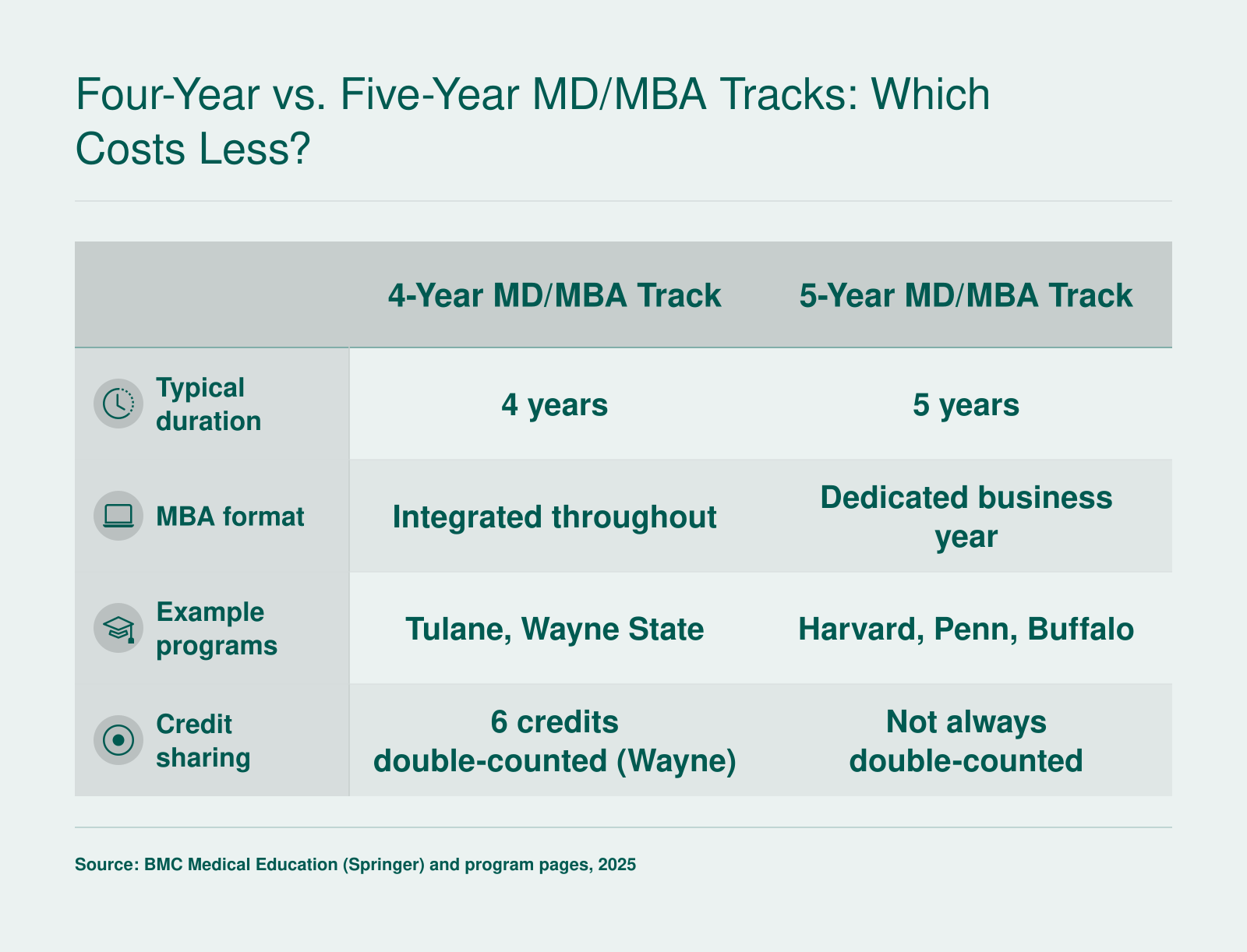
Four-Year vs. Five-Year MD/MBA Tracks: Which Costs Less?
Most U.S. MD/MBA programs use a five-year structure with a dedicated business year. A smaller group runs the MBA alongside the MD to finish in four years. The financial appeal of the four-year path is one fewer year of tuition and living costs plus an earlier residency salary, but billing rules differ by program.
Related Articles
Indebted U.S. medical graduates in the Class of 2025 owed a median $215,000 in education debt, according to the AAMC's Debt, Costs, and Loan Repayment Fact Card. Adding an MBA year stacks more tuition on that base, so choosing an affordable program matters.
MD/MBA Dual Degree Scholarships and Financial Aid
Medical school aid and business school aid are two separate systems, and neither assumes you are in the other's program. Medical schools lean on need-based grants. Harvard Medical School, for example, awards need-based aid covering tuition and mandatory fees, limited to eight semesters of full-tuition charges.1 At best MBA programs, business schools lean on merit. Rice automatically considers full-time MBA applicants for awards of 10 to 100 percent of tuition, capped at three semesters, and Kansas lists a $10,000 award with no GMAT required.2
MD/MBA-specific money is rare. Cornell's Lee Family Scholarship covers full tuition for the Tech MBA portion for one student a year3, while Penn offers no MD-specific scholarships and MD scholarships do not apply during the Wharton year.4 Duke bills only Fuqua tuition that year and does not apply medical scholarships. Its Duke Scholarship offered new recipients $15,000 in 2025-2026.5
Service-based options such as NHSC and military HPSP target medical tuition, and the research here does not confirm they cover an MBA year. Confirm that in writing before relying on them.
Action step: ask each financial aid office how aid is split across the two schools, which year each school funds, and whether awards pause during the business year.
Public vs. Private MBA/MD Schools: Total Debt and Payoff
Sector matters for MD/MBA cost because public universities charge lower in-state tuition and follow different aid formulas than private universities. In this ranked set, the schools are public, so the useful net price comparison is the public in-state figure rather than a private-school figure. The institution-wide public net price runs from about $10,400 at the University of Central Florida to roughly $14,700 at UC Davis.
A few programs publish master's-level debt and earnings data. For the MBA/MD master's degree at IU Indianapolis, median debt is $37,032 with a 10-year monthly payment of $421, and median earnings four years after finishing are $171,615. At the University of Central Florida, the comparable figures are $40,236 in median debt, a $458 monthly payment, and $108,978 in median earnings four years after finishing. Other programs in the list do not report these program-level outcomes, so treat published institution-wide averages with caution.
The decision rule is straightforward: for most students, an in-state public medical school paired with a four-year MD/MBA track is the lowest-debt path. Private universities can compete only when a large aid package brings their true net price below the public option.
MBA/MD programs by state
MBA/MD Cost and Admissions Questions, Answered
These are the MBA/MD cost and admissions questions prospective students ask most. The answers reflect program-specific policies for the 2026-27 cycle where dates are confirmed, and they point you to the public options that can keep combined costs down.
How much does an MD/MBA dual degree cost in total?
Which MBA/MD programs are the cheapest after combining both degrees?
Do you apply to the MD and MBA programs at the same time?
Do MD/MBA applicants need the GMAT or GRE in addition to the MCAT?
Are there affordable MBA/MD programs in California?
Can federal loans cover the MBA year of a dual degree?
Compare MBA/MD programs on the data that matters
Explore more MBA specializations or browse every graduate field.
All MBA programs