Best MBA/MD Programs in Pennsylvania
Compare 8 accredited MBA/MD programs in Pennsylvania, with graduate earnings, cost, debt, and completion data from IPEDS and the U.S. College Scorecard.

Which Pennsylvania medical schools let you add an MBA to the MD, and does the extra year earn its keep? Most dual-degree tracks here run five years, folding business coursework into a schedule already built around clerkships and board prep.
The programs below come from private research universities, public flagships, and hybrid options that let you take the business half partly online while the MD stays firmly on campus. Admissions terms vary sharply: some require the GMAT or GRE, while others are test-optional or offer a GMAT waiver. Tuition and residency rules move the real cost more than any sticker price suggests.
Key Points
- Penn requires the GMAT or GRE for its Wharton MD/MBA, with no MCAT substitution.
- The MD half is never online, so flexibility applies only to business coursework.
- Drexel reports a $137,596 median five years out, versus $90,865 at Widener.
The Best MBA/MD Schools in Pennsylvania, Ranked
Seven Pennsylvania universities offer an MD/MBA pathway in our dataset, spanning private research universities, public flagships, and a hybrid option with an online MBA. Graduation rates on each card reflect the university's overall graduation rate, not an MD/MBA completion rate. Net price is an institution-wide average after aid, not a quote for dual-degree students, so confirm costs with each program.
University of Pennsylvania
#1Philadelphia, PA · ~$48,000/yr (est.)
Best for: Future physician-executives focused on health care management
The University of Pennsylvania runs a five-year MD/MBA for Perelman School of Medicine students who want Wharton's business training alongside clinical education. Most students major in Health Care Management, and the dedicated Wharton year typically comes in Year 4, followed by a business internship. It is the most selective option on this list and has the highest university-wide graduation rate, though applicants must submit the GMAT or GRE and apply in Round 1 of their third year.
- Five-year integrated MD/MBA for Perelman medical students
- 19 credit units, with 15 from Wharton and four transferred from medicine
- GMAT or GRE required
- Apply in Round 1 of the third year of medical school
- Health Care Management major available, other Wharton majors possible
- Wharton grants and fellowships available, including Kaiser Fellowships for the major
- Career paths include academic physician, hospital director, consultant
University of Pittsburgh-Pittsburgh
#2Pittsburgh, PA · ~$28,000/yr (est.)
Best for: Applicants preferring a public university pathway
The University of Pittsburgh pairs its School of Medicine with the Katz Graduate School of Business in an in-person MD/MBA. Twelve credits are shared between the degrees, and students typically spend a full year at Katz between stretches of medical study. As a public university, Pitt offers a markedly lower in-state tuition than the private schools ranked around it.
- Joint program between Katz and the School of Medicine
- 12 credits shared between the two degrees
- 33 Katz credits in addition to the shared credits
- Usually one full-time year at Katz after two or three years of medicine
- Management simulation capstone
- In-person format
- Curriculum covers leadership, management, finance, and entrepreneurship
Drexel University
#3Philadelphia, PA · ~$39,000/yr (est.)
Best for: Applicants prioritizing MBA tuition scholarships
Drexel's five-year MD/MBA combines the College of Medicine with LeBow College of Business, running on the quarter system. The MBA core covers finance, marketing, strategy, and operations, followed by three concentration electives and an open elective. A scholarship on MBA tuition is available, which helps offset the cost of a private university.
- Five-year program across the College of Medicine and LeBow
- 39 total credit hours on a quarter system
- Core courses in finance, marketing, strategy, and operations
- Three concentration electives plus one open elective
- 40% scholarship on MBA tuition available
- Apply in the third year
- Career paths include hospital administration and health care consulting
Thomas Jefferson University
#4Philadelphia, PA · ~$25,000/yr (est.)
Sidney Kimmel Medical College at Thomas Jefferson University offers an integrated five-year Joint MD/MBA-MHA program built through an educational partnership with Widener University. Coursework blends medical training with economics, organizational strategy, and policy. Students can pursue research, administrative field placements, and potential fellowship support.
- Five-year integrated curriculum
- Educational partnership with Widener University in Chester
- Combines MBA and MHA study with the MD
- Administrative field placements
- Research opportunities
- Potential fellowship support
- Widener site is about 25 minutes from Jefferson's main campus
Temple University
#5Philadelphia, PA · $23,000 – $30,000/yr (est.)
Temple's Fox MBA + MD, offered with the Lewis Katz School of Medicine, is the only program on this list that lets MD students earn the MBA online. Nine credits transfer from the MD program, and a high MCAT percentile can waive the GMAT requirement. That flexibility makes it a practical fit for students juggling clinical rotations.
- Hybrid format with an online MBA option
- 36 total credit hours, with nine MD credits accepted toward the MBA
- GMAT can be waived with a high MCAT score
- Exams listed: MCAT, GMAT
- Offered with the Lewis Katz School of Medicine
- Dedicated academic advisor guides the dual-degree path
Widener University
#6Chester, PA · ~$28,000/yr (est.)
Widener University is the business-school partner behind Jefferson's joint degree, offering an MBA in Health Care Management alongside Sidney Kimmel Medical College. The concentration focuses on managed care, ambulatory services, and long-term settings, with attention to population risk management and cost effectiveness. Applicants go through two separate admission processes.
- Five-year joint program with Jefferson's Sidney Kimmel Medical College
- Health Care Management concentration
- Covers managed care, ambulatory care, and long-term settings
- Focus on population risk management and cost effectiveness
- Two admission processes required
- Prepares physician-managers for administrator and executive roles
Pennsylvania State University
#7University Park, PA · ~$25,000/yr (est.)
Penn State splits its five-year MD/MBA between the College of Medicine in Hershey and the Smeal College of Business at University Park. Students must apply separately to each school, and current MD students can apply to Smeal during their first three years. It carries the lowest listed tuition among the ranked schools, which matters for students watching total cost.
- Five-year integrated MD/MBA
- First three years of medical study in Hershey
- MBA coursework at Smeal in University Park
- Final year combines MD/MBA study and clinical rotations
- Separate applications to the College of Medicine and Smeal
- Current MD students may apply within their first three years
Cost & outcomes by school
Federal data for the highest-earning MBA/MD programs, independent of the ranking above. Earnings are this field's master's graduates four years after completing, where the Scorecard reports them.
| School | Earnings | Tuition / yr | Debt | Grads/yr | Format |
|---|---|---|---|---|---|
| Pennsylvania State University PA | $108,997 | $26,034 | — | — | Hybrid |
| Temple University PA | — | $22,818 | — | — | Hybrid |
| Thomas Jefferson University PA | — | $24,528 | — | — | Campus |
| Pennsylvania State University PA | — | $24,650 | — | — | Campus |
| University of Pittsburgh-Pittsburgh PA | — | $27,580 | — | — | Campus |
| Widener University PA | — | $28,004 | — | — | Hybrid |
| Drexel University PA | — | $39,261 | — | — | Campus |
| University of Pennsylvania PA | — | $47,844 | — | — | Campus |
Sources: U.S. Department of Education. Tuition and graduates: IPEDS. Earnings and debt: College Scorecard, this field's master's graduates; a dash means no figure is reported.
Which Pennsylvania MBA/MD Programs Waive the GMAT or GRE?
At Penn, Perelman medical students pursuing the Wharton MD/MBA must take the GMAT or GRE and submit a separate application directly to Wharton. There is no MCAT substitution: the program explicitly requires one of the two business exams. Timing matters here, since applications are accepted only in Round 1 of the third year of medical school, with a September deadline.
The University of Pittsburgh takes a different approach. The Katz Graduate School of Business uses a test-optional process, an approach shared by many No-GRE master's programs, so applicants to the Pitt MD/MBA may submit GMAT or GRE scores but are not required to. Katz does not state that the MCAT can stand in for those exams.
Temple advertises a GMAT waiver; for the remaining schools beyond Penn, Pitt, and Temple, we found no published GMAT, GRE, or MCAT-substitution policy specific to the dual degree.
Many MBA/MD dual degree programs do accept the MCAT or waive testing, but policies change and vary by cohort. Confirm the current requirement with each admissions office before you assume you can skip a standardized test.
Online and Hybrid MBA/MD Options in Pennsylvania
Start with the hard constraint: the MD half is never online. Clinical rotations, anatomy labs, and clerkships require you on site, so when a school advertises flexibility, it is talking about the business coursework alone.
Among the master's programs in Pennsylvania, Temple's Fox MBA, paired with the Lewis Katz School of Medicine, is listed as hybrid and offers an online MBA option; Widener's health care management MBA track, run jointly with Jefferson, is also listed as hybrid. Penn, Pitt, Drexel, and Penn State run their MD/MBA business coursework on campus, with Penn State sending students to University Park for a dedicated MBA year.1
That dedicated year is the realistic flexible path. Most students step out of the medical curriculum after clerkships or during a research year and concentrate the MBA into that window, with online or evening sections easing the scheduling crunch rather than replacing residency on campus.
Before you commit, confirm the medical school holds LCME accreditation and the business school holds AACSB accreditation.2 Both are published by the accreditors themselves, and delivery formats change, so verify directly with each program.
Related Articles
MBA/MD Program Cost and Pennsylvania Employer Demand for MBA Graduates
Pennsylvania's MD/MBA pricing is program-specific, and the real difference often comes down to how the added business year is charged compared with best MBA programs.
Published Costs at a Glance
- Penn: The Perelman-Wharton route, according to Perelman School of Medicine tuition and admissions, lists 2026-27 MD tuition at $80,511 and a first-year cost of attendance near $117,173, but no single MBA-year tuition total is published.
- Drexel: Medical students complete 39 MBA credits and receive an advertised 40% tuition discount, with the dollar value tied to the current full-time MBA rate.
- Temple: The MBA is built into medical school with no added time and the school advertises special tuition scholarships, but no percentage or dollar amount is published.
Scholarships and Remission
At Penn, Perelman scholarships continue while students are enrolled in medical coursework, not during the full-time Wharton year. Wharton fellowships and Kaiser Fellowships are considered but not guaranteed. Drexel's 40% discount is the clearest published remission.
Sticker Price vs. Net Price
Published graduate tuition is a ceiling, not a typical out-of-pocket cost. An institution-wide average net price reflects institutional aid across all students and often runs well below the graduate sticker price, so students should compare aid-adjusted figures before choosing.
Pennsylvania Employer Demand
Pennsylvania's large health systems and insurers use value-based and managed-care models, so they expect physician-executives to bridge clinical, financial, and operational decisions. Local hiring data is not published for these programs, but the business training aligns with those executive roles.
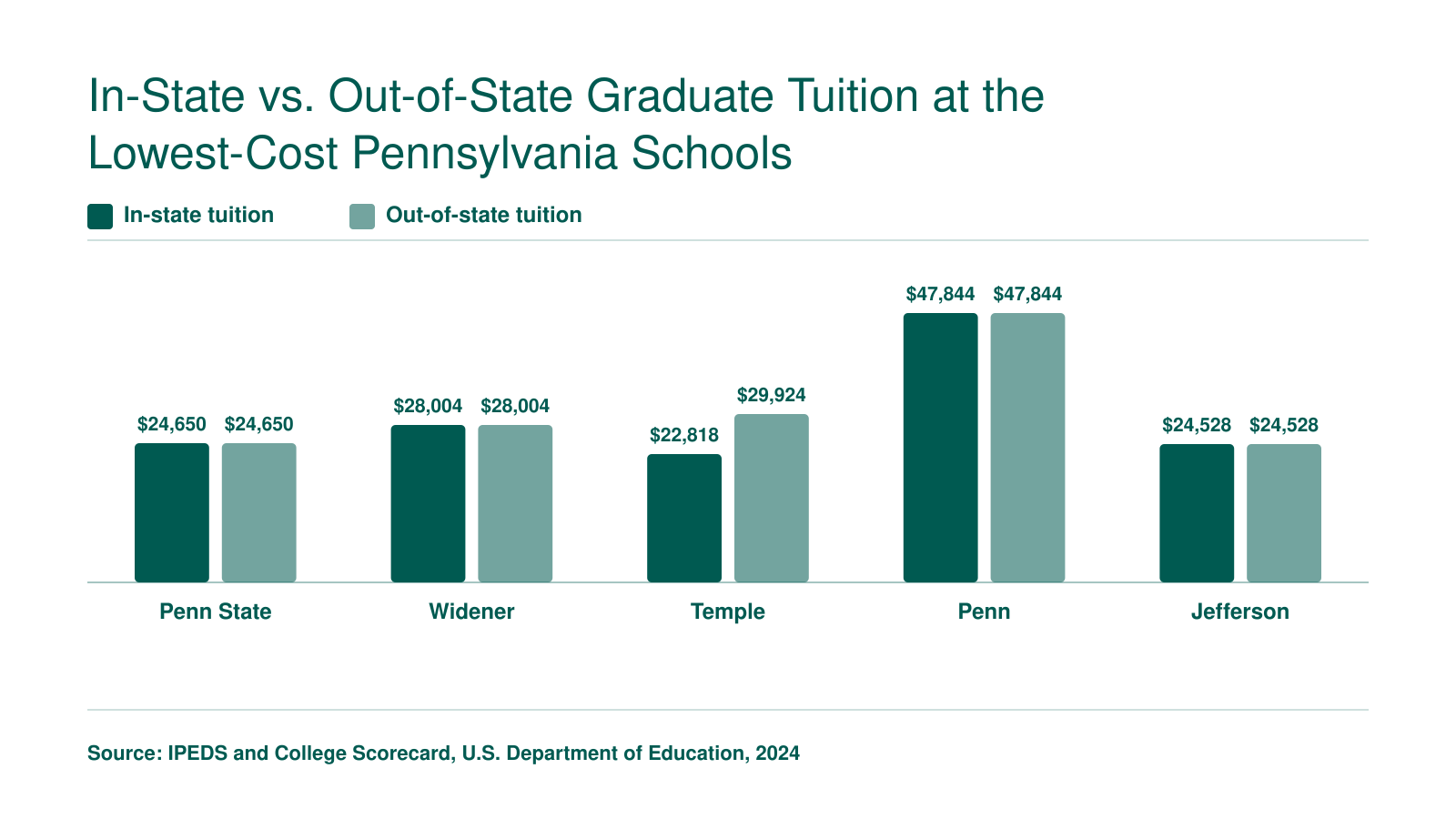
In-State vs. Out-of-State Graduate Tuition at the Lowest-Cost Pennsylvania Schools
Temple is the clearest example of a residency gap here, charging out-of-state students about $7,100 more than Pennsylvania residents. Penn State's listed program rate is the same for both groups, and the private schools, Widener, Penn and Jefferson, charge one rate to everyone. Published tuition is not what you will pay after aid, so compare net price before ruling a school in or out.
How to Choose the Right Pennsylvania MD/MBA Program
Among programs here with published program-level earnings, Drexel reports a median of $137,596 five years after finishing and Widener $90,865. Use those figures only for a same-window comparison, not as a stand-in for institution-wide MBA salaries.
Match the structure to your goal. Among MBA programs in Pennsylvania, Penn's Perelman/Wharton track sends students through a full business school, while Jefferson's joint program with Widener emphasizes healthcare management, a focus common in healthcare management master's programs in Pennsylvania; Pitt's Katz partnership shares leadership, management, and finance coursework. Drexel offers a five-year integrated format with concentration electives. A dedicated Wharton MBA year may fit students aiming for strategy or private equity, while the Wharton MBA Program in Health Care Management track suits hospital operations.
After residency, Penn describes MD/MBA graduates moving into roles as academic physicians, hospital directors, business consultants, and health-policy researchers. It does not publish specific match rates, so treat residency placement claims cautiously.1
Finally, weigh location and hospital affiliations. Clinical rotations at Philadelphia's Penn Medicine or Jefferson Health, or Pittsburgh's UPMC, shape letters and networks that can matter more than a program's name. Check whether business training runs before, after, or alongside clinical years; some programs interleave the two, others separate them.
An MD/MBA asks for extra time and tuition up front, and what it returns is leadership credibility and career flexibility that a medical degree alone does not provide.
Frequently Asked Questions About MBA/MD Programs in Pennsylvania
How long does it take to complete an MD/MBA in Pennsylvania?
Can I add the MBA after I've already started medical school?
Which Pennsylvania MD/MBA program is the best?
Do I need business experience before applying?
Compare MBA/MD programs on the data that matters
Explore more MBA specializations or browse every graduate field.
All MBA programs