Best JD/MBA Programs in Pennsylvania
Compare 12 accredited JD/MBA programs in Pennsylvania at 10 schools, with graduate earnings, cost, debt, and completion data from IPEDS and the U.S. College Scorecard.
Earning a JD and an MBA separately takes five years: three in law school, two in business school. A joint program in Pennsylvania usually takes four, and Penn and Temple run three-year tracks. The catch is a heavier courseload, two admissions processes, and a total bill above either degree alone.
The schools ranked here span Ivy League, private research, and public flagship campuses, plus Widener's hybrid format, a smaller set than the best MBA in management programs in Pennsylvania.
Even at Widener, ABA limits on distance credits keep JD coursework on campus. Only the MBA side can move online.
Key Points
- A fully online JD/MBA is effectively unavailable in Pennsylvania, though Widener offers the clearest hybrid route.
- Penn and Temple both offer three-year tracks, while a standard JD/MBA takes four years.
- Net price figures are institution-wide averages, so confirm JD/MBA costs and test policies with each school for 2027.
Top JD/MBA Schools in Pennsylvania
Pennsylvania offers JD/MBA paths from Ivy League and private research universities to public flagships and a hybrid option. Cost and format vary widely, so compare each card's tuition, net price, and program length. Graduation rates shown are institution-wide, not specific to the JD/MBA.
University of Pennsylvania
#1Philadelphia, PA · ~$48,000/yr (est.)
Best for: Applicants wanting a compressed three-year path
Penn's Carey JD/MBA pairs Penn Carey Law with Wharton in a three-year campus program in Philadelphia, with a capstone and a pro bono requirement. Published tuition and fees run about $68,686, and institution-wide net price averages $28,699. Scorecard reports median earnings of $104,212 one year after completion for its law program, and the institution-wide graduation rate is about 97%. It earns the top spot on outcomes and the shortest path.
- Three-year accelerated curriculum earning both JD and MBA
- First year is the standard Penn Carey Law curriculum
- Summer session introduces joint law and business courses
- Years two and three blend Wharton MBA core with law electives
- Capstone course in the final year
- Pro bono legal work required
Carnegie Mellon University
#2Pittsburgh, PA · ~$51,000/yr (est.)
Best for: Students pairing law with Tepper business training
Carnegie Mellon's Tepper School of Business partners with the University of Pittsburgh School of Law on a four-year campus JD/MBA in Pittsburgh. The pairing saves a full year compared with separate degrees. Published tuition and fees run about $66,246, institution-wide net price averages $31,944, and institution-wide graduation rate is about 94%. It ranks second on institutional outcomes and the strength of its business school.
- Four-year program, one year shorter than separate degrees
- Partnership with the University of Pittsburgh School of Law
- Starts with a full year in one school, then the other
- Years three and four blend law and business courses
- Joint admissions committee decides, with separate applications to both programs
University of Pittsburgh-Pittsburgh
#3Pittsburgh, PA · ~$28,000/yr (est.)
Best for: Applicants who want to choose their MBA school
Pitt is the main public option in Pittsburgh, and its distinguishing feature is choice: students can pair the law degree with Pitt's Katz MBA or Carnegie Mellon's Tepper MBA. In-state tuition and fees run about $21,926 (about $41,430 out of state), with institution-wide net price near $30,434 and a graduation rate around 86%. The program is four years and campus based, and it is among the lowest-cost routes on this list for in-state students.
- Entrance exam required, with LSAT and GMAT listed
- Separate admission to law and business schools
- Full-time enrollment required for the first four semesters
- Complete in eight to ten semesters
- Tuition formula: 85% law plus 42.5% business
- 115 total credit hours
- Option to start at law or business
- Full-time first year at each school
- New York bar admission restrictions noted
- Eight-semester program with flexible eight to ten semester completion
- Combines the JD with a Carnegie Mellon MBA
- Integrated law and business training
Drexel University
#4Philadelphia, PA · ~$39,000/yr (est.)
Drexel's JD-MBA combines the Kline School of Law and LeBow College of Business in Philadelphia, with ties to the city's venture capital and private equity community. Published tuition and fees run about $62,412, and institution-wide net price averages $38,509. Scorecard reports median earnings of $112,692 one year and $142,843 four years after completion for its related business program. Institution-wide graduation rate is about 78%.
- Completes in 3.5 to 4 years
- Reduced credit requirement: 79 law and 39 business credits
- LSAT required, with a 2.5 minimum GPA
- One letter of recommendation minimum
- 50 pro bono hours required for the JD
- Scholarships and financial aid available
Pennsylvania State University
#5University Park, PA · ~$26,000/yr (est.)
Penn State's JD/MBA is a cooperative program between Dickinson Law and the business school at Penn State Harrisburg, built for location-bound students with an undergraduate business background. In-state tuition and fees run about $20,644 (about $41,790 out of state), and institution-wide net price averages $32,875. Penn State Law and Smeal also offer a joint path in which law students can pause to complete Smeal's one-year residential MBA. Institution-wide graduation rate is about 86%.
- Cooperative program between two Penn State campuses
- Concurrent JD and MBA degrees
- Designed for location-bound students
- Requires undergraduate business background
Duquesne University
#6Pittsburgh, PA · $25,000 – $30,000/yr (est.)
Duquesne's JD/MBA in Pittsburgh runs four years full time, with a part-time option, and the first year is spent entirely in law school. A competitive LSAT score can substitute for the GMAT or GRE. Published tuition and fees run about $48,986, institution-wide net price averages $37,730, and institution-wide graduation rate is about 77%.
- Accepted exams: LSAT, GMAT, or GRE
- Four-year program with full-time and part-time options
- First year solely in law school
- Capstone required
- Law tuition rate for law terms, business rate for MBA-only terms
- Joint degree requires petition approval
Temple University
#7Philadelphia, PA · $23,000 – $30,000/yr (est.)
Temple's JD/MBA joins Beasley School of Law and the Fox School of Business in Philadelphia, with a three-year track for students with business backgrounds and a four-year track for everyone else. In-state tuition and fees run about $23,011 (about $38,958 out of state), with institution-wide net price near $28,198. Institution-wide graduation rate is about 75%.
- Three-year track requires a business background
- Four-year track includes 10+ business law courses
- 13.5 credits transfer to the MBA and 12 to the JD
- Apply to the law school first
- Separate graduation requirements per school
- Financial aid available
Widener University
#8Chester, PA · ~$28,000/yr (est.)
Widener is the one hybrid option here: the JD is on campus at Harrisburg or Wilmington, Delaware, while the MBA is fully online or hybrid through the Chester campus. Up to 18 credits cross-count, and full-time completion takes four years (five part time). Published tuition and fees run about $55,730, and institution-wide net price averages $25,759. Scorecard reports median earnings of $90,865 five years after completion for a very small group in its related business program. Institution-wide graduation rate is about 68%.
- JD requires 90 credits and the MBA 33
- Up to 9 credits count each way, saving 18 credits
- Four years full time or five years part time
- MBA fully online or hybrid, JD coursework on campus
- JD offered at Harrisburg or Wilmington
- Applications go through LSAC
Pennsylvania State University-Penn State Harrisburg
#9Middletown, PA · ~$25,000/yr (est.)
Penn State Harrisburg, in Middletown, hosts the MBA half of the cooperative program with Dickinson Law and is the lowest-cost option on this list: in-state tuition and fees run about $15,972 (about $26,958 out of state), with institution-wide net price near $23,330. Applicants must be admitted to Dickinson Law first, and nine law credits may count toward the MBA with approval. Institution-wide graduation rate is about 26%, so ask the program about its own completion experience.
- Concurrent JD and MBA degrees
- Cooperative program between two Penn State campuses
- Designed for location-bound students
- Requires undergraduate business background
- MBA tracks include analytics, finance, and supply chain management
- GMAT and a Dickinson Law associate dean recommendation for MBA admission
Cost & outcomes by school
Federal data for the highest-earning JD/MBA programs, independent of the ranking above. Earnings are this field's master's graduates four years after completing, where the Scorecard reports them.
| School | Earnings | Tuition / yr | Debt | Grads/yr | Format |
|---|---|---|---|---|---|
| Drexel University PA | $142,843 | $39,261 | $41,000 | 8 | Campus |
| Villanova University PA | — | $22,335 | — | — | Campus |
| Temple University PA | — | $22,818 | — | — | Campus |
| Pennsylvania State University-Penn State Harrisburg PA | — | $25,356 | — | — | Campus |
| Pennsylvania State University PA | — | $26,034 | — | — | Campus |
| Duquesne University PA | — | $27,612 | — | — | Campus |
| University of Pittsburgh-Pittsburgh PA | — | $27,580 | — | — | Campus |
| Carnegie Mellon University PA | — | $50,975 | — | — | Campus |
| Widener University PA | — | $28,004 | — | 7 | Hybrid |
| University of Pennsylvania PA | — | $47,844 | — | 1 | Campus |
Sources: U.S. Department of Education. Tuition and graduates: IPEDS. Earnings and debt: College Scorecard, this field's master's graduates; a dash means no figure is reported.
How We Rank Pennsylvania JD/MBA Programs
A famous name on the diploma and a defensible return on six figures of tuition are not the same thing, and this ranking is built around the second one. We weigh published program earnings for graduates, the debt they carry out, net price after aid, and institution-wide completion, drawing on the most recent College Scorecard and IPEDS releases available in 2026.
Some jd/mba dual degree programs are too small or too new for federal reporting to publish graduate earnings at the program level. Those schools are not penalized for the gap; they are ranked on the remaining measures, and we say so where it applies.
Bar passage rates and admissions selectivity matter to applicants, but they sit outside the scoring. We report them separately so you can weigh them yourself.
Online and Hybrid JD/MBA Options in Pennsylvania
Can you earn a JD/MBA fully online in Pennsylvania? A fully online JD/MBA is effectively unavailable in Pennsylvania because the ABA limits distance-education credits on the JD side. The clearest online/hybrid option in this group is Widener: its JD remains on campus at Harrisburg or Wilmington, while the MBA can be completed 100% online through one of the best online MBA programs or hybrid, with hybrid MBA coursework in Chester, and the five-year dual degree is part-time. Penn Carey Law and Wharton run an accelerated three-year Philadelphia program, but it is not described as online, hybrid, part-time, or evening. Temple's JD/MBA is also Philadelphia-based; Temple does not confirm the broader online MBA format for the joint degree. Penn State Dickinson offers two routes: Harrisburg's Middletown campus for location-bound students with MBA elective tracks, and Smeal's full-time residential one-year MBA at University Park, with law study possibly in Carlisle or University Park.1 Pitt Law and Katz list a four-year Pittsburgh path, but Katz's separate part-time MBA is not established for joint-degree students. Duquesne lists full-time and part-time options, while Drexel's joint-degree delivery details are sparse; confirm the current format on each school's program page.
Pennsylvania's JD/MBA programs remain a campus-based path, so plan for in-person law classes even if some MBA coursework moves online.
Which Pennsylvania JD/MBA Programs Waive the GMAT or GRE
Some dual-degree programs let one LSAT score serve both the law school and the business school. The Pennsylvania schools below do not all say so, and the Wharton program works the other way. Check each admissions page before you register for a test.
| School | Tests Accepted | GMAT/GRE Waiver Policy | Source Note |
|---|---|---|---|
| University of Pennsylvania (Carey Law/Wharton) | GRE or GMAT required; LSAT optional | No waiver or test-optional policy stated; a GRE or GMAT score is required | Penn Carey Law JD/MBA admissions FAQ, checked October 2026 |
| Widener University (JD/Online MBA) | Must meet both schools' admission qualifications; currently enrolled online MBA students must take the LSAT | GMAT waived for currently enrolled JD students who apply by the stated eligibility point and meet the published criteria | Widener Commonwealth Law JD & Online MBA page, checked August 2026; it does not say the LSAT alone satisfies both schools for the standard route |
| Temple University | Not stated in the sources reviewed | No published policy | No official waiver or test-optional policy identified as of October 2026 |
| University of Pittsburgh-Pittsburgh | Not stated in the sources reviewed | No published policy | No official waiver or test-optional policy identified as of October 2026 |
| Duquesne University | Not stated in the sources reviewed | No published policy | No official waiver or test-optional policy identified as of October 2026 |
| Drexel University | Not stated in the sources reviewed | No published policy | No official waiver or test-optional policy identified as of October 2026 |
| Pennsylvania State University | Not stated in the sources reviewed | No published policy | No official waiver or test-optional policy identified as of October 2026 |
Related Articles
Cost of a JD/MBA in Pennsylvania and Employer Demand for MBA Graduates
The table ranks the most affordable schools here by net price, which is an institution-wide average for the whole school and not a JD/MBA-specific figure. At Penn, the published 2026-2027 JD/MBA budget is not split by residency. Year 1 totals $120,294, summer 2026 adds $47,713, and Year 2 totals $162,830. Those totals include estimated living costs, the third-year total is not published, and Penn expects annual increases. Temple describes a four-year JD/MBA that accepts nine JD credits toward the MBA, but the sources we reviewed did not give current JD/MBA tuition. Widener's current JD/MBA tuition was not confirmed either, so check its page directly. Temple and Pitt both charge in-state and out-of-state tuition, so confirm which rate applies to dual-degree students. The dual degree usually means four years of tuition instead of the five needed for separate degrees, and Penn compresses it to three. We found no Pennsylvania-specific hiring report for MBA graduates. Philadelphia and Pittsburgh both have large finance, healthcare, and technology employers, but verify demand with each school's career office.
| Net Price Rank | School | City | Net Price (Institution-Wide Average) | Program Format |
|---|---|---|---|---|
| 1 | Pennsylvania State University-Penn State Harrisburg | Middletown | $23,330 | Campus |
| 2 | Widener University | Chester | $25,759 | Hybrid |
| 3 | Temple University | Philadelphia | $28,198 | Campus |
| 4 | University of Pennsylvania | Philadelphia | $28,699 | Campus |
| 5 | University of Pittsburgh-Pittsburgh | Pittsburgh | $30,434 | Campus |
Admissions Requirements for Pennsylvania JD/MBA Programs
Expect to clear both schools' standards. Figures below are 2025 law-school-wide JD data, not JD/MBA-specific, so confirm current terms with each school.
- Two admissions decisionsPenn uses one integrated Wharton application with a Carey Law supplement; other schools' structures are not confirmed here.
- Test scoresPenn requires the GRE or GMAT and makes the LSAT optional. Other schools' policies are unpublished here.
- Law-school selectivityPenn Carey: 8.05% admitted, median LSAT 173. Penn State: 43.0%, 159. Pitt: 34.9%, 160. Duquesne: 43.23%, 157. Widener: 60.4%, 150.
- Essays and experiencePenn asks no extra JD/MBA essays and states no minimum work experience, though Wharton values professional maturity.
- DeadlinesPenn's Round 1 is September 8, 2026, and Round 2 is January 5, 2027. Check other schools directly.
- Adding the MBA laterCurrent Wharton students apply to Carey by September 30, 2026 or January 31, 2027. Ask other schools about post-1L entry.
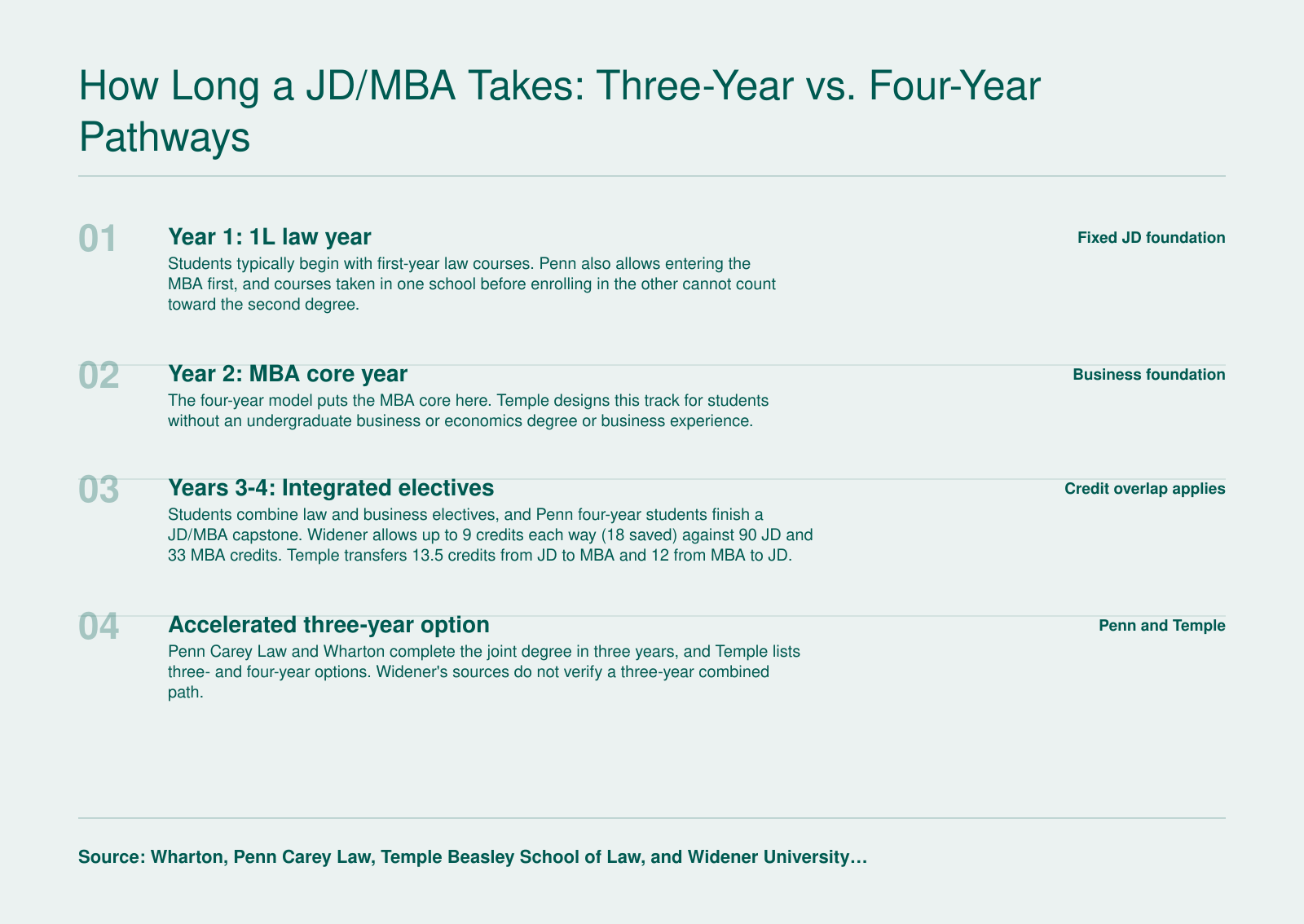
How Long a JD/MBA Takes: Three-Year vs. Four-Year Pathways
A standard four-year JD/MBA starts with the law curriculum, adds a business core, then blends both. Penn and Temple also offer three-year tracks. Widener's published timeline is four years full-time or five part-time.
Career Outcomes and Earnings for JD/MBA Graduates
No school here publishes a top-employer list specifically for JD/MBA graduates, so employer types are left out rather than guessed. Earnings windows differ by row, and the federal figures reflect each program's reporting category, so compare them with care. On the evidence available, Penn has the strongest overall outcomes: a one-year median of $104,212 and 279 Class of 2024 graduates in full-time, long-term, bar-required jobs. Drexel's five-year figure is higher, but it covers a longer window.
| School | Published program earnings | Earnings window | ABA employment and bar data |
|---|---|---|---|
| Drexel University | $137,596 | Five years after finishing | Not reported in the sources reviewed |
| University of Pennsylvania | $104,212 | One year after finishing | Class of 2024: 279 full-time long-term bar-required, 3 JD-advantage; no first-time bar rate published |
| Widener University | $90,865 | Five years after finishing | Delaware first-time bar pass rate 73.91% (2025); Commonwealth Class of 2025: 81 full-time long-term bar-required, 7 JD-advantage |
| Duquesne University | Not reported | N/A | First-time bar pass rate 88.72% (July 2024); 96.4% employed or in a graduate program (Class of 2023) |
| Temple University | Not reported | N/A | Class of 2025: 93.8% in full-time long-term bar-required or JD-advantage roles; 96.4% overall employment; no first-time bar rate published |
Frequently Asked Questions About JD/MBA Programs in Pennsylvania
These answers cover the questions applicants ask most often. Policies change by admissions cycle, so confirm dates and requirements with each school before you apply.
Can I earn a JD/MBA online in Pennsylvania?
How long does a JD/MBA take in Pennsylvania?
Do JD/MBA programs in Pennsylvania require the GMAT or LSAT?
Can I add the MBA after starting law school, and what is the deadline to apply?
Compare JD/MBA programs on the data that matters
Explore more MBA specializations or browse every graduate field.
All MBA programs