MBA/MD Programs With No GMAT or GRE Required
Compare 90+ accredited no-gre MBA/MD programs, with graduate earnings, cost, debt, and completion data from IPEDS and the U.S. College Scorecard.

Medical school applicants have already spent months preparing for the MCAT, a roughly 7.5-hour exam, and few want to sit the GMAT or GRE for the MBA half of a dual degree. Many MD/MBA programs let the MCAT stand in for a business-school test, which removes a real barrier.
Policies are not uniform, though. Some schools waive the requirement automatically, others ask for a petition, and a few still expect scores from certain applicants. Confirm the rule with each school before you budget time or test fees.
Key Points
- In 2027, NYU Stern waives GMAT/GRE for MCAT submitters.
- Some programs bill the MBA year at MBA tuition rates.
- In 2026, 12 of 93 analyzed U.S. programs offered four-year tracks.
Best MD/MBA Programs That Waive the GMAT or GRE
These MD/MBA programs stand out for one practical reason: each has a path that waives or makes optional the GMAT or GRE. The schools below are ordered using a composite view of test-waiver eligibility, retention, completion, and institutional quality, with cost and earnings playing a moderate supporting role. Policy details can change, so contact each school to confirm the current waiver before you apply.
Cornell University
#1Ithaca, NY · ~$30,000/yr (est.)
Best for: Medical students wanting a 12-month MBA
Cornell University in Ithaca, NY, offers a campus-based M.D.-M.B.A. through Weill Cornell Medicine and the Johnson School of Management. Medical students can complete the MBA in 12 months during a one-year leave between their third and fourth years, and no GMAT is required. Graduate tuition is $69,314 for both in-state and out-of-state students, and the school's graduation rate is 95%.
- No GMAT required for Weill Cornell medical students
- Complete the MBA in 12 months
- Scheduled during a one-year leave between M.D. years
- Partnership with Cornell's Johnson School of Management
- Curriculum covers healthcare management, finance, and strategy
- Scholarships available
University of Maryland-College Park
#2College Park, MD · ~$18,000/yr (est.)
Best for: Five-year dual degree seekers needing flexibility
The University of Maryland in College Park, MD, offers a campus-based Business Administration and Medicine (BMED) dual degree through the Robert H. Smith School of Business and the School of Medicine. Students complete both degrees in five academic years, and GMAT or GRE scores are optional. In-state graduate tuition is $11,809 and out-of-state is $41,186; the school's graduation rate is 89%.
- GMAT or GRE scores are optional
- Complete both degrees in five academic years
- Joint program with the School of Medicine
- Requires separate admission to each school
- Starts in fall
- Minimum one recommendation letter
University of Iowa
#3Iowa City, IA · $13,000 – $32,000/yr (est.)
Best for: Working physician leaders preferring hybrid delivery
The University of Iowa in Iowa City, IA, offers a hybrid MBA & MD Dual Degree through the Carver College of Medicine and Tippie College of Business. Medical students complete 33 credit hours of MBA coursework in one additional year, with online and in-person weeknight options and no GMAT or GRE required. In-state graduate tuition is $11,283 and out-of-state is $33,371; the school's graduation rate is 75%.
- No GMAT or GRE required
- 33 credit hours of MBA coursework
- Complete MBA in one additional year
- Cross-counted credits reduce total by 24 hours
- Professional work experience requirement waived for medical students
- 8-week sessions, primarily weeknights
- Online and in-person options in Iowa City
- 8 concentration options
University of Kansas
#4Lawrence, KS · $12,000 – $27,000/yr (est.)
The University of Kansas in Lawrence, KS, offers a campus-based MBA/MD dual degree. Students complete a one-year MBA cohort that can be scheduled before medical school or during a break in the MD curriculum, and no GMAT is required for the $10,000 MBA/MD scholarship. In-state graduate tuition is $12,102 and out-of-state is $30,432; the school's graduation rate is 69%.
- No GMAT required for the $10,000 MBA/MD scholarship
- Five-year dual degree program
- One-year MBA cohort experience on the Lawrence campus
- Cohort-based structure
- Two recommendation letters minimum
- Flexible sequencing with the MD curriculum
Western Michigan University
#5Kalamazoo, MI · $20,000 – $25,000/yr (est.)
Western Michigan University in Kalamazoo, MI, offers a campus-based MD-MBA Dual Degree through the Haworth College of Business and Homer Stryker M.D. School of Medicine. Students complete 24 MBA credits in Year 4, and only the MCAT is required; GMAT and GRE are waived. In-state graduate tuition is $15,252 and out-of-state is $19,034; the school's graduation rate is 58%.
- Only the MCAT is required; GMAT and GRE are waived
- 24 MBA credits during Year 4
- Five-year campus program
- Rolling admissions allow applying after matriculation
- Business prerequisites available through Coursera
- Medical school tuition applies in Years 1, 2, 3, and 5
Cost & outcomes by school
Federal data for the highest-earning MBA/MD programs, independent of the ranking above. Earnings are this field's master's graduates four years after completing, where the Scorecard reports them.
| School | Earnings | Tuition / yr | Debt | Grads/yr | Format |
|---|---|---|---|---|---|
| Florida Atlantic University FL | — | $6,693 | — | — | Campus |
| East Carolina University NC | — | $7,658 | — | — | Hybrid |
| University of Kansas KS | — | $11,971 | — | — | Campus |
| The University of Texas at Austin TX | — | $12,006 | — | — | Campus |
| University of Iowa IA | — | $13,425 | — | — | Hybrid |
| University of Maryland-College Park MD | — | $18,276 | — | — | Campus |
Sources: U.S. Department of Education. Tuition and graduates: IPEDS. Earnings and debt: College Scorecard, this field's master's graduates; a dash means no figure is reported.
MD/MBA Dual Degree Cost: Tuition and Net Price Compared
MD/MBA billing rules vary widely, so annual tuition alone can mislead. Some schools bill the MBA year at MBA rates, while others keep medical-school tuition, and a few publish a combined total; Miami, for example, lists a four-year MD/MBA tuition of $67,601, compared with $57,600 for the MD alone. The table below shows each program's listed graduate tuition and an institution-wide average net price after aid, not a personal quote. Because the extra MBA year adds a full year of tuition and living costs, compare total program cost, not just annual tuition.
| School | In-state graduate tuition | Out-of-state graduate tuition | Institution-wide average net price after aid |
|---|---|---|---|
| Western Michigan University | 15,252 | 19,034 | 15,273 |
| University of Maryland-College Park | 11,809 | 41,186 | 15,678 |
| University of Kansas | 12,102 | 30,432 | 18,059 |
| University of Iowa | 11,283 | 33,371 | 22,531 |
| Cornell University | 69,314 | 69,314 | 28,690 |
How GMAT/GRE Waivers Work: MCAT Substitution vs. Petition
At NYU Stern, an MBA/MD dual degree applicant needs only the MCAT; GMAT and GRE scores are waived. That automatic substitution is also the rule at Minnesota's Carlson School, Buffalo's Jacobs School, and Western Michigan's Homer Stryker M.D. School, a pattern common among No-GRE master's programs. At Buffalo, the waiver applies to students starting the MBA after third year, but early-assurance applicants still need GMAT or GRE.
Petition and exam-required paths
In the University of Texas at Austin's McCombs School Houston MD/MBA track, the MCAT is not treated as automatic: students apply separately during years 1-3 of medical school and must obtain approval through a test-waiver petition. Ohio State's Fisher College describes a holistic waiver review1, while its MD/MBA-specific application still lists the GMAT2; the policy is not a guaranteed substitution. University of Cincinnati requires both the MCAT and the GMAT, including a minimum overall score of 600 and a 39 on the quantitative section.3
Timing and what to confirm
When you apply matters. NYU expects MD/MBA applicants in the fall of second year, one year before the MBA. McCombs accepts applications during years 1-3 and requires three years of medical school before beginning MBA programs. Buffalo's standard path starts the MBA after third year. Before applying, check whether the waiver is automatic or must be requested in writing, and confirm the deadline, such as Ohio State's mid-January MBA date.4
Related Articles
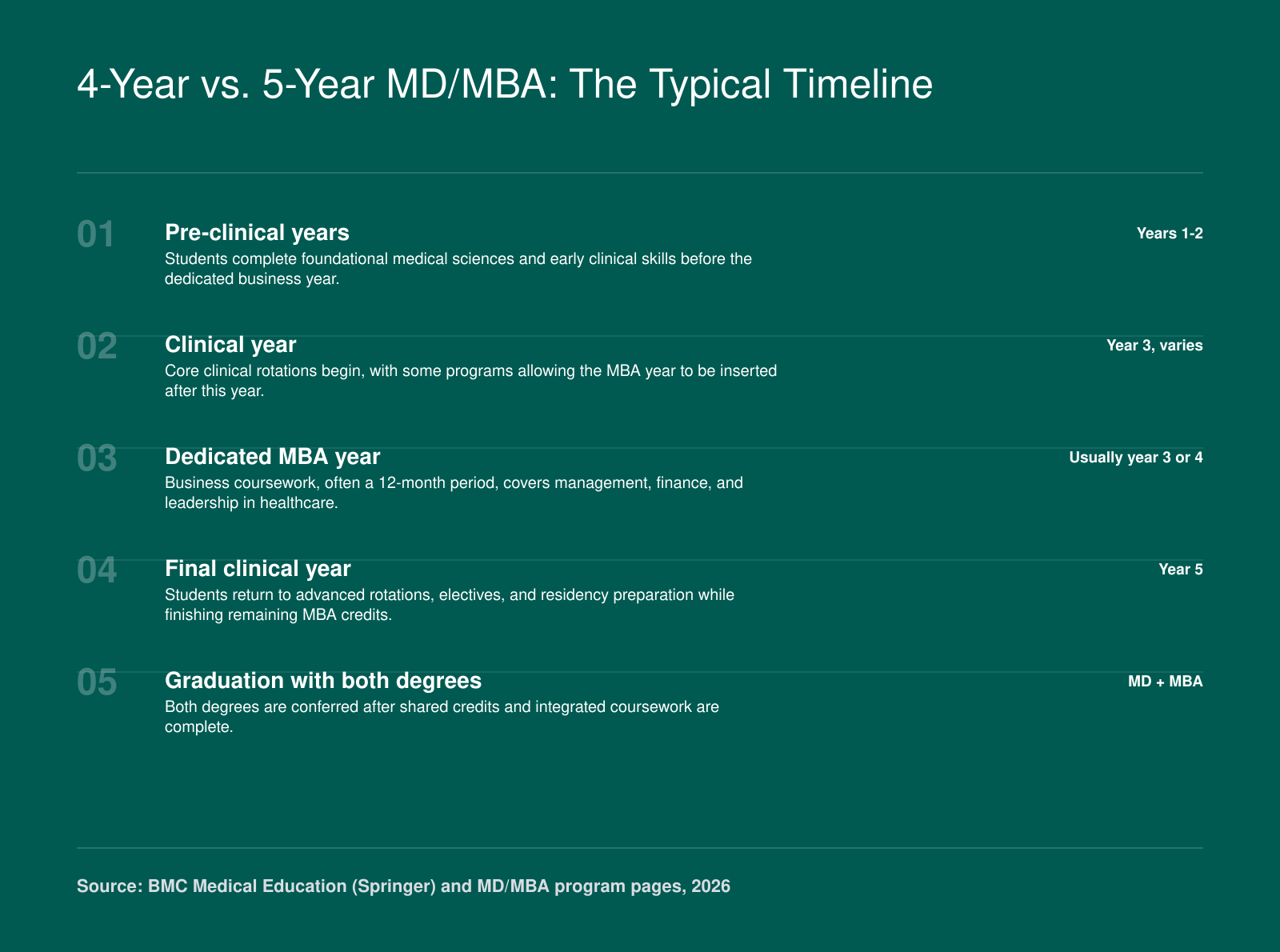
4-Year vs. 5-Year MD/MBA: The Typical Timeline
Most U.S. MD/MBA programs follow a five-year sequence. In 2026, 12 of 93 U.S. programs analyzed offered an integrated four-year track, usually by folding business coursework into summers or electives. Shared credits shorten the path from roughly six years if the two degrees were earned separately.
Accreditation, Delivery Format, and Leave-of-Absence Rules
University of Miami's MD-MBA is delivered fully face-to-face and is AACSB-accredited,1 making it a useful benchmark for verifying a dual degree's structure. For any program, confirm two accreditations: LCME (or COCA for DO-based programs) for the medical degree and AACSB for the business school. The first matters for residency and licensure; the second signals employer credibility for the MBA. Check the LCME directory and AACSB accredited MBA programs no GMAT schools search rather than relying on a program's marketing page.
Delivery format
Most MD/MBA programs are campus-based. Miami lists its dual-degree classes as in person.2 But hybrid and weekend options exist: LSU Health Sciences Center blends evening and online courses with about one on-campus weekend per month,3 and Texas McCombs at Houston runs a weekend-based MBA every other weekend with Friday evening and Saturday classes.4 These formats let medical students continue clinical rotations while completing business coursework.
Leave of absence
Some schools require a formal leave from medical school during the MBA year. Hofstra/Northwell directs accepted students to take leave after MD year 3 to complete most MBA coursework, targeting both degrees in five years.5 Minnesota requires approval for a Medical School Leave of Absence, while Harvard handles leave case-by-case through a written petition and good standing at both schools.6 A leave can affect financial aid and delay your graduation date, so review the policy and aid terms before committing.
MD/MBA Admission Requirements and Application Checklist
You'll typically clear two admissions processes. To enter an MD/MBA pathway, you usually need to be admitted or enrolled in the partner medical school, then complete a separate business-school application, commonly during your second or third year of medical school.
- Medical school acceptance or enrollmentRequirements vary, but you typically need to be admitted to or enrolled in the partner MD program; some tracks let you apply to the MBA before starting medical school.
- MCAT substitutionSome programs accept an MCAT score in place of the GMAT or GRE, while others require a test-waiver petition.
- Bachelor's degree and prerequisitesYou need a completed bachelor's degree and the required medical-school prerequisite coursework.
- MBA application materialsExpect essays, a resume or CV, transcripts, one or two recommendations, and sometimes a video assessment or interview.
- Deadlines and feesDeadlines often fall in year two or three of medical school. UT Austin McCombs charges a $200 application fee; the McGovern/UTMB pathway states its fee is waived. NYU Stern's deadline is December 15, 2026.
- Work experienceFull-time work experience is usually not required; UT Austin McCombs strongly suggests at least two years but does not mandate it.
Earnings Snapshot for Ranked Program Graduates
MBA/MD programs by state
MD/MBA Programs: Frequently Asked Questions
Do MD MBA programs require the GMAT?
Are there 4 year MD/MBA programs?
Can I add the MBA after I've already started medical school?
Does taking a year off for the MBA affect residency applications or federal loan deferment?
Compare MBA/MD programs on the data that matters
Explore more MBA specializations or browse every graduate field.
All MBA programs