Accelerated MBA/MD Programs
Compare 90+ accredited fastest MBA/MD programs, with graduate earnings, cost, debt, and completion data from IPEDS and the U.S. College Scorecard.

A traditional MD followed by a standalone two-year MBA can stretch to six years of graduate study. Most combined MD/MBA programs trim that to five by folding in one dedicated business year, and a small number compress everything into four.
That gap of one or two years, measured in tuition and lost physician income, is the central trade-off. The schools ranked here are sorted by time to degree, with cost, admissions, and salary outcomes examined further down.
Every figure comes from federal data or the schools themselves. The ranked list follows immediately below.
Key Points
- Most MD/MBA programs take five years; a few tracks finish in four.
- The lowest-cost ranked schools include IU Indianapolis, Georgia Tech, and Houston.
- MD/MBA salary starts at resident pay, rising with leadership roles after residency.
Best MD/MBA Programs for 2027: The 10 Fastest Routes to Both Degrees
The fastest combined tracks fold business training into a single intensive year, so students can pair the MD with a campus-based MBA without doubling their time in school. The ten programs below are all campus-based, with several featuring one-year MBA components and at least one school offering a four-year accelerated option. Use the cards to compare program lengths, concentrations, and practical highlights before shortlisting.
Cornell University
#1Ithaca, NY · ~$30,000/yr (est.)
Best for: Ivy-bound physicians wanting one-year business training
Pairs the MD with a one-year MBA taken during a leave between the third and fourth medical years, so business training fits without stretching medical school. The curriculum covers healthcare management, finance, and strategy, and no GMAT is required for medical students in this track. The format is campus-based and full-time, designed for a condensed return to clinical training.
- Earn MBA in 12 months during a leave between medical years
- No GMAT required for Weill Cornell students
- Curriculum covers healthcare management, finance, and strategy
- Partnership with Johnson School of Management
- Campus-based, full-time format
Northwestern University
#2Evanston, IL · ~$55,000/yr (est.)
Best for: Healthcare leaders wanting Kellogg's executive network
Combines the MD with a one-year Kellogg MBA, adding core business disciplines and the Healthcare at Kellogg specialization. The program emphasizes healthcare operations, strategy, and leadership, with access to a large executive and alumni network. Students complete the business year in a full-time, campus-based format.
- One-year MBA component at Kellogg
- Healthcare at Kellogg specialization
- Joint-degree partnership with Feinberg School of Medicine
- Full-time, campus-based format
- Access to full Kellogg course catalog and executive network
Georgia Institute of Technology
#3Atlanta, GA · ~$16,000/yr (est.)
Best for: Students seeking technology-driven healthcare leadership
Links the MD with a one-year Scheller MBA, transferring 15 MD credits into the 39-credit business portion. The five-year dual degree emphasizes applied learning, healthcare entrepreneurship, and technology-driven care, plus a built-in leadership development course. Students study near corporate research centers and startups.
- Complete both degrees in five years
- 39 credit hours at Scheller
- Transfer 15 credit hours from MD coursework
- Partnership with Morehouse School of Medicine
- Healthcare entrepreneurship and applied learning focus
- Entrance exam required: GMAT, GRE, or MCAT
Johns Hopkins University
#4Baltimore, MD · ~$65,000/yr (est.)
Combines a Genes to Society medical curriculum with a one-year, STEM-designated accelerated MBA. The five-year program counts 18 MD credits toward the 54-credit MBA, and the business year runs as a full-time cohort. Students prepare for leadership roles in hospitals, biotech, and health policy.
- Five-year dual-degree timeline
- STEM-designated MBA
- 18 MD credits count toward 54-credit MBA
- Genes to Society medical curriculum
- Full-time MBA cohort experience
- Prepares physicians for leadership roles
Washington University in St Louis
#5St. Louis, MO · ~$65,000/yr (est.)
Pairs the MD with a one-year Olin MBA that sits alongside the medical curriculum. The dual degree emphasizes mentorship, cross-cultural healthcare perspectives, and experiential projects that connect business skills to patient care. Financial aid is available from multiple sources.
- One-year MBA component in addition to MD curriculum
- Focus on cross-cultural healthcare perspectives
- Mentorship and leadership development
- Experiential learning opportunities
- Financial aid available
Emory University
#6Atlanta, GA · ~$49,000/yr (est.)
Combines the medical degree with a Goizueta MBA that can be completed in a one-year or two-year track. The five-year program requires 50 credit hours, including two global requirements and a directed study project bridging medicine and business. The business portion offers fall or summer starts.
- Five-year program
- 50 total credit hours
- One-year or two-year MBA tracks
- Two global requirements
- Directed study project bridging medicine and business
- Fall or summer start options
University of Maryland-College Park
#7College Park, MD · ~$18,000/yr (est.)
Joins a School of Medicine with the Robert H. Smith School of Business in a five-year accelerated dual degree. The program requires separate admission to each school and accepts optional GMAT or GRE submission. Students finish both degrees in five academic years through shared coursework.
- Five-year accelerated dual degree
- Requires admission to both schools
- GMAT or GRE optional
- Joint program with the School of Medicine
- Fall start
Ohio State University
#8Columbus, OH · ~$14,000/yr (est.)
Combines a College of Medicine with the Fisher College of Business in a five-year path that saves one year compared with earning the degrees separately. The curriculum covers financial management, organizational leadership, and health systems strategy. Applicants apply during their second year of medical school and take the GMAT.
- Complete both degrees in five years
- Saves one year versus separate degrees
- GMAT required
- 3.0 GPA minimum
- Apply during second year of medical school
- MD and MBA awarded at same graduation
Tulane University of Louisiana
#9New Orleans, LA · ~$69,000/yr (est.)
Offers both a four-year accelerated MD/MBA and a traditional five-year option. The four-year track begins with business coursework the summer before medical school and integrates the remaining 48-credit Freeman curriculum across the MD years; the five-year path uses the same curriculum less compressed. Students choose from five concentrations including analytics, finance, and strategy.
- Four-year accelerated option available
- Traditional five-year pathway
- 48 total credit hours
- Five concentration options
- Starts summer or fall
- Global immersion project included
- AI integration across curriculum
Texas A&M University-College Station
#10College Station, TX · ~$12,000/yr (est.)
Adds one year of business study to the MD through the MD Plus program, creating a five-year total. The campus-based curriculum emphasizes healthcare entrepreneurship, management, and policy, with competitive scholarships and a reported 100 percent first-choice residency match rate.
- One additional year of study
- Healthcare entrepreneurship and management focus
- Competitive scholarships available
- Reported 100 percent residency match rate
- Campus-based program
Cost & outcomes by school
Federal data for the highest-earning MBA/MD programs, independent of the ranking above. Earnings are this field's master's graduates four years after completing, where the Scorecard reports them.
| School | Earnings | Tuition / yr | Debt | Grads/yr | Format |
|---|---|---|---|---|---|
| Texas A&M University-College Station TX | — | $11,748 | — | — | Campus |
| University of Florida FL | — | $12,737 | — | — | Campus |
| West Virginia School of Osteopathic Medicine WV | — | $12,700 | — | — | Hybrid |
| Wright State University OH | — | $15,771 | — | — | Hybrid |
| Georgia Institute of Technology GA | — | $15,962 | — | — | Campus |
Sources: U.S. Department of Education. Tuition and graduates: IPEDS. Earnings and debt: College Scorecard, this field's master's graduates; a dash means no figure is reported.
Four-Year MD/MBA Programs vs. the Standard Five-Year Track
Can you really finish an MD and an MBA in four years? At a small number of schools, yes, but most MBA/MD dual degree programs still take five.
The standard model adds one dedicated business year, usually between the second and third years of medical school. You pause clinical training, complete the core MBA curriculum full time, then return for clerkships. Tulane still offers this 60-month track alongside its newer option.1
Who Offers a True Four-Year Path
Tulane announced a four-year Accelerated MD/MBA on April 3, 2026. Its announcement describes students beginning in Fall 2026, while the current program page lists accelerated classes starting in Summer, so the exact first term is unclear. First cohort size is not reported. Tulane says it joins about a dozen U.S. universities with four-year pathways, but it does not name them all, so confirm the current list with each school.
How the Compression Works
Tulane's pathway spreads 48 business credits across the MD timeline: four courses the summer before medical school, then courses woven through the four years, including evening and intersession options.1 Expect a heavier workload than an Accelerated MBA with no free business year.
Which Track Fits You
Choose four years if you are certain about a business-leaning clinical career. Choose five if you want room for research and residency preparation.
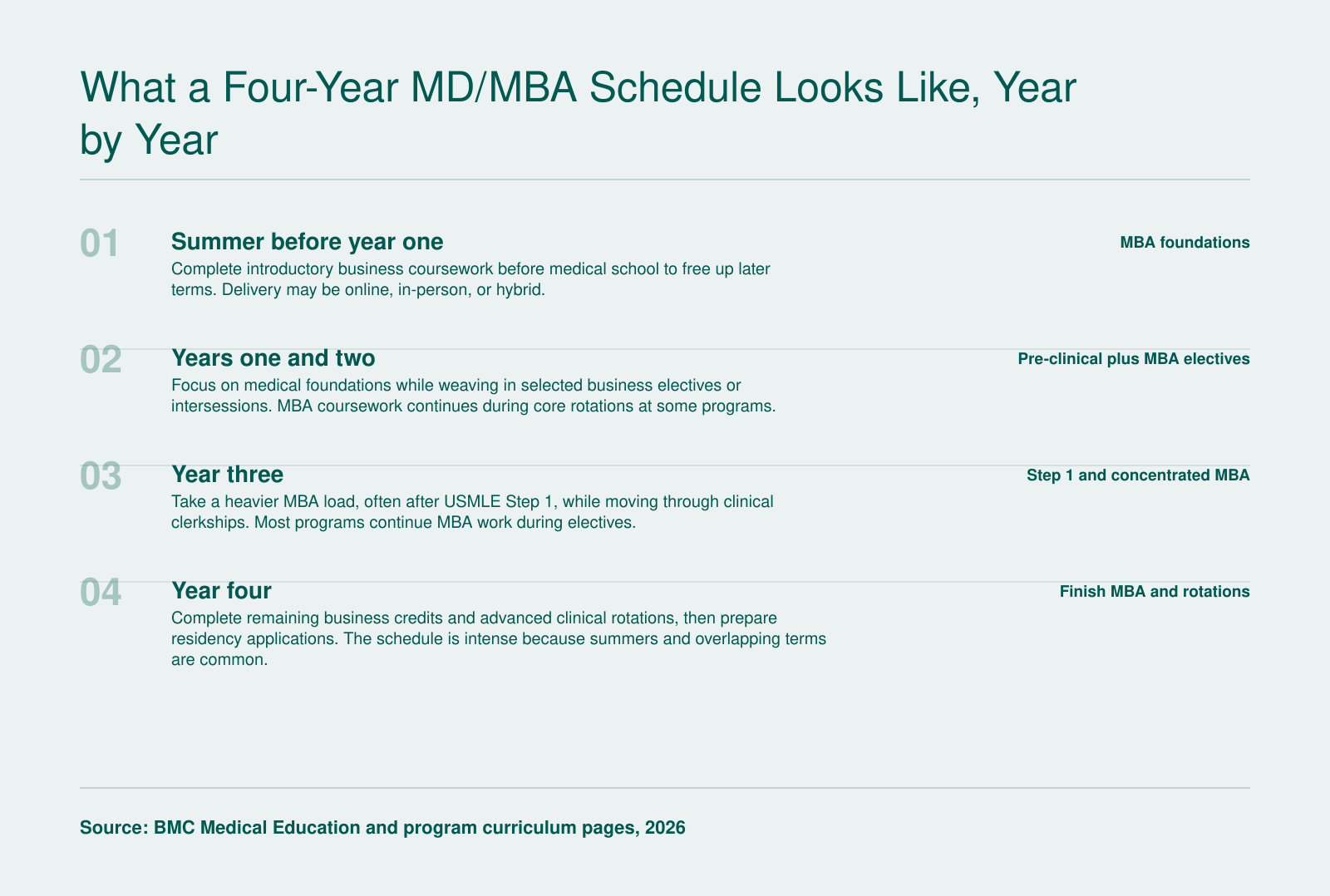
What a Four-Year MD/MBA Schedule Looks Like, Year by Year
A four-year MD/MBA is a compressed schedule rather than a single template. The sequence below reflects a common structure built from cited program examples: business work spreads across all four years, with delivery formats varying from online to hybrid to in-person.
MD/MBA Program Cost: Where the Combined Degree Is Cheapest
The three lowest-cost ranked schools in the data are IU Indianapolis, Georgia Tech, and the University of Houston, based on institution-wide net price. Net price is an average across all students, not a quote for any single MD/MBA student. A four-year combined track can remove a full year of MBA tuition and living costs. Published program budgets vary: UVA's Darden Year 1 in-state total is $33,766, with a possible $9,670 M4 summer need-based award, and Miami lists four-year MD/MBA tuition at $67,601.
| School | In-state graduate tuition and fees | Out-of-state graduate tuition and fees | Institution-wide net price |
|---|---|---|---|
| Indiana University-Indianapolis | $10,762 | $34,891 | $11,668 |
| Georgia Institute of Technology | $12,058 | $34,484 | $12,116 |
| University of Houston | $9,717 | $22,547 | $14,276 |
Related Articles
MD/MBA Admissions: MCAT, GMAT/GRE Waivers, and Deadlines
- Separate admissionsAdmission is competitive and two-step: secure MD admission through AMCAS and MCAT, then apply to the business school once enrolled or admitted in good standing.
- GMAT/GRE policyMCAT-only: NYU Stern, Johns Hopkins Carey, and WMed Haworth. No test: BU Questrom. Waiver available: UNC. Required: Wharton and Harvard. Morehouse accepts MCAT or GMAT/GRE.
- DeadlinesMorehouse Dec 1; NYU Stern Dec 15, 2026; Hopkins January in MD year 2 or 3; Wharton September of third year; UNC Jan 6 and Mar 3, 2026.
- Application timingWMed and Harvard allow joint interest with the medical application or later; BU and UNC encourage applying in years 1-3 or 2-3.
- Prerequisites and standingWMed requires accountancy, corporate finance, basic economic analysis, and data economic foundations, waivable for a business bachelor's. Harvard requires the first three MD years in good standing before HBS.
MD/MBA Salary and Career Paths: Residency, Leadership, and Beyond
The MD/MBA payoff is back-loaded: early years track resident pay, but the dual degree's value compounds in leadership. Most graduates still complete residency, so salaries start at resident level. The Medscape 2026 Resident Salary & Debt Report puts the national resident average at about $79,000, rising from $74,000 in the first two years to $85,000 for fifth through eighth year residents; a more than $15,000 regional gap means the national average won't fit every location.
The longer-term value sits in administrative and executive tracks, including roles that an MBA in Organizational Leadership prepares graduates for: hospital executive, chief medical officer, healthcare consulting, biotech, and health-tech startups. Public benchmarks are clearer for management roles than for CMO-specific pay. Medical and health services managers had a median wage of $117,960 in May 2024, with the top decile at $219,080, and the field is projected to grow 23% through 2034.1 Hospital administrators averaged $110,278 as of May 2026.1 Chief medical officers typically hold the role for 3-5 years, so compensation often resets to executive market standards rather than clinical pay.2 No nationally representative split between clinical practice and industry is published for MD/MBA graduates, but the AAMC describes physician-executive roles as largely administrative.2
Top Earnings Figure Among Ranked MD/MBA Schools
MBA/MD programs by state
Quick Answers on Combined MD/MBA Degrees
What is the quickest path to earning an MD and an MBA?
How many medical school credits transfer toward the MBA in a combined program?
Can any part of an MD/MBA be completed online?
Which medical schools offer combined MD/MBA programs?
Can you add the MBA after starting medical school?
Compare MBA/MD programs on the data that matters
Explore more MBA specializations or browse every graduate field.
All MBA programs