Best MBA/MD Programs in Michigan
Compare 4 accredited MBA/MD programs in Michigan, with graduate earnings, cost, debt, and completion data from IPEDS and the U.S. College Scorecard.

Michigan's MD/MBA tracks split between a four-year path at Wayne State University and five-year paths at Western Michigan University and its Homer Stryker M.D. School of Medicine. Michigan State University, among the MBA programs in Michigan, pairs its MBA with medical degrees too. The extra year adds tuition and delays attending-level pay, so the trade-off is real.
Few institutions here offer the dual degree, which keeps the comparison short.
Most graduates use the credential for hospital administration, health policy, or physician-executive roles rather than clinical practice alone.
Key Points
- Wayne State lists the lowest in-state tuition here at $17,960, ahead of Western Michigan and Michigan State.
- The MCAT is still required for the MD side, even where the GMAT or GRE is waived.
- Michigan State offers a DO/MBA, and most applicants win medical school admission before applying to the MBA.
Best MBA/MD Programs in Michigan: Ranked List
Net price shown on each card is an institution-wide average after aid, not a quote for the dual degree. MD/MBA students pay medical-school and MBA tuition separately, so confirm the combined cost with each school. Graduation rates below describe the schools offering these programs, not the dual-degree cohorts themselves.
Michigan State University
#1East Lansing, MI · $22,000 – $42,000/yr (est.)
Best for: Students wanting concentration choices
Michigan State University pairs its College of Human Medicine with the Broad College of Business in East Lansing. Schools offering this program have graduation rates of about 81%. The MBA is taught in person on weekdays, and students pick one primary concentration from seven. Its College of Human Medicine holds full LCME accreditation, and the Broad College's AACSB status was not confirmed in the directory results we reviewed.
- Joint degree: College of Human Medicine and Broad College of Business
- Apply separately to both colleges; each committee decides independently
- Seven concentrations, including Finance, Marketing and Business Analytics
- Some concentrations carry STEM designation
- MBA classes meet in person Monday through Thursday
- Built for completion of both degrees in five years
- MSU also lists a D.O.-MBA and a J.D.-MBA
Wayne State University
#2Detroit, MI · ~$18,000/yr (est.)
Best for: Students keeping the four-year MD timeline
Wayne State University offers its M.D./M.B.A. through the School of Medicine and the Mike Ilitch School of Business in Detroit. Schools offering this program have graduation rates of about 58%. The first cohort graduated in May 2026, so the track record is short. Wayne State's School of Medicine holds full LCME accreditation, and the business school's AACSB status was not confirmed in the results we reviewed.
- Integrated four-year curriculum without delaying residency
- 36-credit MBA, with six credits transferred from medical studies
- Classes on Thursday evenings and Saturdays
- In-person sessions combined with self-paced online modules
- Courses cover healthcare finance, strategy, operations and leadership
- Business of Medicine elective in year one to explore the option
- MBA tuition is billed in addition to medical tuition, starting in year two
Western Michigan University
#3Kalamazoo, MI · $20,000 – $25,000/yr (est.)
Best for: Applicants skipping GMAT and GRE
Western Michigan University supplies the MBA through its Haworth College of Business in Kalamazoo. Schools offering this program have graduation rates of about 58%. It is a five-year path with one MBA year, and it asks only for the MCAT. Haworth's AACSB status was not confirmed in the results we reviewed, so check the AACSB directory before applying.
- Five-year campus program
- 24 MBA credits in year 4 at the Haworth College of Business
- MCAT only; GMAT and GRE are not required
- Rolling admissions, at initial application or after matriculation
- Prerequisites in accountancy, finance, economics and data via Coursera
- MBA tuition and fees are paid separately from medical school charges
Western Michigan University Homer Stryker M.D. School of Medicine
#4Kalamazoo, MI · ~$35,000/yr (est.)
The Western Michigan University Homer Stryker M.D. School of Medicine (WMed) in Kalamazoo grants the medical degree in this partnership with WMU's Haworth College of Business. Institution-wide graduation data is not available for this school. LCME lists the school, but the accreditation status fields were not in the excerpt we reviewed, so confirm its current status directly.
- Five-year program with medical and MBA degrees
- MBA year covers 24 credits
- Apply with the WMed application or after enrolling
- MCAT required; rolling admissions
- Prerequisites may be waived for those with business backgrounds
- Prerequisites also available online via Coursera
- Register and pay WMed and WMU separately in each term
Cost & outcomes by school
Federal data for the highest-earning MBA/MD programs, independent of the ranking above. Earnings are this field's master's graduates four years after completing, where the Scorecard reports them.
| School | Earnings | Tuition / yr | Debt | Grads/yr | Format |
|---|---|---|---|---|---|
| Wayne State University MI | — | $17,960 | — | — | Campus |
| Western Michigan University MI | — | $20,103 | — | — | Campus |
| Michigan State University MI | — | $21,772 | — | — | Campus |
| Western Michigan University Homer Stryker M.D. School of Medicine MI | — | $35,200 | — | — | Campus |
Sources: U.S. Department of Education. Tuition and graduates: IPEDS. Earnings and debt: College Scorecard, this field's master's graduates; a dash means no figure is reported.
Online & Hybrid MBA/MD Options in Michigan
The business half of a dual degree has become more flexible, but the MD half has not left campus. Clinical rotations require in-person training, so even in the Best Online MBA/MD Programs, only part of the MBA coursework can ever move online.nnMichigan State University's MD/MBA, described on the College of Human Medicine's program page, combines classroom and online study and is expected to take five years. The MBA side totals 61 credits, with 31 core credits, 18 concentration credits, and up to 12 transfer credits. The page does not say whether the classroom portion is on-campus, hybrid, or weekend, or how it is scheduled around rotations, so ask the admissions office before you plan around it.nnThe Western Michigan University Homer Stryker M.D. School of Medicine is the clearest on timing. Prerequisite MBA core courses are online through Coursera and can be completed while you are enrolled in the MD program. The 24 required MBA credits are scheduled for Year 4, when Haworth tuition and fees are paid. The page does not state the delivery format for those Year 4 courses.nnNo program page describes a fully online MD/MBA, so don't spend time searching online master's programs in Michigan for one.
GMAT/GRE Waivers and Test-Optional Policies
For dual-degree applicants, the MBA side of a Michigan MD/MBA often accepts the MCAT in place of the GMAT or GRE. The MCAT is still required for the MD side at every school here, so skipping the GMAT or GRE never means skipping the MCAT. Policies change by admissions cycle, so confirm with each admissions office before you decide against taking a test.
| School | MBA Test Requirement | MCAT Accepted in Lieu? | Waiver/Test-Optional Notes |
|---|---|---|---|
| Michigan State University | Dual-degree applicants must submit a standardized test score. GMAT, GRE, MCAT, and LSAT scores are all acceptable. | Yes | MBA candidates will be considered for admission without a GMAT or GRE score. |
| Western Michigan University Homer Stryker M.D. School of Medicine | MCAT only. The GMAT or GRE is not necessary. | Yes | No GMAT or GRE needed. MBA core prerequisite courses may be waived for applicants with a business degree or relevant coursework, but that is a course waiver, not a test waiver. |
Related Articles
MBA/MD Program Costs and Michigan Employer Demand
Wayne State University lists in-state tuition of $17,960 for its MD/MBA dual degree, against $20,103 at Western Michigan University and $21,772 at Michigan State University. Average net price after aid follows the same order: $12,766 at Wayne State, $15,273 at Western Michigan and $19,680 at Michigan State.
The Residency Gap and the Extra Year
Out-of-state students pay $36,542 at Wayne State, $41,848 at Michigan State and $29,681 at Western Michigan. That is a yearly gap of roughly $18,600, $20,100 and $9,600. If a gap that size held across a five-year track, it would approach $100,000 at Michigan State, so residency can matter more than which school you pick.
None of these schools publishes a single combined price for the full dual degree. Before you commit, ask each school three things: whether medical tuition continues during the MBA year, which rate applies to the 24 MBA credits Western Michigan places in year four, and whether any MBA-year scholarships exist. Also confirm how federal loan limits apply to that year.
Who Is Hiring Physician Leaders
Among physician executive job listings in Michigan, an opening at a Michigan academic medical center, with a start date of October 14, 2026, required an MD, DO or MD/PhD, board certification and active clinical practice. Roles like this put clinical credentials first. The MBA adds an edge but does not replace them.
What Health Care Managers Earn in Michigan
A benchmark for the leadership roles MD/MBA graduates pursue
How Does the MBA/MD Application Path Work in Michigan?
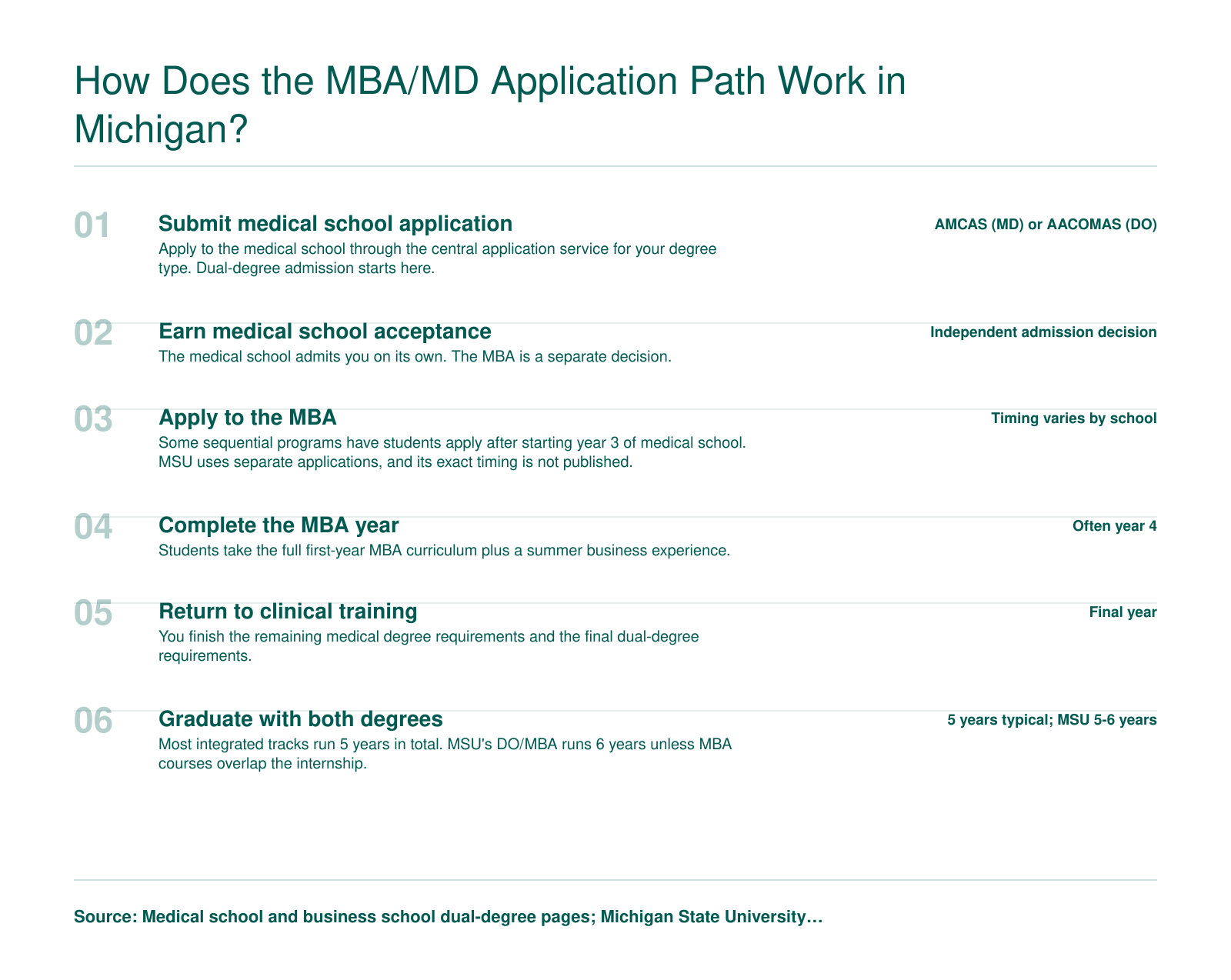
Most applicants cannot apply to both degrees in a single submission. Where programs run sequentially, you win medical school admission first and apply to the MBA later, usually after starting year 3. Michigan State University offers a DO/MBA rather than an MD/MBA and uses separate applications. Total length is typically 5 years. MSU's DO/MBA is described as 5 to 6 years, with the 5-year version available by taking MBA courses alongside the internship. The sources give no firm 2026 MBA deadlines, so confirm dates with each program.
Career Outcomes and ROI for MBA/MD Graduates
Federal data answers only part of whether an MD/MBA pays off in Michigan. Michigan State University is the one school here with program-level earnings, and they cover its master's-level business administration graduates (the Best MBA Programs track, in a 2022 data cycle), not dual-degree physicians specifically.
Those graduates had median earnings of $133,992 one year after finishing and $188,085 four years after finishing. Median debt for the program was $78,686, which works out to about $895 a month over a 10-year repayment plan. Even after that payment, the earnings sit well above the debt load.
Western Michigan University and Wayne State University report no comparable program-level earnings or debt figures, so no ROI comparison is possible for them. Their MD-MBA tracks should be judged on structure and cost instead, with the Most Affordable MBA/MD Programs as a cost benchmark. Wayne State's program runs four years, and Western Michigan's runs five. Be wary of substituting campus-wide numbers for program results.
Where graduates land
Typical destinations include hospital administration, health system C-suite roles, consulting, biotech, and health policy. Wayne State specifically points to hospital administration and health policy careers.
How to Choose Between Michigan's MBA/MD Programs
The real choice here is rarely prestige versus prestige; it is fit and cost versus a name you hope will travel. Start with the work you want after residency. Hospital and system leadership rewards an MBA heavy on operations and finance. Entrepreneurship and biotech favor a business school with venture and commercialization coursework. Consulting and health policy ask for analytics and strategy depth.
Then weigh in-state residency savings against location. Michigan State University, Wayne State University and Western Michigan University Homer Stryker M.D. School of Medicine each sit in different corners of the state's health care economy, and clinical rotations plus MBA networking tend to decide where your first post-residency offer comes from.
Three practical factors usually break a tie: whether the business school accepts a waiver or test-optional application (MBA/MD Programs With No GMAT or GRE Required), how the MBA year is scheduled around clerkships (including Accelerated MBA/MD Programs), and whether both applications move at once or sequentially.
Before you submit AMCAS, email each school's dual-degree coordinator and confirm all three in writing.
Compare MBA/MD programs on the data that matters
Explore more MBA specializations or browse every graduate field.
All MBA programs