Best JD/MBA Programs in Michigan
Compare 5 accredited JD/MBA programs in Michigan, with graduate earnings, cost, debt, and completion data from IPEDS and the U.S. College Scorecard.

A Michigan JD/MBA can compress a law license and MBA into about four years instead of five, mirroring accelerated JD/MBA programs. University of Michigan's dual degree runs four years, with separate law and business applications and the LSAT required.
Admissions odds range widely: Michigan Law accepts 9% of applicants, while several other ranked schools accept between 25% and 53%. The ranked programs weigh tuition against salary outcomes; online and hybrid options and JD/MBA programs with no GMAT or GRE required are called out. ABA distance-education caps mean no Michigan JD/MBA is fully online.
Key Points
- Wayne State has the lowest in-state graduate tuition and fees here, at $17,960.
- No Michigan JD/MBA can be completed fully online, since ABA rules cap distance-education law credits.
- Applicants usually need separate law and business admission, and the LSAT may substitute for the GMAT at some schools.
Best JD/MBA Programs in Michigan: Our 2027 Ranking
This ranking is outcomes-based, weighing cost, graduation rate, and graduate earnings data. The graduation rates quoted below are institution-wide figures, not JD/MBA-specific completion rates. Tuition figures are each school's listed graduate rates, so confirm your actual JD and MBA billing with the schools.
University of Michigan
#1Ann Arbor, MI · $29,000 – $58,000/yr (est.)
Best for: Full-time campus students wanting a flexible start
The University of Michigan in Ann Arbor offers an on-campus MBA/JD dual degree through its business and law schools, with an institution-wide graduation rate of about 93%. Listed graduate tuition is $28,554 in-state and $57,444 out-of-state, and tuition is assessed at the higher school's rate when you take courses in both schools at once. The official page lists 140 combined credits (57 MBA plus at least 83 JD) over four years. It does not establish any shared credits, since the MBA and JD requirements are listed separately.
- Combined total of 140 credits: 57 MBA plus a minimum of 83 JD
- Completed in 4 years; begin in either the business or law school
- MBA core of 30 credit hours plus 15 elective hours
- Separate applications to both schools; LSAT required for Law School
- Tuition charged at the higher school's rate when enrolled in both
- No shared JD/MBA credits are established on the official page
Michigan State University
#2East Lansing, MI · $22,000 – $42,000/yr (est.)
Best for: Law-first applicants avoiding extra testing
Michigan State University in East Lansing pairs its College of Law with the Broad College MBA in a hybrid-format JD/MBA. The institution-wide graduation rate is about 81%, and listed graduate tuition is $21,432 in-state and $41,508 out-of-state. The Broad MBA accepts the LSAT, described as a pilot for JD students, which streamlines applications. Federal data for MSU business master's graduates (not JD/MBA specific) show median earnings near $134,000 one year after completion. Combined credits, shared credits, and typical completion time were not confirmed in the sources we reviewed.
- Hybrid format in partnership with the Broad College MBA
- Exams listed: LSAT, GMAT, GRE; LSAT accepted for MBA admission
- Apply concurrently or during the first year of law school
- Separate tuition and scholarships for each program
- Scholarships are limited for applicants submitting the LSAT
University of Detroit Mercy
#3Detroit, MI · ~$23,000/yr (est.)
Best for: Working professionals needing part-time options
The University of Detroit Mercy is a private Detroit school offering an on-campus JD-MBA with both full-time and part-time options. Its institution-wide graduation rate is about 67%, and listed graduate tuition is $22,544 for in-state and out-of-state students alike. Program materials cite 102 to 120 total credits and completion in as few as seven semesters. Shared credit limits were not confirmed in our research. Joint-degree admission follows the first-year, 30-credit law curriculum.
- Total of 102 to 120 credits listed on the program page
- Can be completed in as few as seven semesters
- Full-time and part-time options available
- Exams listed: LSAT, GMAT; some MBA foundation courses may be waived
- Law students apply by June 15 for the upcoming fall term
- Formal admission follows the first-year, 30-credit law curriculum
Wayne State University
#4Detroit, MI · ~$18,000/yr (est.)
Wayne State University in Detroit runs a joint JD/MBA with the Mike Ilitch School of Business, with separate admission to each school. The institution-wide graduation rate is about 58%, and listed graduate tuition is $15,937 in-state and $34,519 out-of-state. All courses, including MBA courses, are charged at Law School rates, so the listed figures may understate your bill. Up to nine credits may double-count, and the total credit count was not confirmed in our research.
- Up to nine law credits may double-count as MBA electives
- Law School tuition rates apply to all courses
- GMAT/GRE waiver available with an acceptable LSAT score
- Start in law school; full-time students have five years, part-time six
- Full-time and part-time options available
Western Michigan University
#5Kalamazoo, MI · $20,000 – $25,000/yr (est.)
Western Michigan University in Kalamazoo partners its Haworth College of Business with Thomas M. Cooley Law School for a hybrid-format JD and MBA. The institution-wide graduation rate is about 58%, and listed graduate tuition is $19,154 in-state and $28,732 out-of-state. Up to six credits transfer each way between the schools. The second degree should be completed within twelve months of conferral of the first. The total combined credit count was not confirmed in our research.
- Partnership between the Haworth College of Business and Cooley Law School
- Up to six credits transfer in each direction
- Law electives may be accepted for MBA credit
- Early enrollment in the partner program after initial credit requirements
- Second degree should finish within twelve months of the first
- Six-year limit for master's completion
Cost & outcomes by school
Federal data for the highest-earning JD/MBA programs, independent of the ranking above. Earnings are this field's master's graduates four years after completing, where the Scorecard reports them.
| School | Earnings | Tuition / yr | Debt | Grads/yr | Format |
|---|---|---|---|---|---|
| Michigan State University MI | $188,085 | $21,772 | $78,686 | 117 | Hybrid |
| Wayne State University MI | — | $17,960 | — | — | Campus |
| Western Michigan University MI | — | $20,103 | — | — | Hybrid |
| University of Detroit Mercy MI | — | $22,544 | — | — | Campus |
| University of Michigan MI | — | $28,886 | — | — | Campus |
Sources: U.S. Department of Education. Tuition and graduates: IPEDS. Earnings and debt: College Scorecard, this field's master's graduates; a dash means no figure is reported.
How We Rank Michigan JD/MBA Programs
A formal JD/MBA dual degree and an informal "partnership" are not the same thing, and the GVSU Seidman and MSU Law pairing is a case where you should verify before you commit. The current catalogs describe a GVSU B.B.A./J.D. combined program1, not a Seidman MBA path2, so confirm the details yourself.
- Confirm the program exists: Check both the GVSU Seidman and MSU Law official program and admissions pages for a dual-degree listing, and note the contact names published there.
- Clarify how you apply: Email each admissions office and ask whether you apply separately, whether a joint application exists, and whether test requirements are shared or waived.
- Verify shared credits: Request a program plan or degree audit, read the official transfer-credit policy, and ask an advisor how many credits count toward each degree.
Online and Hybrid JD/MBA Options in Michigan
No Michigan online JD/MBA programs can be completed fully online. The JD portion is regulated by the American Bar Association, which caps distance-education credits, so law schools rarely offer an entirely remote law degree, and the joint degree inherits that constraint.
Flexibility does exist on the business side. Wayne State's MBA can be taken 100% online with evening and occasional Saturday courses. Western Michigan's MBA offers online, in-person, evening, and part-time formats, and the university lists the JD/MBA as hybrid. Michigan Ross runs online, evening, and weekend MBA options, with the weekend track meeting every other weekend in Ann Arbor. These MBA programs are not always extended to dual-degree students, so confirm with each school.
GMAT and GRE Waivers for Michigan JD/MBA Programs
No, you often do not need both the LSAT and the GMAT: Wayne State University lets applicants use the LSAT for MBA consideration if they select that option, and Michigan State University accepts the LSAT in place of the GMAT or GRE for JD students under a pilot initiative. Detroit Mercy may require the GMAT but lists GPA, experience, and prior-degree exceptions. Policies change, so confirm each one with the school before you apply. Tip: check whether applying to the law school first lets your LSAT stand in for the GMAT.
| Program | Law School Tests Accepted | MBA Test Policy | GMAT/GRE Waiver | Application Deadline |
|---|---|---|---|---|
| University of Michigan | Not confirmed | The published policy covers the online MBA only and does not establish the full-time JD/MBA rule | For the online MBA, a waiver may be available for certain academic or professional backgrounds, including holding a JD. If denied, applicants can submit the GRE, GMAT, or Executive Assessment, or complete a Quantitative Readiness Course | Not confirmed |
| Michigan State University | LSAT | Full-time MBA accepts the LSAT in lieu of the GMAT or GRE for JD students (pilot initiative) | LSAT substitution is available. LSAT applicants may receive limited scholarship consideration; GMAT/GRE applicants are advised to apply for additional scholarships | Not confirmed |
| Wayne State University | Not confirmed | LSAT may be used for MBA consideration if chosen at application; otherwise the GMAT is required | No separate waiver stated; the LSAT option serves as the alternative | Not confirmed |
| University of Detroit Mercy | LSAT required | GMAT may be required; a full law school application with a current LSAT is also needed | GMAT may not be required with a 3.0 or higher undergraduate GPA, seven or more years of professional experience, or an existing graduate or professional degree. No GRE policy stated | June 15 for the upcoming fall term |
| Western Michigan University | Not confirmed | No published policy | No published policy | Rolling, no fixed deadline; September or January starts |
Related Articles
Michigan JD/MBA Cost and Employer Demand for MBA Graduates
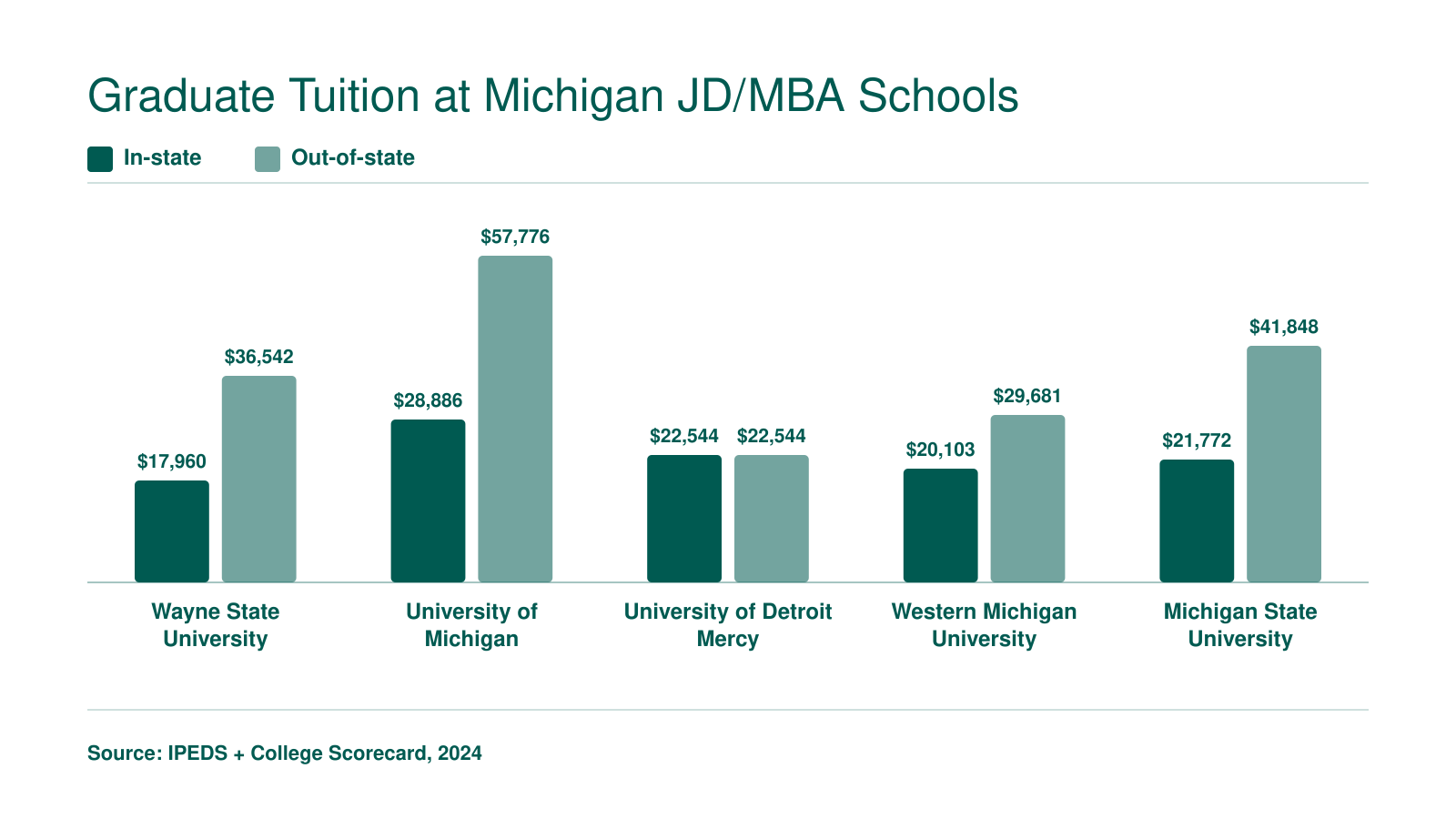
JD/MBA cost is the combined price of a law degree and an MBA, and several schools here bill at the higher of the two rates. Wayne State lists the lowest graduate tuition at $17,960 in-state ($36,542 out-of-state), a figure that places it among the most affordable JD/MBA programs reviewed. University of Michigan is the most expensive at $28,886 in-state and $57,776 out-of-state, so residency roughly doubles the sticker price at both public schools. Detroit Mercy charges a flat $22,544. Institution-wide net price averages cover every student, so they are not a quote for dual-degree students.
Aid for dual-degree students
Ross considers full-time MBA applicants automatically for awards from $10,000 to full tuition, renewable with good standing, though it publishes no JD/MBA-only award.1 Michigan State requires separate law and Broad applications, and both offer competitive funding, so apply early. Detroit Mercy's merit scholarships consider all admitted law students, with a February 15 priority deadline.2 Confirm whether they carry into your MBA years.
Employer demand
Michigan employers in automotive, manufacturing, healthcare, finance, and technology hire MBA graduates as project managers, financial analysts, supply-chain managers, and healthcare administrators3, roles that also draw from top master's in finance schools in Michigan. A 2026 state forecast projects 18.4% growth for financial managers and about 9% for general managers.3 Goldman Sachs' Detroit office also recruits JD and MBA holders.4 These are projections, not placement guarantees.
Graduate Tuition at Michigan JD/MBA Schools
Wayne State University has the lowest in-state graduate tuition and fees here at $17,960, while University of Detroit Mercy is cheapest for nonresidents at $22,544 because it charges one rate to everyone. University of Michigan is the most expensive for both groups. Figures are the federal graduate tuition and fees reported for each school, and law school rates can differ from these.
Michigan JD/MBA Admissions Requirements and Acceptance Rates
What does it actually take to get into a Michigan JD/MBA? You usually need separate admission to the law school and the business school, so the law school's acceptance rate is the main hurdle. Reported 2026 ABA disclosure figures show: Michigan 9% acceptance, 171 median LSAT, 3.88 median GPA; Michigan State 26%, 162, 3.73; Wayne State 25%, 164, 3.89; Detroit Mercy 41%, 156, 3.52; Western Michigan Cooley 53%, 147, 3.09. Michigan State confirms separate JD and MBA applications for MSU graduate programs, and the MBA can be added during 1L. Detroit Mercy requires admission to both schools.1 For the other programs, available materials do not clarify joint versus separate admission, so verify each school's current process. Do not rely on undergraduate admission rates, which measure a different applicant pool.
On the July 2026 Michigan bar exam, 71 percent of first-time takers passed, according to statistics published by the Michigan Board of Law Examiners. School-level results vary widely: a year earlier, in July 2025, first-time pass rates at Michigan law schools ranged from 29 percent to 93 percent.
Michigan JD/MBA Salary and Career Outcomes
Salary and career outcomes for a JD/MBA come down to two things: what graduates earn after finishing, and how quickly they land full-time work. No Michigan school reports JD/MBA-only results, so the clearest picture comes from pairing each school's MBA figures with its law school's ABA employment summary.
Federal data for Michigan State's master's-level business graduates show median earnings of $133,992 one year after finishing and $188,085 four years after. Median debt is $78,686, or about $895 a month on a 10-year plan. That is a solid return on paper, though it reflects business graduates broadly rather than dual-degree students.
School employment reports for the Class of 2025 add context:
- University of Michigan: 92% of full-time MBA graduates had a first offer within six months, at a median base salary of $170,000.1
- Michigan State University: 78.6% of MBA job seekers accepted offers within six months, with a median base of $105,000 (reported by 70.7% of graduates).2
Before committing, check each law school's latest ABA summary for its full-time, bar-passage-required employment rate.
Michigan JD/MBA FAQs
Which Michigan JD/MBA program is the cheapest?
How long does it take to complete a JD/MBA in Michigan, and are there 3-year JD/MBA programs?
Can I add the MBA after starting law school in Michigan?
Is a JD/MBA worth it if I plan to practice law in Michigan rather than work in business?
Compare JD/MBA programs on the data that matters
Explore more MBA specializations or browse every graduate field.
All MBA programs