JD/MBA Programs With No GMAT or GRE Required
Compare 200+ accredited no-gre JD/MBA programs at 180+ schools, with graduate earnings, cost, debt, and completion data from IPEDS and the U.S. College Scorecard.

A no-GMAT JD/MBA is a dual law and business degree where the business school offers an MBA without GMAT or GRE, usually by accepting your LSAT score or exempting admitted law students. Most JD applicants already sit for the LSAT, so a second exam adds months of prep and another fee.
Most of these programs are campus-based, with hybrid models that split coursework between a law school and a partner business school.
The label is not uniform among No-GRE master's programs. "No GMAT" can mean test-free, GMAT-optional, or LSAT substitution, and an optional policy often means a waiver review that can still end with a request for scores.
Key Points
- Most JD/MBA programs below waive GMAT/GRE, but waivers are not test-free.
- LSAT often substitutes for GMAT/GRE in JD/MBA admission reviews.
- Northeastern University reports the highest program-level earnings among schools ranked here.
Top No-GMAT JD/MBA Programs for 2027
This list spotlights JD/MBA programs where the GMAT or GRE can be waived or replaced, most often by submitting an LSAT or through a test-optional MBA review. The ranking filter covers programs with a no-exam pathway, but it does not claim every listed school has zero entrance exams. Graduation rates used in this composite are institution-wide, not program-specific, so treat them as a general signal rather than a guarantee for the joint degree.
University of New Hampshire-Franklin Pierce School of Law
#1Concord, NH · ~$36,000/yr (est.)
Best for: IP and entrepreneurship law candidates
UNH Franklin Pierce's J.D./MBA lets law applicants substitute an LSAT for the GMAT, removing a separate business school test. The hybrid program combines five semesters at Franklin Pierce in Concord with two MBA semesters at the Durham campus, emphasizing entrepreneurship and IP law. Graduate tuition is about $36,000 in state and $42,000 out of state. The listing does not independently confirm ABA approval for the law school or AACSB accreditation for the business school.
- No GMAT required when LSAT is submitted
- Seven-semester integrated timeline
- Hybrid with MBA classes at UNH Durham
- Entrepreneurship and IP law focus
- Apply by end of second law semester
University of Maryland-College Park
#2College Park, MD · ~$18,000/yr (est.)
Best for: Mid-Atlantic business law career changers
Maryland's joint LMBA is offered through the Smith School and the Maryland School of Law in a four-year integrated format. The MBA side is test-optional, so applicants may submit GMAT or GRE scores but are not required to do so. In-state graduate tuition runs about $16,900 with out-of-state closer to $36,800. The listing does not separately confirm ABA or AACSB accreditation, so verify with each school.
- Four-year joint MBA and JD
- Test optional; GMAT or GRE not required
- Campus format in DC-Baltimore corridor
- Separate applications to both schools
- Career services including resume matching
Northeastern University
#3Boston, MA · ~$26,000/yr (est.)
Best for: Boston co-op experience seekers
Northeastern's D'Amore-McKim JD/MBA does not currently require a GMAT or GRE, using a test-optional admission review. The Boston program offers Analytics and Corporate Finance concentrations, with three semesters of legal co-op and the student-managed 360 Huntington Fund. Graduate tuition is $25,327 for both in-state and out-of-state students. Program materials reference AACSB and ABA accreditation, but this listing did not independently verify those directory entries.
- Analytics concentration
- Three semesters of legal co-op
- 360 Huntington Fund student-managed portfolio
- GMAT or GRE not required
- Rolling admission with fall start
- Corporate Finance concentration
- AI Strategic Hub Research Practicum
- Global consulting project with travel
- Complete in under four years
- Financial aid available
Lewis & Clark College
#4Portland, OR · $15,000 – $20,000/yr (est.)
Lewis & Clark's joint J.D./MBA with Portland State University waives the GMAT for law students, instead requiring demonstrated math proficiency for the MBA side. The hybrid program runs about four years, with one year of MBA study at Portland State and law coursework at Lewis & Clark. Graduate tuition is $19,800 for both in-state and out-of-state students. ABA approval for the law school and AACSB accreditation for the business school are not independently confirmed in this listing.
- No GMAT required for law students
- Math proficiency required for MBA admission
- One year at Portland State University
- Business law credits satisfy MBA core
- Enter during first or second JD year
Elon University
#5Elon, NC · ~$22,000/yr (est.)
Elon's JD/MBA accepts the LSAT and does not require a separate GMAT or GRE, but it is not test-free because the LSAT remains required. The campus-based program blends the School of Law and Love School of Business with experiential learning, including a residency-in-practice. Graduate tuition is about $22,086 for both in-state and out-of-state students. The listing does not confirm ABA or AACSB accreditation, so verify current status.
- LSAT accepted; GMAT or GRE not required
- Campus-based JD/MBA
- Experiential residency-in-practice
- Lower cost than separate degrees
- Entrance exam required (LSAT)
Loyola Marymount University
#6Los Angeles, CA · ~$23,000/yr (est.)
Loyola Marymount's J.D./MBA requires no GMAT or GRE for J.D./MBA applicants, but admission to both Loyola Law School and the LMU business program is separate. The full-time campus program in Los Angeles takes about four years, and applications open after the first year of law school. Graduate tuition is $22,848 for both in-state and out-of-state students. The listing does not independently confirm ABA or AACSB accreditation.
- Dual degrees from Loyola Law School and LMU
- Four-year full-time program
- Separate applications to both programs
- Opens after first law year
- No GMAT/GRE required
University of Cincinnati
#7Cincinnati, OH · ~$15,000/yr (est.)
Cincinnati's JD/MBA makes the GMAT optional on the MBA side and does not require a separate graduate management test beyond law school admission. The four-year campus program starts with a first year in law, then a year in business, and includes an accelerated path for business undergraduates. In-state graduate tuition is about $13,224 with out-of-state around $24,996. The listing does not independently confirm ABA or AACSB accreditation.
- Four-year integrated JD/MBA
- GMAT optional for MBA admission
- First year law, second year business
- Accelerated path for business undergraduates
- Admission to both schools required
Cost & outcomes by school
Federal data for the highest-earning JD/MBA programs, independent of the ranking above. Earnings are this field's master's graduates four years after completing, where the Scorecard reports them.
| School | Earnings | Tuition / yr | Debt | Grads/yr | Format |
|---|---|---|---|---|---|
| University of Iowa IA | — | $13,425 | — | — | Hybrid |
| University of Cincinnati OH | — | $14,902 | — | — | Campus |
Sources: U.S. Department of Education. Tuition and graduates: IPEDS. Earnings and debt: College Scorecard, this field's master's graduates; a dash means no figure is reported.
Cost, debt & payoff
Median earnings of this field's master's graduates (4 yrs after completing) vs. their median federal loan debt · U.S. College Scorecard
Across these programs the median graduate earns about $142,843 and finishes with roughly $47,552 in debt — a ratio that clears a common rule of thumb (keep debt below first-year salary). Tuition and debt vary widely school to school, so check the per-school figures in the table above before you shortlist.
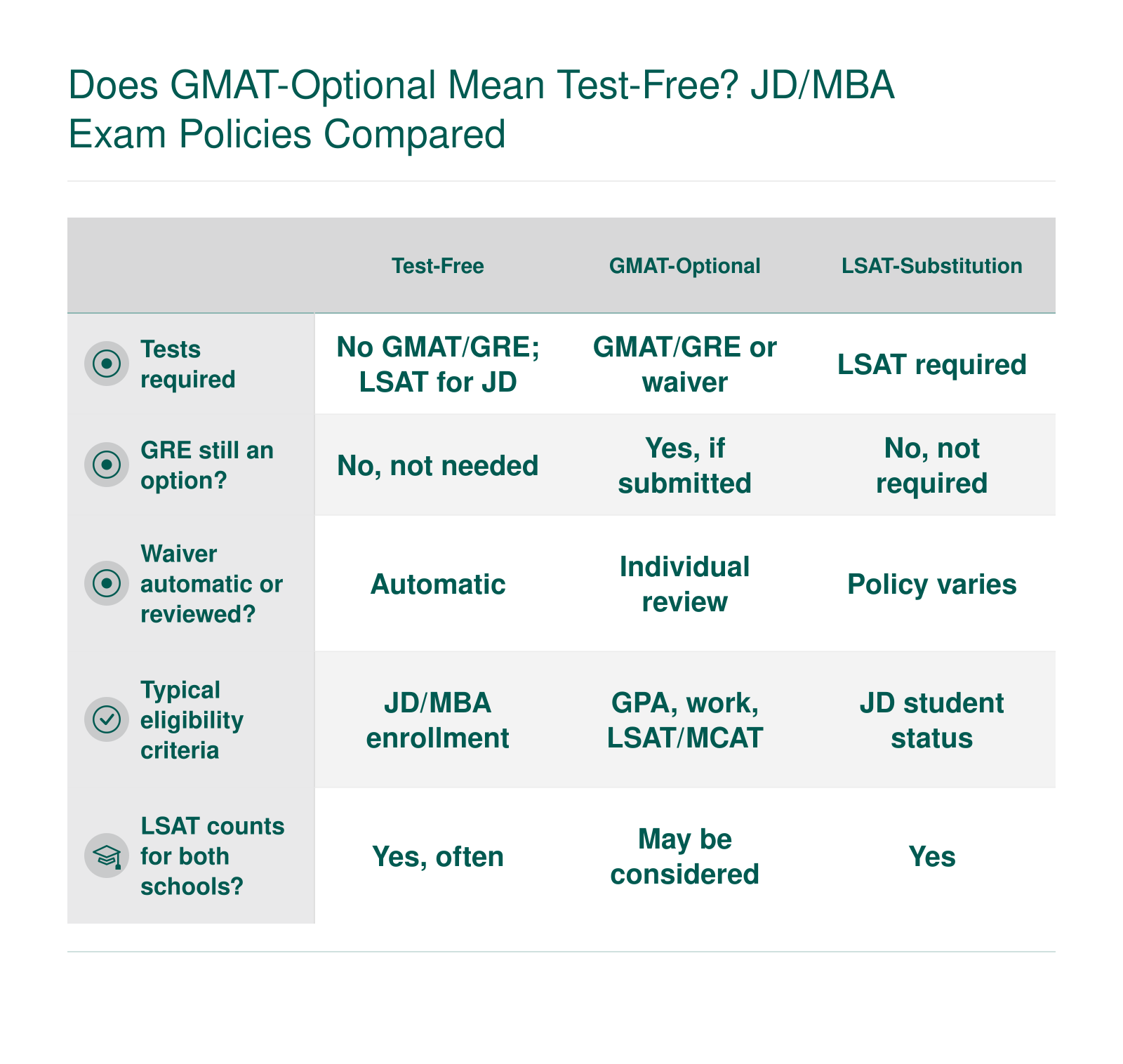
Does GMAT-Optional Mean Test-Free? JD/MBA Exam Policies Compared
No, GMAT-optional does not mean test-free. It usually means the test requirement is waived only when an applicant qualifies through a review process, while test-free programs remove the GMAT/GRE requirement for JD/MBA students entirely. Belmont is an example of a waived policy, Ohio State's Fisher College of Business reviews waivers case by case, and Michigan State Broad and Texas Tech Rawls accept the LSAT in lieu of the GMAT or GRE.
Cost Comparison: Tuition and Net Price at No-GMAT JD/MBA Schools
The table below shows published graduate tuition and fees for JD/MBA pathways in the ranked set, alongside the institution-wide average net price after grant and scholarship aid. These are annual figures; because most JD/MBA programs run three to four years, students should multiply the tuition and fees by their expected year count for a rough total. Across the schools listed, in-state tuition and fees span from $14,902 to $23,172, with the public institutions carrying the lower published rates and the private institutions showing higher average net prices after aid.
| School | Type | Published in-state graduate tuition and fees | Published out-of-state graduate tuition and fees | Average net price after aid (institution-wide) |
|---|---|---|---|---|
| University of Maryland-College Park | Public | 18,276 | 38,207 | 15,678 |
| University of Cincinnati | Public | 14,902 | 26,674 | 25,648 |
| Lewis & Clark College | Private | 19,800 | 19,800 | 36,013 |
| Elon University | Private | 22,086 | 22,086 | 41,555 |
| Loyola Marymount University | Private | 23,172 | 23,172 | 48,381 |
Related Articles
Top Program-Level Earnings Among Ranked Schools
Among the schools ranked here, Northeastern University reports the highest program-level earnings.
JD/MBA Application Requirements and Deadlines
Most JD/MBA programs require separate admission to both the law school and the business school, but several use a single joint application. Published 2026-2027 dates vary by school.
- Joint vs. separate applicationsChicago Booth, Northwestern Kellogg, and Columbia’s 3-year JD/MBA use one joint application through the business school; Columbia also requires a CAS report through LSAC. Harvard, Stanford, Yale, Wisconsin, and Chapman require separate law and business applications.
- Core application materialsExpect official transcripts (a CAS report via LSAC where required), a resume or CV, separate essays for each school, recommendations, and an exam score: LSAT where the law school accepts it, or GMAT/GRE for the business side. Some programs accept LSAT as the sole test; others still require GMAT or GRE.
- Exam and waiver rulesWaiver criteria are not uniform. Wisconsin allows a waiver request through the MBA application at least two weeks before the desired round deadline, with unofficial transcripts and a 250-word Quantitative Readiness Statement. Chapman waives the MBA application fee for current JD students, but its MBA still requires the GMAT or GRE. Many programs do not publish blanket waiver standards, confirm case-by-case.
- Deadline windowsRound one deadlines cluster from September through November 2026, with later rounds into spring 2027. Examples include Chicago Booth (Sept. 15 and Jan. 7), Kellogg (Sept. 9, Jan. 6, Mar. 31), Columbia (Nov. 2 and Feb. 15), and Chapman (Nov. 1, Feb. 1, Jun. 1).
- Adding the MBA after law schoolWhether the MBA can be added during the first year of law school is not stated at most programs. Wisconsin recommends applying to both in the same year and defers MBA admission one year during the first year of law; at other schools, confirm whether a later MBA application is permitted.
Online, Hybrid, and Part-Time No-GMAT JD/MBA Options
An Online JD/MBA that is fully online does not exist in the way marketing copy implies, because American Bar Association rules cap how much of a law degree can be earned at a distance. Among the programs here, delivery splits between campus-based formats and hybrid ones: the University of New Hampshire Franklin Pierce and Lewis & Clark are listed as hybrid, while Maryland, Northeastern, Elon, Loyola Marymount, and Cincinnati run on campus.
What "online" usually means
The MBA side carries the flexibility. North Dakota, for example, pairs an all-online MBA with law courses that meet on campus only, and its joint path typically runs four years across 114 credits.1 Syracuse's joint degree, also 114 credits, routes students through a part-time hybrid JD first, with the MBA opening after 34 law credits; most finish in about four years.23 Lincoln Memorial's part-time hybrid JD spans 11 semesters with roughly two-thirds of coursework online.4
Weighing flexibility against the room
Accelerated three-year JD/MBA dual degree programs exist at Boston University,5 Northwestern, USC,6 and Indiana,7 but they demand full-time presence. If you keep working, plan on four years and deliberate campus time, since on-campus recruiting still drives most law and consulting hiring.
JD/MBA programs by state
No-GMAT JD/MBA FAQs
Which schools accept the LSAT instead of the GMAT or GRE?
Are GMAT waivers automatic or reviewed individually?
Can applicants use the LSAT for both law and business admission?
Do international applicants qualify for the same GMAT/GRE waivers, or do they face extra testing such as TOEFL/IELTS?
Compare JD/MBA programs on the data that matters
Explore more MBA specializations or browse every graduate field.
All MBA programs